
 Black Steel Doors
 Woodstock Campers
 Phillips Joinery
The fastest way to generate high-value B2B leads on LinkedIn is to combine targeted organic content with Lead Gen Forms and personalised Sales Navigator outreach. None of the three works well alone. Together, they cover awareness, capture and follow-up, and the rest of this guide walks through formats, targeting and measurement, so give it three to six months before judging results by pipeline rather than likes.
TL;DR:
- Targeted Lead Gen Forms paired with Sales Navigator outreach significantly boost lead quality, especially for high-value, complex B2B sales.
- Consistent, persona-driven content posting three to five times weekly sustains engagement and builds authority across awareness, consideration, and decision stages.
- Account-based targeting tools like Sales Navigator enable precise outreach to ideal customer profiles, reducing wasted ad spend and increasing conversion potential.
- Properly optimised company pages and employee advocacy efforts can expand organic reach, while retargeting ensures no warm leads are missed.
- Measuring cost per qualified lead and pipeline impact, with regular review of campaign data, is critical for maximising ROI and refining targeting strategies.
AMW Media Build A Stronger B2B PipelineAMW Media combines strategic marketing with creative content and digital campaigns to help ambitious brands strengthen their online presence.
Explore AMW Media
Why LinkedIn matters for B2B lead generation
LinkedIn works for B2B because the people on it are there in a professional headspace, not scrolling between holiday photos. That context changes behaviour: someone reading a post about procurement software on LinkedIn is more likely to be weighing up procurement software than the same person seeing an ad on a general social platform. Industry analyses consistently show LinkedIn drives the majority of B2B leads generated through social media, with noticeably higher lead quality than other networks manage.
Fast fact: LinkedIn accounts for the largest share of social-driven B2B leads of any platform, and its leads tend to convert better than those from general social channels, according to Charle’s LinkedIn statistics roundup.
That quality gap matters more than raw volume in most B2B contexts. If you’re selling a £40,000 software contract, one warm conversation with a genuine decision-maker beats a hundred clicks from people who will never buy.
Company post engagement rates on LinkedIn for UK SMBs commonly sit in the 2 to 5% range, which sounds modest until you compare it with the fractions of a percent typical of cold email or display advertising. Advertising costs on LinkedIn have also been trending in a direction that rewards precision over volume, so a scattergun approach gets more expensive by the month, while a tightly targeted one holds its ground.
LinkedIn isn’t the right channel for every business, though, and it’s worth being honest about that. It earns its budget when your product is complex enough to need explaining, your sales cycle runs longer than a single impulse click, and your buyer needs to trust you before signing anything. If you sell a £15 gadget on impulse, LinkedIn is the wrong room. If you sell enterprise software, consultancy, manufacturing equipment, or anything with a multi-stakeholder buying committee, it’s close to unavoidable. LinkedIn’s own B2B marketing plan guidance frames this well: the platform rewards businesses that treat marketing as relationship-building rather than a one-off transaction, which is exactly the mindset that longer, higher-value sales cycles need.
Audience and targeting: build buyer lists and account-based targeting
Good LinkedIn targeting starts with a persona document, not a filter menu. Before you touch a single audience setting, write down who actually buys your product: their job title, seniority level, the size of company they work in, the industry they sit in, and any specific skills or tools that hint they’re your buyer. That translation from “persona” to “filter” is where most campaigns go wrong, because marketers pick filters that sound relevant instead of ones a real buyer would actually match.
Here’s a practical way to map it:
- Job title and function: use LinkedIn’s title filters but pair them with function (e.g. “Operations” or “Procurement”) since titles vary wildly between companies of the same size.
- Seniority: separate director-level and above from managers if your product needs budget sign-off, since messaging to each should differ.
- Company size: set a band, not a single figure. A business with “51 to 200 employees” behaves very differently from one with “5,000+”.
- Industry: narrow to two or three sectors maximum for a first campaign, rather than spreading thin across ten.
- Skills and groups: use skill tags or group membership as a secondary filter to sharpen intent, not a primary one.
For account-based targeting, Sales Navigator is the tool that does the heavy lifting. Set it up by building saved searches around your ideal customer profile, then create lead lists from the accounts that match. From there, you can build matched audiences, which let you upload a target account list and serve ads specifically to people at those named companies. That’s the core mechanic behind ABM on LinkedIn: rather than casting wide and hoping the right people notice, you decide exactly who should see your content and work backwards.
A few things worth doing early: exclude your own employees and existing customers from cold prospecting campaigns, since showing them acquisition ads wastes spend. Build a lookalike or matched audience from your best existing accounts rather than guessing at fresh filters. And keep a running contact list, exported from Sales Navigator, that both your ads team and your outreach team can use, so paid and organic efforts are targeting the same people rather than working in silos.
Content strategy and formats that drive engagement and leads
Different formats do different jobs, and treating them all the same is the single most common content mistake on LinkedIn. A short text post is for a quick opinion or observation; it works because it’s low-friction to read and often gets more comment engagement than anything longer. Long-form articles are for building topical authority on something complex, where the reader wants depth. Native video, uploaded directly rather than linked from YouTube, tends to outperform link posts because LinkedIn’s own algorithm favours content that keeps people on the platform. Document posts (PDF carousels) are underused and punch above their weight for how-to content and mini case studies, because they invite swiping, which the algorithm reads as engagement. Polls are the fastest way to get a read on your audience’s opinions and often attract comments from people who’d never otherwise engage.
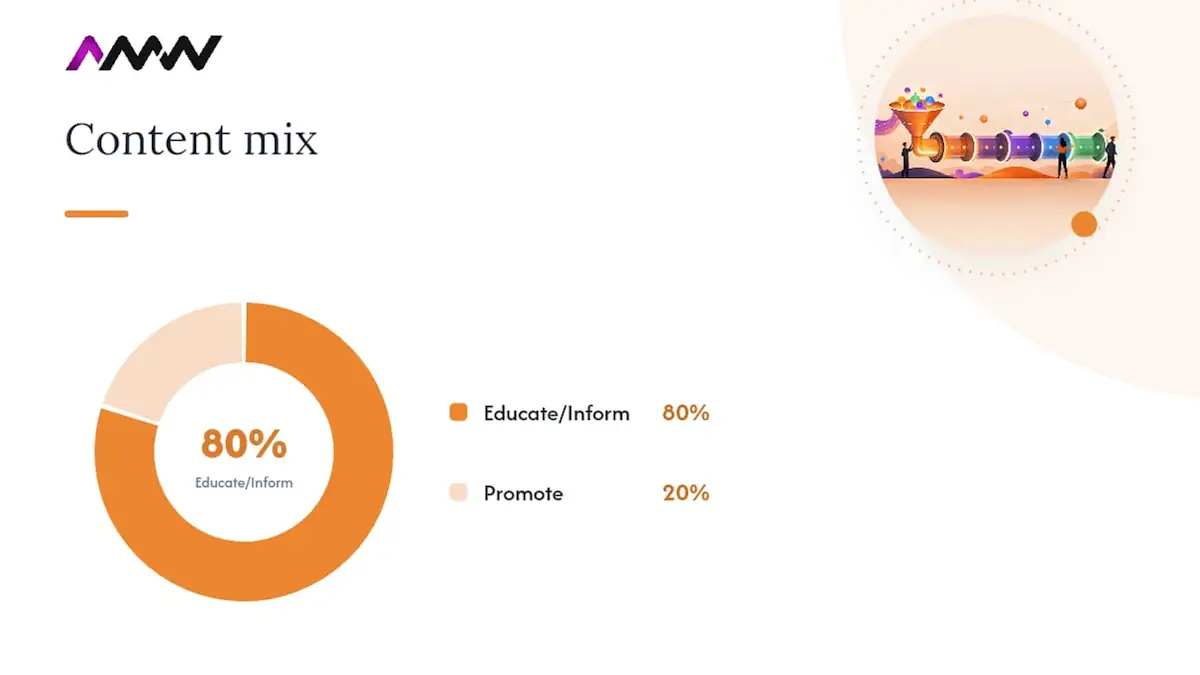
Content Marketing Institute’s B2B research backs the 80/20 principle: roughly 80% of your content should educate, entertain or inform, with only 20% directly promoting what you sell. Push past that ratio and engagement drops off because your feed starts to feel like an advert break. UK-focused benchmarks suggest posting 3 to 5 times a week hits the sweet spot for SMBs, frequent enough to stay visible without burning out your audience’s patience.
A simple weekly rotation that works for most B2B teams:
- Monday: a short opinion post reacting to industry news, low production effort, high engagement potential.
- Wednesday: a document carousel breaking down a process, a framework, or a “how we solved X” walkthrough.
- Friday: native video, 60 to 90 seconds, either a quick tip or a behind-the-scenes look at the work.
- Fortnightly: a long-form article or a poll, alternating between the two to test what resonates with your specific audience.
Match content to funnel stage rather than posting at random. Awareness content should teach something useful with no pitch attached, think “three mistakes we see in X”. Consideration content can show your thinking, comparisons, frameworks, or a case study breakdown that proves you’ve solved this problem before. Decision-stage content is where a soft call to action belongs, a demo offer, a downloadable guide, or an invitation to a webinar.
Pro Tip: Write your video scripts assuming the sound is off. LinkedIn autoplays muted, and the first three seconds of on-screen text decide whether someone stops scrolling. If your hook only works with audio, you’ve lost most of your audience before they’ve heard a word.
Organic tactics: optimise your company page and scale employee advocacy
A company page that hasn’t been touched since it was set up is doing you no favours, no matter how good your content is. Start with the basics and work outward:
- Fill in the “About” section properly, including specialities and a clear one-line description of what you actually do, not marketing fluff.
- Use a banner image that states your value proposition, not just your logo on a plain background.
- Post a “Life at [Company]” style piece early on. Company pages with recent activity and visible culture content tend to convert profile visits into follows more reliably than static ones.
- Make sure every leadership profile has a clear headline, a summary that reads like a person wrote it, and a “featured” section pointing to recent content or case studies.
None of that scales reach on its own, though. Employee advocacy is where organic distribution actually multiplies, because a post shared by ten employees to their combined networks reaches further than the same post shared once from the company page. Build a simple advocacy structure: a shared content calendar employees can pull from, a short set of guidelines (tone, what not to say, when to tag the company), and a cadence, perhaps one share per employee per week, rather than demanding daily participation that nobody sustains. Track it loosely with reach and click data from LinkedIn’s own analytics rather than trying to build a complicated incentive scheme from day one. A small reward for the most active advocates each quarter, a shout-out or a modest voucher, tends to work better than a rigid points system that feels like homework.
Groups, Events and document posts round out the organic toolkit. A well-run LinkedIn Group around a niche topic gives you a direct line to a self-selected, interested audience, though they need active moderation to stay useful rather than turning into a dumping ground for spam. LinkedIn Events work well for webinars because registrants get reminders automatically, cutting the no-show rate compared with external event tools. Document posts deserve a second mention here specifically for lead capture: a well-designed PDF carousel that ends with “comment below for the full report” generates a steady trickle of warm, low-pressure engagement that’s easy to follow up on individually.
Paid LinkedIn tactics: ad formats, budgets and campaign structure
Match the ad format to what you’re actually trying to achieve, not to what looks most impressive. Sponsored Content, essentially boosted versions of native posts, works well for engagement and mid-funnel nurturing, since it looks and feels like organic content rather than an obvious advert. Video and carousel ads suit top-of-funnel awareness, where the goal is simply getting your name and category in front of the right people. Lead Gen Forms are built specifically for direct capture: because they pre-fill with the user’s LinkedIn profile data, they remove almost all the friction of a normal landing page form, and benchmarks show they often convert noticeably higher than sending the same audience to an external page. Message Ads (what used to be called Sponsored InMail) work best for direct outreach with a specific, time-bound offer, a webinar invite or an event, since they land in someone’s inbox rather than competing with feed content.
Budget ranges vary hugely by industry, but a few structural principles hold regardless of sector:
- Start any new campaign with a modest daily budget while you test creative and targeting, then scale the winners rather than committing a large monthly figure to something unproven.
- Expect Lead Gen Form campaigns to typically cost more per click than Sponsored Content, but produce a lower cost per qualified lead once you account for conversion rate.
- Choose cost cap or manual bidding once you have enough data to know your target cost per lead; use automated bidding early on when you’re still learning who responds.
- Reserve Message Ads for smaller, highly targeted lists rather than broad audiences, since deliverability and response rates drop sharply at scale.
A campaign structure that holds up across most B2B accounts runs: audience first (built from the persona and ABM work above), then creative built specifically for that audience rather than reused generically, then a lead capture mechanism matched to funnel stage, and finally a retargeting layer aimed at people who engaged but didn’t convert. Skipping that last step is the single most common waste of ad spend, since the people who’ve already shown interest are consistently your cheapest, most responsive audience for a second touch.
Measurement and KPIs: tracking performance and proving ROI
Different funnel stages need different KPIs, and judging a top-of-funnel awareness video by cost per lead will make it look like a failure when it’s doing its job perfectly well. At the top, track engagement rate and impressions; a healthy engagement rate for UK B2B company pages sits between 2% and 5%. In the middle, track click-through rate and cost per click on Sponsored Content. At the bottom, track cost per lead and, critically, cost per qualified lead, since a cheap lead that never buys is worse than an expensive one that does.
Attribution doesn’t need to be complicated to be useful. Build a consistent UTM structure (source, medium, campaign, and format as separate parameters) so every click can be traced back to the exact post or ad that generated it. Feed that into your CRM so leads carry their originating campaign right through the pipeline, not just at the point of form submission. Review the dashboard weekly for quick optimisation calls, but report to leadership monthly, since pipeline influence takes longer to show than click data.
A few things worth having in every report you send upward:
- Leads generated, split by organic versus paid source.
- Cost per lead and cost per qualified lead, tracked over time rather than as a single snapshot.
- Pipeline value attributed to LinkedIn, pulled from CRM records rather than estimated.
- Engagement rate trend on organic content, since a dropping trend often signals content fatigue before lead numbers show it.
Iterating on this data pays off more reliably than simply spending more. Case evidence on analytics-led optimisation suggests that regularly reviewing performance and adjusting targeting or creative tends to produce measurable uplifts that a bigger budget alone doesn’t guarantee.
Converting LinkedIn engagement into pipeline: capture, outreach and nurture
Lead Gen Forms, landing pages and gated documents each suit a different situation, and picking the wrong one costs you leads you’d otherwise have caught. Lead Gen Forms win on pure conversion rate because they remove almost every barrier, but you get less qualifying information since the person barely has to think before submitting. Landing pages let you ask more qualifying questions and control the full experience, at the cost of a noticeably higher drop-off rate. Gated documents (a report or template behind a form) sit in the middle: better qualification than a Lead Gen Form, but still lighter friction than a full landing page journey.
A practical structure for turning that capture into pipeline:
- Immediate: an automated thank-you message or email within minutes, confirming what they’ll receive and setting expectation for next contact.
- Within 24 hours: a personalised Sales Navigator connection request referencing the specific content they engaged with, not a generic pitch.
- Day 3 to 5: a short follow-up message offering something concrete, a relevant case study, a quick call, or another useful resource, still no hard sell.
- Week 2: if no response, a value-add nurture email begins, dripping useful content rather than repeated asks.
- Ongoing: lead scoring tracks engagement (opens, content downloads, profile visits), and once a threshold is crossed, sales gets an alert to take over the conversation directly.
Pro Tip: Never open a Sales Navigator message with “I noticed you work at [Company]”. Everyone can see that from your screen. Reference something specific they posted or engaged with instead, it takes thirty seconds and it’s the difference between a reply and an ignore.
Building a full document ad and Lead Gen Form workflow around one core offer, rather than scattering several competing calls to action, keeps the whole sequence coherent from first click to sales handover.
AMW Media’s take and a checklist you can actually use
The team holds partnerships with major platforms, and the certifications matter less than what they force you to keep up with: platform changes that quietly break campaigns nobody’s watching. Clients working with this approach on paid and organic LinkedIn programmes tend to see the biggest jump in lead quality once Lead Gen Forms are paired with Sales Navigator outreach rather than run separately, largely because the handover between marketing and sales stops leaking warm contacts.
Here’s a checklist worth running against your own LinkedIn programme:
- Company page fully filled in, with a recent culture post and clear specialities.
- Buyer personas mapped to specific title, seniority, industry and company-size filters.
- Content calendar following the 80/20 mix, posted 3 to 5 times weekly.
- At least one Lead Gen Form campaign live, paired with a Sales Navigator follow-up sequence.
- UTM tracking feeding a CRM, reviewed weekly and reported monthly.
Common pitfalls and compliance considerations in LinkedIn B2B marketing campaigns
The most common pitfall isn’t a targeting mistake, it’s inconsistency. Businesses launch a burst of content, get excited by early engagement, then vanish for six weeks when someone gets busy. LinkedIn’s algorithm rewards consistency over intensity, so a steady drip beats sporadic bursts almost every time.
The second pitfall is treating every connection request as a sales opportunity. Pitching immediately after someone accepts a connection is one of the fastest ways to get reported or blocked, and it poisons the well for genuine outreach later.
On compliance, data handling deserves real attention, not an afterthought. Lead Gen Forms and gated content both collect personal data, and under UK data protection rules, that means clear consent language, an honest explanation of what you’ll do with the information, and an easy way to opt out. Transparent data practices build trust with professional audiences specifically, since B2B buyers are often more privacy-conscious about their work identity than their personal one. Vague or missing privacy language on a form quietly depresses conversion rates even when nobody complains outright, because hesitant prospects simply close the tab.
Finally, watch automation tools carefully. Third-party bots that auto-connect or auto-message at scale routinely breach LinkedIn’s terms of service and can get accounts restricted, which is a painful way to lose months of relationship-building in an afternoon.
What actually matters, in Amir’s view
Most LinkedIn advice treats content and ads as separate disciplines run by separate people, and that split is exactly what quietly kills lead generation programmes. The businesses getting real pipeline out of LinkedIn are the ones where the content calendar and the ad account are planned by the same conversation, not bolted together after the fact.
When Amir audits a page, the first thing checked isn’t follower count or post frequency, it’s whether the last ten posts would mean anything to a specific named buyer persona, or whether they’d fit any company in any industry. That single test exposes more wasted budget than any analytics dashboard. Our Harrow page covers which part of digital marketing a north west London business usually needs first.
Amir
How AMW Media can help you put this into practice
AMW Media is the alternative to running LinkedIn in-house with nobody actually owning the strategy end to end. We handle the content production, the social media management, and the ongoing campaign optimisation as one connected job, rather than treating your organic posts and your paid spend as two separate projects that never talk to each other.
If your LinkedIn programme currently runs on whoever has ten minutes free that week, that’s usually the real problem, not the platform. Our team builds the content calendar, sets up and manages Lead Gen Form campaigns, and reports back in plain figures your leadership team can actually use to judge pipeline impact rather than vanity metrics. If you’d rather your marketing budget went into strategy and execution than trial and error, get in touch through our contact page and we’ll talk through where your current setup is leaking leads.
Sources
- B2B Marketing Plan Strategy & Best Practices | LinkedIn Ads
- B2B content research and benchmarks, Content Marketing Institute
- LinkedIn algorithm guide, Hootsuite blog
FAQ
Is LinkedIn good for B2B marketing?
Yes. LinkedIn drives the largest share of B2B social leads of any platform, with generally higher lead quality than other social networks, because the audience is already in a professional mindset.
Is LinkedIn a B2B platform?
LinkedIn serves both B2B and B2C marketers, but its professional context, job-title targeting, and company data make it particularly effective for reaching business decision-makers.
What is the 4-1-1 rule on LinkedIn?
The 4-1-1 rule suggests posting four educational or entertaining pieces of content, one soft promotional post, and one direct sales-focused post for every six updates, keeping self-promotion firmly in the minority.
What is the rule of 7 in B2B?
A prospect typically needs multiple meaningful touchpoints with your brand before they’re ready to buy, which is why a mix of organic content, ads and personal outreach works better than any single tactic alone.
How often should a B2B company post on LinkedIn?
UK benchmarks suggest 3 to 5 posts per week gives enough visibility without exhausting your audience’s patience.
Recommended
- Turn LinkedIn Ads Into B2B Pipeline With Document Ads
- Lead generation methods: proven strategies for sales growth
- What is lead generation? A practical guide for 2026
- Automated lead routing: what it is and how to get it right
Our free marketing audit looks at your site, your ads and your content, and comes back with a 30 day plan. No pitch deck.

Runs the content calendars and the community side of every social account, and keeps clients posted on what is going out and when. Meet the team.