
 Black Steel Doors
 Woodstock Campers
 Phillips Joinery
TL;DR:
- Lead generation attracts prospective customers and nurtures their interest toward a purchase.
- Effective systems combine inbound and outbound methods to build predictable, scalable pipelines.
Lead generation is defined as the process of attracting prospective customers, capturing their interest, and moving them toward a purchase decision. Every business that wants predictable revenue needs a working lead generation system. Without one, sales teams rely on referrals and luck, which is not a growth plan. This guide covers what lead generation actually means, how leads are classified, what the best practices look like, and how to measure whether your efforts are worth the spend. UK B2B marketers now pay an average of £440 per lead from paid channels, so getting this right matters more than ever.
Lead generation sits at the intersection of marketing and sales. Inbound methods such as SEO and content marketing attract prospects who find you. Outbound methods such as cold email and paid advertising put you in front of prospects who have not found you yet. The most effective programmes combine both approaches for full funnel coverage. AMW Media works with ambitious brands to build exactly these kinds of joined-up systems.
What is lead generation and how does it work?
Lead generation is the practice of identifying people or businesses that might buy from you, then nurturing their interest until they are ready to speak with sales. The term “demand generation” is sometimes used interchangeably, though demand generation refers more broadly to creating market awareness, while lead generation focuses on capturing specific individuals into a pipeline.
The process follows a simple arc. A prospect encounters your brand through a blog post, a paid advert, or a social media post. They take an action, such as downloading a guide or filling in a contact form. That action converts them from an anonymous visitor into a named lead. From that point, your job is to build enough trust and relevance that they eventually buy.
Lead generation builds brand awareness and lays the groundwork for long-term customer loyalty, not just immediate sales. That distinction matters because it changes how you measure success. A lead who downloads your pricing guide today may not buy for six months. If you only track short-term conversions, you will undervalue the channels doing the most important work.
What are the different types of leads in marketing?
Not all leads are equal, and treating them as if they were is one of the most common and expensive mistakes in marketing. Lead classification exists to help sales and marketing teams prioritise their time and spend.
Marketing Qualified Leads (MQLs) and Sales Qualified Leads (SQLs)
Leads are typically classified as Marketing Qualified Leads (MQLs) and Sales Qualified Leads (SQLs), reflecting their position in the sales funnel. An MQL has shown interest, perhaps by reading several blog posts or attending a webinar, but is not yet ready to buy. An SQL has taken a more deliberate action, such as requesting a demo or asking for pricing, and is actively considering a purchase.
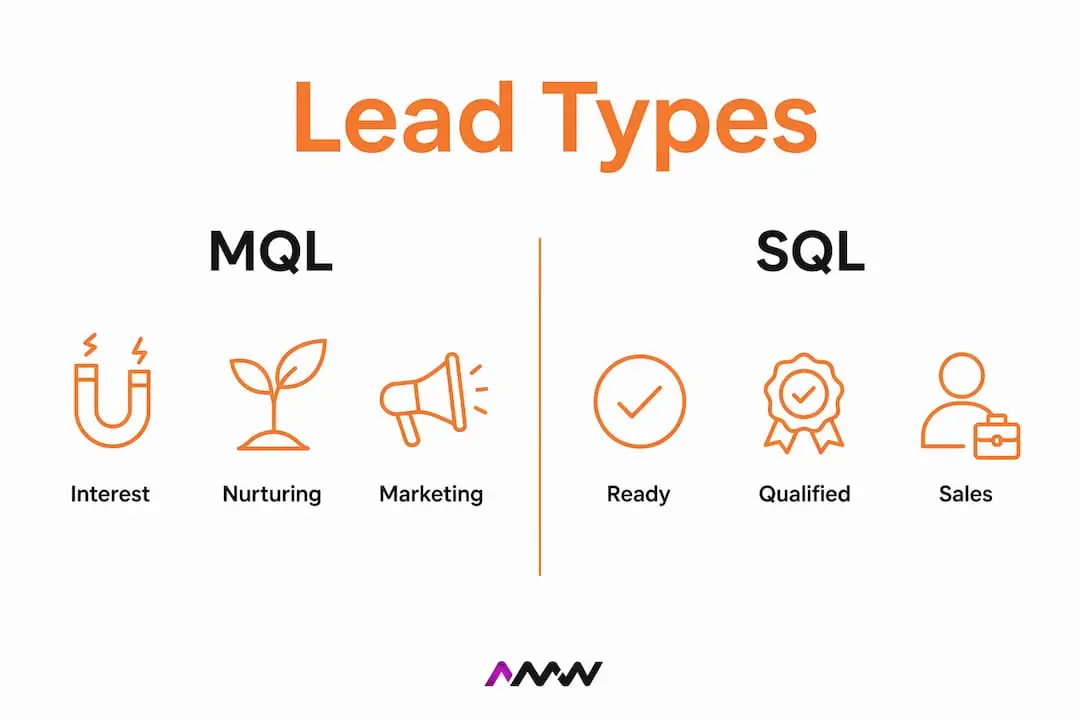
The practical difference is significant. Passing an MQL directly to sales wastes everyone’s time. The prospect feels pressured, the salesperson feels frustrated, and the lead goes cold. A proper qualification process keeps MQLs in a nurturing sequence until their behaviour signals sales readiness.
B2B versus B2C leads
B2B and B2C leads behave very differently, and your strategy needs to reflect that. In most B2B environments, a purchase involves multiple stakeholders including finance, operations, and leadership. A single deal might require sign-off from four or five people, each with different concerns. That complexity demands specific nurturing and longer timelines.
B2C leads, by contrast, typically involve a single decision-maker with a shorter consideration window. A consumer buying a £50 product online may decide within minutes. A business buying a £50,000 software contract may take six months. Your lead generation strategy needs to match the complexity of the buying process, not the other way around.
Lead scoring
Lead scoring assigns a numerical value to each lead based on their behaviour and profile. Common scoring criteria include:
- Job title and seniority (does this person have budget authority?)
- Company size and industry (does this match your ideal customer profile?)
- Engagement level (how many emails have they opened, pages visited, or events attended?)
- Recency (did they engage last week or six months ago?)
- Specific actions (pricing page visit, demo request, or contact form submission)
A lead who scores above a defined threshold moves from MQL to SQL and enters the sales process. Scoring removes subjectivity from the handoff between marketing and sales, which reduces friction and improves conversion rates.
What are the best practices for effective lead generation?
The gap between a lead generation programme that works and one that burns budget comes down to a handful of repeatable practices. None of them are complicated, but most businesses skip at least two of them.
Combine inbound and outbound methods
Inbound lead generation, which includes SEO, content marketing, and social media, attracts prospects who are already looking for what you offer. Outbound methods, including cold email, LinkedIn outreach, and paid advertising, reach prospects who do not know you yet. Neither approach alone is sufficient for consistent pipeline growth.

A business that relies only on inbound waits for prospects to find them. A business that relies only on outbound burns through budget chasing cold audiences. The combination creates a pipeline that is both self-sustaining and scalable.
Use lead magnets and clear calls to action
A lead magnet is something valuable you offer in exchange for contact details. Common formats include eBooks, webinar registrations, free audits, and downloadable templates. The key is that the lead magnet must be useful, not a thinly veiled sales brochure. Combining inbound and outbound strategies with strong calls to action measurably improves lead quality and reduces wasted spend.
Your call to action (CTA) needs to be specific. “Download the free guide” outperforms “Learn more” every time because it tells the prospect exactly what they will get. Place CTAs at logical decision points: the end of a blog post, the bottom of a landing page, and within email sequences.
Nurture leads with CRM and personalised follow-ups
Most leads are not ready to buy when they first engage. Effective lead nurturing involves personalising follow-ups and using CRM tools to move leads toward sales readiness over time. A well-structured nurture sequence delivers relevant content at regular intervals, building trust without being pushy.
Personalisation does not require writing individual emails to every lead. It means segmenting your list by industry, role, or behaviour, then sending content that speaks directly to each segment’s concerns. A finance director and a marketing manager at the same company have different priorities. Your emails should reflect that. Automated marketing tools make this kind of segmentation practical at scale.
- Define your ideal customer profile before building any campaign. Know the industry, company size, job title, and pain points you are targeting.
- Map content to funnel stages. Awareness content (blog posts, social media) attracts MQLs. Consideration content (case studies, webinars) moves them toward SQL status.
- Set up a CRM from day one. Spreadsheets do not scale. A CRM tracks every interaction and tells you where each lead sits in the funnel.
- Establish a lead handoff process. Agree with your sales team on the exact criteria that define an SQL. Document it and stick to it.
- Review and refine monthly. Lead generation is not a set-and-forget activity. Check your conversion rates, cost per lead, and lead quality scores every month.
Pro Tip: Monitor your cost per lead against your average deal value, not just against industry benchmarks. A £600 lead is expensive for a £2,000 product but cheap for a £20,000 contract.
How can businesses measure the quality and cost of leads?
Measuring lead quality is where most businesses either get serious about growth or continue wasting budget on vanity metrics. The three numbers that matter most are cost per lead (CPL), lead acceptance rate, and lead-to-sale conversion rate.
Understanding cost per lead
Cost per lead is calculated by dividing total marketing spend by the number of leads generated. The number alone tells you very little. Context is everything. The cost per lead should be evaluated relative to your average deal value. A typical ceiling is 5 to 15% of deal value to maintain cost-effectiveness. If your average deal is worth £10,000, a CPL of up to £1,500 can still be profitable, provided your conversion rates hold up.
UK CPL benchmarks vary significantly by sector and funnel stage. The market splits into three tiers, from top-of-funnel leads costing under £80 to high-CPL tiers ranging from £80 to over £600, depending on industry vertical.
| Sector / Lead type | Typical CPL range |
|---|---|
| Top-of-funnel (content downloads, newsletter sign-ups) | Under £80 |
| Legal qualified enquiry | £80 to £250 |
| SaaS qualified leads | £200 to £600 |
| B2B SQL (across sectors) | £250 to £700 |
| Average blended B2B paid lead (UK, Q2 2026) | £440 |
What drives CPL higher than it should be
High CPL is often linked to process inefficiencies rather than channel problems. The most common culprits are lead definition drift (where the definition of a “lead” quietly expands to inflate numbers), poor landing page experience, slow follow-up after a lead submits a form, and broken tracking that misattributes spend.
Slow follow-up is particularly damaging. A lead who fills in a contact form at 10am and receives a response at 4pm has spent six hours cooling off. Response time within the first hour consistently produces better conversion rates than responses sent later in the day.
Accepted leads versus vanity leads
A vanity lead is one that looks good in a report but never converts. It might be a competitor researching your pricing, a student writing a dissertation, or a contact who downloaded your eBook with no intention of ever buying. Accepted leads are those that meet your agreed qualification criteria and are worth a salesperson’s time.
Tracking your lead acceptance rate, the percentage of leads that sales actually accepts, tells you whether your marketing is attracting the right people. A low acceptance rate means your targeting or your lead magnet is pulling in the wrong audience.
What lead generation strategies should you prioritise in 2026?
The fundamentals of lead generation have not changed, but the channels and tools available in 2026 make it possible to execute them with far greater precision. The businesses generating the most pipeline are not doing anything exotic. They are doing the basics exceptionally well across multiple channels simultaneously.
Multi-channel presence
Relying on a single channel is the fastest way to make your pipeline fragile. A business that generates all its leads from Google Ads is one algorithm update or budget cut away from a serious problem. A multi-channel approach spreads that risk and creates multiple touchpoints with the same prospect.
The channels worth prioritising in 2026 are:
- Organic search (SEO): The highest-quality inbound channel for most B2B businesses. Prospects who find you through search are actively looking for a solution. AMW Media’s SEO services are built specifically to drive this kind of qualified organic traffic.
- Paid search (PPC): Fast to launch and highly targetable. PPC advertising works best when paired with well-designed landing pages and a clear offer.
- Social media: LinkedIn is the dominant B2B lead generation platform in the UK. Organic content builds authority; paid social scales reach. Both require consistent effort to produce results.
- Email marketing: The most cost-effective nurture channel available. Email campaigns that segment by behaviour and deliver relevant content consistently outperform broadcast newsletters.
- Account-based marketing (ABM): A targeted approach where marketing and sales align on a defined list of high-value accounts and create personalised campaigns for each. ABM is resource-intensive but produces the highest-quality leads for complex B2B sales.
Personalisation and automation
Personalisation at scale is no longer optional. Prospects receive dozens of marketing messages every day. Generic content gets ignored. Personalised content, which references the prospect’s industry, role, or specific challenge, gets read. AI-driven lead generation approaches are making this level of personalisation achievable for businesses of all sizes in 2026.
Automation handles the repetitive parts of lead nurturing, such as sending follow-up emails, scoring leads based on behaviour, and alerting sales when a lead hits a threshold. It does not replace human judgement. It frees up human time for the conversations that actually require it.
Landing page and follow-up optimisation
Your landing page is where lead generation either succeeds or fails. A page with a clear headline, a single focused offer, and a short form consistently outperforms a page that tries to do too much. Remove navigation menus from dedicated lead capture pages. Every link that takes a visitor away from the form is a potential lost lead.
Follow-up speed and relevance are equally critical. The first email a new lead receives sets the tone for the entire relationship. It should confirm what they signed up for, deliver the promised content immediately, and set clear expectations for what comes next. Effective lead nurturing strategies consistently show that the quality of the first follow-up has an outsized impact on long-term conversion rates.
Key takeaways
Effective lead generation requires combining inbound and outbound methods, qualifying leads rigorously, and measuring cost per lead against deal value rather than in isolation.
| Point | Details |
|---|---|
| Define lead types clearly | Distinguish MQLs from SQLs to avoid passing unready leads to sales. |
| Benchmark your CPL correctly | UK B2B SQL leads average £440; evaluate cost against your deal value, not just sector averages. |
| Combine inbound and outbound | SEO and content attract warm prospects; paid and outbound channels reach cold audiences. |
| Nurture with CRM and automation | Personalised, behaviour-triggered follow-ups move leads through the funnel faster. |
| Track acceptance rates, not just volume | A high volume of low-quality leads wastes sales time and inflates your true cost per acquisition. |
Why quality beats quantity every time in lead generation
I have seen businesses celebrate record lead volumes while their sales teams quietly despair. The number on the dashboard looked great. The pipeline told a different story. That disconnect is the most common and most avoidable problem in lead generation.
The instinct to chase volume makes sense on the surface. More leads should mean more sales. But when the leads are poorly qualified, sales teams spend their time chasing people who were never going to buy. Conversion rates drop, morale drops, and the marketing team gets blamed for generating “bad leads.” The real problem is almost always a broken qualification process, not the channel.
What I have found actually works is agreeing on the definition of a qualified lead before a single campaign goes live. Marketing and sales need to sit in the same room and answer the question: what does a good lead look like? When that definition is written down and agreed upon, everything else becomes measurable.
The other misconception worth challenging is that lead generation is a marketing function. It is a business function. The best lead generation programmes I have seen are owned jointly by marketing and sales, with shared targets and shared accountability. When marketing is only measured on lead volume and sales is only measured on closed deals, the incentives pull in opposite directions. Align the incentives and the results follow.
Track your data every month without exception. The businesses that consistently improve their lead generation are the ones that review their numbers, ask why, and make one change at a time. Not ten changes. One. Our Manchester page untangles media agency, creative agency and digital agency, three labels used interchangeably by people selling all three.
Amir
How AMW Media helps businesses generate better leads
Generating quality leads consistently requires the right mix of channels, content, and follow-up processes. AMW Media works with ambitious businesses across the UK to build lead generation systems that actually fill pipelines. From PPC campaign management that targets qualified prospects through paid search, to social media management that builds brand authority and attracts inbound enquiries, the team handles the execution so you can focus on closing. If your current lead generation is producing volume without quality, or simply not producing enough of either, get in touch with AMW Media to find out what a properly structured programme looks like for your business.
FAQ
What is lead generation in simple terms?
Lead generation is the process of attracting potential customers and capturing their contact details so your sales team can follow up. The goal is to build a pipeline of people who are interested in what you sell.
What is the difference between an MQL and an SQL?
An MQL (Marketing Qualified Lead) has shown interest but is not yet ready to buy, while an SQL (Sales Qualified Lead) has taken a deliberate action such as requesting a demo or pricing and is actively considering a purchase.
What is a good cost per lead in the UK?
The average blended cost per B2B lead from paid channels in the UK was £440 in Q2 2026, with SQL-level leads ranging from £250 to £700. A good CPL is one that sits within 5 to 15% of your average deal value.
What are the most effective lead generation techniques?
The most effective techniques combine inbound methods such as SEO and content marketing with outbound approaches such as PPC, cold email, and LinkedIn outreach, supported by a CRM for lead nurturing and scoring.
Why does lead generation matter for business growth?
Lead generation creates a predictable flow of prospective customers into your sales funnel. Without it, businesses depend on referrals and repeat business, which limits growth and makes revenue unpredictable.
Recommended
- How to master your digital marketing process for 2026
- What is SEO? a clear guide for marketers in 2026 | AMW Media
- What is PPC advertising? A 2026 guide for business growth
- Lead generation methods: proven strategies for sales growth | AMW Media
Our free marketing audit looks at your site, your ads and your content, and comes back with a 30 day plan. No pitch deck.

Founded AMW Media in 2024 and runs strategy, paid media and the CRM builds. The reason everything here is in house and measured in revenue. Meet the team.