
 Black Steel Doors
 Woodstock Campers
 Phillips Joinery
TL;DR:
- Most businesses struggle with lead qualification and nurturing, not lead generation itself.
- Creating a structured funnel with clear stages and shared definitions improves conversion and aligns sales and marketing efforts.
Wasting budget on leads that never convert is one of the most common frustrations in modern marketing. You run campaigns, capture contact details, and hand them over to sales, only to hear that none of them are worth following up. The problem rarely lies with the channel itself. It lies with the absence of a structured system behind it. This guide walks you through how to build a staged, evidence-backed lead generation system that consistently delivers qualified prospects, measurable results, and a predictable pipeline your sales team will actually thank you for.
Key Takeaways
| Point | Details |
|---|---|
| Build a staged funnel | Successful lead generation requires attracting, capturing, qualifying, and routing prospects using a systematic approach. |
| Balance inbound and outbound | A hybrid mix lets you generate both immediate pipeline and sustainable growth, matched to your goals and budget. |
| Prioritise qualification | Lead scoring, clear definitions, and nurture frameworks prevent wasted follow-up and improve pipeline quality. |
| Measure CPL by channel | Track cost-per-lead benchmarks for each channel and adjust strategies using real data, not assumptions. |
| Invest in compounding assets | Content, SEO, and partnerships reduce costs and provide scalable returns over time. |
Understanding the lead generation funnel
Most businesses treat lead generation as a single tactic. They run a paid ad, collect some emails, then wonder why conversion rates are dismal. The reality is that effective lead generation is a staged funnel with four distinct phases: attract, capture, qualify, and route. Each phase has its own purpose, and skipping any one of them creates expensive gaps in your pipeline.
Understanding this structure is the foundation for any serious digital marketing strategies investment. It also prevents the tension that arises when marketing declares a campaign successful because it generated 500 leads, whilst sales insists those leads were useless. Without shared definitions and a shared funnel, you are essentially running two separate businesses under one roof.
The four stages explained:
- Attract: Draw in the right audience through SEO, paid media, social content, events, or partnerships. The goal is relevant traffic, not just any traffic.
- Capture: Convert visitors into contacts via offers such as gated content, webinar registrations, free tools, or consultation requests. This is where contact information is exchanged for value.
- Qualify: Assess whether a contact is a realistic potential customer using demographic data, firmographic signals (company size, industry, job title), and behavioural signals (pages visited, content downloaded, emails opened).
- Route: Pass sales-ready leads to the right sales representative at the right time, using lead scoring models and clear definitions of what constitutes a Marketing Qualified Lead (MQL) and a Sales Qualified Lead (SQL).
MQL vs SQL: why the distinction matters
| Term | Definition | Who owns it | Trigger criteria |
|---|---|---|---|
| MQL | A lead who meets marketing criteria for further nurturing | Marketing team | Job title match, content downloads, webinar attendance |
| SQL | A lead who has been vetted by sales as ready for outreach | Sales team | Budget confirmed, timeline identified, decision-making authority |
| Lead score | A numerical value assigned based on behaviour and fit | Shared (marketing + sales) | Points for page visits, email opens, form fills, firmographic match |
The moment you introduce lead scoring and qualification into your funnel, everything changes. Sales stops receiving a bulk list of contacts every Monday. Instead, they receive a curated shortlist of prospects who have already demonstrated intent. That shift alone can dramatically improve conversion rates and reduce friction between departments.
Common pitfalls to watch for:
- Skipping the qualify stage and routing all contacts directly to sales
- Marketing and sales using different definitions for the same terms
- Failing to assign lead scores based on both fit and behaviour, relying solely on job title
- No agreed handoff protocol, meaning leads sit uncontacted for days or even weeks
Fixing these problems does not require a complete overhaul of your technology stack. It requires agreement, documentation, and a shared commitment to treating lead generation as a system rather than a series of isolated campaigns.
Selecting inbound and outbound methods
With your funnel stages mapped, the next decision is choosing which channels and tactics will fill each stage. This is where many marketing managers get stuck. There is no shortage of options, from blogging and SEO to cold email and LinkedIn outreach, and the temptation to try everything simultaneously leads to shallow execution across all channels.
The more useful framework is to choose based on four variables: your time horizon, your deal size, your need for a predictable pipeline, and your available budget. As inbound and outbound approaches each carry distinct trade-offs, neither is universally superior. The decision depends on your specific commercial situation.
Inbound lead generation builds compounding assets over time. When you invest in SEO for long-term leads, a well-optimised article or resource page can continue attracting qualified traffic for years without additional spend. The cost-per-lead (CPL) decreases as the asset matures. The downside is that inbound takes time. You are unlikely to see meaningful pipeline impact within the first 90 days.
Outbound lead generation delivers faster results. Cold email campaigns, LinkedIn Sales Navigator outreach, pay-per-click advertising, and event activations can all generate pipeline within days. However, the CPL tends to be higher, the targeting must be precise to avoid wasted spend, and results stop the moment you stop paying.

| Method | Speed | CPL over time | Scalability | Best for |
|---|---|---|---|---|
| SEO and content | Slow (3 to 12 months) | Decreasing | High | Long sales cycles, brand authority |
| Email marketing | Medium (weeks) | Low to medium | High | Nurture, re-engagement |
| PPC advertising | Fast (days) | Medium to high | Medium | Immediate pipeline, testing |
| Cold outreach | Fast (days) | Medium | Low to medium | ABM, enterprise deals |
| Partnerships | Medium | Very low | High | New markets, co-marketing |
How to build your method mix in six steps:
- Define your sales cycle length and average deal value. High-value, long cycles favour inbound and partnership approaches. Short cycles and lower deal values suit paid and outbound.
- Identify your quarterly pipeline gap. If you need to fill pipeline now, outbound is non-negotiable regardless of your long-term strategy.
- Audit your existing assets. If you have an established blog with domain authority, double down on SEO. If you have a strong CRM, activate email marketing sequences immediately.
- Allocate budget across at least two methods, one inbound and one outbound, to balance short-term results with long-term compounding.
- Agree on tracking and attribution before launching. Know how you will credit a lead that first came through organic search but converted via a paid retargeting ad.
- Review performance monthly and reallocate spend towards the channels delivering the best qualified lead rate, not just raw volume.
Pro Tip: Do not confuse a high volume of inbound leads with a healthy pipeline. A campaign that delivers 50 highly qualified leads is almost always more valuable than one that delivers 500 leads with no qualification filter applied. Set qualification thresholds before you launch, not after.
Core mechanics and assets for digital lead generation
Choosing your channels is only half the work. The other half is building the assets and mechanics that make those channels perform. Think of these as the infrastructure of your lead generation system. Without them, you are driving traffic to a destination with no front door.
The core mechanics of modern lead generation include lead magnets, landing pages, forms and CTAs, email nurture sequences, and lead scoring frameworks. Each plays a distinct role, and when orchestrated well, they work together to move a prospect from first contact to sales-ready status without requiring constant manual intervention.
Lead magnets are the offers you make in exchange for contact information. The best ones solve a specific, immediate problem for a narrowly defined audience. Generic eBooks rarely perform well in competitive markets. What does perform is hyper-relevant content tied to a specific challenge your target audience faces right now. Strong formats include:
- Diagnostic tools or assessments: “Score your current marketing funnel” attracts prospects actively seeking self-improvement.
- Checklists and templates: Highly practical, quick to consume, and easy to share.
- Webinars and live Q&A sessions: Build trust whilst capturing contact details and qualifying interest simultaneously.
- Whitepapers and research reports: Ideal for B2B audiences with longer evaluation cycles.
- Free trials or demos: The most direct qualification mechanism available, because only interested prospects invest the time.
As content marketing examples consistently demonstrate, the relevance of the offer matters far more than its production value. A precisely targeted checklist will outperform a glossy eBook every time if it speaks directly to the prospect’s situation.
Landing pages and forms are where capture happens. A landing page should have one goal and one goal only: to convert the visitor. Remove navigation links. Keep copy focused on the benefit of the offer. Use social proof, such as a testimonial or a recognisable client logo, to build trust rapidly. Your form should ask only for what you need. Every additional field reduces conversion rates. Name, email, and job title are often sufficient at the top of the funnel.
Email nurture sequences guide captured leads towards a buying decision over time. A well-constructed nurture sequence typically runs across four to eight emails over two to six weeks, depending on your sales cycle. Each email should add value, not just push a product. Share case studies, answer common objections, and introduce the team behind the solution.
“Lead scoring using behavioural signals such as email opens, link clicks, and page revisits, combined with firmographic signals such as company size and industry, allows marketing teams to prioritise effort and ensure sales only spends time on prospects with genuine commercial potential.”
The value of investing in content creation becomes especially clear in nurture sequences. Prospects who consume multiple pieces of relevant content before speaking to sales are already partially convinced. The sales conversation becomes shorter, less combative, and more likely to result in a deal.
Lead scoring assigns points to leads based on their fit (firmographic match) and their behaviour (engagement with your content). For example, a prospect who is a marketing director at a company with 100 to 500 employees, and who has downloaded two resources and visited your pricing page, should receive a significantly higher score than someone who downloaded a single checklist and never returned. The lead scoring system connects directly to your CRM and triggers automated handoffs to sales when a threshold is reached.
A strong mastering SEO strategy further amplifies lead quality by ensuring the right people find your content in the first place. When your content ranks for terms your ideal customer is actively searching, the leads who arrive are already demonstrating relevant intent, which makes every downstream mechanic more effective.
Measuring success: benchmarks, cost-per-lead, and common mistakes
To ensure your lead generation is translating into real business results, measuring performance and diagnosing mistakes is critical. Many marketing teams track the wrong metrics entirely, focusing on impressions and clicks whilst ignoring the figures that actually connect to revenue.
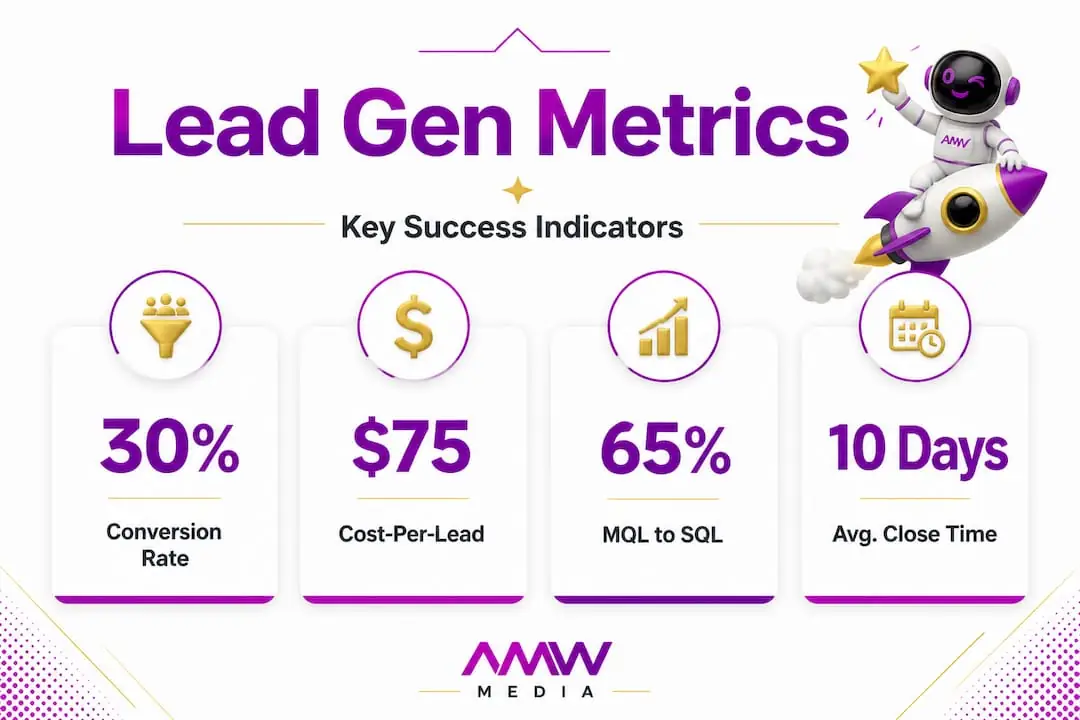
The metric that deserves your closest attention is cost-per-lead (CPL) by channel. This tells you what you are paying for each new contact, broken down by the source. CPL benchmarks by industry vary significantly, which is why comparing your performance against your specific vertical matters far more than chasing a generic target. A CPL of £80 might be excellent for a software-as-a-service company but financially catastrophic for an ecommerce business selling low-margin products.
Key metrics to track across your lead generation system:
- CPL by channel: Calculated as total channel spend divided by total leads generated via that channel.
- MQL to SQL conversion rate: The percentage of marketing-qualified leads that sales team accepts as sales-qualified. A low rate signals a misalignment in qualification criteria.
- Lead-to-opportunity rate: How many leads become genuine commercial opportunities. Industry benchmarks typically sit between 10% and 20% for well-qualified B2B pipelines.
- Time to contact: The average time between a lead being captured and first outreach from sales. Research consistently shows that response times exceeding 24 hours dramatically reduce conversion probability.
- Pipeline contribution by channel: Which channels are generating closed deals, rather than leads alone. This requires clean CRM attribution and is the only way to make informed budget decisions.
“When marketing optimises for lead volume without a qualification framework, teams can burn through significant budget filling a CRM with contacts that never progress to opportunity stage, creating frustration, distrust between departments, and a genuine waste of commercial resource.”
This is perhaps the most expensive mistake in B2B marketing. It happens when marketing and sales have not agreed on what a “good” lead looks like, and marketing is incentivised purely on lead volume targets. The solution is to set shared goals around MQL-to-SQL conversion rates and pipeline contribution, not just lead numbers.
Troubleshooting your lead generation system:
- Low conversion from traffic to leads: Audit your landing pages and lead magnet relevance. Are your CTAs visible and compelling? Is the offer specific enough to prompt action?
- High MQL volume but low SQL acceptance: Review your MQL criteria with the sales team. The qualification bar may be set too low, or the handoff process may be breaking down.
- Leads going cold after capture: Evaluate your nurture sequence. Are emails being sent? Are open rates acceptable? Is the content relevant to where the prospect is in their decision process?
- Inconsistent CPL across campaigns: Cross-reference audience targeting, ad creative, and landing page alignment. Mismatched messaging between ad and landing page is a frequent culprit.
Use content production strategies to keep your nurture sequences fresh and your lead magnets current. Stale content is one of the most overlooked causes of declining lead quality over time.
Pro Tip: Build a monthly lead generation review with both marketing and sales attending. Present CPL by channel, MQL-to-SQL rates, and pipeline contribution together in one dashboard. This single habit eliminates most of the departmental friction that undermines lead generation performance.
What most articles miss about lead generation method effectiveness
Here is the uncomfortable reality that most articles on this subject gloss over: the majority of businesses do not have a lead generation problem. They have a lead qualification and nurture problem dressed up as a lead generation problem.
We see this pattern repeatedly. A business invests in a new campaign, generates a solid volume of enquiries, sales follows up on the top ten and ignores the rest, and three months later the verdict is that “the campaign did not work.” In truth, the campaign generated a reasonable outcome. The system around it failed.
The obsession with lead volume is understandable. It is easy to measure, easy to report upward, and produces the impression of momentum. But compounding assets like SEO, content, and strategic partnerships reduce your marginal cost of acquisition over time precisely because they attract leads who are already educated, already interested, and already further down their own decision-making process before they ever speak to your team. That is a fundamentally different kind of lead, and it requires a fundamentally different approach to nurture and conversion.
Outbound is not the enemy. When you need pipeline this quarter, outbound campaigns and paid media activations are often the only practical answer. The mistake is treating them as the permanent solution rather than a bridge whilst your compounding assets build momentum. Businesses that invest in content creation for sustainable growth consistently outperform those reliant on paid acquisition alone over a two to three year horizon, because their CPL decreases whilst their competitors’ CPL continues to rise with advertising costs.
The other factor that separates effective lead generation from expensive activity is marketing and sales alignment. This is not a new idea, but it is one that most organisations pay lip service to without implementing. Alignment means shared definitions, shared metrics, shared accountability, and a genuine feedback loop where sales tells marketing which leads converted and why. That feedback loop is the engine of continuous improvement. Without it, you are optimising blind.
Next steps: accelerate your lead generation with proven digital solutions
Building a lead generation system that consistently delivers qualified, sales-ready prospects takes more than choosing the right channel. It requires the right web assets, compelling creative, and the technical infrastructure to capture, score, and nurture leads at scale. Our Northampton page makes the point that workshops and conversion businesses film well and their buyers search with intent.
At AMW Media, we design and execute end-to-end lead generation systems matched to ambitious brands. From high-converting web design services and landing pages that capture the right contact details, to targeted PPC campaign management that fills your pipeline immediately, to ongoing social media management that builds brand trust over time, our team combines strategic thinking with creative execution to deliver measurable results. If you are ready to move from scattered tactics to a structured, results-driven lead generation system, we are the digital partner to make it happen.
Frequently asked questions
How do I choose the best lead generation method for my business?
Select a mix based on your time horizon, deal size, sales cycle length, urgency, and channel economics. A hybrid approach that combines inbound and outbound methods typically performs best for mid-sized businesses seeking both immediate pipeline and long-term growth.
What is a MQL and why does it matter?
A Marketing Qualified Lead (MQL) is a contact who meets criteria agreed upon by both marketing and sales, ensuring only appropriately qualified leads are passed through to the sales team for follow-up.
How can I benchmark the cost-per-lead in my industry?
Compare your channel results against industry CPL benchmarks published by sources like HubSpot, adjusting for your specific business vertical, target audience, and campaign spend levels.
How do lead magnets increase lead quality?
Well-targeted lead magnets attract prospects who already have relevant needs, helping to filter genuine interest from casual curiosity and capturing contact details for structured nurture sequences. The behavioural and firmographic signals generated through lead magnet engagement also feed directly into your lead scoring model.
What is the biggest mistake marketers make in lead generation?
Focusing on lead volume without qualification burns budget and creates conflict between marketing and sales. Always define lead scoring thresholds and nurture pathways before launching any significant campaign.
Recommended
- Proven content marketing examples to boost your brand | AMW Media
- Email marketing strategies to engage and grow your business | AMW Media
- Essential digital marketing guide: strategies for brand growth
- Why invest in content creation for competitive brand growth
Our free marketing audit looks at your site, your ads and your content, and comes back with a 30 day plan. No pitch deck.

Runs the business alongside Amir: contracts, onboarding and making sure every client knows what is happening and when. Meet the team.