
 Black Steel Doors
 Woodstock Campers
 Phillips Joinery
Many business owners assume that strong organic search rankings alone will drive sufficient traffic to their website. Yet 54% of all traffic goes to the top three Google search results, and securing those positions organically can take months or even years. PPC advertising offers an immediate solution, placing your brand at the top of search results whilst you build your organic presence. This guide explains what PPC advertising is, how it works, why it matters for competitive industries, and how to use it effectively to grow your business in 2026.
Key takeaways
| Point | Details |
|---|---|
| Top search positions dominate traffic | The top three Google results capture 54% of traffic, making paid ads highly valuable for visibility |
| PPC delivers immediate visibility | Pay-per-click advertising places your ads at the top of search results instantly, unlike organic methods |
| Strategic management drives ROI | Effective PPC requires careful keyword research, bid optimisation, and continuous performance monitoring |
| Budget control and measurability | PPC offers flexible spending limits and detailed metrics to track return on investment accurately |
| Complements organic strategies | Combining PPC with SEO maximises your overall online marketing effectiveness and reach |
Understanding the fundamentals of PPC advertising
PPC advertising is a digital marketing model where you pay a fee each time someone clicks on your ad. These ads typically appear on search engines like Google, Bing, or partner websites, positioned above or alongside organic search results. The pay-per-click model gives you precise control over your advertising spend whilst targeting users actively searching for products or services like yours.
The core components of PPC include keywords, bids, quality score, ad copy relevance, and landing pages. Keywords are the search terms you want to trigger your ads. Bids represent the maximum amount you’re willing to pay per click. Quality score measures how relevant and useful your ad is to users, affecting both your ad position and cost. Ad copy must align with user intent and your landing page content to drive conversions effectively.
Google Ads dominates the PPC landscape, operating through an advertising auction system. When someone searches for a term you’re bidding on, Google’s algorithm instantly evaluates all competing advertisers based on their bid amount and quality score. The highest-ranking ads appear in premium positions, with advertisers paying only when users click. This auction happens billions of times daily, making strategic positioning crucial.
The competition for top positions is fierce because the top three Google search results capture 54% of all traffic. Users rarely scroll beyond the first page, making visibility in those top slots essential for driving meaningful traffic. PPC advertising provides immediate access to these coveted positions, bypassing the lengthy process of building organic rankings through SEO alone.
Platforms beyond Google Ads include Microsoft Advertising (formerly Bing Ads), which reaches a different demographic segment, and social media platforms like Facebook, Instagram, and LinkedIn that offer their own PPC models. Each platform has unique strengths depending on your target audience and business objectives.
Key PPC components to master:
- Keyword selection and match types (broad, phrase, exact) that balance reach with relevance
- Bid strategies including manual bidding, automated bidding, and target CPA or ROAS goals
- Ad extensions that enhance visibility with additional information like phone numbers or site links
- Landing page optimisation to ensure post-click experience matches ad promises
- Conversion tracking to measure which clicks lead to valuable business outcomes
Pro Tip: Start with phrase match and exact match keywords to maintain tighter control over when your ads appear, then gradually expand to modified broad match as you identify high-performing terms and refine your negative keyword list.
Working with expert PPC campaign management can accelerate your learning curve and help you avoid costly mistakes during the critical early stages of campaign development.
How PPC advertising compares to other digital marketing methods
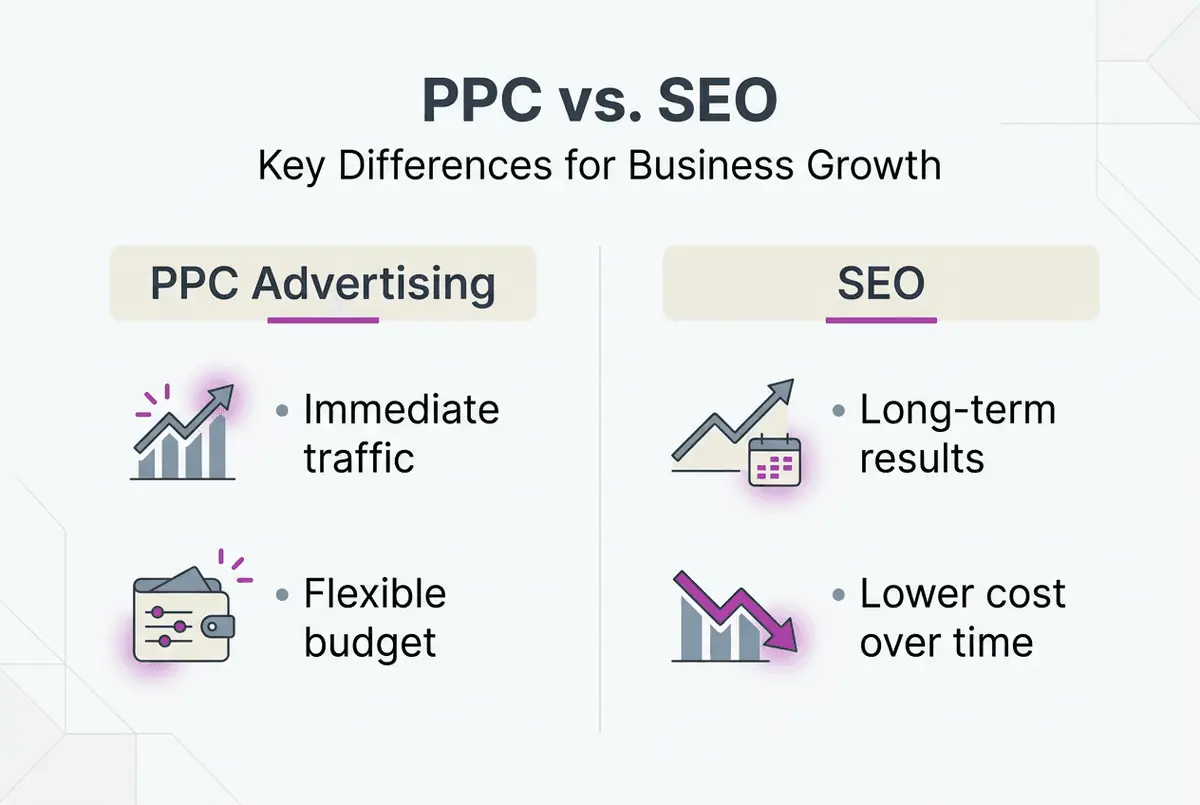
Organic search through SEO builds long-term visibility by improving your website’s ranking in unpaid search results. SEO requires consistent effort in content creation, technical optimisation, and link building, typically taking three to six months before showing significant results. Whilst organic rankings don’t incur per-click costs, they demand substantial time investment and ongoing maintenance.
PPC advertising delivers immediate visibility and traffic. You can launch a campaign today and start receiving clicks within hours. This speed makes PPC ideal for time-sensitive promotions, new product launches, or competitive markets where waiting months for organic rankings isn’t viable. You control exactly when your ads appear, what message they convey, and which landing pages users reach.

Cost considerations differ significantly between channels. SEO requires upfront investment in content, technical improvements, and possibly professional services, but doesn’t charge per visitor. PPC involves ongoing costs for every click, making budget management essential. However, PPC’s measurability lets you calculate precise return on ad spend and adjust budgets based on performance data.
Social media advertising operates on similar auction principles but targets users based on demographics, interests, and behaviours rather than search intent. Someone searching “emergency plumber London” has immediate intent to hire, whilst someone seeing a plumbing ad on Facebook might simply fit the demographic profile. Search-based PPC typically converts better for high-intent services, whilst social ads excel at building awareness and reaching new audiences.
The top three Google search results still capture 54% of all traffic, reinforcing why both paid and organic strategies matter. PPC secures immediate top positions whilst you build organic authority. Many successful businesses run both simultaneously, using PPC to maintain visibility for competitive terms whilst SEO efforts mature.
| Method | Speed to results | Cost structure | Targeting approach | Best use case |
|---|---|---|---|---|
| PPC advertising | Immediate (hours) | Pay per click | Search intent, keywords | Quick visibility, conversions |
| SEO | Long-term (months) | Upfront investment | Content relevance | Sustainable traffic growth |
| Social media ads | Fast (days) | Pay per click/impression | Demographics, interests | Brand awareness, engagement |
Factors for integrating PPC with other strategies:
- Use PPC data to identify high-converting keywords worth targeting through SEO content
- Maintain PPC coverage for competitive terms where organic rankings are difficult to achieve
- Allocate budget between channels based on customer lifetime value and acquisition costs
- Coordinate messaging across paid and organic touchpoints for consistent brand experience
- Test ad copy and landing pages through PPC before investing in long-term SEO content
Combining SEO services and packages with PPC creates a comprehensive search strategy that captures both immediate and long-term opportunities. Similarly, integrating social media management services extends your reach beyond search engines to build brand awareness across multiple channels.
Key strategies to optimise your PPC campaigns for maximum impact
Successful PPC campaigns follow a structured process that begins with thorough keyword research. Identify terms your target customers actually use when searching for your products or services. Tools like Google Keyword Planner reveal search volumes, competition levels, and suggested bids. Focus on keywords with clear commercial intent rather than informational queries that rarely convert.
- Conduct comprehensive keyword research using multiple tools to identify opportunities competitors might miss
- Write compelling ad copy that addresses user intent directly and includes a clear call to action
- Set up precise targeting parameters including location, device type, and audience demographics
- Choose appropriate bidding strategies aligned with your goals, whether maximising clicks, conversions, or return on ad spend
- Create dedicated landing pages that match ad promises and guide visitors smoothly towards conversion
- Implement conversion tracking to measure which keywords and ads drive valuable business outcomes
- Monitor performance daily during launch phase, then adjust frequency based on campaign stability
- Analyse data to identify underperforming elements and opportunities for improvement
A/B testing systematically compares ad variations to determine which elements resonate best with your audience. Test one variable at a time, such as headline, description, or call to action. Run tests until you achieve statistical significance, typically requiring at least 100 clicks per variation. Winners become your new control, and you continue testing to incrementally improve performance.
Quality score significantly impacts both your ad position and cost per click. Google assigns quality scores from 1 to 10 based on expected click-through rate, ad relevance, and landing page experience. Higher quality scores reduce your cost per click whilst improving ad positions, making quality optimisation more valuable than simply increasing bids. Focus on creating highly relevant ad groups with tightly themed keywords and matching landing pages.
Negative keywords prevent your ads from appearing for irrelevant searches, reducing wasted spend. If you sell premium software, add “free” as a negative keyword to avoid clicks from users seeking free alternatives. Review search term reports weekly to identify new negative keywords based on actual queries triggering your ads.
Pro Tip: Review your search terms report every week to discover both new keyword opportunities and negative keywords to add, then reallocate budget from underperforming keywords to your top converters for immediate ROI improvement.
Combining PPC insights with SEO enhances both strategies. Keywords that convert well in PPC campaigns deserve organic content investment. Conversely, pages ranking well organically might benefit from PPC support to dominate the entire first page of results. This integrated approach, available through PPC campaign management services, maximises your visibility and market share.
The impact of top search rankings on traffic distribution makes continuous optimisation essential. Small improvements in ad position or click-through rate compound over time, significantly affecting your overall campaign performance and profitability.
Measuring the return on investment from PPC advertising
Tracking the right metrics separates profitable PPC campaigns from money-losing ones. Click-through rate (CTR) measures the percentage of people who see your ad and click it, indicating how compelling your ad copy is. Industry averages vary, but CTRs above 3% for search ads generally signal strong relevance. Low CTRs suggest your ad doesn’t match user intent or your targeting needs refinement.
Cost per click (CPC) represents the average amount you pay each time someone clicks your ad. CPCs vary dramatically by industry and keyword competitiveness, ranging from under £1 for niche terms to over £50 for highly competitive sectors like legal services or insurance. Monitoring CPC trends helps you identify when competition increases or your quality score changes.
Conversions are the valuable actions you want visitors to take, whether purchasing products, submitting contact forms, or downloading resources. Conversion rate divides conversions by total clicks, showing what percentage of visitors complete desired actions. Improving conversion rates through landing page optimisation often delivers better ROI than simply driving more traffic.
Return on ad spend (ROAS) calculates revenue generated divided by advertising costs. A ROAS of 400% means you earn £4 for every £1 spent on ads. ROAS requirements vary by business model and profit margins. E-commerce businesses might need 300% ROAS to be profitable, whilst service businesses with higher margins might succeed at 200%.
| Metric | Example value | What it indicates | Optimisation action |
|---|---|---|---|
| Click-through rate | 4.2% | Strong ad relevance | Test variations to push higher |
| Cost per click | £2.35 | Moderate competition | Improve quality score to reduce |
| Conversion rate | 8.5% | Effective landing page | Scale budget to capture more traffic |
| Return on ad spend | 425% | Highly profitable | Increase bids to gain market share |
How to interpret metrics and take action:
- High CTR but low conversions suggests your ad promises don’t match landing page delivery
- Low CTR indicates poor ad relevance or targeting issues requiring keyword or copy refinement
- Rising CPCs without corresponding conversion increases means competition has intensified or quality score dropped
- Strong ROAS on specific keywords justifies increasing budgets to capture additional market share
- Declining performance over time often signals ad fatigue, requiring fresh creative or expanded targeting
Integrating Google Analytics with your PPC campaigns provides deeper insights into user behaviour after clicking. Track metrics like bounce rate, pages per session, and time on site to understand whether paid traffic engages meaningfully with your content. Set up goal tracking and e-commerce tracking to attribute revenue directly to specific campaigns, ad groups, and keywords.
Well-managed PPC campaigns deliver measurable and scalable returns. Unlike traditional advertising where attribution remains uncertain, PPC provides precise data on every pound spent and every conversion generated. This transparency lets you confidently invest more in what works whilst cutting what doesn’t.
The concentration of 54% of traffic in the top three search results means even small improvements in ad position or click-through rate significantly impact your business outcomes. Regular performance analysis through PPC performance measurement ensures your campaigns continuously improve and adapt to changing market conditions.
Boost your PPC success with AMW Media
Navigating the complexities of PPC advertising requires expertise, time, and constant attention to evolving best practices. AMW Media specialises in expert PPC campaign management built for businesses in competitive industries seeking measurable growth. Our team combines strategic thinking with data-driven optimisation to maximise your return on ad spend whilst you focus on running your business.
We develop customised PPC strategies aligned with your specific business goals, whether driving immediate sales, generating qualified leads, or building brand awareness in new markets. Our approach integrates smoothly with broader digital marketing services including SEO, social media, and content production to create cohesive campaigns that amplify results across channels. Explore our AMW Media case studies to see how we’ve helped ambitious brands achieve their online growth objectives through strategic PPC management and creative excellence.
What is PPC advertising FAQ
What channels can PPC advertising be used on?
PPC advertising works across search engines like Google and Bing, social media platforms including Facebook, Instagram, LinkedIn, and Twitter, display networks that place banner ads on millions of websites, shopping platforms like Amazon and eBay, and video platforms such as YouTube. Each channel offers unique targeting capabilities suited to different business objectives, with search engines typically delivering the highest intent traffic.
How much should I budget for a PPC campaign?
Minimum effective budgets start around £500 to £1,000 monthly for local businesses, whilst competitive industries often require £3,000 to £10,000 or more to achieve meaningful results. Your budget depends on your industry’s average cost per click, target market size, and desired conversion volume. Start with a test budget to gather performance data, then scale investment based on proven return on ad spend rather than arbitrary spending limits.
How long does it take to see results from PPC?
You’ll see immediate traffic once campaigns launch, typically within hours of activation. However, meaningful performance data requires at least two to four weeks of running campaigns to gather sufficient clicks and conversions for statistical significance. Full optimisation takes two to three months as you test variations, refine targeting, and adjust bids based on accumulated performance insights. Professional PPC campaign management accelerates this learning curve significantly.
Can PPC advertising improve organic search results?
PPC doesn’t directly influence organic rankings, but it provides valuable data that informs SEO strategy. High-converting PPC keywords indicate topics worth creating organic content around. PPC also maintains visibility for competitive terms whilst you build organic authority, ensuring you don’t lose market share during the months required for SEO results. The combined approach delivers better overall performance than either channel alone.
What is the difference between PPC and CPM pricing?
PPC charges you only when someone clicks your ad, making you pay for engaged traffic rather than mere impressions. CPM (cost per thousand impressions) charges based on how many times your ad displays, regardless of whether anyone clicks. PPC suits conversion-focused campaigns where you want to drive specific actions, whilst CPM works better for brand awareness campaigns where visibility matters more than immediate response.
National averages only take you so far. For a business advertising in one area, the local auction is what decides the budget, which is the starting point for our Google and Meta Ads work in Milton Keynes.
Recommended
- Expert PPC Campaign Management London | AMW Media | AMW Media
- Creative content production steps for marketing success in 2026
- Our Services | AMW Media
- Social Media Management Services | AMW Media | AMW Media
Our free marketing audit looks at your site, your ads and your content, and comes back with a 30 day plan. No pitch deck.

Founded AMW Media in 2024 and runs strategy, paid media and the CRM builds. The reason everything here is in house and measured in revenue. Meet the team.