
 Black Steel Doors
 Woodstock Campers
 Phillips Joinery
TL;DR:
- SEO is the most cost-effective digital marketing channel that drives long-term, high-quality traffic and builds credibility. Its success depends on integrating technical, on-page, and off-page strategies while adapting to 2026 trends like Google’s Experience Operators and AI search. Ongoing optimisation and a strong foundation are essential for sustained search visibility amid rapid algorithm changes.
SEO, which stands for Search Engine Optimisation, is the practice of improving a website’s visibility in unpaid search results to attract more relevant visitors. It is the single most cost-effective acquisition channel available to digital marketers, and in 2026 it has grown more complex, more rewarding, and more tied to artificial intelligence than ever before. Organic search drives 53% of all trackable website traffic, outpacing paid search, social media, email, and direct visits combined. That figure alone tells you where your audience is spending their attention. Tools like Google Search Console, Ahrefs, and Semrush exist precisely because the rewards of ranking well are enormous, and the competition to get there is fierce. This guide covers the SEO definition, how it works, why it matters, and what the arrival of Google Experience Operators and AI-powered search means for your strategy right now.
What is SEO and how does it work?
SEO is the process of making your website more attractive to search engines so they rank it higher for relevant queries. Search engines like Google use automated programmes called crawlers to scan the web, index pages, and then rank them based on hundreds of signals. Your job is to send the right signals.
SEO blends technical and creative components for effective outcomes. That means you cannot simply write good content and hope for the best, nor can you build a technically perfect site with nothing worth reading on it. Both sides must work together.
The process follows a clear sequence. A crawler discovers your page, reads its content and structure, stores it in an index, and then an algorithm decides where it ranks when someone searches a relevant term. Every SEO decision you make influences one or more steps in that chain.
Search engines connect businesses to users who are actively looking for answers, making SEO the highest-intent acquisition channel available. A person typing “best running shoes for flat feet” into Google is far closer to a decision than someone who sees a social media advert. That intent gap is why SEO converts so well.
What are the core components of SEO?
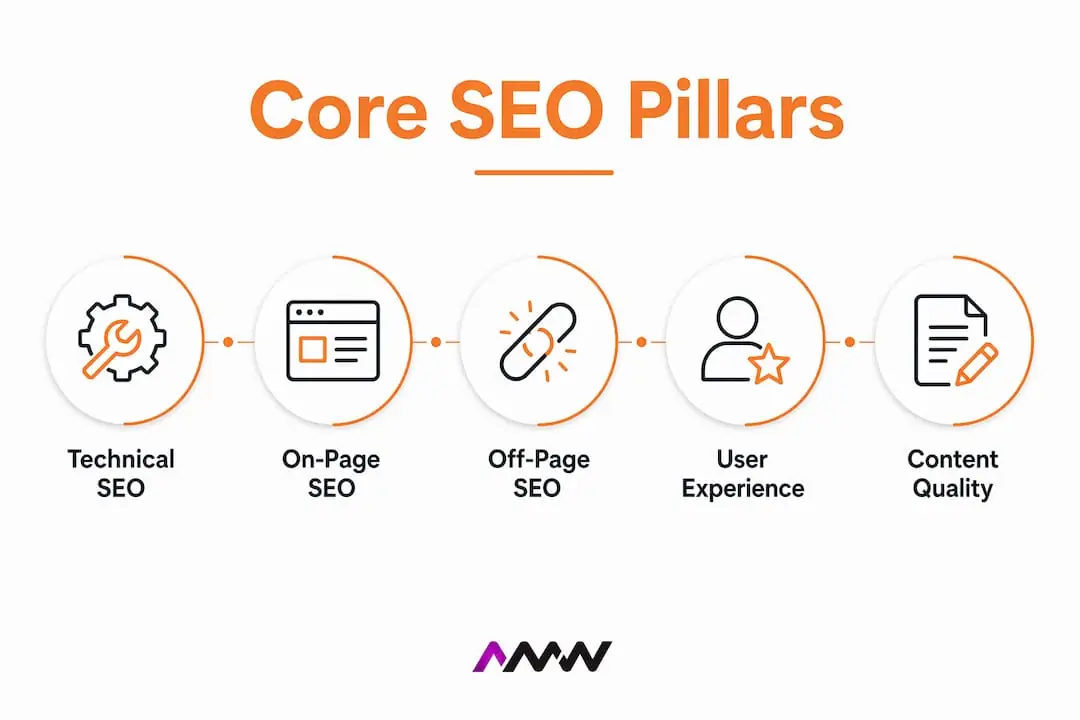
The three pillars of SEO are technical, on-page, and off-page. Each pillar addresses a different dimension of how search engines evaluate your site, and neglecting any one of them limits the effectiveness of the other two. Our SEO agency Milton Keynes page walks through the Google Business Profile side of this, starting with whether you would call your own business from its listing.
Technical SEO covers everything that affects how search engines crawl and index your site:
- Site speed and Core Web Vitals scores
- Mobile responsiveness and usability
- Structured data and schema markup
- Crawl budget management and XML sitemaps
- HTTPS security and canonical tags
On-page SEO focuses on the content and structure of individual pages:
- Keyword research and placement within titles, headings, and body copy
- Matching content to user intent (informational, navigational, or transactional)
- Internal linking to distribute authority across your site
- Meta descriptions and title tags that improve click-through rates
- Content depth and readability
Off-page SEO builds your site’s authority in the eyes of search engines:
- Earning backlinks from reputable, relevant websites
- Brand mentions and digital PR
- Reviews and social signals that reinforce credibility
These three pillars interact constantly. A technically sound site earns more crawl coverage, which helps your on-page content get indexed faster. Strong content attracts backlinks naturally, which boosts your off-page authority. That authority then helps your technical and on-page signals carry more weight. You can read more about how these elements combine in AMW Media’s guide on SEO strategies for growth.
Pro Tip: If you are starting from scratch, prioritise technical SEO first. A site that cannot be crawled properly will not rank regardless of how good the content is. Fix the foundations before investing heavily in content production.
Why is SEO important in 2026?
SEO is the most financially sustainable digital marketing channel for most businesses. The numbers back this up clearly.

A well-executed SEO campaign yields a median ROI of 748% over three years. That figure dwarfs the typical return from paid search campaigns, which stop delivering the moment you stop spending. SEO compounds over time. Pages you optimise today can generate traffic for years.
| Channel | Traffic Share | Cost Model | Longevity |
|---|---|---|---|
| Organic Search (SEO) | 53% of all traffic | Time and expertise | Long-term, compounding |
| Paid Search (PPC) | Significant but declining | Cost per click | Stops when budget stops |
| Social Media | Moderate | Ad spend or content effort | Algorithm-dependent |
| Email Marketing | Consistent but smaller | List management cost | Dependent on list health |
The comparison above makes the case plainly. Organic search is not just the largest traffic source. It is also the most durable.
Beyond traffic volume, SEO builds credibility. Users trust organic results more than paid adverts. Appearing at the top of a Google search page signals authority in your field, and that perception carries real commercial weight.
“SEO targets high-intent users with organic content, making it the most sustainable acquisition channel for businesses seeking long-term growth.”, Digital Marketing Institute
The importance of SEO also extends to cost reduction across your entire marketing mix. When your organic presence is strong, you rely less on expensive paid campaigns to maintain visibility.
How does SEO differ from SEM, PPC, and paid search?
These terms are often used interchangeably, but they describe distinct things. Getting them straight helps you allocate budget and effort more effectively.
SEM (Search Engine Marketing) is the umbrella term that covers all activity designed to gain visibility in search engine results pages (SERPs). It includes both organic and paid approaches.
SEO sits within SEM and covers only the unpaid, organic side of search visibility.
PPC (Pay-Per-Click) and SEA (Search Engine Advertising) refer to paid placements, where you bid on keywords and pay each time someone clicks your advert. Google Ads is the dominant platform for this.
| Term | Definition | Cost Model | Speed of Results |
|---|---|---|---|
| SEO | Organic search visibility | Time and expertise | Weeks to months |
| SEM | All search marketing activity | Mixed | Varies |
| PPC / SEA | Paid search adverts | Cost per click | Immediate |
The strategic relationship between SEO and PPC is worth understanding. Integrating SEO early in campaign planning significantly reduces paid advertising costs by improving quality scores. Google’s Ad Quality Score rewards landing pages that are relevant, fast, and well-structured. Those are exactly the qualities that good SEO produces. So investing in SEO does not just build organic traffic. It also makes your paid campaigns cheaper to run.
The smartest approach combines both channels. Use PPC for immediate visibility on high-value terms while your organic rankings build. Use SEO data to identify which keywords convert best, then feed those insights back into your paid strategy. AMW Media’s PPC management services work alongside organic SEO for precisely this reason.
What are the biggest SEO trends in 2026?
The SEO landscape in 2026 is shaped by two forces above all others: Google’s introduction of Experience Operators (GEO) and the rapid growth of AI-powered search platforms.
Google experience operators (GEO) explained
Google Experience Operators represent a new signal that impacts how pages are indexed and ranked by prioritising user experience quality. GEO shifts the emphasis from pure keyword matching towards how users actually interact with your content. Pages that load quickly, present information clearly, and satisfy the user’s intent without friction are rewarded more directly than before.
This means technical SEO and UX design are now more closely linked than ever. A page with excellent content but poor mobile usability will lose ground to a competitor whose page is both informative and easy to use. If you have not audited your Core Web Vitals recently, GEO makes that task urgent.
Optimising for ai-powered search
Visibility in AI-powered search platforms is increasingly critical, requiring SEO to adapt to semantic search and intent-based optimisation. Platforms like Google’s AI Overviews, Perplexity, and ChatGPT are now answering user queries directly, often without the user clicking through to a website at all. Getting cited in those AI-generated answers is the new frontier of search visibility.
To appear in AI search results, your content needs to do several things well:
- Answer questions directly and completely, with the key claim in the first sentence of each section
- Use structured headings that match how users phrase their queries
- Build topical authority by covering a subject thoroughly across multiple pages
- Earn citations from credible sources, since AI models favour well-referenced content
- Write at a clear, accessible reading level that AI systems can parse and summarise easily
Semantic SEO and intent matching
Keyword stuffing is not just ineffective in 2026. It actively signals low quality to modern algorithms. Semantic SEO means writing content that addresses the full context of a query, not just the exact phrase. Google’s natural language processing understands that “best trainers for running” and “top running shoes” are the same intent. Your content should reflect that depth of understanding.
Pro Tip: Use tools like Google’s “People Also Ask” boxes and Ahrefs’ related keywords feature to map the full semantic territory around your target topic. Then build content that answers every relevant question in one place. This approach signals topical authority and dramatically improves your chances of appearing in AI-generated answers.
For a deeper look at how these trends affect your planning, AMW Media’s guide on types of SEO strategies covers the tactical side in detail.
Key takeaways
SEO is the highest-intent, most financially sustainable digital marketing channel available, delivering a median ROI of 748% over three years when executed well.
| Point | Details |
|---|---|
| SEO definition | Search Engine Optimisation improves organic visibility in search results without paying per click. |
| Three core pillars | Technical, on-page, and off-page SEO must all work together for strong rankings. |
| Financial case | Organic search drives 53% of all web traffic and delivers a median ROI of 748% over three years. |
| SEO vs PPC | SEO builds long-term compounding traffic; PPC delivers immediate results but stops when budget stops. |
| 2026 priorities | Google Experience Operators and AI search visibility now require content that is technically sound, intent-focused, and clearly structured. |
The part most SEO guides skip telling you
I have worked with dozens of brands on their search visibility, and the pattern I see most often is this: businesses treat SEO as a one-time project rather than an ongoing practice. They invest in a site audit, fix the technical issues, publish a batch of content, and then wait. Six months later they wonder why rankings have plateaued.
SEO is not a project. It is a discipline. Google updates its core algorithm several times a year, and the arrival of GEO and AI Overviews in 2026 has accelerated the pace of change considerably. The brands winning in search right now are the ones reviewing their performance data monthly, updating older content regularly, and adapting their approach as the signals shift.
The other thing I would push back on is the idea that technical SEO and creative content are separate concerns. The best-performing pages I have seen combine both without compromise. They load in under two seconds, use structured headings that answer real questions, and contain useful information written by people who know their subject. There is no shortcut that replaces that combination.
My honest recommendation: start with a thorough technical audit using Google Search Console and Ahrefs, fix what is broken, then build a content calendar around the questions your audience is actually asking. Do not chase trends at the expense of fundamentals. GEO and AI search matter, but a site that is slow, poorly structured, and thin on substance will not benefit from any trend. Get the foundations right first, then layer in the newer signals.
The brands that will dominate search in the next three years are not the ones spending the most. They are the ones who understand that content and digital strategy must work as a single, coherent system.
Amir
Ready to improve your search visibility?
Understanding SEO basics is the first step. Putting them into practice consistently is where most businesses need support.
AMW Media’s SEO services are built around the full picture: technical audits, on-page content strategy, off-page authority building, and adaptation to 2026 priorities including GEO and AI search optimisation. The team holds Google certifications and works with ambitious brands that want measurable results, not vague promises. Starting from scratch or trying to recover lost rankings: AMW Media builds strategies around your specific goals and market. Get in touch to find out what a specific SEO approach could do for your organic traffic.
FAQ
What does SEO stand for?
SEO stands for Search Engine Optimisation. It is the practice of improving a website’s visibility in unpaid search engine results to attract more relevant visitors.
How long does SEO take to show results?
SEO typically takes three to six months to produce noticeable ranking improvements, depending on competition and the current state of your site. It compounds over time, meaning results continue to grow long after the initial work is done.
What is the difference between SEO and PPC?
SEO generates organic traffic without paying per click, while PPC (Pay-Per-Click) involves paying for adverts that appear in search results. SEO builds long-term visibility; PPC delivers immediate traffic that stops when the budget runs out.
What are google experience operators (GEO)?
Google Experience Operators are a new ranking signal introduced in 2026 that rewards pages delivering strong user experience, including fast load times, clear structure, and content that directly satisfies search intent.
Why is appearing in AI search results important?
AI-powered platforms like Google’s AI Overviews and Perplexity now answer queries directly, reducing click-throughs to websites. Optimising for AI search visibility ensures your brand is cited in those answers, maintaining reach even as user behaviour shifts away from traditional search clicks.
Recommended
- The role of SEO in 2026: your complete guide | AMW Media
- Types of SEO strategies: a practical 2026 guide | AMW Media
- Essential digital marketing guide: strategies for brand growth
- How to master your digital marketing process for 2026
Our SEO manager runs the technical checks by hand, looks at who is beating you, and sends back the order to fix it in. Free, and you keep it either way.

Technical, on page and local SEO. Turns the numbers in Search Console into pages that rank and enquiries that convert. Meet the team.