
 Black Steel Doors
 Woodstock Campers
 Phillips Joinery
TL;DR:
- In 2026, SEO focuses on earning AI citations and trusted sources rather than just ranking high in search results.
- Content structure, E-E-A-T signals, and schema markup are essential for AI-driven visibility and citations.
The role of SEO in 2026 is defined by a single shift: your content must not only rank in traditional search results but also be cited and trusted by AI-powered platforms like Google AI Overviews, ChatGPT, and Perplexity. Search visibility is no longer measured purely by position one on Google. It is measured by how often AI systems choose your content as the source they quote. Generative Engine Optimisation (GEO) has moved from buzzword to core practice, and E-E-A-T signals now act as the primary filter determining which brands get cited in AI-generated answers.
How has AI transformed the role of SEO in 2026?
The most significant structural change in search over the past two years is the rise of AI-generated answers sitting above organic results. Google AI Overviews appear in roughly 30% of informational queries, and the knock-on effect for traditional rankings is severe. Click-through rates for positions four through ten have dropped by 30 to 60% on queries where an AI Overview is present. That is not a marginal dip. It is a fundamental redistribution of traffic.
What makes this interesting is the flip side. Sources that are cited inside an AI Overview receive a higher CTR than an equivalent traditional ranking would deliver. The AI panel effectively acts as a trust endorsement. Being cited by Google’s AI is worth more than sitting at position three in the standard blue-link results. This changes the entire objective of SEO from “rank as high as possible” to “become the source AI systems trust enough to quote.”
Traditional rankings still matter. They feed the data that AI systems use to decide which sources are authoritative. But they are no longer the sole measure of success. The new KPIs that forward-thinking teams are tracking include:
- AI Overview impressions (now filterable in Google Search Console)
- AI citation frequency across platforms like Perplexity and ChatGPT
- Referral traffic from AI platforms, tracked separately in analytics
- Share of model: how often your brand appears in AI-generated responses for your core topics
Tracking these new KPIs alongside traditional metrics is now standard practice for any serious SEO programme. Zero-click search is real, but it does not mean zero value. A brand cited in an AI Overview builds recognition even when the user does not click through. That brand recall compounds over time into direct traffic and conversion.
AI agents like GPTBot and PerplexityBot are also shaping decisions before any user interaction occurs. Agentic SEO, the practice of optimising for AI assistants that autonomously retrieve product and pricing data, is no longer theoretical. If your product pages are not structured for machine-readable extraction, you are invisible to an entire layer of the purchase funnel.
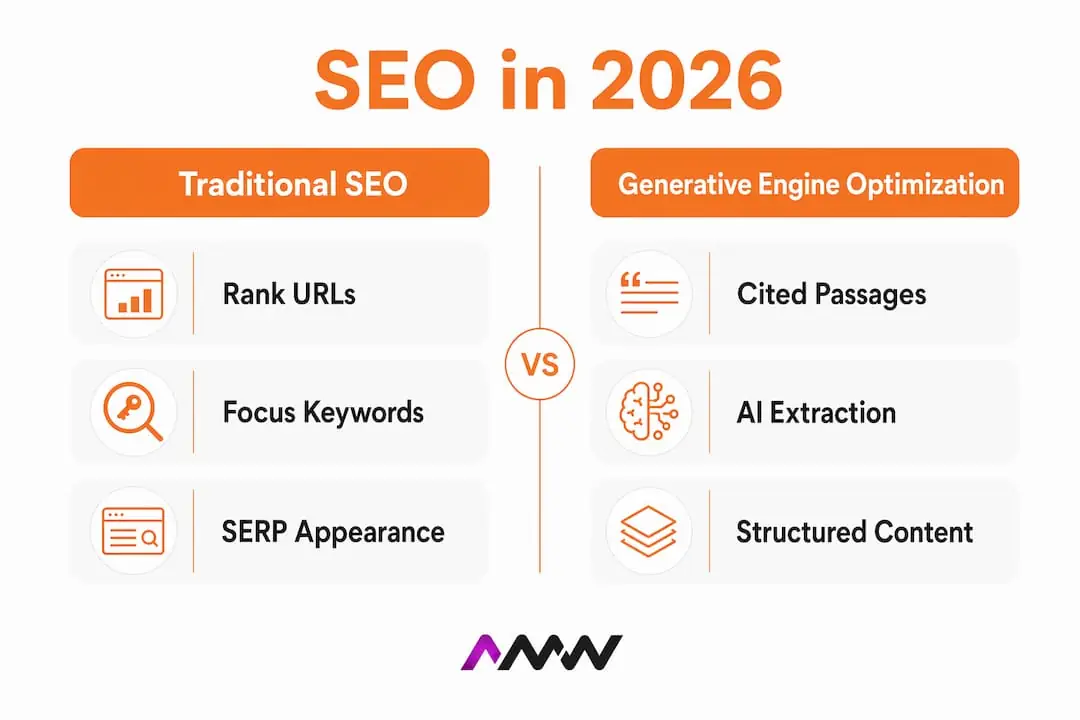
What is GEO and how does it fit with traditional SEO?
Generative Engine Optimisation is SEO layered with AI extraction logic. The goal shifts from getting a URL ranked to getting a passage cited in an AI-generated answer. GEO and traditional SEO overlap by roughly 80%, which means the foundational work you have already done on technical health, authority, and content quality still counts. The remaining 20% is where GEO diverges, and that divergence matters enormously for visibility in AI searches.

Here is a direct comparison of where GEO and traditional SEO align and where they part ways:
| Dimension | Traditional SEO | GEO |
|---|---|---|
| Primary objective | Rank URLs in SERPs | Get passages cited in AI answers |
| Success metric | Position, CTR, organic traffic | Citation frequency, AI referral traffic |
| Content structure | Keyword-optimised headings | Extractable, verifiable, question-shaped content |
| Schema priority | Title, meta, breadcrumb | FAQPage, HowTo, author attribution |
| Authority signals | Backlinks, domain rating | E-E-A-T, named authors, verifiable sources |
| Bot management | robots.txt | robots.txt plus emerging llms.txt |
Answer Engine Optimisation (AEO) sits alongside GEO as a closely related discipline. AEO focuses on being the direct answer to a query, while GEO focuses on being the cited source within a synthesised response. In practice, the two are converging into a single approach: optimising content for both human readers and AI extraction simultaneously.
The technical requirements for GEO are specific. AI systems accurately cite content that is structured for enhanced extractability, verifiability, and contextual clarity. That means short, declarative paragraphs. Named authors with credentials. Outbound citations to primary sources. Schema markup that labels your content type explicitly. And content that answers a question completely within a single passage rather than spreading the answer across five paragraphs.
The llms.txt file is an emerging standard designed to guide AI crawlers, complementing robots.txt in the same way that robots.txt guides traditional search bots. Adoption of llms.txt is rising, though debate continues about its utility and the risk of manipulation. Think of it as a policy document for AI rather than a simple crawler instruction. The concept of robots.txt itself has shifted in this direction too, now functioning more as a governance document than a technical directive.
Pro Tip: Add FAQPage schema to any page that answers a specific question. Content with FAQPage schema is cited two to four times more often by AI engines and qualifies for rich results on Google. Implementation takes roughly ten minutes per page and delivers disproportionate returns.
What are the best SEO strategies for 2026?
The most effective SEO strategies for 2026 combine technical rigour with content depth and AI-specific signals. The following approach covers both dimensions without sacrificing one for the other.
Build topical authority, not just keyword coverage. Publish clusters of content that cover a subject from multiple angles, each piece linking to the others. AI systems favour sources that demonstrate consistent expertise across a topic rather than isolated high-ranking pages.
Use question-shaped headings throughout your content. AI systems extract answers by matching queries to headings. A heading like “What is GEO?” signals to both Google and ChatGPT that the following paragraph answers that specific question. This is one of the most direct ways to improve AI citation rates.
Implement FAQPage and HowTo schema on relevant pages. As noted above, structured schema dramatically increases AI citation frequency. Prioritise pages that already receive impressions for informational queries.
Maintain Core Web Vitals and technical SEO foundations. HTTPS adoption sits above 91% and canonical usage above 67% across the web. These are now baseline expectations, not differentiators. Falling below them signals neglect to both Google and AI crawlers.
Manage your crawler policy actively. Update robots.txt to address AI bots like GPTBot and ClaudeBot explicitly. Decide which content you want AI systems to index and which you want to protect. This is no longer optional for brands with proprietary content.
Cite your sources and name your authors. E-E-A-T signals act as a primary filter for AI citation decisions. A well-sourced article with a named, credentialed author is significantly more likely to be cited in an AI-generated response than an anonymous piece with no references.
Track AI-specific metrics in Google Search Console and your analytics platform. Monitor AI Overview impressions, filter referral traffic from AI platforms, and measure citation frequency using tools like Semrush’s AI Overviews tracking or dedicated GEO monitoring platforms.
Pro Tip: Content freshness matters more than ever. Google’s Helpful Content classifier actively demotes thin AI-generated articles without research, sources, or editorial oversight. A quarterly content audit that updates statistics, adds new examples, and refreshes author credentials will protect your rankings and AI visibility simultaneously.
For a deeper look at how to structure these approaches, the AMW Media SEO strategy guide covers the foundational principles that underpin both traditional and AI-focused optimisation.
What are the biggest SEO challenges in 2026?
The blended AI and traditional search environment creates specific pitfalls that are worth understanding before you encounter them.
The first is the bot traffic problem. The proliferation of AI crawlers, including GPTBot, ClaudeBot, PerplexityBot, and others, has added significant complexity to server load management and analytics interpretation. Many teams are seeing inflated crawl budgets consumed by AI bots that do not contribute to rankings. Identifying and managing these bots through robots.txt and server-level rules is now a genuine technical SEO task, not an afterthought.
The second challenge is content quality at scale. The temptation to use AI to produce large volumes of content quickly is understandable, but Google’s scaled content abuse policy is explicit. Sourceless, unedited AI content is penalised. The irony is that optimising for AI citation requires more editorial rigour, not less. Every claim needs a source. Every author needs credentials. Every page needs a clear, original point of view.
- Rising standards across the board: HTTPS above 91%, canonical usage above 67%, and meta robots usage at 46.2% mean that technical hygiene is now table stakes rather than a competitive advantage.
- llms.txt uncertainty: The file is experimental and its adoption is uneven. Implementing it prematurely without a clear governance policy can create confusion rather than clarity.
- Incremental progress is invisible: AI search optimisation does not produce overnight results. Teams that expect a GEO audit to deliver immediate citation gains will be disappointed. The compounding effect of consistent, well-structured content takes months to register.
- Cross-functional demands: Managing AI crawler policies, schema implementation, and content governance requires collaboration between SEO, development, legal, and content teams. Treating it as a solo SEO task is a structural mistake.
The practical guide to SEO strategies from AMW Media covers how to organise these efforts across teams without creating bottlenecks. The key insight from working through these challenges is that SEO has evolved from a ranking project into a continuous operational system. Organisations that treat it as a quarterly campaign will consistently lose ground to those running it as a live process.
Key takeaways
SEO in 2026 succeeds when content is structured for AI citation, technically sound, and backed by verifiable expertise across every page.
| Point | Details |
|---|---|
| AI citation is the new ranking | Being cited in Google AI Overviews delivers higher CTR than equivalent traditional positions four to ten. |
| GEO extends traditional SEO | GEO and SEO overlap by roughly 80%; the remaining 20% focuses on extractable, schema-marked, author-attributed content. |
| E-E-A-T is non-negotiable | Named authors, verifiable sources, and trust signals are the primary filter AI systems use to decide which brands to cite. |
| Track new KPIs | AI Overview impressions, citation frequency, and AI referral traffic must sit alongside traditional rankings in every reporting dashboard. |
| Technical hygiene is baseline | HTTPS, canonical tags, and active bot management are now minimum standards, not differentiators. |
SEO in 2026 is an operating system, not a campaign
I have been working in digital marketing long enough to remember when SEO meant picking keywords, building a few links, and waiting. That model is gone. What I find exciting about 2026 is that SEO now demands the same operational discipline as any other core business function.
The teams winning in AI search are not the ones with the cleverest tactics. They are the ones with the fastest feedback loops. They see a drop in AI Overview impressions on Monday, identify the content gap by Wednesday, get the update approved and published by Friday. Speed of execution on search data is the actual competitive advantage now.
What I keep telling clients is that human expertise is not under threat from AI search. It is the product. AI systems are specifically hunting for original insight, verifiable claims, and named expertise. If your content reads like it was written by a committee trying to avoid saying anything specific, no AI will cite it. The brands getting cited are the ones willing to take a clear position and back it with evidence.
The cross-functional piece is where most organisations underestimate the work. Getting schema implemented requires a developer. Managing llms.txt requires a conversation with your security team. Keeping author credentials current requires HR involvement. SEO in 2026 is not a solo sport. The sooner you build the internal processes to support it, the sooner you start compounding the returns.
For anyone wondering whether to invest more in AI-driven search visibility, the answer is simple: the cost of not adapting is already showing up in your traffic data.
Amir
How AMW Media can help you win in AI-driven search
AMW Media builds SEO programmes that account for both traditional rankings and AI citation visibility. The team handles everything from technical audits and schema implementation to content planning built around GEO principles and E-E-A-T signals. If your current strategy was designed before AI Overviews became a daily reality, it needs updating. AMW Media’s SEO services are built for the 2026 search environment, with measurement frameworks that track AI impressions, citation frequency, and referral traffic alongside the metrics you already know. Get in touch to find out what your content is currently missing in AI-generated search results.
FAQ
What is the role of SEO in 2026?
SEO in 2026 is defined by optimising content for both traditional search rankings and AI-generated citations in platforms like Google AI Overviews, ChatGPT, and Perplexity. Visibility is now measured by citation frequency and AI referral traffic, not position alone.
What is GEO and why does it matter?
Generative Engine Optimisation (GEO) is the practice of structuring content so AI systems can extract and cite it in generated answers. It overlaps with traditional SEO by roughly 80% but adds specific requirements around schema, author attribution, and extractable content formatting.
Will SEO change significantly in 2026?
SEO has already changed. AI Overviews appear on roughly 30% of informational queries, reducing CTR for positions four to ten by 30 to 60%. The fundamentals of technical SEO and quality content remain, but AI citation optimisation is now a required layer on top.
How do I track SEO success in the AI search era?
Track AI Overview impressions in Google Search Console, monitor referral traffic from AI platforms in your analytics tool, and measure citation frequency using platforms that support AI visibility monitoring. These sit alongside traditional rankings and organic traffic in your reporting.
What is llms.txt and should I implement it?
llms.txt is an experimental file that guides AI crawlers on how to interact with your site, complementing robots.txt. Adoption is growing but the standard is still evolving, so implement it with a clear governance policy rather than as a quick technical fix.
For a business serving one city, most of this reduces to three things: the profile, the pages behind it and the speed of the site. That is the shape of our SEO work in Milton Keynes.
Recommended
- Types of SEO strategies: a practical 2026 guide | AMW Media
- Master your SEO strategy: guide for effective brand growth
- SEO in marketing: strategies for long-term growth
- How to master your digital marketing process for 2026
Our SEO manager runs the technical checks by hand, looks at who is beating you, and sends back the order to fix it in. Free, and you keep it either way.

Technical, on page and local SEO. Turns the numbers in Search Console into pages that rank and enquiries that convert. Meet the team.