
 Black Steel Doors
 Woodstock Campers
 Phillips Joinery
TL;DR:
- Effective SEO in 2026 relies on fixing technical issues, creating high-quality content, and earning credible backlinks. Prioritise resolving crawl errors, enhancing site speed, and optimising on-page elements to improve visibility and rankings. Consistently update content and build genuine links to maintain long-term search engine authority.
Search engine optimisation (SEO) is defined as the practice of improving a website’s visibility in organic search results by making it more relevant and accessible to both search engines and users. Knowing how to boost website SEO is the difference between a site that attracts consistent traffic and one that sits quietly on page four. The good news is that the core principles have not changed dramatically. You still need solid technical foundations, well-structured content, and credible links pointing your way. Tools like Google Search Console, Screaming Frog, and Grammarly each play a distinct role in that process. This guide covers every major area, in the order you should actually tackle them.
What are the essential technical SEO tasks to improve crawlability?
Technical SEO is the foundation everything else sits on. Before Google can rank your content, it needs to find it, crawl it, and index it without hitting errors. If your technical setup is broken, even brilliant content will not rank.
Pages, status codes, and sitemaps
Every important page on your site must return an HTTP 200 status. Error pages and redirects cannot be indexed, so they are invisible to search engines by definition. Your robots.txt file must allow Googlebot to access the pages you want ranked, and an XML sitemap submitted via Google Search Console tells Google exactly where to look.
Crawl issues like broken links, redirect loops, and pages buried too deep in your site structure harm your crawl budget and prevent Google from discovering your content efficiently. Screaming Frog is the go-to tool for auditing these problems. Run a full crawl, filter for 4xx and 5xx errors, and fix them before you touch a single piece of content.
Site speed, HTTPS, and core web vitals
HTTPS and site speed are confirmed ranking signals. Google flags non-HTTPS sites in Chrome, which damages trust before a visitor even reads a word. Cloudflare’s free SSL/TLS and caching features are a practical starting point for most sites.
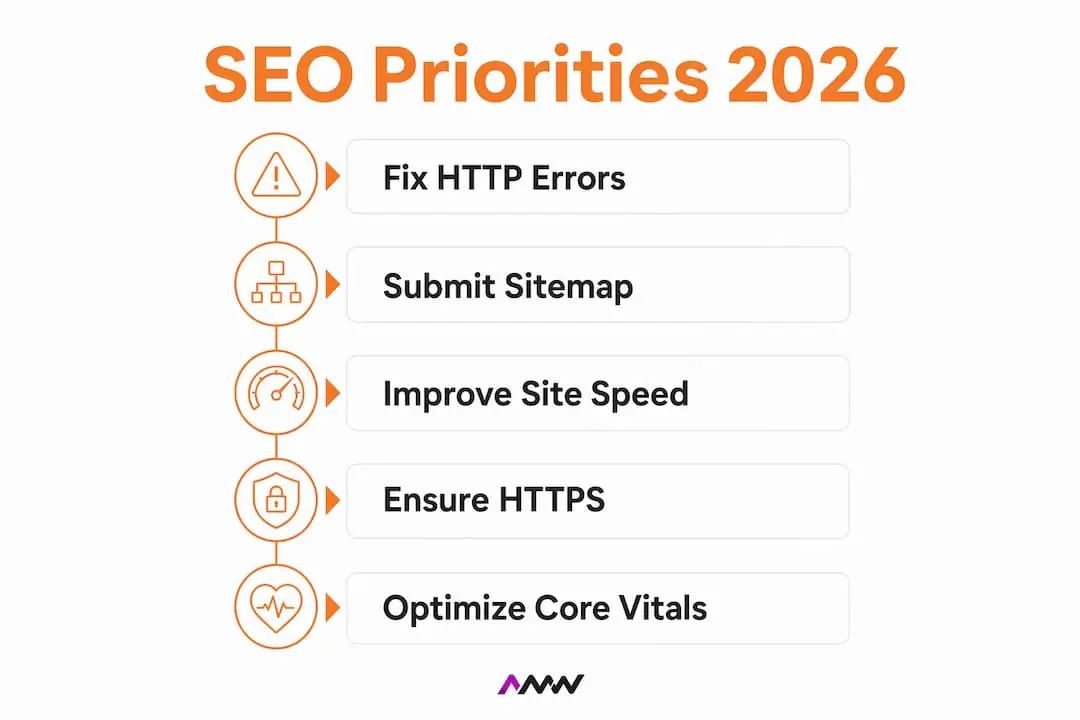
Core Web Vitals (LCP, INP, and CLS) are ranking baseline signals, but their influence is often overstated. Moving from “Poor” to “Good” on Core Web Vitals can lift rankings, but pushing from “Good” to “Excellent” rarely makes a measurable difference. Fix severe problems first, then focus your energy on content and links.
Here is a quick reference for the technical priorities you should address in order:
| Priority | Task | Tool |
|---|---|---|
| 1 | Fix HTTP errors and redirect loops | Screaming Frog |
| 2 | Submit XML sitemap | Google Search Console |
| 3 | Enable HTTPS | Cloudflare / hosting provider |
| 4 | Improve page speed and TTFB | PageSpeed Insights |
| 5 | Resolve Core Web Vitals failures | Chrome UX Report |
Pro Tip: Audit how Googlebot renders your JavaScript. If your site relies heavily on client-side JS to load content, use Google Search Console’s URL Inspection tool to check what Googlebot actually sees. Content that only appears after JS execution may be invisible to the crawler.
How to optimise on-page SEO for content relevance
On-page SEO in 2026 means optimising for AI systems parsing your page structure alongside human readers. Search engines and AI tools like Perplexity and ChatGPT both extract answers from well-structured pages. Getting this right improves your visibility in both traditional search results and AI-generated answers. For local search specifically, our SEO agency High Wycombe page uses Wheels VT, second on Google for their main term with 235 organic clicks in three months, as the worked example.

Keywords, meta tags, and headings
Each page needs one primary keyword and 3 to 5 related terms woven naturally into the copy. Your meta description should sit at 145 to 155 characters and give a genuine reason to click, not just repeat the page title. Think of it as a two-line advert for your content.
Use a single H1 per page containing your primary keyword. From there, build a logical heading hierarchy with H2s and H3s that reflect what users are actually searching for. Question-based headings (“How does X work?”) perform particularly well for featured snippets and AI citations.
Structured formatting and schema markup
Short sections under 300 words, bullet points, and answer-first paragraphs make it far easier for AI engines to extract and cite your content. This is not just good UX. It is a direct ranking and citation signal.
Schema markup helps search engines interpret your content accurately. One important update: Google removed FAQ rich results as of May 2026, so FAQPage schema no longer triggers visual enhancements in search results. That does not mean you should remove it. Schema still helps Google understand your content structure, even without the visual payoff.
Here is a checklist for on-page SEO on any new or updated page:
- One primary keyword per page, placed in the H1, URL, and first paragraph
- Meta description of 145 to 155 characters with a clear value proposition
- Logical H2 and H3 hierarchy using question and descriptive formats
- Short paragraphs (3 to 5 sentences) with bullet points where appropriate
- Schema markup for relevant content types (Article, Product, HowTo, FAQ)
- Internal links to related pages using descriptive anchor text
Pro Tip: Refresh your top-performing pages every three to six months. Update statistics, add new examples, and adjust headings to reflect current search intent. A well-maintained page consistently outperforms a stale one, even if the original content was excellent.
Which content strategies actually boost SEO in 2026?
Content quality is the single largest driver of organic rankings, and it has become harder to fake. Google’s spam policies specifically target low-value AI-generated content that lacks original data, real-world perspective, or genuine expertise. The bar for what counts as “good content” has risen considerably.
Here is a practical workflow for creating content that ranks and earns trust:
- Identify user intent first. Before writing a word, confirm whether the searcher wants information, a comparison, a product, or a how-to guide. Matching intent is more important than keyword density.
- Answer the primary question in the first paragraph. Search engines and AI tools both favour content that gets to the point immediately. Burying your answer in paragraph five is a ranking disadvantage.
- Use real data and named sources. Citing Google Search Console data, Ahrefs reports, or original case studies makes your content more credible and more likely to earn backlinks naturally.
- Build topic clusters around pillar pages. A pillar page covers a broad topic (e.g. “SEO strategies”) and links out to detailed cluster pages (e.g. “how to fix crawl errors”). This structure distributes authority across your site and signals topical depth to Google.
- Audit your existing content regularly. Content freshness is a high-impact tactic. A systematic update workflow, reviewing your top 20 pages every quarter, keeps your site healthy without requiring constant new content production.
- Add unique perspective. AI can draft a competent article. It cannot share your client results, your failures, or your genuine opinion. That human layer is what separates rankable content from noise.
For a deeper look at how content fits into a broader marketing plan, the content marketing guide from AMW Media covers the full picture well.
Pro Tip: Use a simple content calendar in Notion or Google Sheets. Track publish date, last updated date, primary keyword, and current ranking position for every page. You will quickly spot which pages are slipping and need attention before they drop off page one entirely.
What link-building practices best enhance site authority?
Backlinks remain one of Google’s strongest ranking signals. High-quality backlinks combined with smart internal linking increase domain authority and improve rankings more reliably than almost any other single tactic. The emphasis here is on quality, not volume.
Building backlinks that actually count
The most durable links come from content worth citing. Original research, detailed guides, and data-driven articles attract links naturally over time. Guest blogging on reputable industry publications, building genuine partnerships, and getting listed in relevant directories are all legitimate routes. What does not work, and actively harms you, is buying links or participating in link schemes. Google’s spam detection has become sophisticated enough to identify and discount these.
Toxic backlinks from low-quality or spammy sites can drag your rankings down. Use Google Search Console’s disavow tool to flag links you cannot get removed manually. Do not disavow aggressively though. Only target links that are clearly manipulative or from penalised domains.
Internal linking done properly
Internal links distribute authority across your site and help Google understand the relationship between your pages. The key is using descriptive anchor text that tells both users and search engines what the linked page is about. “Click here” tells nobody anything useful.
Here is a comparison of weak versus strong internal linking practice:
| Approach | Example | Effect |
|---|---|---|
| Generic anchor text | “Click here for more” | No SEO signal, poor UX |
| Descriptive anchor text | “technical SEO audit guide” | Clear signal, better rankings |
| Over-linking | 15 links in one paragraph | Dilutes link value, confuses users |
| Contextual linking | 2 to 3 links per section, relevant | Distributes authority effectively |
For a detailed walkthrough of internal linking strategy, this internal linking guide covers the mechanics thoroughly.
Pro Tip: When you publish a new page, immediately add internal links to it from two or three existing high-authority pages on your site. This gives the new page a crawl path and passes some authority to it from day one, rather than leaving it isolated.
Key takeaways
Improving your site’s SEO requires fixing technical foundations first, then layering on quality content and credible links in that order.
| Point | Details |
|---|---|
| Fix technical issues first | Resolve crawl errors, broken links, and HTTPS before rewriting content. |
| Structure on-page content clearly | Use one H1, logical headings, and short paragraphs to aid both users and AI parsers. |
| Prioritise content quality | Add original data and expert perspective to avoid Google’s spam filters. |
| Build links through value | Earn backlinks with original research and use descriptive internal anchor text. |
| Update content regularly | A quarterly review of your top pages maintains rankings without constant new production. |
Where most SEO advice goes wrong
I have worked on enough sites to notice a pattern. Most website owners start with content rewrites when the real problem is technical. They spend weeks polishing blog posts while Googlebot is quietly blocked by a misconfigured robots.txt or a redirect chain that adds two seconds to every page load. The content changes make no difference because Google cannot properly index the updates.
My honest recommendation is to spend the first week of any SEO project entirely in Google Search Console and Screaming Frog. Fix what is broken before you write a single new word. The ranking improvements from resolving crawl issues are often faster and more significant than anything a content refresh will deliver.
The other trap I see regularly is obsessing over Core Web Vitals scores. Getting from 45 to 98 on PageSpeed Insights is satisfying, but if your content is thin and your backlink profile is weak, that score improvement will not move your rankings. Core Web Vitals are a baseline, not a ranking superpower. Treat them accordingly.
What actually compounds over time is a combination of well-structured, regularly updated content and a steady trickle of genuine backlinks. Neither is glamorous. Both work. The SEO strategies guide from AMW Media goes deeper on how to balance these priorities across different site types, which is worth reading once you have your technical house in order.
Amir
Want professional help improving your site’s SEO?
Understanding what needs to be done is one thing. Having the time and expertise to do it consistently is another. AMW Media offers full SEO services and packages covering technical audits, on-page optimisation, content strategy, and link-building, all matched to your specific goals and market.
The team also builds SEO-friendly websites from the ground up, so your technical foundations are solid before a single page goes live. Whether you need a one-off audit or ongoing monthly support, AMW Media works with ambitious brands that want measurable results, not just a prettier dashboard. Get in touch to discuss what your site actually needs.
FAQ
What is the fastest way to improve site SEO?
Fix technical errors first. Resolving crawl issues, broken links, and HTTPS problems in Google Search Console and Screaming Frog delivers faster ranking improvements than content changes alone.
How many keywords should each page target?
Each page should target one primary keyword and 3 to 5 closely related terms. Targeting multiple unrelated keywords on a single page dilutes relevance and confuses search engines about the page’s purpose.
Does schema markup still help SEO in 2026?
Schema markup helps search engines understand your content, but Google removed FAQ rich results in May 2026. Use structured data for content interpretation, not for guaranteed visual enhancements in search results.
How often should i update existing content?
Review your top-performing pages every three to six months. Content freshness is a high-impact tactic, and a regular update workflow maintains rankings without requiring constant new content production.
Are backlinks still important for SEO in 2026?
Backlinks from reputable sources remain one of Google’s strongest ranking signals. Focus on earning links through original research and quality content rather than volume, and use Google’s disavow tool to remove toxic links that may be dragging your rankings down.
Recommended
- The role of SEO in 2026: your complete guide | AMW Media
- Types of SEO strategies: a practical 2026 guide | AMW Media
- Master your SEO strategy: guide for effective brand growth
- how to design a website a practical guide for 2026 | AMW Media
Our SEO manager runs the technical checks by hand, looks at who is beating you, and sends back the order to fix it in. Free, and you keep it either way.

Leads the WordPress, Shopify and custom builds, and the integrations that connect them to your CRM. Fast, accessible and yours to keep. Meet the team.