
 Black Steel Doors
 Woodstock Campers
 Phillips Joinery
Yes, LinkedIn ads B2B campaigns work, but only if your average deal is worth chasing and your sales cycle can stretch past a single click. If you sell something with a decent contract value and a considered buying process, LinkedIn gives you the sharpest targeting of any paid channel going. Start by testing Lead Gen Forms, Document Ads, and Thought Leader Ads before you touch anything else.
TL;DR:
- Using Document Ads combined with Lead Gen Forms typically results in a lower cost per lead than cold Sponsored Content, especially when content is useful.
- Target audiences should be built with firmographics first, then layered with job function, seniority, skills, or member groups only if niche, avoiding overly narrow pools below 50,000 contacts.
- Campaigns should be structured by audience temperature, separating cold prospecting, retargeting, and ABM, to prevent internal competition and optimise delivery.
- Initial campaign testing should start with maximum delivery bidding, then switch to cost control once 25 to 50 conversions are achieved, focusing on learning and accurate measurement.
- For high-value, considered B2B sales, expect CPCs from £5 to £8 and plan a monthly spend of £2,000 to £3,500 to generate around 50 qualified leads.
Which LinkedIn ad formats to use at each funnel stage
Most B2B advertisers throw budget at one format and wonder why results stall. The trick is matching the format to where the buyer actually sits in their decision, not to what looks flashiest in the Campaign Manager preview.
Sponsored Content is the workhorse. It comes in four flavours, and each does a different job:
- Single image ads work best for simple offers, webinar promotion, or retargeting warm audiences who already know your name.
- Video ads earn attention in a busy feed, particularly when the first three seconds show a person talking rather than a logo animation.
- Carousel ads suit multi-step explanations, such as walking through a product feature or a client transformation.
- Document ads let you upload a PDF, whitepaper, or slide deck directly into the feed. Prospects flip through it inside LinkedIn without leaving the platform, and this format pairs beautifully with Lead Gen Forms because the content itself pre-sells the click.
Practitioner data collected by Expandi shows Document Ads combined with Lead Gen Forms consistently produce a lower cost per lead than cold Sponsored Content aimed at the same audience. That is not surprising: someone who has just skimmed twelve slides of useful content is a warmer prospect than someone who saw a static image for two seconds.
Thought Leader Ads deserve special mention because they behave differently to every other format. Instead of promoting a company page post, you sponsor a post from an employee’s personal profile, usually a founder, salesperson, or subject expert. These convert better for one obvious reason: people trust people, not brands. According to Neal Schaffer’s LinkedIn Ads guide, Thought Leader Ads tend to lower cost per click and lift engagement precisely because they feel like organic scrolling content rather than an interruption.
Message Ads and Conversation Ads land directly in someone’s LinkedIn inbox. Message Ads are a single call-to-action message; Conversation Ads let the recipient choose between a few response paths, almost like a mini chatbot. Both work well for event invites and demo bookings, but they fatigue an audience quickly, so keep frequency low and rotate your list.
Dynamic Ads and Text Ads are the quiet workhorses of brand awareness. Dynamic Ads pull the viewer’s own profile photo and name into the creative, which nudges click-through rates up a little. Text Ads are cheap, low-commitment, and best used for retargeting rather than cold prospecting, where their tiny format simply won’t earn attention.
If you are building your first campaign structure, a sensible split looks like this: Thought Leader Ads and video for top-of-funnel attention, Document Ads with Lead Gen Forms for mid-funnel consideration, and Message Ads for bottom-funnel nudges once someone has already engaged.
Precise targeting strategies and common audience mistakes
LinkedIn’s targeting is the reason marketers put up with its higher CPCs. No other paid channel lets you layer job title, seniority, function, company size, and skills in one campaign, and that precision is exactly what Expandi’s research points to when explaining why LinkedIn commands a premium over Meta or Google for B2B audiences.
Here’s how to build a targeting stack that doesn’t waste money:
- Start with firmographics. Set company size and industry first, because this filters out the noise before you even touch job titles.
- Layer job function and seniority, not just title. Titles vary wildly between companies (one firm’s “Head of Growth” is another’s “VP Marketing”), so function and seniority combined give you a steadier net.
- Add skills or member groups only if your audience is niche. Stacking too many layers shrinks your pool below a usable size.
- Build Matched Audiences from your CRM before you touch Predictive Audiences. Upload your closed-won customer list, your target account list, and your website visitor pixel data. These give you retargeting pools with intent already baked in.
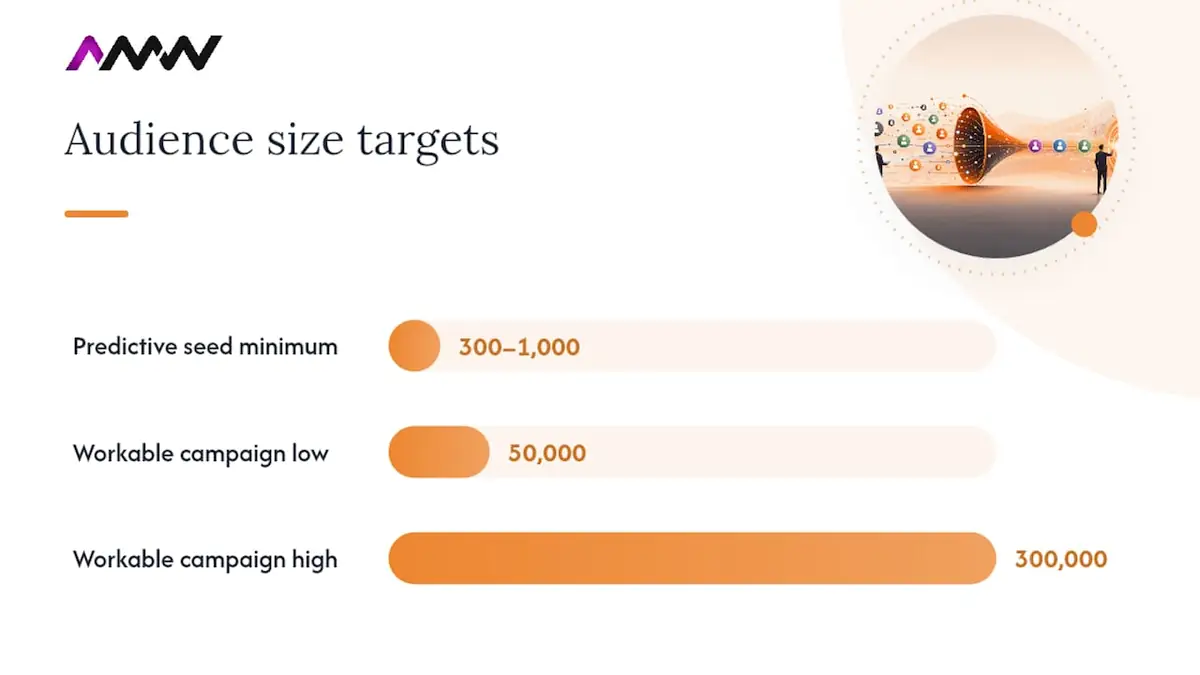
- Only move to Predictive Audiences once you have a seed list of real size. LinkedIn’s own guidance, echoed in Expandi’s findings, suggests a seed audience of 300 to 1,000 or more before Predictive Audiences finds a reliable lookalike pattern. Feed it fewer than that and the algorithm is essentially guessing.
- Apply exclusions from day one, not after you’ve burned budget. Exclude current employees, existing customers (unless you’re deliberately upselling), and anyone who has already converted on the Lead Gen Form you’re currently running.
On audience size: too narrow and LinkedIn simply won’t spend your budget, showing “audience too small” warnings; too broad and you’re back to paying premium CPCs for people who will never buy. A workable range for most B2B campaigns sits somewhere between 50,000 and 300,000, though niche enterprise software sellers might comfortably run tighter.
One mistake shows up again and again: marketers stack retargeting and cold prospecting into the same campaign to “save time.” Don’t. LinkedIn’s delivery algorithm will bias spend toward whichever audience is cheapest to reach, which is almost always the warm retargeting pool, starving your cold prospecting of impressions without you ever noticing why top-of-funnel numbers look flat.
Practical campaign structure that accelerates learning and scales
Structure is the unglamorous bit that decides whether your account actually learns anything useful. Get it wrong and every campaign competes with every other campaign for the same budget and the same handful of impressions.
A sensible account hierarchy looks like this:
- Account, one per brand or business unit.
- Campaign group, organise by funnel stage or objective (e.g. “Cold Prospecting Q1”, “ABM Target List”, “Retargeting Warm Traffic”).
- Campaign, one per audience segment and format combination, named clearly (e.g. “UK_SaaS_DirectorLevel_DocumentAd_Cold”).
- Ad, two to four creative variants per campaign, rotated to find the winner without splitting your budget too thin.
The single most important structural rule, backed by practitioner experience rather than any single benchmark study, is to separate campaigns by audience temperature: cold prospecting, retargeting, and account-based marketing (ABM) each get their own campaign, never a shared one. Mixing them means your ABM target list, however small and valuable, gets outbid internally by a cheaper cold audience competing for the same daily budget.
For learning-phase budgets, PromiseClick’s LinkedIn Ads management guide recommends running Maximum Delivery bidding for the first two to three weeks. This lets LinkedIn’s algorithm gather data without you second-guessing every daily fluctuation. Once you’ve collected 25 to 50 meaningful conversions, switch to Cost Cap or Manual bidding, where you can start controlling cost per result rather than just chasing volume.
ABM campaigns behave differently from the rest of your account. Because the audience is tiny and hand-picked (often a named list of 50 to 500 target accounts uploaded via Matched Audiences), you should expect slower delivery and higher CPCs, and you should not judge them by the same cost benchmarks you’d apply to a broad cold campaign. Patience here pays off; ABM campaigns are playing a longer, more deliberate game.
Creative and copy playbook for B2B creatives that actually convert
Most B2B ad copy fails for a boring reason: it sounds like a press release. Professionals scrolling LinkedIn on their lunch break respond to the same things they’d respond to in a good conversation, specificity, a clear problem, and evidence you understand their world.
A few rules that consistently improve performance:
- Lead with the outcome, not the feature. “Cut invoice processing time by three days” beats “our platform streamlines your finance workflow” every time.
- Keep the first line doing all the work. LinkedIn truncates copy quickly, so your hook has to survive being cut off after roughly 150 characters.
- Use native video, not repurposed TV ads. A founder talking straight to camera for 30 seconds consistently outperforms polished brand video on this platform.
- Design documents for skimming, not reading. One idea per slide, big text, minimal jargon. Remember the viewer is flipping through inside their feed, often on mobile.
For Thought Leader Ads, the mechanics matter. The post must come from a real employee’s profile, not a company page, and LinkedIn requires that person’s consent before you can sponsor it. The best-performing posts read like genuine opinion, a hot take on an industry trend, a lesson from a recent client project, a mildly contrarian view, rather than a disguised advert. Disclose sponsorship; LinkedIn labels these as “Promoted” automatically, and trying to hide that fact damages trust fast.
For Lead Gen Forms, resist the urge to ask for everything. Every additional field costs you completion rate. Name, work email, and company are usually enough for a first touch; save job title and phone number for a second-stage form once someone has already shown intent. This native-form advantage is real: research on Lead Gen Forms shows they convert at materially higher rates than sending traffic to an external landing page, largely because the form auto-fills from the user’s LinkedIn profile.
Pro Tip: Set up your follow-up email to fire within minutes of a Lead Gen Form submission, not the next morning. B2B buyers researching a purchase are often comparing three or four vendors in the same sitting, and the fastest response usually wins the meeting.
Budget framework and benchmark ranges to judge performance
LinkedIn is not cheap, and pretending otherwise sets you up for disappointment. According to PromiseClick’s benchmark data, B2B advertisers should expect CPCs to run higher than on Meta or Google, often landing well above £5 to £8 per click depending on industry and targeting tightness, with cost per lead varying enormously by offer strength and form length.
Benchmark reality check: LinkedIn’s own membership data confirms the platform’s professional reach keeps growing quarter on quarter, which is exactly why CPCs haven’t dropped even as more advertisers pile in. You’re paying for precision, not cheap volume.
For learning-phase testing, don’t launch with less than £30 to £50 per day per campaign. Anything lower and LinkedIn’s algorithm simply doesn’t get enough signal to optimise, and you’ll spend weeks stuck in “learning limited” purgatory.
A work-back framework helps put budget in perspective. You need roughly 50 qualified leads. If your realistic cost per lead through Document Ads and Lead Gen Forms lands around £40 to £70 (again, a range, not a promise), you’re looking at a monthly LinkedIn spend somewhere between £2,000 and £3,500 to hit that pipeline target. Run the maths on your own numbers before setting a budget you can’t defend to finance.
How to prove LinkedIn influence on pipeline and revenue
Last-click attribution lies to you constantly on LinkedIn, because B2B buying journeys rarely convert on the first ad click. Someone sees your Thought Leader Ad, ignores it, googles your company two weeks later, and converts through organic search. If you’re only measuring last-touch, LinkedIn looks worthless even when it started the whole journey.
Build a measurement stack that catches this:
- Set a consistent UTM taxonomy across every campaign, tagging source, campaign name, and ad format, so your CRM can filter LinkedIn traffic cleanly rather than lumping it into “paid social.”
- Install the LinkedIn Insight Tag on your site before you launch anything. It powers retargeting and conversion tracking, and you can’t backfill the data once it’s gone.
- Create custom conversion events for the actions that actually matter, demo requests, pricing page views, not just page loads.
- Push CRM data back into LinkedIn where possible, so closed-won revenue eventually informs your targeting and bidding, not just your dashboard.
- Report on assisted pipeline, not just first-touch or last-touch leads. Look at how many closed deals had a LinkedIn touchpoint anywhere in the journey, even if it wasn’t the final click.
- Track cost per qualified opportunity, not cost per lead. A cheap lead that never talks to sales is worse than an expensive one that books a demo.
A tool like the one described in AMW Media’s guide on lead generation methods can help you connect these dots between ad spend and actual sales conversations, which is where the real ROI conversation happens.
Six-step checklist to launch a meaningful test campaign
You can go from a blank Campaign Manager account to a useful first test within a week if you follow a tight sequence rather than trying to do everything at once.
- Prepare your foundation first. Get your LinkedIn Company Page current, ask two or three colleagues to post something relevant this week (you’ll need this for Thought Leader Ads), and install the Insight Tag.
- Define your ideal customer profile precisely. Write down job titles, seniority, company size, and industry, then map that into two or three separate audience segments rather than one giant blob.
- Split those segments into separate campaigns from the start, one cold, one retargeting your website visitors, and an ABM list if you have named target accounts.
- Pick your formats and set conversion events. Start with Document Ads plus Lead Gen Forms for one campaign and Thought Leader Ads for another, and make sure each has a clearly defined conversion goal in Campaign Manager.
- Create three creative variants per campaign before launch, not one. You need enough variation to actually learn something in the first fortnight.
- Launch on Maximum Delivery, watch your frequency and CTR daily for the first ten days, and be ready to pause and rework any ad that’s burning spend with a CTR well below your account average.
Follow this sequence and you’ll have a informative first month instead of a pile of spend with no clear story behind it. A structured setup guide like AMW Media’s PPC campaign setup steps walks through similar sequencing if you want a second reference point.
AMW Media proof: certifications and real-world results
AMW Media holds partner certifications across Google, Meta, Shopify, WordPress, and Framer, and our PPC team manages LinkedIn campaigns alongside Google and Meta accounts for B2B clients who need pipeline, not just impressions.
The pattern we see repeatedly: a client comes in running broad Sponsored Content with no audience separation, burning budget on employees and existing customers who were never excluded. We rebuild the account into cold, retargeting, and ABM structures, introduce Document Ads and Thought Leader Ads, and tighten the Lead Gen Form fields. Cost per qualified opportunity typically drops within the first full reporting cycle once the structural fixes take hold. Full breakdowns of client work sit on the AMW Media blog alongside testimonials from brands we’ve worked with.
What we’d tell you if you were a client
Here’s the bit most agencies won’t say out loud: company-page Sponsored Content is dying a slow death, and Thought Leader Ads work because they’re not really ads. We push clients towards sponsoring genuine posts from real employees because LinkedIn’s own algorithm favours that content anyway, sponsored or not.
We also insist on tying LinkedIn spend to outbound sales activity. If a target account engages with an ad, that’s a signal for the sales team to reach out directly, not a signal to wait for a form fill. And we’re not afraid to tell a client to pause spend entirely if their sales cycle is under two weeks or their average deal is small. LinkedIn punishes impatience and rewards accounts with something worth waiting for. Closer to home, our marketing agency High Wycombe page makes the case that almost nobody looking for a nearby agency actually cares about the distance.
Amir
Ready to turn LinkedIn spend into actual pipeline?
If you’ve read this far and thought “this is exactly what our account is missing,” that’s usually the moment clients call us. AMW Media manages LinkedIn campaigns as part of a joined-up social media management service, so your organic employee posts, Thought Leader Ads, and paid Document Ads all pull in the same direction instead of fighting each other for attention.
We typically start with a quick account audit, spotting the structural issues (mixed audiences, missing exclusions, weak Lead Gen Form design) before recommending a pilot campaign built around the formats that suit your sales cycle. If your Lead Gen Forms are converting but your landing pages aren’t, our web design team can rebuild the post-click experience too, so nothing leaks between the click and the CRM. Get in touch through our contact page and we’ll tell you whether LinkedIn is the right channel for your deal size before we take a penny of your budget.
Sources
The benchmark figures and format guidance throughout this piece draw on Statista’s LinkedIn membership data, Expandi’s LinkedIn Ads research, PromiseClick’s management guide, and Neal Schaffer’s LinkedIn Ads guide. For related reading, see AMW Media’s guide to lead generation and its notes on marketing analytics and ROI.
- Statista, quarterly numbers of LinkedIn members
- Expandi, LinkedIn Ads for lead generation
- PromiseClick, LinkedIn Ads management guide (2026)
FAQ
Do LinkedIn ads work for B2B?
Yes, particularly for businesses selling considered, higher-value products where the buyer’s job title and company profile matter. LinkedIn’s precise targeting layers make it one of the most reliable paid channels for reaching decision-makers directly.
Is LinkedIn a B2B or B2C platform?
LinkedIn is fundamentally a B2B platform built around professional identity, job history, and company data, which is exactly why its ad targeting outperforms general-purpose social platforms for reaching business buyers.
What is the rule of 7 in B2B marketing?
It’s the idea that a prospect typically needs around seven meaningful touchpoints with your brand before they’re ready to buy, which is why LinkedIn campaigns work best when combined with email nurturing and sales outreach rather than run in isolation.
What is the 4-1-1 rule on LinkedIn?
It’s a content ratio guideline suggesting that for every self-promotional post, you should share four pieces of useful third-party or educational content and one soft promotional post, keeping your feed presence from feeling like a constant sales pitch.
How much should I budget to test LinkedIn ads for B2B?
Most learning-phase campaigns need at least £30 to £50 per day per campaign to gather enough data for LinkedIn’s algorithm to optimise properly, run for two to three weeks before judging results.
Recommended
- The role of case studies in B2B: a proof-to-revenue guide
- Bing display advertising for marketers: a practical guide
- What is lead generation? A practical guide for 2026
- Effective content production strategies for brand growth
Our free marketing audit looks at your site, your ads and your content, and comes back with a 30 day plan. No pitch deck.

Runs the content calendars and the community side of every social account, and keeps clients posted on what is going out and when. Meet the team.