
 Black Steel Doors
 Woodstock Campers
 Phillips Joinery
TL;DR:
- Performance marketing charges only for measurable actions like sales or leads, reducing financial risk.
- Key channels include SEM, paid social, affiliate marketing, and emerging options like CTV and retail media.
- Continuous testing, accurate tracking, and multi-channel diversification are essential for successful campaigns.
Most marketing managers have sat in a budget meeting and wondered whether their digital spend is actually working. You commit thousands to a campaign, wait weeks for data, and still struggle to prove the return. Performance marketing offers a fundamentally different model. Instead of paying for visibility and hoping for results, you pay only when something concrete happens. That shift changes everything about how you plan, spend, and measure. This article breaks down what performance marketing actually means, which channels deliver the strongest results, and how ambitious brands can build campaigns that produce real, trackable outcomes.
Key Takeaways
| Point | Details |
|---|---|
| Pay for results only | Performance marketing lets you pay only when users take defined actions, maximising ROI. |
| Multiple effective channels | Top channels include search, social, affiliate, and emerging tech like retail media and CTV. |
| Cycle of optimisation | Campaigns succeed by following data-led cycles: plan, launch, track, and optimise for continuous improvement. |
| Blend with brand building | Long-term growth comes from balancing measurable campaigns with solid brand strategy. |
Defining performance marketing: Results as the focus
Let’s clear something up first. Performance marketing is not simply “digital advertising with better reporting.” It is a structurally different approach to how money changes hands. In a traditional campaign, you might pay for a billboard, a banner impression, or a broadcast slot regardless of whether anyone responds. Performance marketing flips that logic entirely.
As the results-driven approach is defined: advertisers pay only for specific, measurable actions such as clicks, leads, sales, app installs, or form submissions, shifting risk to publishers and focusing on ROI. That last part matters enormously. The financial risk moves away from you and towards the platform or publisher. If the action does not happen, you do not pay.
This transparency is precisely why growth-focused brands are drawn to it. You can see exactly what each pound is producing. Common measurable actions include:
- Clicks to a landing page or product listing
- Lead form submissions from prospective customers
- Completed sales tracked via conversion pixels
- App installs measured through mobile attribution tools
- Phone calls generated from paid search or display ads
The contrast with brand or awareness marketing is worth noting. Awareness campaigns serve a genuine purpose, building recognition and trust over time. But they are harder to tie to immediate revenue. Performance marketing is not a replacement for brand investment; it is a complement that delivers accountability on specific campaign goals.
For brands serious about growth, the appeal is clear. Every pound has a job. Every campaign has a measurable target. And every underperforming tactic can be identified and cut without sentiment. A strong SEO strategy for brand growth often works alongside performance campaigns, capturing organic intent while paid channels handle direct conversion. Similarly, the way you boost brand engagement on social platforms feeds directly into the audiences you retarget through performance channels.
“What gets measured gets managed. In performance marketing, measurement is not an afterthought; it is the foundation the entire strategy is built on.”
The shift to performance thinking also changes internal accountability. Teams stop celebrating impressions and start celebrating outcomes. That cultural change alone can transform how marketing budgets are allocated and defended.
Key channels for performance marketing success
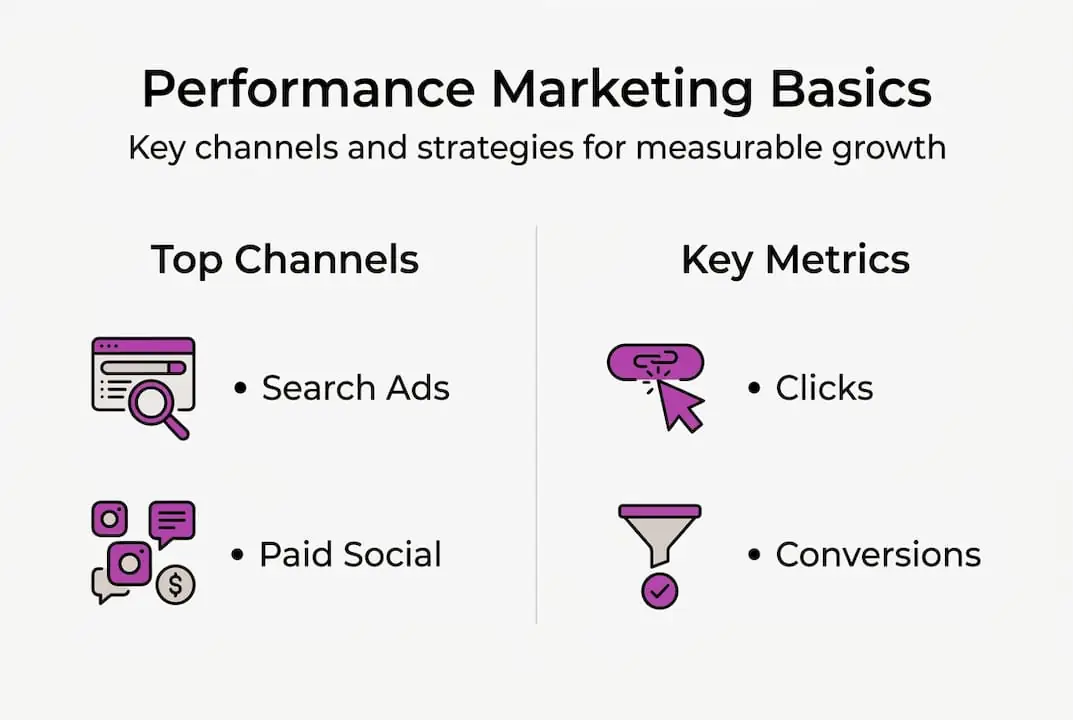
Understanding where performance marketing happens is just as important as understanding what it is. Not every channel suits a performance model equally well. The channel breakdown shows that SEM delivers high intent, paid social enables precise targeting, affiliate operates on commissions, native and display drive engagement, with CTV and retail media emerging as powerful additions.
Here is a practical comparison of the core channels:
| Channel | Primary strength | Cost model | Best for |
|---|---|---|---|
| SEM (search) | High purchase intent | CPC (cost per click) | Direct response, lead gen |
| Paid social | Audience targeting | CPM or CPC | Awareness to conversion |
| Affiliate | Commission-based reach | CPA (cost per action) | E-commerce, SaaS |
| Native/display | Contextual engagement | CPM or CPC | Retargeting, content |
| CTV | Premium video reach | CPM | Brand-led performance |
| Retail media | In-market shoppers | CPC or CPA | Product-focused brands |
For ambitious brands, SEM remains the backbone of most performance strategies. When someone searches for a solution you offer, you are reaching them at the exact moment of intent. Paid social, particularly through Meta and LinkedIn, allows you to build and target audiences with remarkable precision, from job title to recent purchase behaviour.

Affiliate marketing is often underestimated. It works by paying a commission only when a partner drives a completed action, making it one of the purest performance models available. For e-commerce brands especially, a well-managed affiliate programme can generate significant revenue at near-zero upfront cost.
Emerging channels worth testing include:
- CTV (connected TV) for brands wanting video reach with measurable outcomes
- Retail media networks such as Amazon Ads for product-led brands
- Influencer performance deals where payment is tied to tracked conversions
A solid digital marketing guide will help you understand how these channels fit into a broader strategy, while refining your digital marketing process ensures each channel is properly integrated. When you want to optimise digital strategy across multiple channels, the key is testing measurability before assigning performance targets.
Pro Tip: Before committing budget to any new channel, run a small test specifically to confirm you can track the desired action end-to-end. If you cannot measure it reliably, it does not belong in your performance stack yet.
Building a high-performing performance marketing campaign
Knowing the channels is one thing. Knowing how to build a campaign that consistently delivers is another. The most effective framework follows a clear cycle: plan, launch, track, optimise. This loop is not a one-time process; it is continuous.
Here is how to structure your campaign launch:
- Define your target action clearly before anything else. Is it a lead, a sale, a sign-up? Ambiguity here causes every problem downstream.
- Set your cost-per-action (CPA) target based on customer lifetime value and acceptable acquisition cost.
- Choose your channels based on where your audience is and which platforms support your tracking requirements.
- Build dedicated landing pages that are fast, focused, and designed around a single conversion goal. Page speed directly affects Quality Score in SEM and conversion rates across all channels.
- Implement tracking via pixels, UTM parameters, and where appropriate, server-side tagging for more reliable data.
- Launch with a test budget to validate assumptions before scaling.
- Review data weekly and optimise bids, creative, and targeting based on real performance.
Data loops are what separate good performance marketers from great ones. Every campaign generates signals: which ad creative resonates, which audience segment converts, which landing page variant wins. Feeding those signals back into the next iteration is how results compound over time.
For content production for campaign success, founder-led creative and AI-assisted content are proving particularly effective in 2026. Authentic, direct messaging tends to outperform polished but generic production in performance contexts. And content creation for growth should always be informed by performance data, not just creative instinct.
| Metric | What it measures | Target benchmark |
|---|---|---|
| CTR (click-through rate) | Ad relevance and appeal | 2-5% (search), 0.5-1.5% (display) |
| CPA (cost per action) | Efficiency of conversion | Varies by sector and LTV |
| ROAS (return on ad spend) | Revenue per pound spent | 3x minimum for most e-commerce |
| Conversion rate | Landing page effectiveness | 2-5% average across channels |
Pro Tip: Blend performance marketing with consistent brand activity. Brands that run performance campaigns in isolation often hit a ceiling after six to twelve months, because they have exhausted their warm audience without building new demand.
Common pitfalls and best practices in performance marketing
Even well-resourced brands make predictable mistakes in performance marketing. Knowing them in advance saves both budget and time.
The most common errors include:
- Scope creep: Trying to apply performance accountability to activities that cannot be reliably measured, such as early-stage awareness content or PR.
- Poor tracking setup: Launching campaigns before verifying that conversions are being recorded accurately. Flawed data leads to flawed decisions.
- Single-channel dependency: Relying entirely on one platform creates fragility. Algorithm changes, rising CPCs, or policy updates can cripple results overnight.
- Stale creative: Running the same ad creative for months without refresh causes audience fatigue and declining performance.
- Vanity metrics: Optimising for clicks or impressions rather than the actions that actually generate revenue.
Best practices for 2026 include regular creative testing (at minimum monthly), multi-channel diversification across at least three platforms, and clear internal ownership of performance targets.
“Not all activities suit performance management; test for measurability before accountability.”
Understanding the creative agencies in brand growth context also helps here. Creative quality is not a soft consideration in performance marketing; it is a hard driver of results. Weak creative means higher CPCs, lower conversion rates, and wasted budget regardless of how well the rest of the campaign is set up.
Pro Tip: Always validate that a channel or campaign can be measured end-to-end before assigning performance targets. If the tracking breaks anywhere in the chain, your data becomes unreliable and your optimisation decisions will be based on fiction.
Finally, remember that performance marketing is not suitable for every marketing activity. Brand storytelling, community building, and long-form thought leadership all serve important roles that cannot and should not be reduced to a cost-per-action calculation.
Where performance marketing goes wrong today
Here is something the industry rarely admits: no channel or framework offers complete certainty. Tracking has become less reliable since iOS privacy changes, cookie deprecation, and increased platform walled gardens. Brands that built their entire growth model on last-click attribution are discovering that their data was never as clean as they believed.
The uncomfortable reality is that an obsession with short-term measurability can quietly undermine your brand. When every decision is filtered through immediate ROI, you stop investing in the channels and content that build long-term trust and demand. That is a slow erosion that does not show up in your weekly performance report until it is too late.
The brands that win in the long run use data to fuel creativity, not restrict it. They treat performance marketing as one layer of a broader strategy, not the entire strategy. Investing in long-term content investment alongside performance channels creates a compounding effect that pure performance spend cannot replicate. The smartest marketing managers we work with are the ones who can defend both a performance budget and a brand budget in the same meeting, because they understand what each one is actually buying. Our Aylesbury page covers the trade buyer, who wants to see the product used properly before switching supplier.
How AMW Media supports performance-driven growth
If the frameworks above feel like the direction your brand needs to move in, the next step is finding the right partner to execute them properly.
At AMW Media, we build and manage performance marketing campaigns across search, paid social, and organic channels, designed to deliver measurable outcomes for ambitious brands. Our PPC campaign management service handles everything from strategy to optimisation, while our SEO services build the long-term organic foundation that makes paid spend more efficient. Our social media management team ensures your brand stays visible and engaging across the platforms that matter most. Get in touch to discuss a custom performance strategy matched to your brand’s goals.
Frequently asked questions
What is the difference between performance marketing and digital marketing?
Performance marketing requires payment only for measurable actions like clicks or sales, while digital marketing may involve paying for exposure regardless of whether any action is taken.
What channels are best for performance marketing in 2026?
Search engine marketing, paid social, affiliate, native and display, CTV, and retail media are the leading channels for performance-focused campaigns in 2026.
How do you measure the success of a performance marketing campaign?
Success is tracked via defined actions such as clicks, leads, or sales, and evaluated by calculating ROI and metrics including CPA, ROAS, and conversion rate.
Are there risks to relying solely on performance marketing?
Yes. Over-focusing on short-term metrics can lead to plateaued results and neglect of the brand-building activity that sustains long-term growth.
Is performance marketing suitable for all types of campaigns?
No. Only activities where results can be reliably measured and optimised should be managed under a performance marketing model.
Recommended
- What is paid advertising and how it boosts brand growth
- SEO in marketing: strategies for long-term growth
- Essential digital marketing guide: strategies for brand growth
- What is PPC advertising? A 2026 guide for business growth
Our free marketing audit looks at your site, your ads and your content, and comes back with a 30 day plan. No pitch deck.

Runs the content calendars and the community side of every social account, and keeps clients posted on what is going out and when. Meet the team.