
 Black Steel Doors
 Woodstock Campers
 Phillips Joinery
Many marketing professionals view paid advertising as simply throwing money at platforms hoping for quick results. Whilst immediate visibility is certainly part of the appeal, this perspective misses the strategic depth that separates effective campaigns from wasted budgets. Paid advertising represents a sophisticated marketing channel where businesses invest in targeted exposure across digital platforms to accelerate brand visibility, drive measurable actions, and complement organic growth efforts. Understanding the mechanics, formats, strategic applications, and integration possibilities transforms paid advertising from a cost centre into a growth engine that delivers quantifiable returns when executed with precision and purpose.
Key Takeaways
| Point | Details |
|---|---|
| Paid ads as growth engine | Paid advertising, when planned and measured, accelerates brand visibility, drives measurable actions, and complements organic growth rather than simply spending money. |
| Core mechanics | Core mechanics revolve around auction based placement, precision targeting by demographics interests and behaviours, and pricing models such as CPC CPM and CPA. |
| Pricing models | CPC charges only when users click, CPM bills per thousand impressions, and CPA aligns cost with conversions. |
| Targeting precision | Platforms enable segmentation by age location income interests purchase history device type and life events to reach high potential audiences. |
| Real time bidding | Real time auctions run thousands of times per second with relevance and quality scores steering which ads appear and at what cost. |
Understanding the fundamentals of paid advertising
Paid advertising is a form of marketing where businesses pay to place content in front of targeted audiences on digital platforms, distinct from owned media like your website or earned media such as press coverage. This paid exposure operates through sophisticated auction systems where advertisers bid for placement opportunities based on relevance, quality scores, and competitive demand. The fundamental difference lies in control and timing: whilst organic strategies build momentum gradually, paid channels deliver immediate visibility to precisely defined audience segments.
The mechanics centre on auction-based placement where platforms evaluate multiple factors beyond bid amount. Google Ads, for instance, considers ad quality, landing page experience, and expected click-through rates when determining position and cost. This creates a performance-driven ecosystem where relevant, well-crafted campaigns often outperform higher-budget competitors with poor execution. Understanding these dynamics prevents wasteful spending and enables strategic advantage through quality rather than pure budget size. Our PPC agency Milton Keynes page opens with the check we run before touching any bid: what the account is actually counting as a lead.
Core mechanics include auction-based placement, precision targeting by demographics, interests, and behaviours, plus pricing models like CPC, CPM, CPA. Each model serves different campaign objectives. CPC charges only when users click your ad, making it ideal for driving traffic. CPM bills per thousand impressions, suited for brand awareness campaigns. CPA focuses on completed actions like purchases or form submissions, aligning cost directly with conversion goals. Selecting the appropriate model requires clarity on campaign priorities and expected user behaviour.
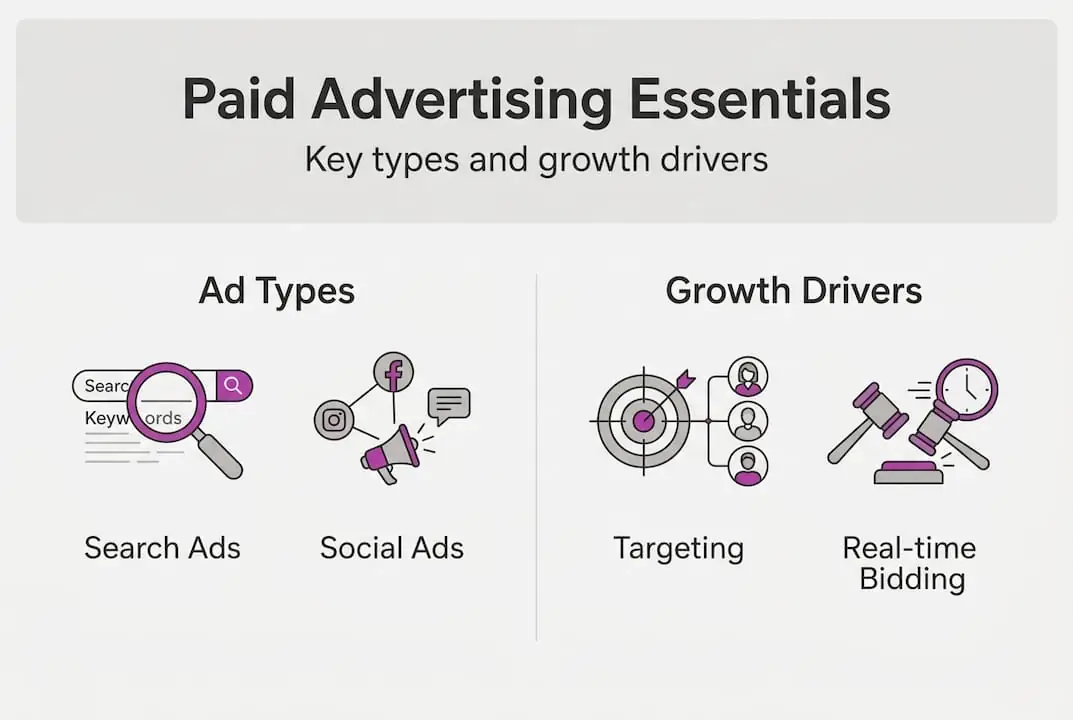
Targeting capabilities distinguish modern paid advertising from traditional broadcast methods. Platforms enable segmentation by age, location, income, interests, purchase history, device type, and even life events. You can reach expectant parents shopping for baby products, professionals researching business software, or homeowners considering renovations. This precision reduces waste by showing ads exclusively to high-potential audiences rather than broadcasting to everyone. What is PPC advertising explores search-specific targeting in greater depth.
The bidding process operates in real-time auctions occurring thousands of times per second. When someone searches a keyword or loads a webpage, platforms instantly evaluate competing advertisers, assess relevance scores, calculate bid amounts, and determine which ads appear. This happens invisibly within milliseconds, creating a dynamic marketplace where strategic bidding, quality content, and audience relevance determine success. Professional PPC campaign management optimises these variables continuously to maximise return whilst controlling costs.
Pro Tip: Start with manual bidding to understand cost dynamics and performance patterns before enabling automated bidding strategies that require historical data to function effectively.
Types of paid advertising and where they fit
Search advertising, commonly called paid advertising, captures users actively seeking solutions. When someone searches “project management software” or “plumber near me”, text ads appear above organic results, targeting high-intent audiences ready to take action. Google Ads dominates this space, but Bing Ads offers lower competition and cost in certain markets. Search ads excel at conversion-focused campaigns because users demonstrate clear intent through their queries.
Social media advertising uses platform-specific audience data to reach users based on interests, behaviours, and demographics rather than search intent. Meta platforms including Facebook and Instagram enable detailed targeting using first-party data about user activities, connections, and preferences. LinkedIn specialises in B2B targeting by job title, company size, and industry. TikTok delivers exceptionally low CPC rates for reaching younger demographics through short-form video content. Each platform serves distinct strategic purposes based on where your audience spends time.
| Platform type | Best use case | Typical CPC range | Key advantage |
|---|---|---|---|
| Search (Google) | High-intent conversions | £0.50-£3.00 | Captures active demand |
| B2B lead generation | £2.00-£6.00 | Professional targeting | |
| Meta (Facebook/Instagram) | Broad awareness and engagement | £0.30-£1.50 | Detailed interest targeting |
| TikTok | Youth audience engagement | £0.10-£0.50 | Low cost, high reach |
| YouTube | Video storytelling | £0.10-£0.30 | Visual engagement |
Display and banner advertising places visual ads across websites within ad networks, reaching users as they browse content related to your offerings. These ads build awareness through repeated exposure rather than immediate conversion. Retargeting represents a powerful display application, showing ads to users who previously visited your site, keeping your brand visible throughout their consideration journey. Display works best for longer sales cycles where multiple touchpoints influence decisions.
Video advertising on YouTube, TikTok, and streaming platforms combines visual storytelling with targeted distribution. Pre-roll ads play before content, whilst in-feed placements appear within user timelines. Video formats enable emotional connection and detailed product demonstrations impossible with static ads. The format particularly suits brands with visual appeal or complex offerings requiring explanation. Production quality matters significantly, as poor creative undermines campaign effectiveness regardless of targeting precision.

Native advertising matches the form and function of surrounding content, appearing as sponsored articles, recommended posts, or in-feed placements that blend with organic content. This format reduces ad blindness by providing value rather than interruption. Platforms like Outbrain and Taboola distribute native ads across publisher networks. Influencer marketing extends this concept through trusted voices promoting products to engaged audiences. Affiliate marketing pays partners only for completed actions, aligning incentives and reducing risk.
Exploring various digital marketing strategies reveals how paid channels integrate with broader marketing efforts for amplified impact.
Crafting effective paid advertising strategies
Successful campaigns begin with SMART goals: Specific, Measurable, Achievable, Relevant, and Time-bound objectives that guide every decision. “Increase sales” lacks direction, whilst “generate 50 qualified leads at £30 CPA within 60 days” provides clear success criteria. Goals determine platform selection, creative approach, targeting parameters, and budget allocation. Without defined objectives, you cannot assess performance or optimise effectively.
Audience segmentation divides your market into distinct groups with shared characteristics, enabling targeted messaging that resonates with specific needs. A software company might segment by company size, industry vertical, and decision-maker role, creating separate campaigns for each combination. This precision improves relevance, increases engagement rates, and reduces wasted spend on unsuitable audiences. Strategies include audience segmentation, high-performing creatives, budget optimisation, A/B testing, and tracking KPIs like CTR, ROAS, and CPA.
- Define clear campaign objectives aligned with business goals and customer journey stages
- Research and segment target audiences based on demographics, behaviours, and intent signals
- Develop compelling ad creatives that address specific pain points and desired outcomes
- Establish budget allocation across platforms, campaigns, and audience segments
- Implement conversion tracking to measure actions beyond clicks
- Launch systematic A/B tests comparing headlines, images, calls-to-action, and landing pages
- Monitor KPIs daily during initial phases, adjusting bids and budgets based on performance
- Analyse results against goals, scaling successful elements whilst pausing underperformers
- Refine targeting based on conversion data, excluding poor performers and expanding winners
- Document learnings to inform future campaigns and build institutional knowledge
Creative quality determines whether targeted users engage or scroll past. High-performing ads combine attention-grabbing visuals, clear value propositions, and compelling calls-to-action. Headlines should address specific problems or desires rather than generic claims. Images must be relevant, professional, and emotionally resonant. Testing multiple creative variations identifies what resonates with your audience, as assumptions often prove incorrect. The creative content production steps guide provides frameworks for developing effective marketing assets.
Budget management balances investment across platforms, campaigns, and audience segments based on performance data. Start with modest budgets whilst gathering data, then scale spending towards high-performing combinations. Daily budget caps prevent overspending, whilst lifetime budgets enable flexible pacing. Bid strategies range from manual control to automated optimisation targeting specific CPA or ROAS goals. Understanding when to use each approach prevents wasted spend during learning phases.
A/B testing systematically compares variations to identify performance drivers. Test one variable at a time: headlines, images, audience segments, or landing pages. Run tests until reaching statistical significance, typically requiring hundreds of clicks per variation. Document results to build knowledge about what works for your specific audience and offerings. Continuous testing prevents stagnation and adapts to changing market conditions.
Key performance indicators provide objective performance assessment. Click-through rate measures ad relevance and appeal. Conversion rate indicates landing page effectiveness and offer strength. Cost per acquisition reveals profitability relative to customer lifetime value. Return on ad spend calculates revenue generated per pound invested. Tracking these metrics enables data-driven optimisation rather than guesswork. Integrating paid efforts with broader digital strategy optimisation makes the channels work together.
Pro Tip: Allocate 20% of your budget to testing new platforms, audiences, or creative approaches whilst maintaining 80% on proven performers to balance innovation with stability.
Balancing paid advertising: pros, cons and integration
Paid advertising delivers immediate visibility that organic strategies require months to achieve. Launch a campaign today and drive traffic within hours, enabling rapid market testing and time-sensitive promotions. This speed proves invaluable for new product launches, seasonal campaigns, or competitive responses requiring quick action. The measurable nature enables precise ROI calculation, showing exactly what each pound invested generates in return. Granular targeting reduces waste by focusing spend exclusively on high-potential audiences.
However, costs continue rising as competition intensifies and platforms prioritise revenue growth. Industries with high customer lifetime values face particularly expensive clicks, sometimes exceeding £10 per click for competitive keywords. Contrasting views highlight fast results and ROI versus costly long-term investment and lower trust compared to earned media. Users increasingly recognise and distrust paid placements, preferring organic results and peer recommendations. Ad blockers eliminate visibility for significant audience segments, whilst banner blindness reduces effectiveness even when ads display.
- Immediate reach to targeted audiences without waiting for organic growth
- Precise measurement enabling ROI calculation and performance optimisation
- Granular targeting by demographics, interests, behaviours, and intent signals
- Scalable investment allowing budget increases as performance proves profitable
- Platform control over costs, visibility, and algorithm changes affecting performance
- Rising competition increasing costs and reducing profitability over time
- Lower trust levels compared to earned media and organic recommendations
- Dependency on continuous spending as visibility stops when budget depletes
“Paid advertising accelerates brand visibility and growth via immediate reach and targeting but requires ongoing optimisation amid rising costs and AI dynamics; best integrated with organic efforts for sustained ROI.”
The PESO model integrates Paid, Earned, Shared, and Owned media for joined up marketing impact. Paid advertising drives initial awareness and traffic. Earned media through press coverage and reviews builds credibility. Shared media via social engagement extends reach. Owned properties like websites and email lists nurture relationships. Each channel amplifies others: paid drives traffic to owned properties, owned content earns shares, shares generate earned coverage. Treating paid as isolated from other efforts limits effectiveness and wastes the compounding benefits of integration.
Performance marketing focuses on immediate conversions and measurable actions, whilst brand building creates long-term mental availability that influences future purchase decisions. Paid advertising excels at performance but struggles with brand depth. Balancing both approaches prevents short-term thinking that sacrifices sustainable growth. Users exposed to brand campaigns convert more efficiently through performance channels later, linking the objectives together. The most sophisticated marketers allocate budgets across both goals rather than choosing one exclusively.
Ongoing optimisation remains essential as platform algorithms evolve, competitor strategies shift, and audience preferences change. Campaigns performing well today may decline tomorrow without active management. Regular analysis identifies emerging trends, declining performance, and new opportunities. Automation assists but cannot replace strategic thinking about positioning, messaging, and market dynamics. Combining paid expertise with strong SEO strategy and other digital marketing strategies creates durable competitive advantage.
Explore expert paid advertising services with AMW Media
Navigating the complexities of paid advertising requires specialised expertise, continuous platform knowledge, and strategic thinking that balances immediate performance with long-term brand building. AMW Media combines certified platform expertise with creative excellence to deliver campaigns that drive measurable results whilst enhancing brand visibility. Our PPC campaign management services optimise every element from keyword selection through landing page conversion, ensuring your investment generates maximum return.
Beyond search advertising, our social media management services use platform-specific targeting capabilities to reach your ideal audiences with compelling creative that drives engagement and conversions. We integrate paid efforts with organic strategies, content production, and conversion optimisation to create cohesive campaigns that amplify results across channels. Explore our full range of digital marketing services to discover how strategic paid advertising fits within comprehensive growth strategies matched to your specific business objectives and market position.
Frequently asked questions about paid advertising
What exactly is paid advertising and when should businesses use it?
Paid advertising involves purchasing placement for marketing messages on digital platforms to reach targeted audiences quickly. Businesses should use it when requiring immediate visibility, launching new products, targeting specific demographics, or complementing organic strategies that take time to build momentum.
How does paid advertising differ from organic reach?
Paid advertising delivers immediate visibility through purchased placements, whilst organic reach builds gradually through content quality, SEO, and audience engagement without direct payment. Paid offers precise targeting and instant results but requires continuous investment, whereas organic creates sustainable visibility that compounds over time without ongoing costs per impression.
What are the most common pricing models in paid advertising?
CPC charges per click received, CPM bills per thousand impressions delivered, CPA costs per completed action like purchases or sign-ups, and CPL focuses on lead generation. Each model aligns with different campaign objectives, from awareness building through CPM to conversion-focused CPA strategies that tie costs directly to results.
How should paid advertising integrate with other marketing channels?
Paid advertising works best within the PESO model, driving traffic to owned properties, amplifying earned media coverage, and extending shared social content reach. Integration pays off where paid accelerates awareness, owned nurtures relationships, earned builds credibility, and shared extends organic reach beyond paid budgets.
Which KPIs matter most for measuring paid advertising success?
Click-through rate indicates ad relevance and appeal, conversion rate measures landing page effectiveness, cost per acquisition reveals profitability against customer value, and return on ad spend calculates revenue generated per pound invested. Track metrics aligned with campaign goals rather than vanity metrics that lack business impact.
Recommended
- What is PPC advertising? A 2026 guide for business growth
- Why invest in content creation for competitive brand growth
- Why use agency services to grow your brand in 2026
- Expert PPC Campaign Management London | AMW Media | AMW Media
Our free marketing audit looks at your site, your ads and your content, and comes back with a 30 day plan. No pitch deck.

Runs the content calendars and the community side of every social account, and keeps clients posted on what is going out and when. Meet the team.