
 Black Steel Doors
 Woodstock Campers
 Phillips Joinery
E-E-A-T is a guidance framework Google’s quality raters use to judge content quality, not a single ranking factor you can tick off. It shapes the automated systems behind search, which means the single most effective first move is proving first-hand experience and putting a real, verifiable author name on your work. Everything else on this page builds from that one action.
TL;DR:
- Proving first-hand experience and linking to detailed author profiles are essential, as generic author bios with no external presence weaken credibility signals.
- Original evidence like case studies and real data significantly boosts perceived expertise and experience over simple summaries or secondhand content.
- Technical trust signals such as HTTPS, accurate metadata, and visible contact details are critical; mismatches between schema and visible content damage trust.
- Credibility signals are increasingly vital across all site types, especially with AI search, requiring a combination of authentic authorship, original evidence, and technical transparency.
- Ongoing E-E-A-T efforts involve regular audits, updating author credentials, adding fresh evidence, and coordinating content, technical, and PR strategies for sustained results.
Table of Contents
- What e-e-a-t SEO actually means for Google
- Breaking down the four pillars with real examples
- Why e-e-a-t SEO matters more with AI search in the mix
- A practical checklist for proving your credibility
- Technical signals search systems check for credibility
- Measuring e-e-a-t SEO progress without guesswork
- How Amwmedia puts E-E-A-T into practice for clients
- Misconceptions that trip people up
- Where E-E-A-T work gets genuinely difficult
- Case studies showing what E-E-A-T improvements actually change
- How to audit your own site for E-E-A-T weaknesses
- Applying E-E-A-T differently across site types
- What the research actually supports, and what doesn’t
- Get your E-E-A-T audited by people who build the evidence too
- Sources
- FAQ
What e-e-a-t SEO actually means for Google
E-E-A-T stands for Experience, Expertise, Authoritativeness and Trustworthiness. It began life inside Google’s Search Quality Rater Guidelines, the internal document thousands of human raters use to score search results and feed that judgement back into Google’s algorithms. In December 2022, Google added the first “E” for Experience, specifically to reward content written by people who have actually done the thing they’re writing about, not just read about it.
Here’s the bit people get wrong constantly: E-E-A-T isn’t a score sitting in some dashboard, and there’s no meta tag for it. Google states plainly that it’s guidance for raters that informs automated ranking systems, rather than a direct, standalone factor. Think of it less like a exam grade and more like a set of values baked into how the ranking systems get trained and evaluated over time.
Where does it bite hardest? Your Money or Your Life topics, known as YMYL, meaning health, finance, legal advice, safety information. Get those wrong and the consequences for a reader are real, so Google’s systems apply extra scrutiny. It’s also become far more relevant with AI Overviews and AI Mode pulling answers straight from the web.
A few concepts get confused with E-E-A-T that are worth separating out:
- Domain authority is a third-party metric (from tools like Moz or Ahrefs), not something Google uses internally.
- Helpful Content System is a Google ranking system that leans on E-E-A-T principles but is a distinct mechanism.
- Backlink profile is one authoritativeness signal among several, not a substitute for the whole framework.
Breaking down the four pillars with real examples
Each pillar asks a different question, and treating them as interchangeable is where most audits go wrong.
Experience asks: has this person actually done the thing? A recipe writer who’s cooked the dish forty times and photographed their own failed attempts demonstrates experience. A financial content site publishing a first-person account of paying off debt, with real numbers and screenshots, does too. This is the pillar Google explicitly added in 2022 to reward lived, first-hand knowledge over content stitched together from other articles.
Expertise asks: does this person know their subject at a professional level? That means verifiable credentials (a registered dietitian’s qualification number, a solicitor’s practising certificate), a proper author bio linking to a full profile page, and content that goes deep enough to show real command of the topic rather than skimming the surface.
Authoritativeness asks: do other credible sources treat this person or site as a reference point? Quality backlinks from recognised publications, citations in industry reports, and unprompted brand mentions all count. One link from a respected trade publication tends to outweigh fifty links from low-quality directories.
Trustworthiness asks: can a reader rely on what they’re seeing? This covers transparent editorial policies, visible contact details, a secure site, clear correction logs when mistakes happen, and accurate claims that don’t overstate what a product or service can do. Google treats trust as the pillar that underpins the other three: brilliant expertise delivered through a shady, contact-less website still fails the test.
Here’s how to prioritise fixes when auditing a page:
- Check trust basics first: HTTPS, working contact page, accurate claims.
- Confirm a named author with a genuine bio exists.
- Look for first-hand evidence: original photos, data, or a case study.
- Check what external sites say about the author or brand.
- Review whether credentials are stated and easily verified.
Pro Tip: Don’t just add an author name and call it done. Link that name to a full author page showing their other work, credentials, and a photo. Thin bylines with no supporting page barely move the needle because raters, and increasingly automated systems, check whether the “expert” actually exists anywhere else.
Why e-e-a-t SEO matters more with AI search in the mix
AI Overviews and AI Mode don’t invent answers from nothing. They pull from sources that carry clear credibility signals, and industry analysis suggests off-site authority, things like backlinks and branded mentions, correlates strongly with which sources get selected for AI citations. If your site has no reputation beyond its own pages, it’s harder to get picked.
Then there’s the Helpful Content System, Google’s site-wide mechanism for detecting content made primarily to rank rather than to help a reader. Thin, unoriginal, or mass-produced pages don’t just fail to rank; they can drag down how the rest of the site performs, since the system evaluates credibility signals across a whole domain, not page by page.
The UK adds another layer. The Competition and Markets Authority has introduced conduct requirements on Google that give publishers new tools to control how their content feeds AI features, plus a requirement for clearer attribution when that content shows up in AI-generated results. Practically, that means:
- Publishers gain more leverage to negotiate how their work is used.
- Clearer attribution rules make original authorship more visible and valuable.
- Sites with weak credibility signals have less to bargain with, since there’s nothing distinctive to protect.
Put together, this is why E-E-A-T work has shifted from “nice to have for YMYL sites” to a baseline expectation across most content categories. Our own look at Google AI Overviews goes further into how these features select sources.
A practical checklist for proving your credibility
Turning E-E-A-T from theory into practice comes down to five workstreams, roughly in order of impact.
Author bylines and pages. Every piece of content needs a named author with a bio that states their relevant background, links to a full profile page, and, where applicable, professional credentials. The profile page should show other published work, not just a headshot and a job title.
Original evidence. This is where most sites are thinest. Original case studies, first-party data, and customer interviews demonstrate experience far more convincingly than another summary of what competitors have already said. Structure them simply: the situation, what was actually done, what happened, with real numbers where you have them.
Editorial standards. Visible publish and update dates, a public editorial policy, and an honest approach to corrections all signal that a real editorial process exists behind the content, not just a content mill.
Structured data and metadata. Article, Author, and Organisation schema, alongside clean title tags and meta descriptions, help search systems parse who wrote what and when. GOV.UK’s own best practice guide for publishers covers this in useful detail.
Brand and PR outreach. Getting quoted in trade press, contributing guest pieces to respected outlets, and responding to journalist requests all build the external validation that authoritativeness depends on.
| Action area | What to implement | Primary pillar supported |
|---|---|---|
| Author bylines | Named author, linked bio page, credentials | Expertise |
| Original evidence | Case studies, first-party data, interviews | Experience |
| Editorial policy | Public policy, dates, correction log | Trustworthiness |
| Structured data | Article, Author, Organisation schema | Trustworthiness |
| PR and outreach | Expert comment, guest contributions | Authoritativeness |
None of these fixes work in isolation. A site with flawless schema but no named authors still reads as anonymous, and a brilliant case study buried with no author bio loses most of its credibility value.
Technical signals search systems check for credibility
Schema markup is where a lot of teams either overdo it or skip it entirely. For most content pages, three types matter: Article schema (headline, date published, date modified), Author schema (name, linking to a sameAs profile such as a LinkedIn page), and Organisation schema (legal name, logo, contact details). Place them in the page head as JSON-LD, and keep them consistent site-wide.
Metadata hygiene sounds dull but pays off. Title tags and meta descriptions should describe the page honestly, not stuff in keywords. Publish dates and “last updated” timestamps need to be visible on the page itself, not just in the schema, because readers check this too. Canonical tags should point to the definitive version of a page to avoid duplicate signals confusing crawlers.
Site health basics round it out:
- HTTPS across the entire site, no mixed content warnings.
- A contact page with a real address, phone number, or email, not just a form.
- Visible privacy policy and editorial policy pages.
- Structured data that matches what’s actually on the page. Marking up a five-star review that doesn’t appear anywhere visible to a human reader is a fast way to lose trust with both users and Google.
Google’s own guidance on succeeding in AI search reinforces this last point: unique, genuinely helpful content paired with clean structured data gives AI systems something reliable to extract and cite.
Measuring e-e-a-t SEO progress without guesswork
You can’t measure E-E-A-T directly, since it isn’t a metric Google exposes, but a handful of proxies track it reasonably well.
- Track referral-quality backlinks and branded search volume as authority indicators, rather than raw link counts.
- Monitor engagement signals (time on page, scroll depth, return visits) alongside AI Overview appearances for your key pages.
- Run a quarterly content audit that flags thin, outdated, or authorless pages for a rewrite or removal.
- Set pruning rules: pages with no organic traffic and no author byline after two audits get merged, rewritten, or unpublished.
- Keep a simple dashboard combining Search Console data, a backlink tool, and manual AI Overview spot checks for your priority queries.
Our guide on measuring AI search visibility walks through setting this up over an eight to twelve week window if you want a structured starting point.
How Amwmedia puts E-E-A-T into practice for clients
When Amwmedia builds out content for a client, every piece carries a named author with a bio linking to their background, not a generic “team” byline. Client project work regularly gets turned into publishable case studies, complete with real figures and outcomes, rather than sitting unused in a report. That’s the same evidence base E-E-A-T rewards: proof someone actually did the work.
Our portfolio of projects shows this in practice, and the content production side of the business is what generates the original photography, video, and written evidence that underpins it.
Misconceptions that trip people up
The biggest one: E-E-A-T is not a ranking factor you can optimise for directly, in the way you’d optimise a title tag. It’s guidance that shapes rating and, through that, the automated systems Google trains. Chasing an “E-E-A-T score” from a third-party SEO tool is chasing something Google never published.
Another common mix-up: people assume adding an author name automatically satisfies expertise. It doesn’t, if that name has no digital footprint anywhere else, no LinkedIn profile, no other bylines, no credentials listed. Raters and algorithms alike treat a name with zero external presence with suspicion.
There’s also a belief that E-E-A-T only matters for YMYL sites. It’s most heavily weighted there, but the Helpful Content System applies similar credibility logic across nearly every content category now, from recipe blogs to B2B software reviews.
Finally, some teams treat E-E-A-T as a one-off project: fix the bylines, add some schema, move on. It behaves more like ongoing maintenance. Authors change roles, case studies go stale, and correction logs need updating. Treating it as a permanent fix rather than a recurring habit is why some sites see gains fade within a year.
Where E-E-A-T work gets genuinely difficult
The honest challenge with E-E-A-T is that it resists shortcuts. You can’t buy first-hand experience or fake a decade of published expertise overnight, which frustrates teams used to fixing SEO problems with a technical patch.
Measurement is the second sticking point. Because there’s no exposed score, it’s hard to prove ROI to a stakeholder who wants a single number. Proxies like backlink quality or branded search help, but they’re indirect, and results often lag months behind the work.
Smaller sites and solo creators face a genuine disadvantage here. A large publisher can put ten journalists’ names and credentials on staff pages; a single-person niche site has one author, and if that person lacks formal credentials, expertise becomes harder to demonstrate convincingly, even when their practical knowledge is solid.
Cross-team coordination adds friction too. E-E-A-T touches content, technical SEO, PR, and legal (for accurate claims and policies), and few organisations have those teams talking to each other regularly. A Search Engine Land analysis notes that winning AI citations specifically requires on-page credibility and off-site signals working together, which in practice means SEO and PR need a shared plan, not separate ones.
Finally, there’s a real risk of over-engineering. Piling on schema, credentials, and disclaimers without genuinely improving the underlying content doesn’t fool anyone. Raters and algorithms both respond to substance, not decoration.
Case studies showing what E-E-A-T improvements actually change
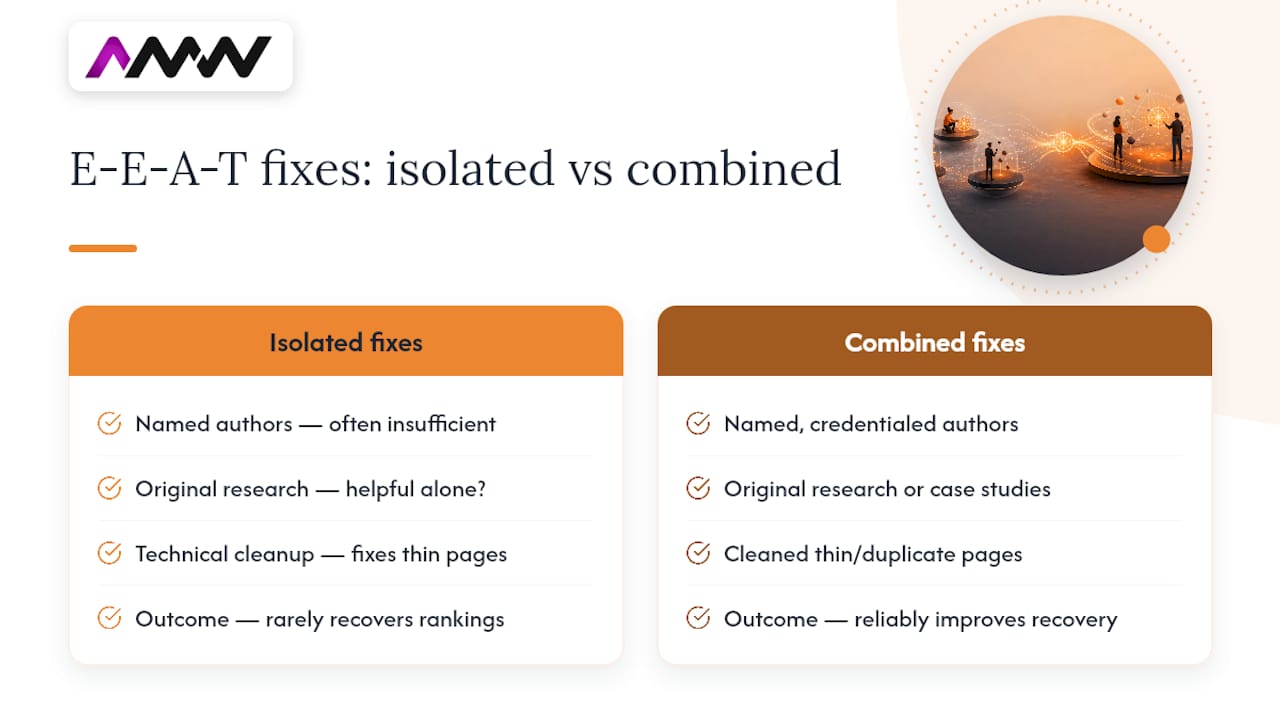
The clearest pattern in published E-E-A-T recovery stories is consistent: sites hit by Google’s Helpful Content updates that later recovered rankings had usually done three things together, added named, credentialed authors, published original research or case studies, and cleaned up thin or duplicate pages. No single fix on its own tends to produce the recovery; it’s the combination.
Health and finance publishers hit hardest by YMYL scrutiny have often recovered visibility by restructuring content around named medical or financial professionals rather than unattributed “editorial team” bylines, alongside adding visible credentials and review dates.
On the AI side, reporting on how businesses are adapting to AI search shows publishers restructuring content with clearer summaries, bulleted key facts, and FAQs specifically to make their expertise easier for AI systems to extract and cite. That’s a direct, practical response to the citation dynamics AI Overviews introduced.
The consistent thread across these cases isn’t a single trick. It’s that credibility signals compound: an authoritative author plus original evidence plus clean technical execution outperforms any one of those in isolation.
How to audit your own site for E-E-A-T weaknesses
Run this as a structured pass rather than a vague once-over.
Step one: inventory your authors. List every content piece and check whether it has a named author, a linked bio, and visible credentials where relevant. Anonymous or “Admin” bylines go on the priority fix list.
Step two: audit for original evidence. Flag pages that are pure summaries of other sources versus pages containing first-party data, screenshots, interviews, or genuine case studies. The ratio tells you how much rewriting work is ahead.
Step three: check technical trust signals. Confirm HTTPS site-wide, a real contact page, visible privacy and editorial policies, and a working correction process.
Step four: review external signals. Pull your backlink profile and check for branded search volume growth. A site with zero unprompted mentions anywhere else on the web has an authoritativeness gap worth addressing through PR.
Step five: cross-check schema against visible content. Anything marked up in JSON-LD that doesn’t appear on the page itself needs fixing immediately, since mismatches actively damage trust signals.
Step six: prioritise by traffic and risk. Fix your highest-traffic YMYL pages first, then work outward. A single well-executed case study on a key page beats scattered small fixes across dozens of low-value ones.
Applying E-E-A-T differently across site types
YMYL sites, health, finance, legal, safety, need the strictest standard. Author credentials should be formal and verifiable: a GMC number for a doctor, an FCA reference for a financial adviser. Case studies and claims need extra scrutiny, since Google’s systems apply heightened scrutiny to topics where inaccuracy could cause real harm.
Non-YMYL sites, hobby blogs, entertainment, general lifestyle content, still benefit from E-E-A-T principles but with lower stakes attached. A recipe site doesn’t need medical-grade credentials, but it does need to show the author actually cooked the dish, with original photos and honest notes about what went wrong.
E-commerce sites sit somewhere in between. Product pages benefit from genuine reviews, clear returns policies, and visible business details, while buying guides and comparison content benefit from the same original-testing evidence that applies to any expertise claim.
B2B and SaaS sites often underuse E-E-A-T because the content feels less risky than YMYL topics. But claims about product performance, security, or compliance carry real consequences for a buyer’s business, so the same standard of verifiable expertise and transparent evidence applies, just with a different subject matter.
What the research actually supports, and what doesn’t
The conventional advice on E-E-A-T has become a checklist industry: add an author box, get a few backlinks, slap on some schema, tick the box. That advice isn’t wrong exactly, it’s just shallow. The genuine signal running through Google’s own documentation and the CMA’s recent intervention is that credibility is becoming a structural requirement, not a decoration you add after the content’s written.
What’s overrated is schema markup on its own. Plenty of sites have immaculate Article and Author schema and still get outranked by a scrappier competitor whose author has genuinely done the thing they’re writing about. Structured data helps machines read what’s already true; it can’t manufacture credibility that isn’t there.
What’s underrated is original evidence, plainly. A single well-documented case study with real numbers does more for E-E-A-T than a dozen generic “expert-reviewed” badges. If you do one thing after reading this, make it that: pick your highest-traffic page and add a named author, a genuine credential, and one piece of first-hand proof. Everything else compounds from that foundation.
— Amir
Get your E-E-A-T audited by people who build the evidence too
Amwmedia is the alternative to guessing your way through an E-E-A-T fix. Instead of a generic checklist, you get content production, SEO, and case study work handled by the same team, so the original evidence your site needs (real case studies, real photography, real author profiles) actually gets made, not just recommended in a report.
Our services page covers the full range, from content production and SEO to web design and branding, and our content production work is specifically what turns client results into the kind of publishable proof that strengthens authorship and expertise signals. One client, Phillips Joinery, picked up 4,497 followers in a month through exactly this kind of joined-up content and social strategy. If your site’s E-E-A-T signals need a proper audit rather than another bolt-on fix, get in touch through our contact page and we’ll talk through where to start.
Sources
- Creating helpful, reliable, people-first content
- CMA secures fairer deal for publishers and improves Google search services in UK
- Google E-E-A-T for SEO — Search Engine Land guide
- Businesses scramble to get noticed by AI search – BBC News
FAQ
What does E-E-A-T stand for in SEO?
E-E-A-T stands for Experience, Expertise, Authoritativeness and Trustworthiness. It’s guidance Google’s quality raters use to assess content, which in turn informs Google’s automated ranking systems rather than acting as a direct score.
Is SEO still relevant with AI search growing?
Yes, and arguably more so, since AI Overviews and AI Mode still pull their answers from indexed, crawlable web content. Sites with strong credibility signals are more likely to be selected for AI citations, which makes traditional SEO fundamentals, including E-E-A-T, a prerequisite for AI visibility.
What are the four types of SEO?
SEO is generally broken into technical SEO (site health, crawlability, schema), on-page SEO (content, keywords, metadata), off-page SEO (backlinks, brand mentions, PR), and local SEO (Google Business Profile, local citations). E-E-A-T work touches all four, but it leans heaviest on on-page and off-page signals.
Is SEO dead now that AI answers questions directly?
No. AI systems still need to source their answers from somewhere, and Google’s guidance on succeeding in AI search explicitly recommends structured, credible content as the way to earn those citations. SEO has shifted focus toward earning citations rather than just rankings, but the underlying discipline hasn’t disappeared.
How is E-E-A-T different from the Helpful Content System?
E-E-A-T is a set of quality principles used in rater guidelines, while the Helpful Content System is a distinct Google ranking system that applies similar logic site-wide to detect content made primarily to rank rather than help readers. They overlap in intent but work as separate mechanisms.
Recommended
- Get Cited, Not Just Crawled: AI SEO Strategy for Marketing Teams
- How to boost website SEO: your 2026 guide
- Effective content production strategies for brand growth
- Master your SEO strategy: guide for effective brand growth
Our free marketing audit looks at your site, your ads and your content, and comes back with a 30 day plan. No pitch deck.

Founded AMW Media in 2024 and runs strategy, paid media and the CRM builds. The reason everything here is in house and measured in revenue. Meet the team.