 Black Steel Doors
 Woodstock Campers
 Phillips Joinery
AI search visibility means being named, recommended, or linked to inside answers from ChatGPT, Gemini, Perplexity, and Google AI Overviews rather than just ranking on a results page. It matters because these tools now answer questions directly, often with no click at all, so the single best first move is running the same 20 to 50 buyer queries across the engines your customers actually use and logging who gets mentioned.
TL;DR:
- Your brand’s mention, recommendation, or citation in AI answers varies significantly across engines because each sources from different indexes and crawlers.
- Focusing solely on Google AI Overviews overlooks opportunities on Perplexity, ChatGPT, and Gemini, which rely on distinct signals like recent web content or knowledge graphs.
- Manual, consistent testing of 20 to 50 buyer queries provides a reliable baseline for measuring your actual AI visibility before investing in automation tools.
- Optimising for AI citations requires structured data, visible freshness indicators, and answer-focused content, with quick wins achievable within the first six weeks.
- Regular tracking and ongoing content updates are essential, as AI models and sourcing behaviours evolve rapidly, making continuous monitoring more effective than one-time audits.
What is AI search visibility and why does it matter?
AI search visibility breaks down into three distinct signals, and mixing them up is the most common mistake marketing teams make when reporting on this. A mention is when an AI answer names your brand in passing. A recommendation goes further, actively suggesting you as the answer to the user’s problem. A citation is the strongest signal: the AI links directly to a page on your site as its source.
This distinction matters because AI search visibility is fundamentally different from traditional SEO ranking, you can rank first for a keyword and still be invisible in an AI-generated answer if the model pulls its facts from a competitor’s page or a third-party review site instead.
The stakes are rising because these answers increasingly replace the click altogether. When someone asks Perplexity “best project management tool for a five-person agency” and gets three named options with reasoning, that search is over. Nobody scrolls down to see who ranked fourth. Being invisible in that one paragraph costs you the entire decision, not just a fraction of the traffic.
- Mention: your brand named, no link
- Recommendation: your brand actively suggested as the solution
- Citation: a direct link to your page as the cited source
How do ChatGPT, Gemini, Perplexity and Google AI Overviews differ?
Treating AI visibility as one target is where most tracking efforts fall apart. Each engine pulls from a different index, uses different crawlers, and weights sources differently, so a brand that dominates one platform can be completely absent from another. The local version of this advice is on our Milton Keynes SEO page, down to making review requests part of finishing every job.
One study sampling the same queries across four major engines found 322 citations pulled from 193 different websites, with only a small overlap in which domains got cited more than once. That is not a rounding error. It means a brand optimising purely for Google’s index could be doing nothing at all for how Perplexity or ChatGPT sources its answers.
Why the gap? Perplexity leans heavily on live web crawling and tends to cite recent articles and forums. Google AI Overviews draws from the same index that powers standard Search, so classic technical SEO still carries weight there. Gemini pulls in Google’s knowledge graph and structured data more visibly. ChatGPT’s browsing behaviour depends on which mode a user has switched on, which makes it the least predictable of the four.
- Perplexity: favours fresh, citable web content and forum discussion
- Google AI Overviews: draws from the existing Search index and structured data
- Gemini: leans on knowledge graph entities and schema
- ChatGPT: variable, depends on browsing mode and training data cutoff
Pro Tip: Don’t chase every engine equally. Work out where your buyers actually ask questions (B2B software buyers lean on ChatGPT and Perplexity, general consumers hit Google AI Overviews constantly) and weight your measurement effort accordingly.
How to measure AI search visibility manually
You don’t need a subscription to start tracking this. A manual protocol run consistently beats an expensive tool run once and forgotten.
- Build a fixed query list. Pick 20 to 50 real buyer questions, the kind a prospect would type before choosing between you and a competitor. Keep the wording identical every time you test, because rephrasing breaks your ability to compare results week to week.
- Run each query on every engine that matters to your audience. Log the raw answer text, not just a summary.
- Record five things per query: whether you were mentioned (yes/no), which sources got cited, the sentiment of any mention (positive, neutral, negative), your share of voice against named competitors, and the date.
- Repeat on a fixed cadence. Weekly or biweekly testing is the sweet spot: frequent enough to catch change, infrequent enough not to burn a full day every week.
- Calculate your visibility rate. Divide the number of queries where you appeared by total queries tested, per engine. If you appeared in 14 of 40 ChatGPT queries, that’s a 35% visibility rate on that engine specifically.
| What to log | Why it matters |
|---|---|
| Mention yes/no | Baseline presence signal |
| Cited sources | Shows who is winning the citation instead of you |
| Sentiment | Flags reputational risk, not just absence |
| Share of voice | Compares you against named competitors in the same answer |
| Date and engine | Makes trend reporting possible |
Store results in a shared spreadsheet or lightweight database, dated by engine, so three months from now you can prove whether a technical fix actually shifted anything. Screenshots alone don’t hold up in a report; structured logs do.
What should AI visibility tools actually deliver?
Plenty of tools now promise to automate the tracking above, and most of them are worth using once you understand what to check before paying for one. Automation earns its keep when you’re running dozens of queries across four engines weekly. Doing that by hand every fortnight gets old fast.
What decent automation should give you:
- Full engine coverage, not just Google AI Overviews dressed up as “AI search”
- A clear split between mentions and citations, not one blended “visibility score” that hides the difference
- Raw exportable data, so you can audit individual answers rather than trust a dashboard number
- Documented sampling methodology: how often it queries, from what location, with what prompt wording
Before signing a contract, ask the vendor directly which engines they cover and how they sample. Some tools quietly rely on API access that behaves differently from the consumer-facing chat interface your customers actually use, which can skew results in ways that flatter the tool.
Verify vendor coverage and export capability before treating any tool’s dashboard as gospel, and always run your own manual sample alongside it for the first month. If the tool’s numbers and your manual test tell wildly different stories, trust the manual test. It’s slower, but it’s honest.
The technical and content checklist that makes pages citable
AI engines cite pages that make their job easy: clear claims, visible structure, and content they can actually read in raw HTML. Here’s what to fix, roughly in order of effort versus payoff.
- Publish an llms.txt file. This simple text file at your site root lists your most important pages and a short description of each, giving AI crawlers a map instead of forcing them to guess. A fuller llms-full.txt can include entire page content for your cornerstone pieces.
- Add structured data. Article, Person, and FAQPage schema help AI systems parse who wrote what and extract clean question-answer pairs. Google’s own guidance on structured data and AI features confirms this is central to how AI Overviews decide what to surface.
- Show a visible “last reviewed” date. Freshness signals matter to models weighing which source to trust between two similar pages.
- Use server-side rendering or prerendering. If your key content only loads after JavaScript fires client-side, some crawlers never see it. Check what your page looks like with JavaScript switched off; if it’s blank, so is what the AI reads.
- Write answer-ready lead paragraphs. Open sections with the direct claim, then the supporting detail, exactly the structure this article follows. Models lift clean, self-contained statements far more readily than buried conclusions.
Tactics like these carry real weight. Experiments on llms.txt, FAQ schema, and citable statistics have shown citation lifts of roughly 30 to 40% when applied properly.
Pro Tip: Put your single strongest statistic in the first two sentences of a section, not the last. AI models tend to lift the opening claim of a paragraph far more often than a conclusion buried at the bottom.
Building a realistic programme: quick wins and timelines
Spread this work across weeks, not one frantic sprint, and set expectations early so nobody panics when week two shows nothing.
Quick wins (2 to 6 weeks): Publish your llms.txt file, add FAQPage schema to your five highest-traffic pages, and rewrite opening paragraphs on cornerstone content to lead with the answer rather than a warm-up sentence. These are quick, low-effort tactics that can show measurable improvements in citation rates within a short time frame.
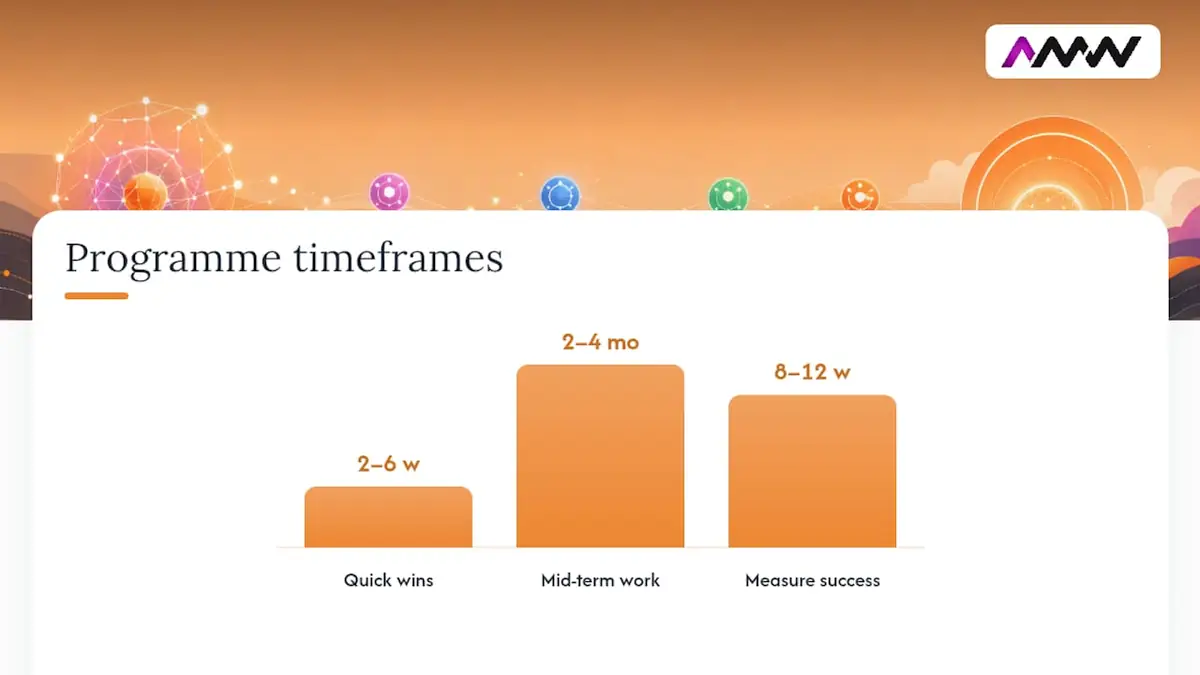
Mid-term work (2 to 4 months): Earn third-party citations. Brand mentions on Wikipedia, LinkedIn, and industry review sites correlate more strongly with AI citation than backlinks do, which is a underused lever compared to how much energy still goes into building in public for visibility, distribution and SEO. Refresh cornerstone pages every 6 to 8 weeks with new data points or updated figures.
Prioritise by commercial value, not ease. Start with the queries that map directly to buying decisions, then the pages that already rank well in classic search but show zero AI mentions. Those are your fastest, highest-impact fixes.
- Weeks 2 to 6: llms.txt, schema, rewritten lead paragraphs
- Months 2 to 4: third-party citations, cornerstone refreshes (content updates within a few months)
- Ongoing: weekly or biweekly manual sampling to track movement
Success looks like a rising visibility percentage on your priority engines over 8 to 12 weeks, not overnight. If nothing moves by week twelve, revisit which queries you’re testing before assuming the tactics failed. Building genuine brand visibility across channels tends to lift AI mentions as a side effect, because the same signals that build reputation with humans build it with models trained on human-written content.
AMW Media: how we audit, measure, and improve AI search visibility
AI visibility work should be run like technical SEO: audit first, measure before changing anything, then optimise against evidence. That means checking your schema, your server-side rendering, and your citation gaps before touching a single page, then running the manual sampling protocol above to set a baseline. Technical remediation (structured data, rendering fixes, content restructuring) should be handled while tracking whether it actually moves your mention rate across engines. If you want that audit run properly rather than guessed at, get in touch and we’ll talk you through what a realistic first month looks like.
Privacy and ethics in AI-driven search visibility
Tracking how AI engines talk about your brand raises questions that classic rank tracking never had to answer, mostly because you’re now dealing with generated text rather than a fixed results page.
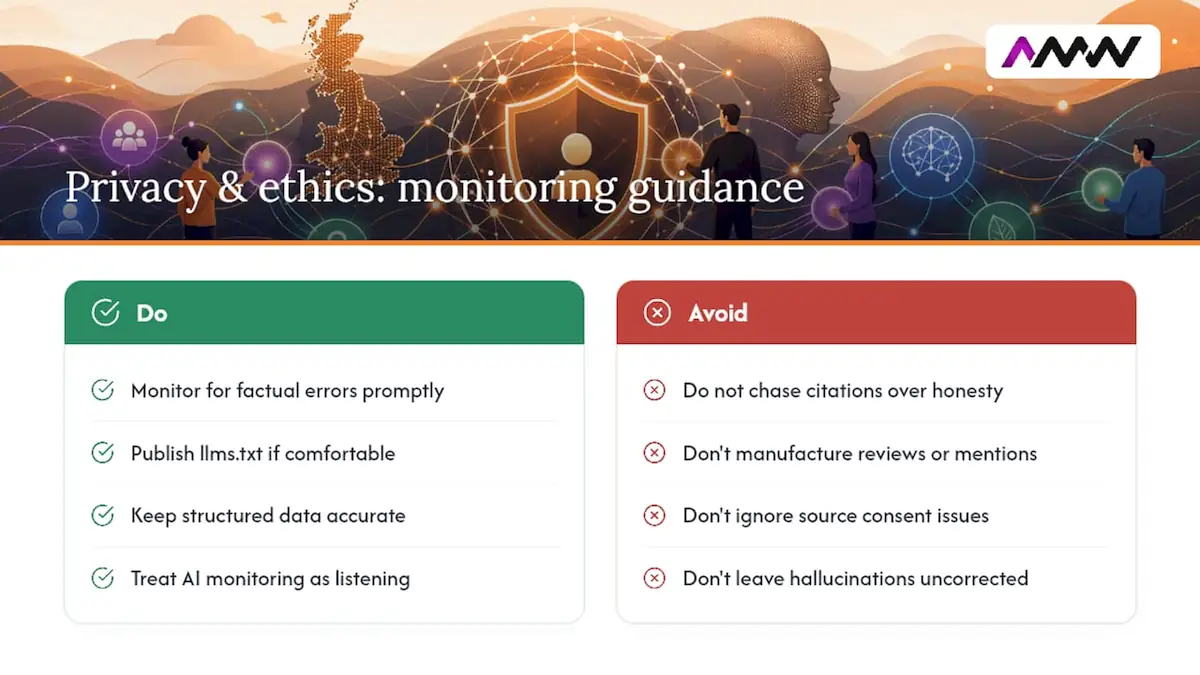
The first issue is accuracy. AI models occasionally invent details about brands, called hallucination, and a wrong claim in an answer can sit there uncorrected for weeks because there’s no obvious feedback mechanism the way there is with a review you can flag. Monitoring isn’t just about visibility volume; it’s about catching factual errors before they compound.
The second issue is consent and scraping. Many of the sources these engines cite were never asked whether their content could be summarised or repurposed this way, which is precisely why llms.txt exists as an opt-in signalling standard rather than a mandatory one. Publishing one is a statement about what you’re comfortable being used, not a legal requirement.
The third issue is manipulation. As brands realise citations drive decisions, some will try to game AI outputs with fake reviews, coordinated mentions, or stuffed structured data designed to trick rather than inform. That erodes trust in AI answers generally, which is bad for everyone using them, including you.
Be transparent about what your content claims, keep your structured data accurate rather than aspirational, and treat AI visibility monitoring as a listening exercise first. Chasing citations at the cost of honesty is a short-term game that AI platforms are actively working to detect and penalise.
Where AI search visibility is heading next
Expect the gap between engines to narrow slightly as they converge on similar crawling standards, but expect entirely new surfaces to open up at the same time. Voice assistants, in-app AI shopping assistants, and agentic AI tools that complete tasks on a user’s behalf (booking, purchasing, comparing) are all becoming answer surfaces in their own right, each with its own citation logic to learn.
Structured data will likely become more, not less, important. As models get better at parsing raw HTML, the sites offering the cleanest machine-readable signals (accurate schema, visible freshness dates, a well-maintained llms.txt) will keep an edge over sites relying purely on writing quality. Google’s own AI features documentation already signals this direction, treating structured markup as a first-class input rather than an afterthought.
Watch for AI engines building more transparent citation trails, partly in response to publisher pressure over attribution and traffic loss. If that happens, measurement gets easier because engines start showing their sourcing more openly rather than making you infer it from sampled answers. Until then, the manual protocol covered earlier remains your most reliable ground truth, and it’s worth building that habit now rather than waiting for tools to catch up.
What actually matters in this space right now
Most advice on AI search visibility still treats it like a vendor-shopping exercise: which tool has the best dashboard, which platform claims the widest engine coverage. That’s backwards. The tools are useful, but they’re validators, not starting points. The research is consistent on this: a small manual sampling run is the strongest check against any tool’s marketing claims, and skipping that step means you’re trusting a black box with your reporting.
The bigger gap I see is teams treating this as a one-off audit rather than an ongoing habit. Visibility on ChatGPT this month tells you almost nothing about visibility in six months, because these models update, retrain, and shift sourcing behaviour constantly. Weekly or biweekly sampling isn’t paranoia. It’s the only way to catch a slide before it costs you a quarter of pipeline.
If you take one thing from this: start with the manual test, this week, before you buy anything. Then decide whether automation earns its cost based on what that test shows you. Most brands skip straight to the dashboard and never learn what it’s actually measuring. Our SEO service starts with the technical fixes, then on page work and local search, from £349 a month and reported from your own Search Console.
Amir
Sources
- AI Search Visibility: What It Is and Why It Matters in 2026 | Is My Brand in AI
- AI Search Visibility: Definition, Framework, Measurement (2026)
- AI Search Optimisation: The Complete Guide for 2026
- AI Visibility Playbook | The Complete Guide
- Google developers: AI features documentation
FAQ
How do I check my AI search visibility?
Run a fixed set of 20 to 50 buyer queries across the engines your audience uses (ChatGPT, Perplexity, Gemini, Google AI Overviews), and log whether you’re mentioned, which sources get cited instead, and the sentiment of each answer.
What is the 30% rule in AI search?
There’s no single universal “30% rule” in AI search, though some studies on tactics like llms.txt and FAQ schema have recorded citation lifts of roughly 30 to 40% when properly implemented, which is likely where the figure gets referenced.
How do you increase AI search visibility?
Focus on earning third-party citations (Wikipedia, LinkedIn, industry press), publishing an llms.txt file, adding FAQPage and Article schema, and writing answer-ready lead paragraphs with citable statistics near the top of the page.
What are the best AI search visibility tools?
There’s no single best tool for every brand; the right choice depends on which engines you need covered and whether it offers raw data export and transparent sampling methodology. Always validate any tool’s output against a manual sample before trusting its dashboard.
Does AI search visibility replace traditional SEO?
No. Classic technical SEO still influences Google AI Overviews since it draws from the same index as standard Search, and a strong SEO foundation remains one of the fastest routes into AI-generated answers rather than a separate discipline to abandon.
Recommended
- SEO trends in 2026: what UK marketers need to know
- Best automation tools for digital marketing: 2026 UK guide
- Get Cited, Not Just Crawled: AI SEO Strategy for Marketing Teams
Our SEO manager runs the technical checks by hand, looks at who is beating you, and sends back the order to fix it in. Free, and you keep it either way.

Technical, on page and local SEO. Turns the numbers in Search Console into pages that rank and enquiries that convert. Meet the team.