
 Black Steel Doors
 Woodstock Campers
 Phillips Joinery
TL;DR:
- AI-powered search dominates in 2026, shifting focus to citations in AI-generated answers rather than traditional rankings. UK-specific content, technical health, and local SEO boost AI visibility and brand authority, while measuring citation frequency becomes essential. Content must be original, well-structured, and optimised for mobile and fast-loading to succeed in the evolving search landscape.
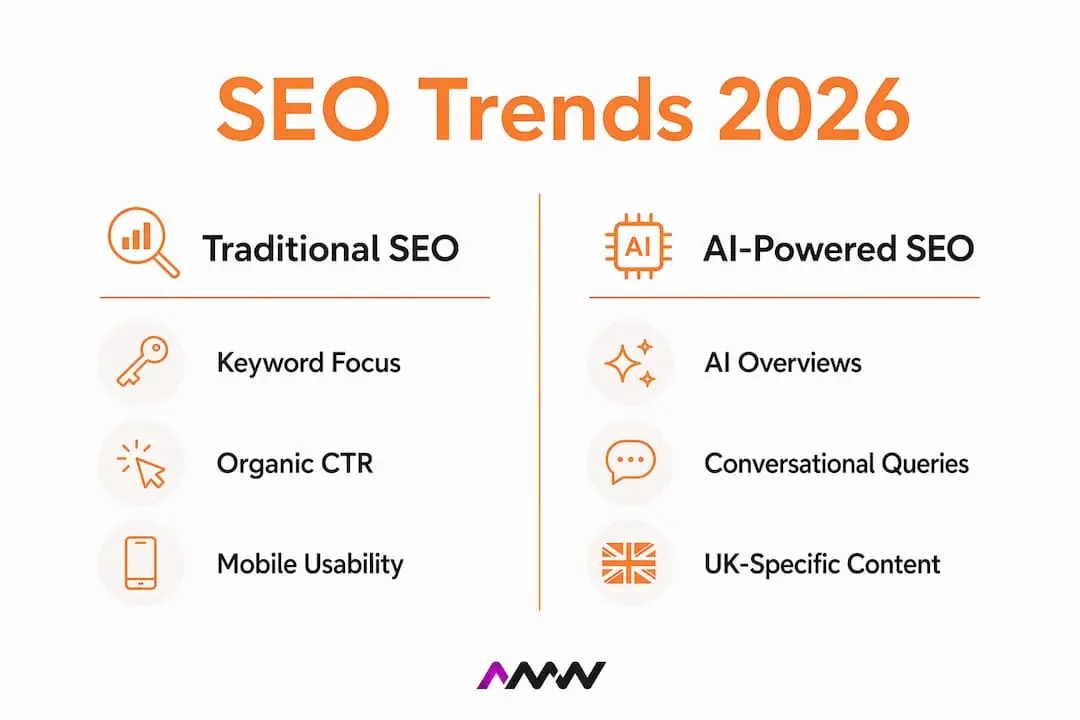
Search engine optimisation in 2026 is defined by one fundamental shift: AI-powered search has moved from novelty to mainstream, and it is actively eating into the organic traffic that UK digital marketers and business owners have spent years building. Generative Engine Optimisation (GEO), the practice of earning citations in AI-generated answers rather than just ranking in blue links, is now a core discipline alongside traditional SEO. The seo trends in 2026 that matter most combine AI visibility, UK-specific content signals, and technical health into a single, joined-up strategy.
How AI-powered search is reshaping SEO in 2026

The single biggest change in search this year is the rise of AI Overviews and generative engines. Google’s AI Overviews, Bing Copilot, and voice-driven smart speakers now answer queries directly on the results page, without requiring a click. That shift has real consequences for traffic.
Informational and how-to queries have seen a 20 to 50% drop in organic click-through rates for positions 1 to 3 in 2026, driven by AI-powered direct answers replacing traditional link clicks. That is not a rounding error. If your site ranks first for “how to register a limited company in the UK” but an AI Overview answers the question in full, a large share of searchers never visit your page.
The response is not to panic and abandon SEO. The response is to shift which metrics you track and how you structure content. Generative Engine Optimisation measures brand citation frequency and sentiment in AI-generated answers as a core performance metric, distinct from click-based KPIs. Your brand appearing in an AI answer without a click still builds authority and trust. That visibility is simply invisible to Google Search Console, which is why new tracking approaches matter.
Conversational queries and longer search phrases
Search behaviour itself is changing. Marketers must shift from targeting short keywords to addressing longer, more conversational phrases that reflect user intent with personalised and problem-focused content. A user no longer types “accountant London.” They ask “which accountant in London specialises in freelance contractors and charges under £500 a year?” Your content needs to answer that kind of question directly and completely.
UK businesses also benefit from a specific structural advantage here. Bing holds a 10 to 15% market share in the UK and smart speaker adoption is strong, both of which feed into AI-driven search results. Bing Copilot draws heavily on Bing’s index, so UK businesses that have historically ignored Bing now have a genuine reason to pay attention to it.
Pro Tip: Set up brand monitoring tools to track how often your business name appears in AI-generated answers, not just in traditional search rankings. Tools like Brandwatch or manual prompt testing in ChatGPT and Bing Copilot give you a rough picture of your AI citation frequency.
Why local and UK-specific SEO is a competitive advantage
Generic global content is losing ground in AI-powered search. The reason is simple: AI engines are trained to serve relevant, contextualised answers to the user in front of them. A UK user asking about VAT thresholds does not want a US-centric answer about sales tax.
Content matched to UK regulations, GBP pricing, and UK institutional contexts significantly increases the likelihood of AI citation compared to generic global content. Referencing HMRC, the ICO, Companies House, or the Financial Conduct Authority signals to both search engines and AI tools that your content is authoritative for a UK audience. This is a gap that many internationally focused sites simply cannot close.
Local SEO is the highest commercial-impact form of SEO for UK SMEs, making Google Business Profile optimisation and consistent local citations non-negotiable. A well-maintained Google Business Profile with accurate categories, regular posts, and genuine reviews feeds directly into local pack rankings and AI-generated local recommendations.
Four steps to strengthen UK-specific SEO
- Reference UK institutions and regulations. Mention HMRC, ICO, or relevant industry bodies where applicable. This builds contextual trust with AI engines serving UK users.
- Price in GBP throughout your content. Avoid generic “$X” figures. UK audiences and AI tools both flag currency inconsistency as a relevance signal.
- Build UK-specific backlinks. Links from .co.uk domains, regional news outlets, and UK trade associations carry stronger local signals than generic international links.
- Use British English vocabulary. “Solicitor” not “attorney,” “flat” not “apartment,” “CV” not “résumé.” UK search behaviour reflects UK vocabulary, and AI engines pick up on these distinctions.
Pro Tip: Content that includes GDPR compliance references, UK-specific case studies, and GBP pricing is not just more trustworthy to readers. It is also more likely to be cited by AI tools responding to UK-based queries.
Local signals influence rankings even for queries that are not explicitly local, meaning UK organisations should apply geographic optimisation broadly, not just to location pages. A London-based HR consultancy writing about “employee handbook templates” should still include UK-specific employment law references throughout, even though the query is not geographically tagged.
What does good content look like for SEO best practices 2026?
Content quality has always mattered, but the definition of “quality” has shifted considerably. Thin, keyword-stuffed pages that once scraped by on domain authority alone are now actively deprioritised. AI engines are particularly unforgiving of content that exists to rank rather than to help.
Google advises that optimising for AI Search means creating great content for people, going deeper with helpful, well-structured, and original material rather than writing for bots. That guidance is not new, but the enforcement mechanism has changed. AI Overviews pull from content that is factually clear, well-organised, and useful. Vague, padded content simply does not get cited.
Here is what AI-ready content looks like in practice:
- Direct factual statements. AI engines extract clean facts. Write “The UK VAT registration threshold is £90,000” rather than “businesses may need to consider VAT registration at certain revenue levels.”
- FAQ sections. Structured question-and-answer formats are among the most frequently cited content types in AI Overviews.
- Original data or case studies. Content that contains information unavailable elsewhere is far more likely to earn citations.
- Multimedia integration. Images with descriptive alt text and embedded video improve dwell time and are increasingly surfaced in AI-enhanced results.
- Clear headings and logical structure. AI parsing tools follow heading hierarchies. A well-structured H1, H2, H3 hierarchy makes content easier to extract and cite.
Mobile usability and Core Web Vitals remain crucial ranking factors in 2026, with Google’s mobile-first indexing and rising user expectations. A page that loads in under 2.5 seconds on mobile and passes Largest Contentful Paint benchmarks will consistently outperform a slower equivalent, even with identical content quality.
| Content element | Why it matters in 2026 |
|---|---|
| Direct factual statements | AI engines extract and cite clean, unambiguous facts |
| FAQ sections | Frequently pulled into AI Overviews and featured snippets |
| Original research or data | Unique information earns citations that generic content cannot |
| UK-specific context | Increases relevance for AI tools serving UK users |
| Core Web Vitals compliance | Affects both ranking and user experience directly |
Technical SEO and AI-driven optimisation channels
Technical SEO has not gone away. If anything, it has become more consequential because AI engines need to crawl, parse, and understand your content before they can cite it. A site with crawl errors, slow load times, or broken internal linking is invisible to AI tools regardless of content quality.
The practical SEO strategies that support AI visibility in 2026 share a common thread: they make content easier for both humans and machines to read. The key technical priorities are:
- Crawlability and indexing. Submit an up-to-date XML sitemap. Fix crawl errors in Google Search Console. Ensure important pages are not accidentally blocked by robots.txt.
- Mobile-first design. Google indexes the mobile version of your site first. If your mobile experience is poor, your rankings suffer regardless of your desktop performance.
- Structured data and schema markup. Structured data improves chances of being cited by AI tools like Google AI Overviews and Bing Copilot. FAQ schema, Article schema, and LocalBusiness schema are particularly valuable for UK businesses.
- Page speed. Aim for a Largest Contentful Paint under 2.5 seconds and a Cumulative Layout Shift score below 0.1. These are not aspirational targets; they are baseline expectations.
- Internal linking. A clear internal link structure helps AI tools understand the relationship between your pages and identify your most authoritative content.
Large Language Model Optimisation (LLMO) is the emerging technical discipline that sits alongside traditional SEO. It focuses specifically on making content parseable and citable by AI engines. The core tactics overlap significantly with good on-page SEO: precise facts, clear structure, and authoritative sourcing. The difference is the intent. LLMO asks “will an AI cite this?” rather than “will a human click this?”
Pro Tip: Add FAQ schema to your most important service and blog pages. It takes under an hour with a plugin like Yoast SEO or Rank Math, and it directly increases the probability of appearing in Google AI Overviews.
Failure to appear in AI-generated answers represents a loss of brand authority that escapes traditional click-tracking tools like Google Search Console entirely. This is why building a parallel measurement framework for AI visibility is not optional in 2026.
Practical steps to implement future SEO strategies right now
Knowing the trends is one thing. Knowing what to do on Monday morning is another. The following steps are ordered by impact for UK digital marketers and business owners working with realistic budgets and timelines.
- Audit your content for AI visibility. Run your key queries through Google AI Overviews and Bing Copilot. Note which competitors appear and what content format they use. That tells you exactly what to replicate and improve.
- Refresh UK-specific content. Update pricing to GBP, add references to relevant UK regulations, and replace any US-centric examples. This single step can meaningfully improve AI citation rates for UK-targeted queries.
- Optimise your Google Business Profile. Add your correct business category, upload recent photos, respond to reviews, and post updates at least fortnightly. Google Business Profile optimisation is the fastest route to local pack visibility for most UK SMEs.
- Build UK-specific backlinks. Reach out to regional business directories, local press, and UK trade bodies. A link from a respected .co.uk domain carries more local signal than ten generic international links.
- Track new KPIs alongside traditional ones. Add AI citation frequency and brand sentiment monitoring to your reporting dashboard. Use manual prompt testing monthly to track whether your brand appears in AI answers for your core queries.
Pro Tip: UK committee-based buying decisions mean that ROI calculators, comparison guides, and case studies perform particularly well in B2B contexts. Build content that helps multiple stakeholders justify a purchase, not just the person doing the initial search.
Key takeaways
SEO success in 2026 requires combining AI citation strategies, UK-specific content signals, and solid technical foundations into a single, joined-up approach.
| Point | Details |
|---|---|
| AI Overviews reduce organic CTR | Informational queries face a 20 to 50% CTR drop; track citation frequency alongside clicks. |
| GEO is now a core discipline | Measure brand mentions in AI answers, not just traditional ranking positions. |
| UK-specific content earns more citations | Reference HMRC, ICO, GBP pricing, and UK institutions to outperform generic global content. |
| Technical SEO enables AI visibility | Structured data, schema markup, and fast mobile pages make content parseable by AI engines. |
| Local SEO drives commercial impact | Google Business Profile optimisation is the highest-return local SEO action for UK SMEs. |
Why I think most SEO advice for 2026 misses the point
Working with UK brands across industries, I keep seeing the same mistake: teams either chase AI metrics obsessively and neglect the fundamentals, or they dismiss AI search as hype and carry on as if it is 2019. Both approaches are wrong.
The brands that are actually winning right now are the ones that treat AI visibility and traditional SEO as two sides of the same coin. Great content, fast pages, and genuine local relevance serve both human readers and AI engines simultaneously. You do not need a separate “AI SEO strategy.” You need a better overall content strategy that happens to be structured clearly enough for AI tools to parse.
The part that concerns me is the measurement gap. Brand visibility in AI answers is invisible to Google Search Console, which means many businesses are losing ground without realising it. If your monthly reporting only covers rankings and organic sessions, you are flying partially blind in 2026.
My honest advice: spend less time reading about AI SEO trends and more time actually testing your own queries in AI tools. Open Bing Copilot, type in the questions your customers ask, and see whose content gets cited. That ten-minute exercise will tell you more than any trend report. The complete SEO strategy guide is not a document you write once. It is a practice you return to every quarter as the search environment shifts.
Amir
How AMW Media can help you stay ahead of SEO changes
Keeping pace with search engine changes while running a business is difficult. AMW Media works with UK brands to build SEO strategies that account for AI search visibility, local optimisation, and technical performance in one joined-up plan. The team holds Google certifications and brings hands-on experience with both traditional ranking tactics and emerging GEO approaches.
From auditing your current content for AI citation readiness to building UK-specific backlink profiles and optimising your Google Business Profile, AMW Media handles the work that shifts the numbers. The agency also offers web design services built around Core Web Vitals and mobile-first performance, so your technical SEO foundations are as strong as your content. Get in touch to discuss a specific plan for your business.
The SEO trends UK businesses should actually act on
Most trend lists are written for enterprise teams with budgets to match. The SEO trends UK small and medium businesses can realistically act on this year are narrower and more boring.
Be the source an AI answer is built from rather than chasing the blue link alone. Keep the Google Business Profile complete, because local results now decide more searches than they used to. And write pages that answer one question properly rather than pages that mention twenty. None of that needs a budget, only the discipline to do it consistently.
FAQ
What are the biggest SEO trends in 2026?
The biggest shifts are the rise of AI-powered search reducing organic click-through rates and the emergence of Generative Engine Optimisation (GEO) as a core discipline. UK-specific content, structured data, and Google Business Profile optimisation are the highest-impact practical responses.
What is Generative Engine Optimisation (GEO)?
GEO is the practice of earning citations in AI-generated search answers, such as Google AI Overviews and Bing Copilot, rather than focusing solely on traditional blue-link rankings. It measures brand citation frequency and sentiment as performance metrics.
How does AI search affect organic traffic for UK businesses?
Informational and how-to queries have seen a 20 to 50% drop in organic click-through rates due to AI Overviews answering queries directly on the results page. UK businesses can offset this by structuring content to earn AI citations rather than relying purely on clicks.
Why does UK-specific content perform better in AI search?
AI engines serving UK users prioritise content that references UK regulations, GBP pricing, and UK institutions like HMRC and the ICO. Generic global content lacks these contextual signals and is less likely to be cited in AI-generated answers for UK queries.
Is technical SEO still relevant in 2026?
Technical SEO is more relevant than ever. Structured data, schema markup, fast mobile pages, and clean crawlability all directly influence whether AI tools can parse and cite your content, making technical health a prerequisite for AI search visibility.
Most of these trends land differently outside London, where the competition is thinner but the search volume is too. Our SEO agency page for Milton Keynes is the regional version of this picture.
Recommended
- What is SEO? a clear guide for marketers in 2026 | AMW Media
- How to boost website SEO: your 2026 guide | AMW Media
- Types of SEO strategies: a practical 2026 guide | AMW Media
- SEO in marketing: strategies for long-term growth
Our SEO manager runs the technical checks by hand, looks at who is beating you, and sends back the order to fix it in. Free, and you keep it either way.

Technical, on page and local SEO. Turns the numbers in Search Console into pages that rank and enquiries that convert. Meet the team.