 Black Steel Doors
 Woodstock Campers
 Phillips Joinery
Motion graphics work best when a message needs to land fast, clearly, and consistently across screens of wildly different sizes. They beat live action on speed-to-market, cost, and clarity of a single idea, but you trade away some of the emotional weight a real human face can carry. Plan for platform variants from day one, and design every frame to work with the sound off.
TL;DR:
- Motion graphics should be designed for mobile and sound-off viewing, with on-screen text, captions, and a clear visual hierarchy.
- Platform-specific aspect ratios, safe areas, and timing delays for reveals are crucial to maximize engagement and compliance.
- Creating multiple variants tailored to different audiences and channels enhances performance, with distinct edits for social, CTV, BVOD, and out-of-home.
- Licenses for music, fonts, stock footage, and visual styles must be checked carefully to avoid legal issues, especially for age-sensitive categories.
- A well-structured brief, clear deliverables, and a phased timeline help prevent costly revisions and ensure strategic consistency across campaign assets.
Table of Contents
- What makes a great motion graphics ad? (annotated examples)
- Where should you use motion graphics in a campaign?
- Creative and technical best practices for motion-graphics ads
- How to brief a motion-graphics ad (checklist, timeline, and cost ranges)
- Our take: how AMW Media scales motion graphics across channels
- Optimising motion graphics for different audiences and platforms
- Copyright and licensing: what you need to know before you animate
- Our honest opinion on what actually moves the needle
- Ready to put this into production?
- Sources
- FAQ
What makes a great motion graphics ad? (annotated examples)
You don’t need a huge budget to make motion graphics that stick. You need one clear idea per ad, and the discipline to repeat it visually until it’s unmissable. Here’s what tends to work, broken down by the single thing worth stealing from each style.
- Brand-building explainer: A simple animated sequence that walks through a product benefit using bold shapes and a consistent colour palette. Steal this: keep the same character or icon set throughout so the brand becomes recognisable even with the sound down.
- Product demo loop: Short, looping animations showing a product feature on repeat, perfect for a static social feed. Steal this: design the loop so the end frame flows straight back into the start, no jarring cut.
- Snack-sized social content: Fast, punchy motion graphics built for a five-second attention window, often text-led with a bold headline animating in first. Steal this: put the hook in the first half-second, not the third.
- Cinematic BVOD spot: A richer, slower-paced animation with layered sound design and a proper story arc, built for the big screen. Steal this: let the reveal build gradually rather than showing the product in frame one.
- Data visualisation ad: Numbers and charts animating on screen to make a statistic feel dramatic rather than dry. Steal this: animate the number counting up, it holds attention far longer than a static figure.
What ties the strongest examples together is designing for a scroll that never stops: captions carry the story, the logo stays visible throughout, and every platform cutdown still makes sense on mute.
Where should you use motion graphics in a campaign?
Different channels reward different edits, so map your format to the job it needs to do.
- Social short verticals (Reels, TikTok, Stories): Fast hooks, big captions, six to fifteen seconds. Built for activation and direct response.
- YouTube, OTT and CTV: Longer-form, sound-on storytelling with room to breathe.
- BVOD (broadcaster video on demand): This is where higher production value earns its keep. Pairing BVOD with linear TV adds incremental reach and can lift total campaign ROI, which makes it the natural home for your best brand-building cut.
- Display and HTML5 banners: Lightweight, loop-friendly, and often the most overlooked format on the media plan.
- OOH (out-of-home) digital screens: Bold, simple motion that reads in three seconds from a moving car or a train platform.
Budget for at least two or three variant edits per campaign, not one master file stretched thin.
Creative and technical best practices for motion-graphics ads
Most motion-graphics ads fail for boring reasons: they were designed for a cinema screen and shown on a phone with the sound off. Fix the fundamentals first.
Digital video should be built mobile-first and sound-off first, since the vast majority of impressions never get audio turned on. That means:
- Animate your key message as on-screen text, don’t rely on a voiceover to carry it.
- Add burned-in captions rather than relying on platform auto-captions, which can be unreliable.
- Keep your logo and call-to-action visible throughout, not just in a five-second end card.
- Build a clear visual hierarchy so the eye knows what to look at first, second, third.
Platform-native specs matter more than people think. Vertical 9:16 for Stories and Reels, 1:1 or 4:5 for feed, 16:9 for YouTube and CTV. Leave safe areas around text so platform UI (like the “follow” button) doesn’t cover your headline. Subtitles need enough contrast and size to read on a small screen in daylight.
On timing: resist the urge to reveal your product or resolve the concept too early. Delaying the full brand reveal keeps the narrative moving and holds attention right through to the end, rather than letting viewers switch off once they think they’ve “got it.” For social cutdowns, that reveal needs to happen faster, but the same principle applies at a smaller scale.
Technical checklist: export in H.264 for most platforms and H.265 where file size is critical; keep social files under roughly 4MB where the platform demands it (Meta’s ad specs cap out around there); use 24 to 30fps depending on the platform; make loops seamless; and consider lightweight HTML5 builds for display ads, since they load faster and often perform better than static GIFs or heavy video files.
One regulatory note worth flagging: the ASA pays close attention to animation styles that could be seen as having strong appeal to children, particularly for age-restricted products. If your category is remotely sensitive, get legal sign-off on tone before you animate a single frame.
Pro Tip: Build your master file in the highest quality first, then cut down. Cutting up from a low-res social edit into a CTV spot always looks worse than the reverse.
How to brief a motion-graphics ad (checklist, timeline, and cost ranges)
A weak brief is the single biggest cause of wasted revisions. Before you contact anyone, lock down the objective, your audience, the one message you want them to remember, any mandatory legal or claims text, your brand assets, and the tone you’re after. An effective brief also fixes the target devices and deliverable aspect ratios upfront, and budgets time for at least two rounds of revisions.
Deliverables to ask for:
- Master file (highest resolution, source aspect ratio)
- Platform cutdowns (vertical, square, landscape as needed)
- Subtitle/caption files
- Social-specific variants with platform-native text sizing
- Source project files and font/asset handover, in case you need edits later in-house
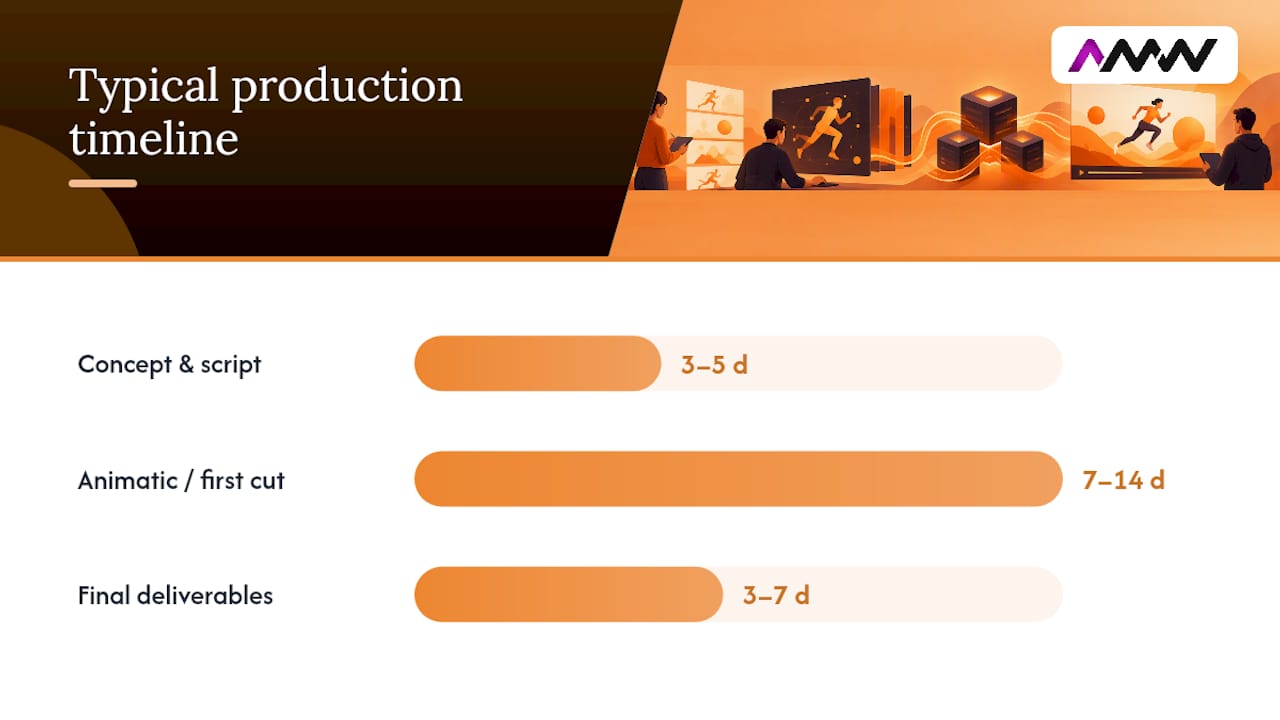
A realistic timeline for a mid-sized project runs roughly: concept and scripting, three to five days; animatic or first cut, seven to fourteen days; final deliverables and cutdowns, three to seven days. Rushed jobs are possible but usually cost more and limit revisions.
Ballpark costs vary hugely depending on complexity, music licensing, and how many revisions you need, but as a rough guide: a simple social loop sits at the lower end, a polished 30-second CTV or BVOD spot with sound design sits well above that, and a multi-variant social package (several cutdowns from one master) usually costs more than a single edit but less than commissioning each separately.
Before signing anyone up, ask what’s included in the price, how many revision rounds you get, who owns the source files afterwards, and whether music and stock footage licensing is covered or billed separately.
Our take: how AMW Media scales motion graphics across channels
We plan every motion-graphics project platform-first, not the other way round. That means the CTV cut and the nine-second social hook get designed as siblings from the same brief, not as an afterthought edit of each other. Creative consistency across a campaign tends to produce stronger long-term results than one-off, unrelated executions, so we build template assets that reuse brand colours, motifs, and pacing across every variant. If you want to see how that plays out in practice, our storyboard examples for UK video teams and wider project portfolio show the planning behind the finished ad, not just the finished ad itself.
Optimising motion graphics for different audiences and platforms
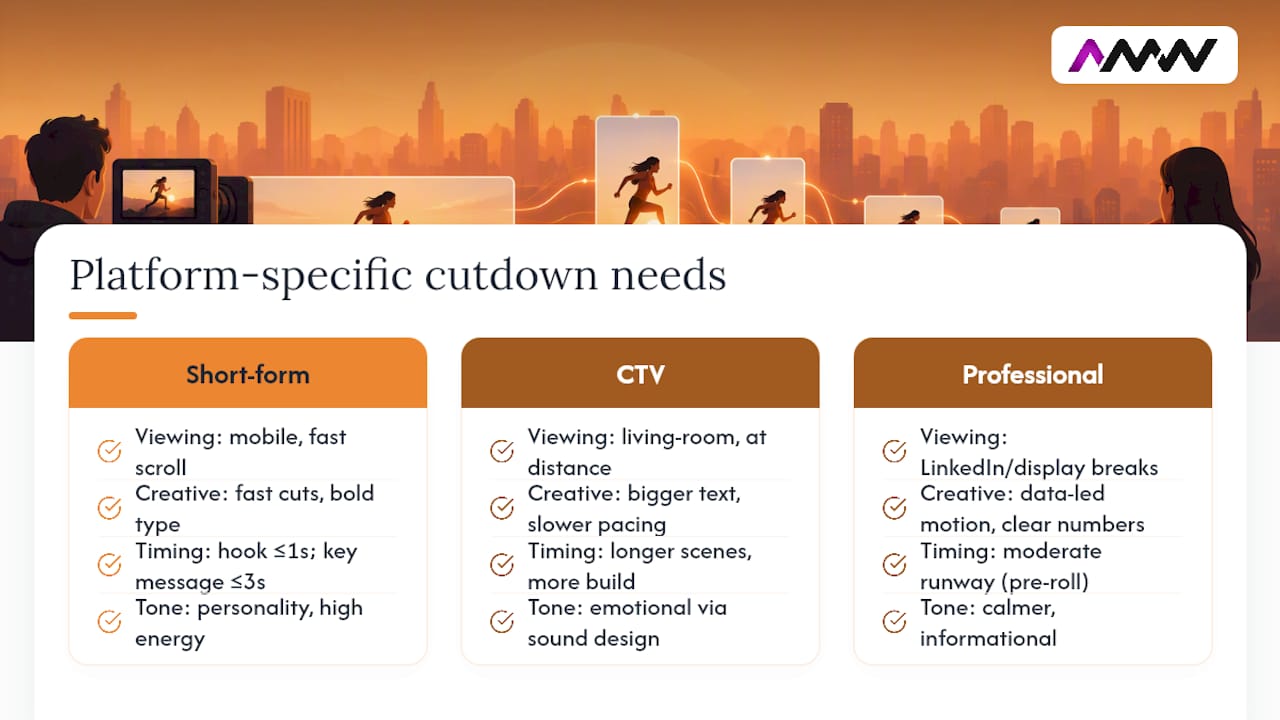
A single master edit rarely performs equally well everywhere, because attention spans and viewing contexts shift dramatically by platform. A younger, TikTok-first audience expects fast cuts, bold typography, and a hook inside the first second. A CTV audience watching on a living-room television, often at a distance from the screen, needs bigger text, slower pacing, and more room for sound design to do the emotional work.
Segment by more than just age. Someone scrolling LinkedIn during a work break wants a different tone (calmer, more informational) than someone watching Instagram Stories at 11pm. B2B audiences on display or LinkedIn respond better to data-led motion graphics with clear numbers and outcomes, while consumer audiences on TikTok or Reels respond to personality and pace.
Platform behaviour also dictates technical choices. Auto-play defaults, whether sound is on by default, and screen size all shift how you cut a scene. A cutdown for Instagram Stories might need the key message in the first three seconds because viewers tap through fast, while a YouTube pre-roll has a slightly longer runway before the skip button appears.
Practically, that means briefing your agency or in-house team with segment-specific notes, not a single generic brief. Specify which cut is for which platform, what device it’ll likely be watched on, and what action you want that particular audience to take. Treating “the ad” as one asset instead of a family of platform-specific edits is one of the most common reasons campaigns underperform once they scale beyond the first channel.
Copyright and licensing: what you need to know before you animate
Every element inside a motion-graphics ad, the music, the font, the stock footage, the icon set, carries its own licence, and mixing them up is one of the fastest ways to get a takedown notice or a legal bill after launch. Stock music and sound effects libraries typically license for specific uses (social, broadcast, or both), so check whether your licence covers paid media placement, not just organic posting, before you commit to a track.
Fonts are a frequent blind spot. Many free-looking fonts have licences that exclude commercial advertising use entirely, so always check the licence terms rather than assuming “free download” means “free to use in an ad.” The same goes for icon packs and illustration libraries: a personal-use licence won’t cover a paid campaign running across multiple platforms.
If you’re commissioning externally, get clear in the brief about who owns the final files afterwards. Some agencies retain rights to templates or the underlying animation system, while handing over full ownership of the finished deliverable. That distinction should be written into the contract before work starts, not negotiated after the invoice arrives.
Finally, if your ad borrows a recognisable meme format, a piece of viral audio, or a visual style closely associated with another brand, get a second opinion before launch. Trend-jacking can work brilliantly, but it can also cross into territory that invites a legal letter rather than engagement.
Our honest opinion on what actually moves the needle
Most advice on motion graphics obsesses over style trends, gradients this year, glitch effects the next, when the research points somewhere far less exciting: consistency and clarity beat novelty almost every time, as can be supported by visual storytelling tips that boost your brand’s impact. Human-centred, emotionally engaging creative outperforms purely informational ads over the long run, and that’s true even inside a motion-graphics format that never features a real face. A well-timed reveal, a relatable scenario animated simply, does more work than a flashy transition.
The conventional advice to “make it pop” misses the bigger risk, which is inconsistency. Brands that keep the same visual language across a dozen small executions build recognition faster than brands chasing a fresh look every quarter. If you’re prioritising anything first, prioritise a reusable system: consistent colours, a locked typeface, a recognisable motion style, then let individual ads flex within that frame rather than reinventing it each time.
— Amir
Ready to put this into production?
If reading all that has left you itching to actually make something, that’s the point. Amwmedia builds motion-graphics ads the way this guide describes: platform-first, sound-off ready, and designed to hold together as a family of edits rather than one master file stretched across every channel and hoping for the best.
Our content production work covers video, photography, and the motion-graphics builds that turn a single campaign brief into social cutdowns, BVOD spots, and display variants without losing the thread between them. Pair that with our social media management and paid asset delivery, and you get a team that plans the whole rollout, not just the hero film. Have a look through our project portfolio to see finished campaigns, then head to our services page or get in touch for a quote scoped to your budget and timeline.
Sources
- Digital video: Principles for creative best practice (IAB UK)
- Pursuit of effectiveness (Marketing Society referencing IPA Effectiveness Databank)
FAQ
What are some examples of ads that use motion graphics?
Common examples include animated explainer ads for apps and software, looping product demos on social feeds, data-driven statistic reveals for finance or health brands, and cinematic brand spots for BVOD and CTV that lean on richer sound design. The best examples share one trait: a single message repeated visually until it’s unmissable, even with the sound off.
Will motion graphics be replaced by AI?
AI tools are speeding up parts of the motion-graphics process, like generating rough animatics or automating simple transitions, but the strategic work of choosing the right message, timing the reveal, and building brand-consistent systems still needs human judgement. Expect AI to change the workflow rather than remove the need for skilled animators and strategists.
How much does a motion graphic cost?
Costs vary a lot depending on complexity, length, and how many platform variants you need, ranging from a simple social loop at the lower end to a fully produced 30-second CTV spot with custom sound design at the higher end. Multi-variant social packages usually cost more than a single edit but less than commissioning each cutdown separately. Amwmedia’s current pricing for content production and motion-graphics work is available on its services page.
How do you make animation for ads?
Start with a locked brief covering your objective, audience, single key message, and mandatory legal text, then move through a concept and script phase, an animatic or first cut for approval, and finally polished deliverables with platform-specific cutdowns and subtitles. Building mobile-first and sound-off from the very first storyboard sketch saves a huge amount of rework later.
Recommended
- 90 Day YouTube Ads Strategy | Creative and First Party Data
- 7 copy ready drip campaign examples to launch in one day for marketers
- Marketers: Export 9:16, 4:5 & 1:1 for Social Video Aspect Ratios
- 8 Video Storyboard Examples and a 10 Step Plan for UK Video Teams
Our free marketing audit looks at your site, your ads and your content, and comes back with a 30 day plan. No pitch deck.

Founded AMW Media in 2024 and runs strategy, paid media and the CRM builds. The reason everything here is in house and measured in revenue. Meet the team.