
 Black Steel Doors
 Woodstock Campers
 Phillips Joinery
TL;DR:
- Marketing personalisation uses customer data and technology to deliver targeted messages that increase relevance and engagement.
- It operates at the individual level, requiring a unified data foundation and careful balancing of privacy and trust.
Marketing personalisation is the deliberate use of customer data and technology to deliver uniquely targeted messages and experiences to individual consumers, increasing relevance and driving better business results. The industry term is “personalised marketing,” and it sits at the intersection of data science, behavioural psychology, and creative content. 83% of consumers are willing to share personal data in exchange for personalised experiences, and 77% of business leaders cite it as a key driver of customer retention. Platforms like Salesforce and HubSpot have made it accessible at scale, and AI is now pushing it further than most marketers anticipated even two years ago.
What is marketing personalisation and how does it work?
Marketing personalisation is defined as the process of using individual customer data to tailor marketing content, offers, and experiences in real time. It goes beyond putting someone’s first name in an email subject line. True personalisation, as HBR describes it, requires a psychology-backed approach that makes customers feel uniquely understood throughout their entire lifecycle.
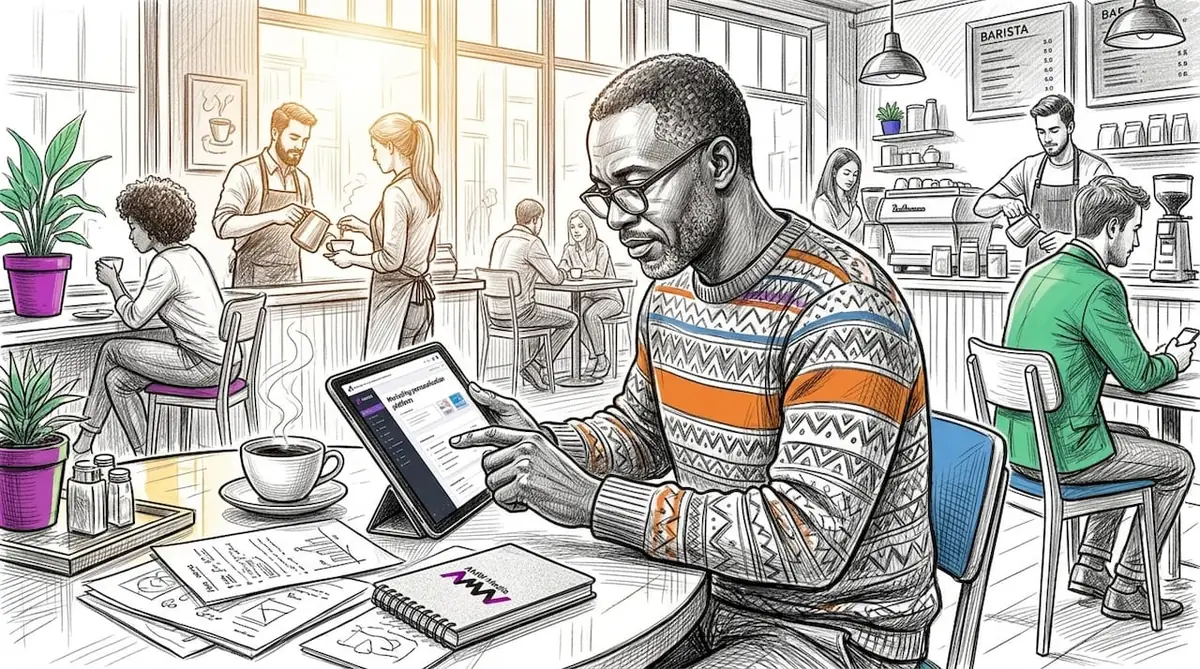
The mechanics are simple. A brand collects data from multiple touchpoints: website visits, purchase history, email engagement, social media behaviour, and CRM records. That data feeds into a marketing automation platform or AI engine, which then determines the most relevant message, product, or experience for each individual at that moment. The result is a customer who sees content that feels written specifically for them, because it essentially was.
71% of consumers expect personalised interactions, and 76% report frustration when they do not receive them. That frustration translates directly into lost revenue and weakened brand loyalty. Getting personalisation right is no longer a competitive advantage. For most industries, it is the baseline expectation.
How does personalisation differ from segmentation and targeting?
These three terms are often used interchangeably, but they describe fundamentally different activities. Understanding the distinction helps you build a strategy that actually works rather than one that just sounds good in a brief.
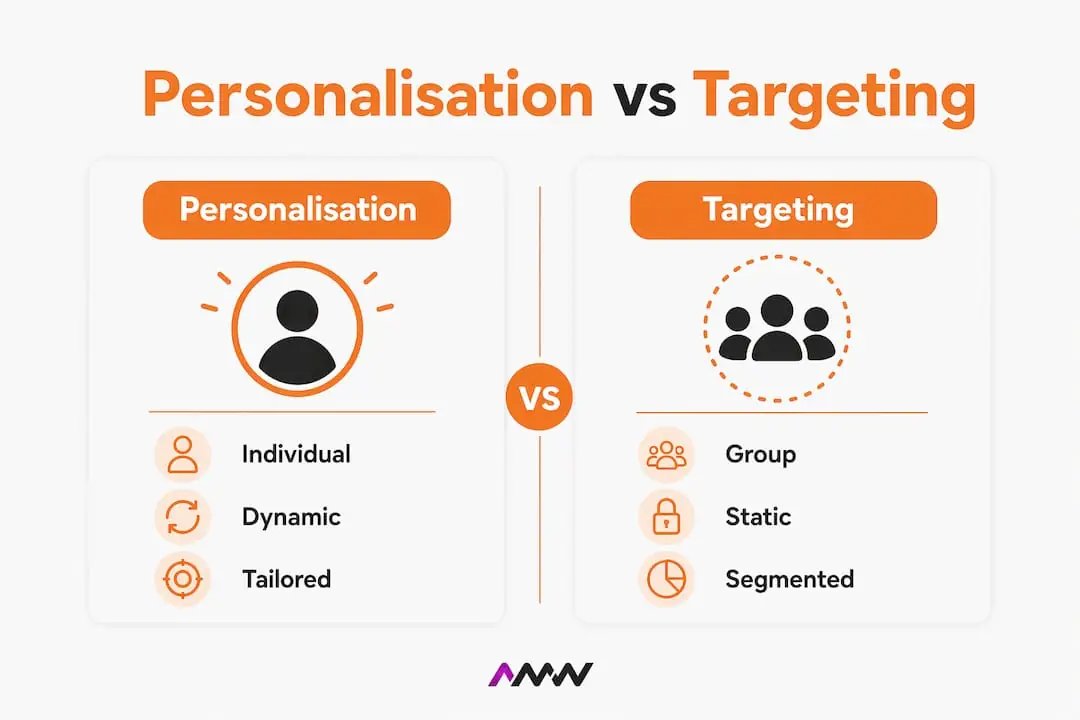
Segmentation groups customers by shared characteristics. Age, location, income bracket, and purchase frequency are classic examples. A clothing retailer might segment its database into “women aged 25 to 34 in London” and “men aged 35 to 44 in Manchester.” Segmentation is a planning tool. It tells you who your audience broadly is.
Targeting takes segmentation one step further by selecting which segments to focus a specific campaign on. The retailer above might decide to run a winter coat campaign targeting only the London women’s segment. Targeting is a selection tool. It tells you who to speak to for a given campaign.
Personalisation operates at the individual level. As LatentView’s marketing glossary confirms, personalisation tailors messages uniquely based on each person’s behaviour and intent, not just their demographic profile. The same retailer would show one customer a wool coat she browsed last Tuesday, and show another customer a waterproof jacket based on her recent searches for hiking gear. Same segment, completely different messages.
Here is a quick comparison to make this concrete:
| Concept | Unit of focus | Data used | Example |
|---|---|---|---|
| Segmentation | Group | Demographics, firmographics | “Women aged 25 to 34 in London” |
| Targeting | Segment | Campaign goals, segment fit | “Run winter ads to London women” |
| Personalisation | Individual | Behaviour, intent, real-time context | “Show Sarah the coat she viewed on Tuesday” |
The practical implication is this: segmentation and targeting are prerequisites for personalisation, not substitutes for it. You need to know your segments before you can personalise within them.
What are the key types of marketing personalisation?
Marketing personalisation covers four main techniques: behavioural, contextual, demographic, and predictive. Each serves a different purpose, and the most effective strategies combine several of them.
Behavioural personalisation responds to what a customer has actually done. Pages visited, products viewed, emails opened, and purchases made all feed into this. Amazon’s “customers who bought this also bought” engine is the most recognisable example in the world.
Contextual personalisation uses situational data: device type, location, time of day, and weather. A coffee brand serving a mobile ad at 7:45am on a rainy Tuesday morning in Birmingham is using contextual signals to make its message land harder.
Demographic personalisation uses profile attributes such as age, gender, job title, and industry. B2B platforms like LinkedIn use this extensively, showing different content to a junior marketer versus a chief marketing officer.
Predictive personalisation uses AI and machine learning to anticipate what a customer will want next, before they have expressed it. Spotify’s Discover Weekly playlist is predictive personalisation at its most elegant. It does not ask you what you want. It works it out from your listening patterns.
A fifth category is now emerging rapidly: hyper-personalisation. Generative AI enables brands to create custom tone, imagery, and copy at scale, producing content that feels hand-crafted for each individual even when it is generated automatically. This is where AI in content creation is having its most significant commercial impact right now.
Pro Tip: Use progressive profiling to build richer customer data without overwhelming people with long forms. Ask one relevant question per interaction, and your data quality improves steadily with minimal friction. HubSpot’s research confirms this approach increases data accuracy while reducing drop-off rates.
What are the benefits of marketing personalisation?
The business case for personalised marketing is well established and backed by hard numbers. Companies that excel at personalisation generate up to 40% more revenue than their peers. That is not a marginal uplift. It is the kind of gap that separates market leaders from everyone else.
The benefits break down across three areas:
Customer engagement. Personalised content earns more attention because it is relevant. A generic email blast competes with everything else in an inbox. A message that references a customer’s recent behaviour, current needs, or stated preferences cuts through. Open rates, click-through rates, and time on site all improve when content is specific.
Conversion and revenue. Relevant offers convert at higher rates. When a customer sees a product that matches their demonstrated intent, the decision to buy requires less persuasion. Personalised product recommendations, dynamic landing pages, and specific PPC ads all shorten the path from awareness to purchase.
Retention and lifetime value. Customers who feel understood stay longer. The 77% of business leaders who link personalisation to retention are not being sentimental. They are recognising that switching costs are lower than ever, and the only reliable way to keep customers is to make every interaction feel worth their time.
There is, however, a genuine risk on the other side of this. Overuse of invasive tracking creates what marketers call the “creepy factor.” A customer who sees an ad for a product they mentioned in a private conversation, or who receives a retargeting message within seconds of leaving a website, does not feel understood. They feel watched. Prioritising zero-party and first-party data is the most effective way to build trust while still delivering relevant experiences.
Pro Tip: Be transparent about how you use customer data. A simple preference centre where customers can tell you what they want to hear about builds trust and gives you higher-quality data than any tracking pixel ever will.
How to implement marketing personalisation effectively
Implementation is where most personalisation strategies either succeed or stall. The technology exists. The challenge is connecting data, content, and delivery in a way that actually scales.
Step 1: Unify your customer data
Personalisation is only as good as the data behind it. Most businesses hold customer data across multiple disconnected systems: a CRM like Salesforce or HubSpot, an e-commerce platform, an email tool, and a web analytics suite. A customer data platform (CDP) connects these sources into a single profile for each individual. Without this foundation, personalisation efforts produce inconsistent and sometimes contradictory experiences. Data-driven marketing starts here, at the data layer, not at the campaign layer.
Step 2: Choose the right automation platform
Once your data is unified, you need a platform that can act on it in real time. HubSpot, Salesforce Marketing Cloud, Klaviyo, and Braze are all capable of delivering personalised messages across email, SMS, web, and paid channels simultaneously. The right choice depends on your existing tech stack, budget, and the complexity of the journeys you want to build.
Step 3: Build and test personalised content
Start with the highest-traffic, highest-value touchpoints. Homepage hero banners, email subject lines, and product recommendation modules are good starting points. Create variants for different behavioural segments and run A/B tests to measure impact. Marketing analytics is the discipline that turns these tests into reliable performance improvements over time.
Step 4: Measure with the right KPIs
The metrics that matter for personalisation are different from those for broadcast marketing. Track conversion rate by segment, revenue per email, repeat purchase rate, and customer lifetime value. These tell you whether personalisation is actually changing behaviour, not just generating impressions.
Common pitfalls to avoid
- Over-relying on third-party cookies and invasive tracking, which are increasingly blocked and legally restricted across the UK and EU.
- Personalising too aggressively too early in the customer relationship, before trust is established.
- Treating personalisation as a one-time campaign rather than an ongoing capability that improves with data over time.
- Neglecting the creative side. Personalisation without good copy and design still produces mediocre results.
Automated marketing strategies can help you scale these efforts without proportionally scaling your team.
What does the future of marketing personalisation look like?
The next wave of personalisation is being driven by generative AI and what McKinsey describes as “agentic orchestration.” This refers to AI systems that go beyond responding to customer behaviour and actively coordinate the entire customer journey in real time, adjusting content, timing, channel, and offer simultaneously based on live signals.
Several trends are shaping where this goes next:
Generative AI at scale. Brands can now produce thousands of personalised content variants automatically, each with a distinct tone, visual style, and message. What previously required a large creative team can now be produced by a single marketer with the right tools.
Zero-party and first-party data dominance. With third-party cookies largely gone and privacy regulations tightening under the UK GDPR and EU’s ePrivacy Directive, brands that have invested in direct data relationships with their customers hold a significant structural advantage.
Real-time journey orchestration. The gap between a customer action and a brand response is collapsing. AI systems can now detect a drop in engagement, identify the likely cause, and trigger a recovery sequence within minutes, without human intervention.
Predictive content matching. Rather than showing customers what they have already expressed interest in, predictive models are getting good enough to surface content that customers did not know they wanted yet.
“The next frontier of personalised marketing is not just knowing your customer. It is anticipating them.” McKinsey, 2026.
The brands that will lead in this environment are those investing now in their data infrastructure, AI capabilities, and first-party data relationships. Technology upgrades in these areas are not optional extras. They are the foundation of competitive marketing in 2026 and beyond.
Key takeaways
Marketing personalisation delivers measurable commercial results when it is grounded in unified customer data, delivered through the right automation platforms, and balanced with genuine respect for customer privacy.
| Point | Details |
|---|---|
| Personalisation vs segmentation | Personalisation operates at the individual level using real-time behaviour, not just group demographics. |
| Revenue impact | Companies excelling at personalisation generate up to 40% more revenue than peers. |
| Data foundation first | Unifying customer data across CRM, e-commerce, and analytics tools is the prerequisite for effective personalisation. |
| Privacy and trust | Zero-party and first-party data strategies outperform invasive tracking for both compliance and customer trust. |
| AI is accelerating the field | Generative AI and agentic orchestration are enabling real-time, hyper-personalised experiences at scale. |
Why I think most brands are personalising the wrong things
Most of the personalisation I see in the wild is surface-level. A first name in an email. A retargeted ad showing the exact product someone already bought. A “recommended for you” section that recommends the same three items regardless of what you actually do on the site. This is not personalisation. It is the appearance of personalisation, and customers can tell the difference.
The brands getting this right are not necessarily the ones with the biggest budgets. They are the ones that have asked a more interesting question: not “how do we use data to sell more?” but “how do we use data to be useful?” That shift in framing changes everything. It changes what data you collect, how you use it, and what you measure.
The ethical dimension matters more than most marketing teams acknowledge. Under UK GDPR, customers have real rights over their data, and regulators are paying attention. But beyond compliance, there is a simple business case for ethical data use: customers who trust you share more data, engage more deeply, and stay longer. The “creepy factor” is not just a PR risk. It is a revenue risk.
My honest advice is to start smaller than you think you need to. Pick one high-value customer journey, unify the data for that journey, and personalise it properly. Measure the impact. Then expand. The brands that try to personalise everything at once usually end up personalising nothing well.
AI is transformative here, but it is not a substitute for understanding your customer. The best personalisation I have seen combines machine-generated relevance with human creative judgement. Neither alone is enough.
Amir
How AMW Media can help you build a personalised marketing strategy
Personalised marketing works best when strategy, data, and creative execution are aligned from the start. AMW Media builds specific marketing programmes for ambitious brands, combining social media management with audience-specific targeting, SEO services that surface the right content to the right searcher, and PPC campaigns built around individual intent signals. Starting from scratch or looking to sharpen an existing strategy: the team brings the technical depth and creative thinking to make personalisation actually perform.
Get in touch with AMW Media to discuss how a custom personalised marketing strategy can drive measurable results for your brand.
FAQ
What is the simplest definition of marketing personalisation?
Marketing personalisation is the practice of using individual customer data to deliver targeted messages, offers, and experiences rather than generic broadcast content. It operates at the individual level, not the segment level.
How is personalisation different from targeted marketing?
Targeted marketing selects which audience segments to reach with a campaign. Personalisation goes further by tailoring the specific message or experience for each individual within that audience, based on their behaviour and intent.
What data do you need to start personalising marketing?
The most valuable starting points are first-party data sources: website behaviour, purchase history, email engagement, and CRM records. Zero-party data, information customers share directly through preference centres or surveys, is equally valuable and fully privacy-compliant.
Does marketing personalisation work for small businesses?
Yes. Email platforms like Klaviyo and Mailchimp offer behavioural personalisation features accessible to businesses of any size. Starting with personalised email sequences based on purchase behaviour or browsing history delivers measurable results without requiring enterprise-level investment.
What are the risks of marketing personalisation?
The primary risks are the “creepy factor” from overly invasive tracking, data privacy breaches under UK GDPR, and poor personalisation that feels irrelevant or tone-deaf. Prioritising zero-party and first-party data mitigates most of these risks while maintaining campaign effectiveness.
Recommended
- What is storytelling in marketing: a 2026 guide | AMW Media
- Open up digital growth with custom marketing strategies | AMW Media
- What is omnichannel marketing: a 2026 guide | AMW Media
- How to master your digital marketing process for 2026
Our free marketing audit looks at your site, your ads and your content, and comes back with a 30 day plan. No pitch deck.

Runs the content calendars and the community side of every social account, and keeps clients posted on what is going out and when. Meet the team.