
 Black Steel Doors
 Woodstock Campers
 Phillips Joinery
TL;DR:
- Data-driven marketing uses real data to inform targeting, messaging, and budget allocation for measurable growth.
- Personalisation and real-time optimisation significantly improve campaign effectiveness and efficiency.
- Combining traditional brand awareness tactics with data-driven methods creates balanced, impactful marketing strategies.
Most marketing teams believe they have good instincts. They trust their gut on campaign timing, creative direction, and audience targeting. But instinct alone is an expensive gamble. Personalised campaigns boost conversions by 32%, and that figure comes from measurable, repeatable strategy, not intuition. The brands pulling ahead in 2026 are those that treat data not as a reporting afterthought but as a creative and strategic input from the very start. In this article, we will explain what data-driven marketing actually means, why it outperforms gut-feel approaches, how it stacks up against traditional methods, and how you can build a practical framework that delivers real, measurable growth for your brand.
Key Takeaways
| Point | Details |
|---|---|
| Personalisation drives results | Brands using personalised, data-driven strategies achieve up to 32% more conversions. |
| Data fuels faster growth | Companies focused on data grow 2.5 times faster than those relying on intuition alone. |
| Balance data and creativity | Most successful brands combine data insights with creative marketing for optimal results. |
| Traditional still has a place | Broad awareness campaigns can complement precise, data-led targeting in modern strategies. |
What is data-driven marketing and why does it matter?
Data-driven marketing is the practice of using real audience and performance data to inform every stage of a campaign: from targeting and messaging to channel selection and budget allocation. It is not a new concept, but the tools available today have made it dramatically more accessible and powerful. Where marketers once relied on broad demographic assumptions, they can now act on behavioural signals, purchase history, real-time engagement, and predictive modelling.
At its core, data-driven marketing combines three elements: technology that collects and stores data, analytics that surfaces meaningful patterns, and creative thinking that turns those insights into compelling campaigns. Remove any one of those three and the whole system weakens. Data without creativity produces bland, mechanical campaigns. Creativity without data produces beautiful work that may miss its audience entirely.
The business case is clear. Data-driven firms grow 2.5x faster than those operating on assumptions. That growth comes from making fewer costly mistakes and doubling down on what actually works. The benefits of digital marketing multiply significantly when underpinned by a strong data strategy, because every channel becomes accountable and every pound spent can be justified.
Here are the core components that define a mature data-driven marketing operation:
- First-party data collection: Building your own audience data through website interactions, email sign-ups, and CRM systems
- Attribution modelling: Understanding which touchpoints actually drive conversions rather than assuming last-click wins
- Audience segmentation: Dividing your audience into meaningful groups based on behaviour, intent, or lifecycle stage
- Real-time optimisation: Adjusting campaigns mid-flight based on live performance signals
- Cross-channel integration: Connecting data across paid, organic, email, and social to see the full customer journey
“The goal is not to collect more data. The goal is to ask better questions of the data you already have.”
Pro Tip: Start with the data you already own. Most brands have untapped value in their CRM, website analytics, and email platform. Audit those sources before investing in new data tools.
Many marketing teams assume they need sophisticated technology before they can start. In practice, a disciplined approach to interpreting existing data is often more valuable than adding another platform to an already crowded tech stack. The discipline comes first. The technology follows.
Key advantages: Measurable, personalised, and smarter campaigns
With the foundational understanding established, it is essential to see how data-driven techniques translate to advantages you can measure, report, and scale.
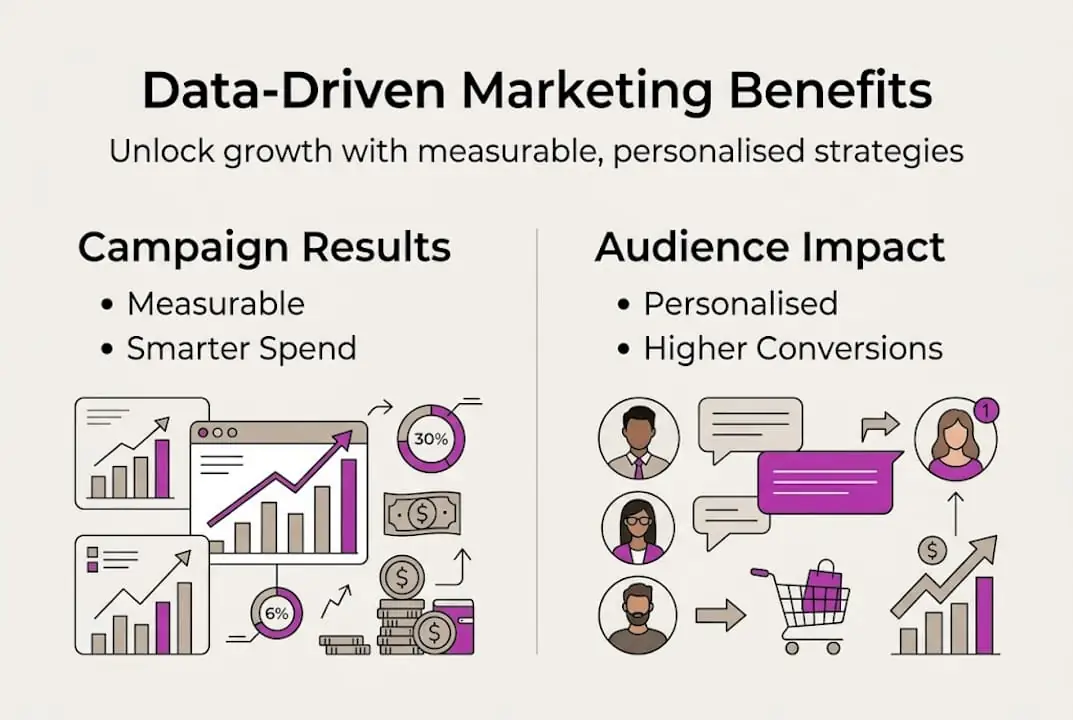
The most immediate benefit is measurability. Every campaign element, from the subject line of an email to the bid strategy on a paid search ad, can be tested, tracked, and improved. This removes the uncomfortable ambiguity of traditional marketing, where you knew half your budget was wasted but could never identify which half. With proper tracking in place, you know exactly what is performing and what is not.
The second major advantage is personalisation at scale. Personalised campaigns boost conversions by 32%, and this is not simply about using someone’s first name in an email. True personalisation means serving the right message, in the right format, at the right moment in the customer journey. That level of relevance requires data. Without it, you are broadcasting. With it, you are having a conversation.

The third advantage is smarter budget allocation. Rather than spreading spend evenly across channels, data-driven marketers concentrate resource where return is highest. This is where optimising marketing strategy becomes transformative. Small shifts in budget allocation, informed by performance data, can dramatically change campaign efficiency.
| Advantage | Traditional approach | Data-driven approach |
|---|---|---|
| Budget allocation | Based on historical habit or instinct | Based on real-time channel performance |
| Audience targeting | Broad demographic assumptions | Behavioural and intent-based segments |
| Campaign measurement | Estimated reach and awareness metrics | Trackable conversions and attributed revenue |
| Personalisation | One message for all | Dynamic content matched to audience segment |
| Optimisation speed | Post-campaign review | Continuous, in-flight adjustments |
Here is how ambitious brands typically progress through adopting data-driven advantages:
- Establish baseline measurement: Set up proper tracking across all channels before launching any new campaigns
- Identify your highest-value audience segments: Use existing data to find patterns among your best customers
- Test personalised messaging: Run A/B tests comparing generic versus segmented creative
- Reallocate budget based on evidence: Move spend toward proven performers rather than assumed ones
- Build a reporting rhythm: Review performance weekly to spot trends and act on them quickly
Real-world results back this up. Expedia used multi-channel data to identify which search and display combinations produced the best booking rates, then reallocated budget accordingly. Brands that invest in strengthening digital presence through data-informed decisions consistently outperform those that treat their online channels as isolated activities.
The bottom line: data-driven marketing does not just improve campaign performance. It changes the nature of how marketing decisions are made, shifting teams from reactive to proactive.
Data-driven or traditional: Which delivers better results?
Armed with the benefits, you may still wonder how data-driven marketing fares against more traditional approaches. The honest answer is that it depends on your goals, and the most effective brands use both thoughtfully.
Traditional marketing builds broad awareness, while data-driven excels in precision. A television advertisement can introduce your brand to hundreds of thousands of people in one evening. No programmatic display campaign matches that kind of cultural reach. However, that same television advertisement cannot tell you whether the viewer went on to make a purchase, searched your brand name, or simply changed the channel.
Here is a direct comparison of how the two approaches differ across the dimensions that matter most:
| Dimension | Traditional marketing | Data-driven marketing |
|---|---|---|
| Audience reach | Broad, mass audiences | Precise, intent-based segments |
| Measurement | Estimated, often delayed | Real-time, directly attributed |
| Cost efficiency | Higher fixed costs, less flexibility | Scalable, optimisable spend |
| Personalisation | Limited, generalised messaging | Highly targeted, dynamic content |
| Speed of insight | Weeks or months | Hours or days |
| Creative risk | High dependence on instinct | Tested and validated before scaling |
Traditional methods still play a powerful role in specific scenarios. Brand launches benefit from the emotional resonance of television or outdoor advertising. Events and sponsorships build community trust in ways that digital channels struggle to replicate. The mistake is treating them as competing philosophies rather than complementary tools.
The risk worth flagging is what happens when brands go too far in the other direction. Over-reliance on data, particularly when attribution models are incomplete or audiences are too narrowly defined, can lead to tunnel vision. You optimise for what you can measure and neglect what you cannot. Explore digital marketing strategies that blend both schools of thinking for a more solid outcome.
- Use traditional methods when: You are building broad brand awareness, entering a new market, or running a campaign with a strong emotional or cultural component
- Use data-driven methods when: You need measurable ROI, precise targeting, rapid iteration, or personalised customer experiences
- Use both when: You want to build brand equity while also driving measurable conversion activity
Pro Tip: Attribution modelling is the bridge between traditional and digital. Even if you run a traditional campaign, set up brand search tracking and direct traffic monitoring to capture the downstream digital impact it creates.
How to make data-driven marketing work for your brand
Having compared major approaches, let us turn theory into action with a guide to embedding data-driven strategies for your brand.
The most common mistake is starting with the tool rather than the question. Before selecting a platform, analytics suite, or automation system, your team needs to agree on what you are actually trying to learn and what decisions that learning should inform.
Here is a practical framework:
- Clarify your marketing goals: Define what success looks like in measurable terms. Not “increase brand awareness” but “achieve a 20% lift in branded search volume over six months”
- Audit your current data sources: Review what your website analytics, CRM, email platform, and paid channels are already tracking. Identify the gaps
- Select tools that connect your channels: Attribution platforms, tag management systems, and customer data platforms help unify signals across touchpoints
- Build your reporting infrastructure: Create dashboards that surface the metrics your team actually uses to make decisions, not vanity metrics that look impressive but drive no action
- Establish a testing rhythm: Run structured experiments regularly. Small, frequent tests compound into significant strategic advantage over time
- Monitor, adjust, and document: Treat every campaign as a learning opportunity. Record what worked, what did not, and why
Expedia used multi-channel attribution and real-time monitoring to optimise booking rates across paid search, display, and email simultaneously. The insight was not in any single channel. It was in understanding how the channels worked together.
“Data-driven marketing is not about having all the answers. It is about having a system that consistently asks the right questions.”
The role of digital content within this framework is often underestimated. Content generates first-party behavioural data. The pages users visit, the topics they engage with, and the formats they prefer all signal intent and interest that can inform everything from paid targeting to email segmentation.
Pro Tip: Avoid the trap of chasing too many metrics at once. Pick three to five key performance indicators that directly connect to revenue or growth, and build your reporting around those. Everything else is context, not priority.
Finally, be honest about your data quality. Incomplete tracking, misattributed conversions, and siloed data sets are the most common reasons data-driven strategies underperform. Custom marketing strategies built on clean, reliable data outperform generic approaches built on impressive-looking but flawed datasets every time.
Why many brands struggle with data-driven marketing
Most articles on data-driven marketing make the process sound simple. Set goals, collect data, optimise, repeat. But having worked with ambitious brands across a wide range of sectors, we know the reality is messier than any framework suggests.
The biggest obstacle is rarely technology. It is data quality. Teams discover mid-campaign that their tracking was misconfigured, their attribution model is flawed, or their audience segments overlap in ways that inflate performance numbers. By the time these issues surface, budget has already been misallocated.
The second obstacle is the false belief that data replaces creative judgement. It does not. Data tells you what happened. It rarely tells you why. And it almost never tells you what to do next. That gap requires human interpretation, strategic thinking, and creative boldness. The brands that treat data as a replacement for creative thinking produce campaigns that are technically optimised but emotionally flat.
Our view is this: data should make your creative team braver, not more cautious. When you know your audience deeply, you can take creative risks with confidence because you understand what resonates. If you are unsure where to start or feel your current strategy lacks cohesion, understanding how to choose a marketing company that bridges data and creativity is worth your time. The right partner does not just hand you a dashboard. They help you ask better questions of your data and build campaigns bold enough to stand out.
Open up your brand’s potential with expert data-driven marketing solutions
If you are ready to move beyond instinct and build a marketing operation grounded in evidence, the next step is finding the right support to get there faster. Our Oxford page starts with a number, 157 leads at £4.59 each for Cotswold Gloss, because that is the only part of an agency page you can check.
At AMW Media, we work with ambitious brands to design and deliver data-driven campaigns across PPC campaign management, web design services, and social media management. Our approach combines rigorous analytics with creative production, so your campaigns are not only measurable but compelling. Starting from scratch with your data strategy or looking to sharpen an existing setup: our team brings the strategic depth and creative firepower to make it work. Get in touch to discuss how we can help your brand grow with greater confidence and precision.
Frequently asked questions
What is the main purpose of data-driven marketing?
The main purpose is to use data to make smarter marketing decisions, personalise campaigns, and measure results for better brand growth. Data-driven firms grow 2.5x faster than those operating on assumptions alone.
How does data-driven marketing increase conversions?
Using customer data allows brands to personalise messages and timing, which can boost conversions by 32% compared to untargeted campaigns.
Can traditional marketing still be effective?
Traditional marketing builds broad awareness and emotional resonance that digital channels often struggle to match, making it particularly effective for brand launches and cultural campaigns.
What is a common pitfall in data-driven marketing?
Relying solely on raw data without proper attribution or context can lead to incomplete or biased conclusions, resulting in misallocated budgets and flawed strategic decisions.
Recommended
- The role of digital content in brand growth and engagement
- Key benefits of digital marketing for brand growth | AMW Media
- Open up digital growth with custom marketing strategies | AMW Media
- Proven content marketing examples to boost your brand | AMW Media
Our free marketing audit looks at your site, your ads and your content, and comes back with a 30 day plan. No pitch deck.

Runs the content calendars and the community side of every social account, and keeps clients posted on what is going out and when. Meet the team.