
 Black Steel Doors
 Woodstock Campers
 Phillips Joinery
TL;DR:
- Most brands have a marketing funnel, but few understand its true impact on customer journeys.
- Modern consumer behaviour is non-linear, with multiple touchpoints influencing conviction beyond traditional stages.
Most brands have a marketing funnel. Far fewer actually understand what theirs is doing. The model sounds simple on paper, a neat sequence from stranger to loyal customer, but in practice the picture is far messier. Prospects discover your brand through six different channels, disappear for three weeks, return via a retargeting ad, read two blog posts, and only then convert. The classic linear funnel is becoming less sufficient for complex, multi-touch customer journeys, and yet most marketing teams still plan and measure as though every prospect follows the same tidy path.
Key Takeaways
| Point | Details |
|---|---|
| Funnels visualise journeys | A marketing funnel helps you see and improve your customer’s path from discovery to purchase. |
| Modern behaviours are complex | Today’s customer journeys are less linear and need data-driven, flexible funnel strategies. |
| Stage optimisation is crucial | Optimising each funnel stage increases engagement and boosts conversions. |
| Measure more than last click | Effective attribution now tracks all influential interactions, not just the final action. |
| Adapt for lasting results | Stay ahead by reviewing and updating your funnel approach regularly. |
What is a marketing funnel?
A marketing funnel is a model that maps how potential customers move from first hearing about your brand all the way through to making a purchase and, ideally, becoming repeat advocates. Think of it as a visual framework for understanding the customer journey: wide at the top where many people first encounter you, narrowing progressively as some drop out and only the most motivated reach the point of conversion. Our PPC agency Milton Keynes page opens with the check we run before touching any bid: what the account is actually counting as a lead.
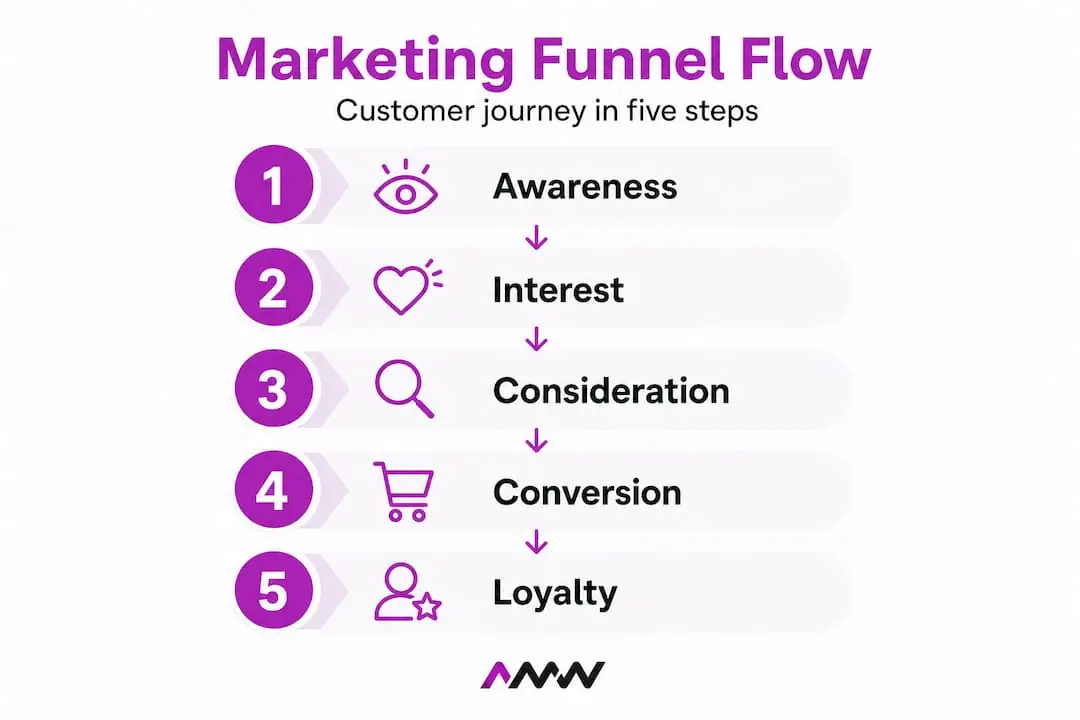
The traditional funnel is built on five core stages:
- Awareness: The prospect discovers your brand for the first time, perhaps through an organic search result, a social post, or a paid advertisement.
- Interest: They engage more deeply, following your account, reading your blog, or watching a product video.
- Consideration: They actively evaluate whether your offer suits their needs, comparing options and researching reviews.
- Conversion: They take the desired action, making a purchase, signing up, or requesting a quote.
- Loyalty: Post-purchase, they return, recommend your brand to others, and become a sustained source of revenue.
These stages give marketing professionals a shared language and a useful structure for planning campaigns, allocating budget, and identifying weak spots. The central purpose is threefold: visualise customer journeys, pinpoint exactly where people are dropping off, and optimise each touchpoint to improve overall conversion rates.
Here is a quick overview of each stage and the typical goals attached to it:
| Funnel stage | Primary goal | Common tactics |
|---|---|---|
| Awareness | Reach new audiences | SEO, paid social, PR, video |
| Interest | Deepen engagement | Email nurture, blog content, webinars |
| Consideration | Build preference | Case studies, testimonials, demos |
| Conversion | Drive action | Offers, landing pages, retargeting |
| Loyalty | Retain and grow | Loyalty programmes, personalisation |
The limitation, though, is significant. The classic linear funnel describes a step-by-step process that may no longer fully reflect how modern consumers actually behave. Real journeys skip stages, loop back, and are influenced by an ever-growing range of touchpoints that sit outside traditional funnel logic. Understanding those digital marketing strategies that account for this complexity is what separates high-performing brands from those that keep wondering why their funnel isn’t converting.
Classic funnel vs. modern journey: How things have changed
The classic funnel was built for a simpler era. A prospect would see a TV advertisement, visit a shop, speak to a salesperson, and buy. The sequence was reasonably predictable. Marketers could influence each stage in relative isolation because the number of touchpoints was limited and relatively easy to track.
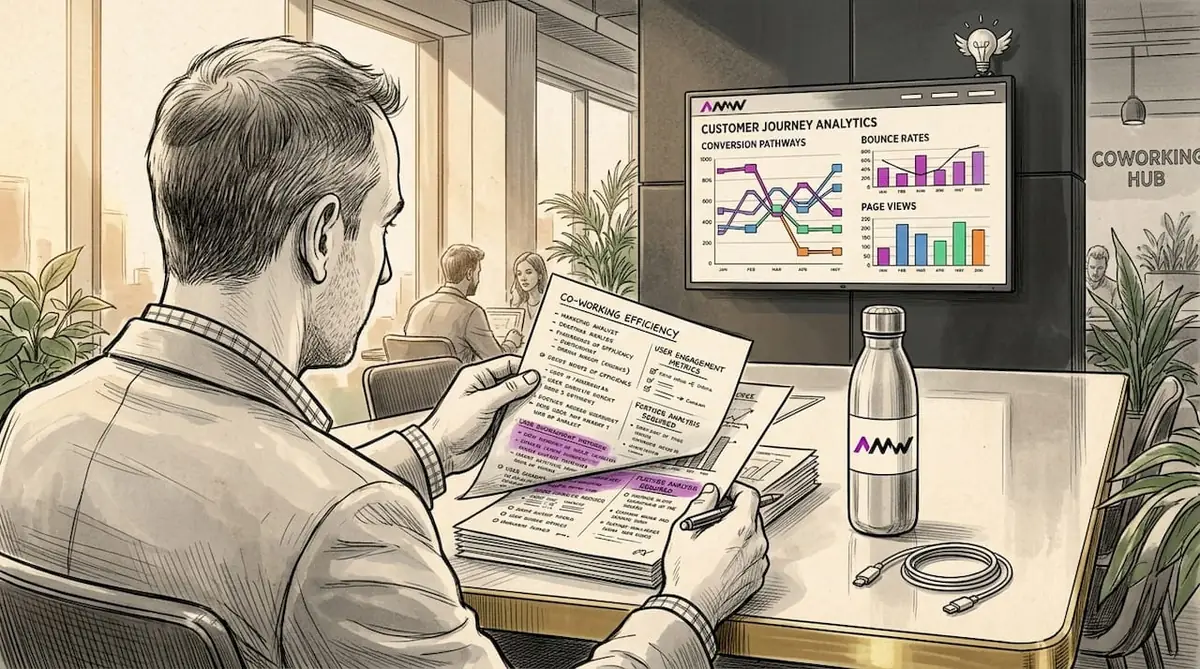
Today, that logic has been stretched to breaking point. A typical B2B buyer interacts with your brand across ten or more distinct touchpoints before signing a contract. A consumer making a considered purchase might watch YouTube reviews, ask for recommendations in a Facebook group, read your blog, browse a competitor’s site, land on a retargeted Instagram ad, and finally convert through a Google Shopping result. The sequence is rarely the same twice.
Here is a side-by-side comparison that illustrates just how much has shifted:
| Factor | Classic funnel | Modern customer journey |
|---|---|---|
| Path structure | Linear, sequential | Non-linear, looping |
| Number of touchpoints | 3 to 5 | 10 or more |
| Channels involved | 1 to 2 | Multiple, simultaneous |
| Decision timeline | Predictable | Highly variable |
| Attribution | Single source | Multi-touch, complex |
| Measurement | Stage completion | Behavioural signals |
What has emerged in response to this complexity is the idea of influence systems, a way of thinking about marketing that moves away from pushing people through predefined stages and instead focuses on the gradual building of conviction over time.
“Alternatives to the funnel, like ‘influence systems’, now focus on how conviction builds over time through various behavioural signals.”
This is a meaningful shift. Rather than asking “has this person reached the consideration stage?”, an influence system asks “how much conviction have we generated so far, and what signals tell us it’s growing?” This reframe changes how you create content, how you measure success, and how you allocate your budget across channels.
Pro Tip: Instead of tracking only large milestone actions such as form completions or purchases, build a tracking plan that captures micro-conversions: scroll depth, video completions, return visits, and content downloads. These behavioural signals are your earliest indicators of building conviction, and using analytics for complex funnels will reveal patterns that stage-completion data alone cannot show.
Key funnel stages and what happens at each point
Understanding that journeys are complex does not mean abandoning stage-based thinking altogether. The stages remain a useful lens. The difference is in how you interpret behaviour within them and what you choose to measure.
Here is a detailed breakdown of each stage, including the typical signals to watch and the key questions to ask:
Awareness: At this stage, a prospect encounters your brand for the first time. They may have found you through a search engine result, a social media post, a podcast mention, or a display advertisement. The key metric here is reach combined with quality. Not all impressions are equal. Pay attention to brand search volume, direct traffic growth, and the profile of new visitors landing on your site. If awareness campaigns are working, you will see a sustained increase in first-time visitors from your target audience segments.
Interest: The prospect is now paying attention. They might follow you on social media, subscribe to your newsletter, watch a product explainer video, or spend time reading your blog. Engagement rate, email open rate, and average session duration are your key indicators here. This stage is often underinvested because it is harder to attribute directly to revenue, but it is where brand preference begins to form.
Consideration: Now the prospect is actively evaluating. They are reading case studies, comparing pricing pages, watching demo videos, and potentially speaking to your sales team. Conversion events at this stage include requesting a demo, downloading a buyer’s guide, or spending significant time on product or service pages. This is where strong social proof, detailed content, and clear differentiation do the heaviest lifting.
Conversion: The prospect takes the intended action. For an ecommerce brand, this is a purchase. For a service business, it might be a signed proposal or a booked discovery call. The metrics are obvious: conversion rate, cost per acquisition, and average order value. But do not stop here. The quality of conversion matters as much as the quantity. Lead generation strategies that attract the wrong audience will produce low-value conversions that waste resource downstream.
Loyalty: This is the most underestimated stage in most marketing plans. Repeat customers cost significantly less to retain than new customers cost to acquire, and they tend to spend more over time. Measure repeat purchase rate, net promoter score, and customer lifetime value. Use personalised email sequences, loyalty incentives, and community-building content to deepen the relationship.
The catch with this stage-by-stage model is that multiple behavioural signals shape conviction, making it vital to observe actions throughout the entire journey rather than checking a stage-completion box and moving on.
Research consistently shows that the vast majority of prospects who enter the top of a funnel will never reach the bottom. Conversion rates vary widely by industry, but it is not uncommon to see only 1 to 3 percent of website visitors ultimately convert. This is not a failure of the funnel model itself. It reflects the reality that most people are not ready to buy on their first visit, and nurturing them intelligently over time is what eventually shifts the numbers.
Pro Tip: Many marketing teams obsess over bottom-funnel performance because it is closest to revenue. But neglecting your upper-funnel audience means you are constantly burning budget on expensive conversion campaigns aimed at people who have not yet built sufficient conviction to act. Invest in top-of-funnel content with discipline. It is a long game with compounding returns.
How to optimise every stage of your marketing funnel
Knowing your funnel stages is one thing. Systematically improving performance at each one is where the real work happens. Here are the most impactful tactics for each stage, drawn from what consistently delivers results for ambitious brands.
Awareness stage optimisation:
- Invest in organic search through high-quality, well-targeted content that answers the questions your ideal customers are already asking.
- Run top-of-funnel paid social campaigns focused on reach and video views rather than immediate conversions. Lower your expectations for short-term ROI here and focus on audience building.
- Explore partnerships, guest contributions, and earned media to expand your reach beyond your own channels.
- Use audience data from your existing customers to build strong lookalike audiences for paid campaigns.
Interest and engagement:
- Build an email nurture sequence that delivers genuine value rather than promotional content. Educational emails consistently outperform sales emails in terms of engagement and long-term conversion.
- Create content that serves different learning styles: blog posts, short-form video, long-form video, infographics, and audio. Prospects will engage through whichever format suits them.
- Use content marketing examples from your own sector to inform a content plan that resonates with your audience’s specific concerns.
Consideration stage tactics:
- Develop case studies and testimonials that speak directly to the objections your sales team hears most often. Generic social proof is far less effective than specific, relevant evidence.
- Offer comparison content and clearly. Prospects who are in the consideration stage are already doing this research. Being the brand that helps them do it builds trust.
- Use retargeting to serve consideration-stage content specifically to people who have already demonstrated interest through prior site visits or engagement.
Conversion optimisation:
- Audit your landing pages for friction. Every unnecessary form field, every slow loading time, and every confusing call-to-action is costing you conversions.
- Test different offer structures, whether free trials, money-back guarantees, or payment plans, to lower the perceived risk of taking the first step.
- Align your conversion copy with the specific language your audience uses when describing their problem. This requires listening, whether through customer interviews, reviews, or sales call recordings.
As the thinking behind modern funnels evolves, it is clear that conviction must accumulate through high-value touchpoints rather than being manufactured through a single persuasive push. A well-structured set of digital marketing growth strategies will account for this across every stage.
Pro Tip: Map your highest-performing content to specific funnel stages and look for gaps. Most brands have strong awareness content and decent conversion content, but a weak middle. The consideration stage is where many prospects make up their minds, and leaving it underdeveloped is one of the most common and costly oversights in funnel strategy.
From funnels to systems: Rethinking attribution and measurement
Even if you optimise every stage of your funnel meticulously, you will struggle to prove its impact if your measurement approach is outdated. Most brands still rely heavily on last-click attribution, which assigns all the credit for a conversion to the final touchpoint the customer interacted with before converting. This is wildly misleading.
Last-click attribution makes your paid search campaigns look like heroes and your content marketing look like an underperformer. In reality, the blog post that introduced your brand three months ago might have been the most influential moment in the entire journey. You simply cannot see it through a last-click lens.
Multi-touch attribution models distribute credit across all the touchpoints that contributed to a conversion, giving you a far more accurate picture of what is actually working. Common models include:
- Linear attribution: Equal credit to every touchpoint in the journey.
- Time decay: More credit to touchpoints closer to the conversion.
- Position-based: More weight on the first and last touchpoints.
- Data-driven: Uses machine learning to distribute credit based on actual conversion patterns.
The modern attribution approach requires seeing the funnel as a system of building conviction rather than a checklist of stages. This means tracking behavioural signals over time and connecting them to eventual conversion outcomes.
Common pitfalls to avoid in funnel analytics:
- Treating all traffic equally: Not all visitors are equal. Segment your analytics by acquisition channel, device type, and audience segment to surface meaningful patterns.
- Ignoring time lag: Many B2B sales cycles span weeks or months. If your attribution window is set to 7 days, you are missing the majority of your actual conversion data.
- Measuring activity instead of impact: Vanity metrics such as total impressions or page views tell you very little. Focus on metrics that correlate with revenue outcomes.
- Failing to connect your data sources: If your CRM, your analytics platform, and your ad accounts are not talking to each other, you are making decisions on incomplete information.
- Not reviewing regularly: Funnel performance changes as markets evolve, competitors shift strategy, and your audience’s behaviour shifts. What worked six months ago may not work now.
Investing in optimising your digital strategy for measurement is not a back-office task. It is a strategic priority that directly affects how confidently you can allocate budget. And the marketing analytics and ROI framework you build today will compound in value as you accumulate more data over time.
Why ‘funnel thinking’ might limit your marketing in 2026
Here is a perspective that might make some marketers uncomfortable. The funnel is not just a model. It is a way of thinking. And like any mental model, it shapes what you look for, what you optimise for, and ultimately what you miss.
When your entire team is trained to think in funnel terms, there is a subtle but significant risk. You start forcing messy, human behaviour into neat categories. You label a prospect as “consideration stage” when in reality they have been quietly consuming your content for four months, are deeply convinced, and simply need one more external trigger, perhaps a colleague’s recommendation or a timely email, to act. Putting them in a stage box misses the nuance entirely.
Funnel thinking can also create damaging silos. Your SEO team optimises for awareness. Your email team focuses on nurture. Your paid media team drives conversions. Each team measures success independently, and nobody has a complete view of the actual conviction-building journey. The result is messaging that feels disjointed to the prospect, even if it looks coherent in your marketing plan.
The movement between funnel stages is being replaced by a focus on engineering conviction with real behavioural evidence. Forward-thinking marketers in 2026 are asking different questions. Not “has this person reached the consideration stage?” but “what evidence do we have that their conviction is growing, and what is the best next touchpoint to accelerate it?”
This shift requires adaptability, cross-channel visibility, and a willingness to experiment outside of traditional funnel logic. It means testing channels and content formats that your attribution model cannot yet credit, because conviction often builds in places that are hard to measure. It means reviewing your funnel model regularly rather than setting it once and treating it as gospel.
The brands that build strong, loyal audiences in the years ahead will be those that focus on the quality of their influence system, not just the efficiency of their conversion funnel. Understanding the brand growth strategies that support this kind of thinking will be a genuine competitive advantage.
How AMW Media can help power your marketing funnel
Putting funnel strategy into practice requires more than a spreadsheet and good intentions. It demands the right mix of creative content, technical infrastructure, and data-driven thinking working in concert across every stage of the customer journey.
At AMW Media, we build and optimise marketing systems that work across the entire funnel. Our SEO services put your brand in front of high-intent audiences at the top of the funnel, while our social media management keeps prospects engaged and building conviction through the middle stages. When prospects are ready to convert, our website design and development ensures that every landing page, user flow, and call-to-action is built for performance. Starting from scratch or refining an existing strategy: we tailor every solution to your specific audience and commercial goals. Get in touch to start the conversation.
Frequently asked questions
Is a marketing funnel still relevant in 2026?
Yes, but today’s funnels are more flexible and need to reflect multi-touch, non-linear customer journeys. Classic funnels are becoming less sufficient for modern marketing without adaptation.
What are the main stages of a traditional marketing funnel?
The typical stages are awareness, interest, consideration, conversion, and sometimes loyalty or advocacy. The classic linear funnel describes these as a step-by-step process, though real journeys rarely follow this path exactly.
How can I measure the effectiveness of my marketing funnel?
Track key actions at each stage and use modern analytics to assess all customer touchpoints. Effective measurement means understanding how conviction builds from various behavioural signals at different stages, not just final conversions.
What is the biggest mistake marketers make with funnels?
Focusing only on lower-funnel conversions causes brands to miss valuable upper-funnel engagement and long-term relationship building. Conviction must accumulate gradually, and pushing users between predefined stages without addressing this is a costly oversight.
Are there alternatives to the funnel model?
Yes, some marketers use influence systems, which track how conviction builds over time rather than measuring linear stage progression. Conviction accumulates through ongoing behavioural signals rather than through a fixed sequence of steps.
Recommended
- Lead generation methods: proven strategies for sales growth | AMW Media
- Essential digital marketing guide: strategies for brand growth
- Creative campaign process: Step-by-step guide for growth | AMW Media
- Proven content marketing examples to boost your brand | AMW Media
Our free marketing audit looks at your site, your ads and your content, and comes back with a 30 day plan. No pitch deck.

Runs the content calendars and the community side of every social account, and keeps clients posted on what is going out and when. Meet the team.