
 Black Steel Doors
 Woodstock Campers
 Phillips Joinery
A lookalike audience is an algorithmically modelled group of people who resemble your best existing customers, built by a platform’s machine learning from a “seed” list you provide. Use it for prospecting when you want to scale past your current audience without guessing at interests. The one thing to do right now: check whether your seed is purchase based and reasonably sized, because a weak seed is the single biggest reason lookalikes underperform.
TL;DR:
- Using a purchase-based seed of at least 1,000 to 50,000 customers drastically improves the accuracy and stability of lookalike audiences.
- Google’s demand gen campaigns now blend lookalike signals with broader machine learning, reducing the strictness of similarity percentages.
- A 1% similarity setting yields the tightest targeting for small budgets, while 6 to 10% reaches broader audiences with less resemblance.
- Excluding existing customers and seed audiences from campaigns prevents wasting budget on already reached contacts and maintains targeting efficiency.
- Regularly refresh your seed audience and rotate creative every two weeks to prevent fatigue and sustain campaign performance over time.
Table of Contents
- How do lookalike audiences actually work?
- Which platforms support lookalike audiences in 2026?
- What makes a good seed audience for lookalikes?
- How do you choose the right similarity percentage?
- What are the best practices for running lookalikes long-term?
- Are lookalike audiences safe to use? Privacy and compliance basics
- An agency’s checklist for lookalike audiences that actually convert
- Want help running your lookalike campaigns properly?
- Sources
- FAQ
How do lookalike audiences actually work?
Every lookalike starts with a seed, which is simply the list of people the algorithm studies before it goes looking for strangers who resemble them, using machine learning in content marketing explained concepts to find the best matches. That seed might be a CRM export of paying customers, a list built from pixel purchase events, or an in-platform engagement audience such as people who watched 75% of your video.
The quality of that starting list matters more than almost anything else in the process, which is why seed selection gets its own section further down.
Once you upload or select a seed, the platform’s model looks at hundreds of signals attached to those people, things like page interactions, purchase history, device usage, and demographic patterns, and builds a statistical fingerprint. It then scans the wider user base and ranks everyone by how closely they match that fingerprint. The people at the top of that ranking become your lookalike audience. If you are weighing up paid advertising, our Milton Keynes PPC page explains why the cost per lead you have been shown is probably wrong.
This is fundamentally different from a custom audience. A custom audience is made of people you already know, past website visitors, email subscribers, past purchasers. You’re retargeting known contacts. A lookalike audience is made of complete strangers the algorithm has never seen interact with your brand. It’s a prospecting tool, not a retargeting one, and mixing up the two is one of the most common set-up mistakes marketers make.
Meta describes a lookalike audience as a way to reach new people likely to be interested in your business because they share characteristics with your existing customers. That’s the whole concept in one sentence, and it holds true across every platform that offers the feature.
The similarity slider (or percentage setting) controls how strict that matching process is:
- 1% means the platform only selects people who are an extremely close statistical match to your seed. Smaller pool, tighter fit.
- 3 to 5% loosens the match slightly, pulling in more people at a modest cost to precision.
- 6 to 10% casts a wide net, prioritising reach over tight resemblance.
Think of it like a dating app matching algorithm. A 1% setting is “only show me people who tick every box.” A 10% setting is “show me anyone who’s broadly in the right ballpark.” Neither is wrong, they just serve different jobs, which is exactly what the next section on similarity and scale digs into.
Which platforms support lookalike audiences in 2026?
Meta remains the most mature player here, and its lookalike tool still works roughly as described above, though the platform increasingly nudges advertisers toward Advantage+ campaigns where audience suggestions (including lookalike-style signals) get folded into a broader automated targeting layer rather than sitting as a standalone, rigid audience.
Google has made the biggest structural change for 2026. Lookalike segments inside Demand Gen campaigns now operate primarily as a suggestion signal rather than a hard similarity constraint, and advertisers can opt out if they want stricter control. In practice, this means Google’s system treats your lookalike seed as one input among many, blending it with its own machine learning rather than restricting delivery purely to that percentage band you set. It’s a meaningful shift from how lookalikes used to behave, and it explains why some advertisers have seen reach patterns change without touching a single setting.
Elsewhere, the landscape is a mixed bag:
- TikTok and Pinterest continue offering lookalike-style audience tools, largely unchanged in mechanics.
- Snapchat still supports the feature for advertisers running prospecting campaigns.
- Display & Video 360 retains lookalike functionality for programmatic buyers running larger, multi-channel campaigns, as confirmed in Google’s DV360 documentation.
- LinkedIn discontinued its lookalike product in 2024, leaving B2B marketers to lean on firmographic targeting or third-party enrichment tools instead.
Quick stat: industry guides consistently point to 1% audiences delivering the tightest precision, with 3 to 10% ranges used deliberately for broader discovery, and testing set-ups that avoid splitting the learning signal (one campaign using suggestion mode, rather than five parallel ad sets) tend to outperform the old multi-tier approach.
The practical takeaway: if you’re running Demand Gen campaigns, stop assuming your lookalike percentage is a hard rule. Treat it as guidance and watch your reporting closely for the first fortnight of any new campaign, because delivery patterns may shift compared to what you’re used to.
What makes a good seed audience for lookalikes?
Purchase-based seeds are the gold standard, full stop. A list built from people who’ve actually bought something, especially high lifetime value customers, gives the algorithm the cleanest signal possible: “find me more people who behave like buyers,” not “find me more people who once clicked something.”
Engagement and pixel-based seeds are the sensible fallback when you don’t have enough purchase data yet. Video viewers, add-to-cart events, page visitors who spent over a minute on a product page, these all work as proxies for intent even if they’re a step removed from an actual sale. Meta’s own in-platform engagement seeds, such as video viewers or page followers, often perform particularly well because that data lives entirely inside the platform’s own signal surface rather than arriving via an uploaded list, which matters more since Apple’s App Tracking Transparency changes limited cross-platform tracking.
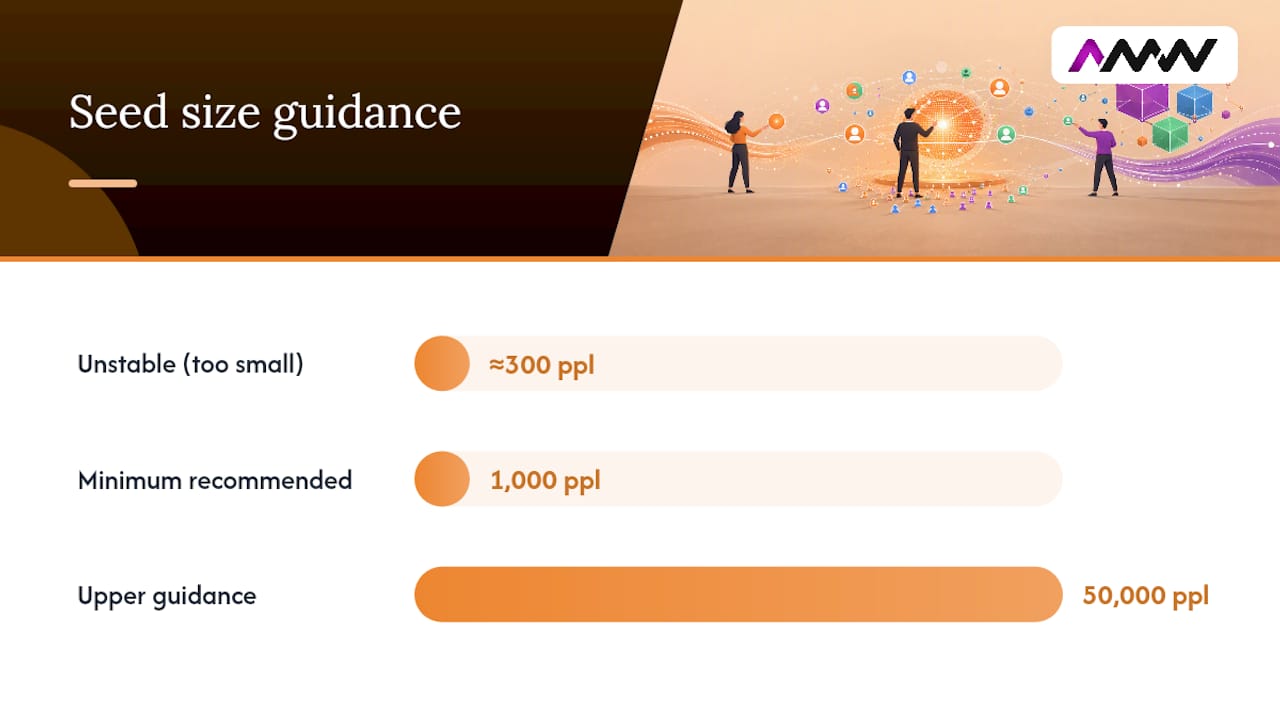
On minimums, Meta recommends seed sizes between 1,000 and 50,000 people for the most reliable modelling. Anything under a few hundred tends to produce unstable, noisy matches because the algorithm simply doesn’t have enough pattern to work with.
If you’re short on purchase data, here’s a practical build order:
- Start with your highest-intent event. Purchasers first, then checkout starts, then add-to-carts.
- Combine smaller events if needed. A pooled list of add-to-cart plus checkout-start events can hit your minimum faster than waiting for pure purchase data to accumulate.
- Weight by value where the platform allows it. Some tools let you prioritise higher LTV customers within the seed, sharpening the match further.
- Deduplicate and clean formatting before upload. Mismatched email formats or duplicate rows quietly shrink your effective seed size without you noticing.
- Set a refresh cadence. Monthly is a sensible default, or sooner if your customer base shifts by more than roughly 10% in a short period.
Pro Tip: Don’t upload your entire customer database as one giant seed and call it done. Split high-LTV repeat buyers into their own seed and build a separate lookalike from that group; it usually outperforms a seed diluted with one-off, low-value purchasers.
How do you choose the right similarity percentage?
This is where most of the real trade-off decisions happen, and it’s worth treating as a proper test rather than a guess.
A 1% lookalike gives you precision at the cost of scale, which suits a mid-size advertiser with a modest daily budget who needs every pound working hard. A 10% lookalike gives you volume, useful when you’re trying to fill a large campaign or feed a broader upper-funnel strategy, but the trade-off is a looser resemblance to your actual best customers.
For testing, two approaches work well:
- Single campaign using audience suggestion mode. Let the platform’s own optimisation blend your lookalike signal with its broader learning. This tends to preserve signal strength better than splitting budget across tiers, an insight Google’s own Demand Gen documentation backs up directly.
- Parallel percentage ad sets, budget permitting. Run 1%, 3%, and 7% side by side with identical creative and a large enough daily spend that each set can exit the learning phase. This costs more but gives you a cleaner read on where your particular audience’s sweet spot sits.
Track cost per acquisition as your headline metric, but don’t ignore frequency and audience overlap, both will tell you if you’re burning through your matched pool too fast. Compare CPA against your standard interest-based campaigns running the same creative; if lookalikes aren’t beating interest targeting after a fair testing period, the seed is probably the problem, not the concept.
One rule that’s easy to skip and costly when you do: always exclude your source seed and any existing customers from the lookalike campaign. Without that exclusion, you’re just paying to re-target people you already reached for free.
What are the best practices for running lookalikes long-term?
Lookalike campaigns aren’t a “set it and forget it” tool. They degrade, and knowing the warning signs saves you from quietly wasting budget for weeks.
Creative fatigue hits lookalike audiences faster than most marketers expect, since the pool is finite and frequency climbs quickly once you’ve exhausted the most obvious matches. Rotate creative every couple of weeks at a minimum, and watch frequency data closely; once it climbs past 3 to 4 for a cold prospecting audience, performance usually starts sliding.
Budget allocation should follow the platform’s own learning phase rather than fighting it. Give a new lookalike campaign enough spend and time to exit learning before judging it, then scale gradually rather than doubling budget overnight, which tends to reset the learning phase and cost you the progress you’d already made.
Layering demographic or interest filters on top of a lookalike audience is tempting but often counterproductive. It shrinks an already-modelled pool further, sometimes below a size the algorithm can optimise well against. It’s usually worth avoiding unless you have a specific business reason (age-restricted products, geographic limits) that makes the narrowing unavoidable.
Some practical maintenance habits:
- Rotate creative on a fixed schedule, don’t wait for performance to visibly drop first.
- Watch for rising CPA alongside rising frequency, that combination is the clearest rebuild signal.
- Rebuild the seed whenever your customer base shifts meaningfully, a new product line, a price change, a new market.
- Feed converted lookalike traffic into a proper retargeting sequence so first-time buyers get nurtured rather than dropped after one purchase.
Pro Tip: Set a calendar reminder to review lookalike seed freshness monthly. It takes ten minutes and catches the slow, invisible decay that quietly inflates CPA over a quarter.
Are lookalike audiences safe to use? Privacy and compliance basics
Platforms build these tools within advertising policy frameworks that prohibit discriminatory targeting, particularly around housing, employment, and credit categories. If your business touches any of those regulated categories, check the platform’s specific policy before building a lookalike, because the restrictions apply to the resulting audience even though the modelling itself is automated.
When your seed is too small to hit recommended minimums, don’t force it. Fall back on:
- Event-based proxies such as add-to-cart or checkout-start actions, which give the model more raw material than a tiny purchaser list alone.
- Interest-based targeting as a temporary bridge until your seed data accumulates naturally.
- Pooled or enriched audience products, where available, which can supplement a thin first-party list.
Data hygiene is a compliance issue as much as a performance one. Uploaded lists should be hashed before they leave your systems, consent for marketing use should be documented, and you should only upload the minimum data needed for matching rather than an entire customer database’s worth of fields. If a seed audience has gone stale, sitting untouched for months while your customer base has changed, treat that as a signal to refresh it rather than trusting an old model to still reflect who you’re trying to reach today.
An agency’s checklist for lookalike audiences that actually convert
The theory is simple. What separates campaigns that work from ones that quietly burn budget is discipline in the boring bits: seed quality, exclusion hygiene, and patience through the learning phase.
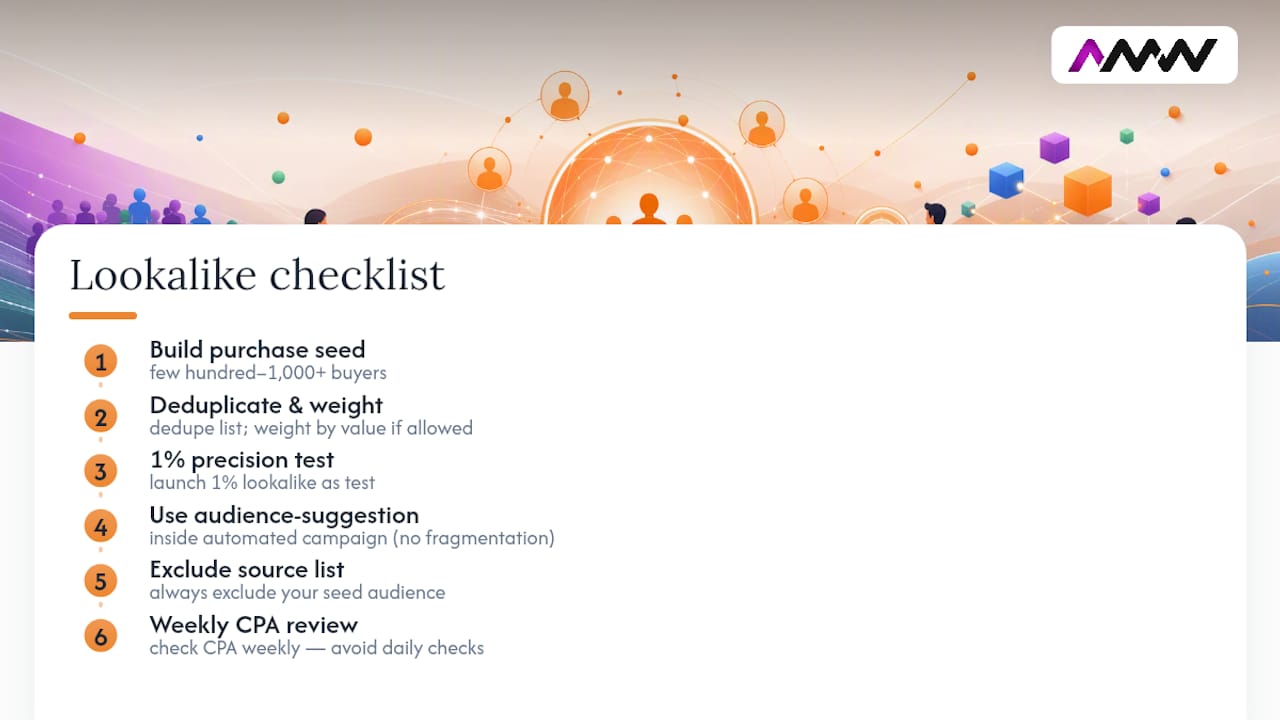
A repeatable checklist looks something like this: build a purchase-based seed of at least a few hundred to a thousand-plus buyers where possible, deduplicate it properly, weight by value if the platform allows it, launch a 1% lookalike as your precision test, run it through audience-suggestion mode inside an automated campaign rather than fragmenting spend across five tiers, exclude your source list without exception, and check CPA weekly rather than daily (daily checks tempt you into premature panic-edits that reset learning).
One anonymised example from agency work: a mid-size retail client’s cold prospecting had stalled on broad interest targeting. The seed was the lever, not the ad copy.
If you want a wider primer on how audience strategy fits together before layering in lookalikes, our guide on audience targeting covers the groundwork.
Amir
Want help running your lookalike campaigns properly?
Building a clean, high-LTV seed and testing it without wasting three months of budget on the wrong percentage split is exactly the kind of unglamorous work that separates a decent lookalike campaign from a profitable one, and it’s not a five-minute job when you’re doing it alongside everything else running a business demands.
Amwmedia’s PPC management service handles the full cycle: seed preparation, similarity testing, creative rotation, and the weekly monitoring that catches audience fatigue before it shows up as a worrying CPA graph. A typical engagement starts with an audit of your existing customer data and pixel events to work out what seed material you actually have to work with, then moves into a structured testing plan rather than guesswork. If your landing pages need attention to convert that new lookalike traffic once it lands, our web design team can sort that too. Consider reaching out to an expert for an assessment of where your current targeting stands and what a proper lookalike strategy would look like for your budget.
Sources
For platform-specific setup steps, Meta’s own lookalike audience guidance and Google’s Demand Gen support pages are the primary references worth bookmarking. Salesforce’s lookalike audience guide and the Wikipedia entry on lookalike audiences both offer useful background on seed theory. For related strategy on our own blog, see our pieces on TikTok targeting recipes and social media campaign growth.
- About Lookalike Audiences | Meta Business Help Centre
- How lookalike segments work in Demand Gen (Google Ads support)
- What is a Lookalike (LAL) Audience? A Complete Guide, Salesforce
FAQ
What is a lookalike audience?
A lookalike audience is a group of new people an advertising platform identifies because they statistically resemble an existing customer list you provide, known as the seed.
What is the difference between a custom audience and a lookalike audience?
A custom audience is built from people you already know, past customers, website visitors, email subscribers, while a lookalike audience is made up of strangers the algorithm matches to that known group’s characteristics.
Does Meta still have lookalike audiences?
Yes, Meta continues to support lookalike audiences, though it increasingly encourages advertisers to use them as one signal within broader Advantage+ automated campaigns rather than as a rigid standalone audience.
What are the four types of target audiences?
Definitions vary across marketing frameworks, but a common grouping covers demographic, geographic, psychographic, and behavioural audiences, with lookalike and custom audiences typically built by combining behavioural and demographic data.
How small can a seed audience be and still work?
Meta recommends seeds between 1,000 and 50,000 people for reliable results, and audiences below a few hundred tend to produce unstable, unreliable matches.
Recommended
- Creative branding ideas list: top strategies for 2026
- Creative content production steps for marketing success in 2026
- Why use agency services to grow your brand in 2026
- The role of creative agencies in digital brand growth
Our free marketing audit looks at your site, your ads and your content, and comes back with a 30 day plan. No pitch deck.

Founded AMW Media in 2024 and runs strategy, paid media and the CRM builds. The reason everything here is in house and measured in revenue. Meet the team.