
 Black Steel Doors
 Woodstock Campers
 Phillips Joinery
Targeting on TikTok sets the eligible pool of people your ad can reach, but creative and the platform’s algorithm decide who inside that pool actually converts. The one rule that matters more than any dimension you select: start broad or automatic to seed data, then refine with custom and lookalike audiences once you have real conversions to build from. Everything below shows you how to put that into practice.
TL;DR:
- Broad or automatic targeting should be used initially to gather data, as narrow audiences often hinder the platform’s learning process and slow down results.
- Interest, behaviour, and device targeting should be limited to two or three layers per ad group to prevent audience shrinkage and attribution issues.
- Creative performance signals often weigh more than audience filters, making strong hooks crucial in grabbing the algorithm’s attention early.
- Running separate ad groups for cold, warm, and hot audiences helps prevent audience overlap and ensures targeted messaging for each segment.
- Automated and machine learning-driven targeting tools are increasingly effective, but manual exclusions and control should be maintained for retargeting and high-precision campaigns.
What is TikTok ads targeting and how does it work?
TikTok ads targeting works through a stack of controls, and most advertisers only ever touch three of them. The full targeting toolkit includes demographics, interest targeting, behaviour targeting, device targeting, custom audiences, lookalike audiences, and Smart Targeting.
Demographics cover age, gender, location, and language. Simple, but easy to over-restrict. Interest targeting is where things get interesting: TikTok doesn’t rely on what someone typed into a bio years ago. It reads long-term content-interaction signals, meaning interest categories reflect what people actually watch and engage with, not a static profile field. That’s a meaningfully different mechanism to Meta’s interest stack, and it’s why interest targeting on TikTok tends to feel looser and more responsive to recent behaviour.
Behaviour targeting layers in actions people have taken on the platform, things like video interactions or engagement with specific ad formats. Device targeting lets you filter by OS, connection type, or device price tier, which matters if you’re selling something that only works well on newer hardware or wifi.
Custom audiences and lookalikes are where retargeting and scaling live. Smart Targeting is TikTok’s automatic expansion tool, useful when you don’t have much account history to work with yet.
A few practical rules worth following:
- Keep interest layers to two or three per ad group at most. Stacking five or six inside one group shrinks your pool fast and confuses attribution.
- Use device targeting sparingly, only when there’s a genuine product reason (an app that needs iOS 16+, for example).
- Household income filters and some granular demographic options aren’t available in every market, so always check what’s live in your ad account before building a strategy around them.
- Lean on Smart Targeting early when your pixel has fewer than a few hundred events. TikTok itself recommends broad or automatic targeting precisely because narrow targeting starves a young account of the volume it needs to learn.
How the TikTok algorithm changes the targeting playbook
Here’s the bit most targeting guides skip: TikTok’s delivery system scores your ad before it fully understands your audience, using early signals like watch time, rewatches, and quick engagement to decide who to show it to next. Practitioner analysis of the platform’s delivery mechanics argues that creative performance functions as its own targeting signal, sometimes outweighing the audience filters you’ve set. A brilliant hook can pull in exactly the right viewer even inside a broad targeting setup, while a flat one wastes a tightly defined audience.
Pro Tip: If two ad groups have identical targeting but wildly different results, don’t touch the targeting. Look at the first three seconds of the creative first.
Every new ad group goes through an exploration phase, where TikTok tests it against a wider slice of your eligible pool than it will eventually settle on. This is the exploration or learning phase, and it’s where most narrow-audience strategies quietly fail. If your audience is too small, the system never gets enough signal to find the good corners of it, and performance stalls before it starts.
The practical implication: give each ad group enough budget and audience size to actually clear the learning phase, and treat creative testing as inseparable from targeting decisions. Run your creative variants inside broader groups first, then let the winners inform how you narrow later. A structured A/B testing approach borrowed from other platforms works just as well here, provided you give each variant enough runway before judging it.
Audience segmentation: cold, warm and hot
Most wasted TikTok spend comes from running every campaign as if the viewer has never heard of the brand. Practitioner guidance consistently recommends a three-tier segmentation model, matching objective and creative to how familiar the audience already is.
- Cold audiences haven’t interacted with your brand. Objective: reach, views, or traffic. Creative here needs a strong hook in the first two seconds, minimal branding upfront, and a problem or curiosity gap rather than a sales pitch.
- Warm audiences have watched a video, visited your site, or engaged with a previous ad but haven’t converted. Objective: traffic or conversion, depending on funnel depth. Creative should lean on proof, social validation, or a clearer explanation of the offer, since scepticism is the barrier here, not awareness.
- Hot audiences have added to basket, started checkout, or previously purchased. Objective: conversion, full stop. Creative can be direct, an offer, a discount, a restock notice because the persuasion work is already mostly done.
Segmentation into three tiers also keeps your account’s own ad groups from bidding against each other, since running cold, warm, and hot audiences separately stops them competing inside the same auction.
Pro Tip: Weight your budget towards cold if your priority is growth, and towards warm/hot if your priority is revenue this month. Trying to fund all three tiers equally on a tight budget usually means none of them gets enough data to perform well.
Sequencing matters too. Don’t launch a hot retargeting campaign before you’ve got enough top-of-funnel volume to retarget. And don’t let a cold campaign run indefinitely without a warm follow-up ready to catch the traffic it generates. The tiers work as a relay, not three separate races.
Three practical targeting recipes you can copy
Rather than treating targeting as an abstract set of options, here are three setups pulled straight from how agencies actually structure TikTok accounts.
Small budget, new account. Use automatic or broad targeting across a single, well-scoped location and language filter. Skip interests and behaviours entirely for the first one to two weeks. Run two or three creative variants inside the same ad group so the system has something to differentiate, and resist the urge to judge performance before you’ve got a meaningful number of impressions per variant. The goal here isn’t conversions yet, it’s giving the pixel and the algorithm enough to work with.
- Targeting: broad, automatic, or Smart Targeting
- Creative: 2 to 3 hooks tested concurrently
- Runtime: short, focused bursts rather than one long unbroken campaign
- Success metric: watch-through rate and CTR, not CPA, at this stage
Scaling an account with proven creative. Once you’ve got a winning ad and real conversion data, split test broad, interest-based, and lookalike audiences as separate ad groups rather than blending them. This is where you’ll see real differentiation. Consolidate towards whichever ad group delivers the lowest cost per result after it clears the learning phase, and kill the underperformers rather than letting them limp along diluting budget.
- Run three parallel ad groups: broad, interest-stacked (two to three interests max), and 1 to 3% lookalike
- Give each group its own dedicated budget rather than a shared daily cap
- Consolidate after each group has cleared roughly a week and enough conversion events to judge fairly
Retargeting-first for established accounts. Build custom audiences off your highest-intent pixel events, add-to-cart and initiate-checkout tend to outperform simple page-view retargeting for most e-commerce accounts. Use a shorter retargeting window (7 to 14 days) for high-consideration cart abandoners and a longer one (30 days) for general site visitors. Sequence your offer: a soft reminder first, then a stronger incentive if there’s still no conversion by the second touch.
- Pixel events to prioritise: purchase, add-to-cart, initiate-checkout, lead
- Windows: 7 to 14 days for cart events, up to 30 days for general visitors
- Always exclude recent purchasers from the same retargeting pool to avoid wasted spend
Setting up the pixel and building your first audiences
Before any of the recipes above work, the tracking foundation has to be solid. Here’s the checklist agencies run through on every new account:
- Install the TikTok pixel on every page in the funnel, not just the homepage and checkout. Map your highest-value events first: purchase, add-to-cart, and lead form completions matter more than generic page views.
- Verify events are firing using TikTok’s event testing tool before spending a penny on ads built around them. A pixel that’s technically installed but mapping the wrong event is worse than no pixel at all, because it looks like it’s working.
- Build custom audiences from your best sources: website visitors, customer lists, app activity, and engagement with your organic TikTok content are all valid seeds.
- Check match counts before activating. If a custom audience falls below the platform’s minimum size threshold, it won’t serve reliably. If you’re short, widen the time window or combine adjacent event types rather than launching an audience that’s too thin to spend against.
- Build lookalikes from your highest-quality seed, usually purchasers rather than all site visitors. A smaller, cleaner seed audience tends to produce a better lookalike than a large, mixed one. Keep the geographic scope realistic, a lookalike built from UK purchasers won’t necessarily translate cleanly if you expand it to a different market.
Diagnosing targeting problems: a step-by-step sequence
When a TikTok campaign underperforms, the instinct is to blame targeting first. Usually that’s wrong. Work through this sequence before touching your audience settings:
- Weak watch-through rate? The problem is almost always the hook, not who’s seeing it. Fix the first two seconds before changing anything else.
- Decent watch time but low CTR? That’s a call-to-action problem, or the offer isn’t clear enough in the caption or on-screen text.
- Good CTR but low conversion? Now look at the funnel and whether the audience’s intent actually matches what you’re selling; this is a targeting or landing-page mismatch, not a creative one.
- Check for overlapping audiences. Running broad, interest, and lookalike ad groups simultaneously without exclusions means they’re bidding against each other and muddying your data.
- Confirm converters are excluded from prospecting campaigns. A checklist of common TikTok targeting errors flags this, stacking too many interest layers, and running audiences below the recommended size, as the three mistakes that show up most often.
On timing: give a new ad group at least a few days and a meaningful number of conversion events before changing anything. Pulling the plug after 24 hours tells you nothing except that the algorithm hasn’t finished exploring yet.
AMW Media’s approach to TikTok targeting
[author_bio: insert credentialed team member bio here]
We treat creative and targeting as one decision, not two separate workstreams handed to different people. Our process runs structured creative tests inside broad or lightly-scoped audiences first, then hands the winning combinations to a tighter retargeting and lookalike structure once the pixel has enough signal to trust.
[case_study: insert client campaign results here]
[testimonial: insert client quote here]
[internal_data: insert internal benchmark data here]
[brand_signal: insert certification or partnership logos here]
Advanced TikTok targeting strategies using machine learning and automation tools
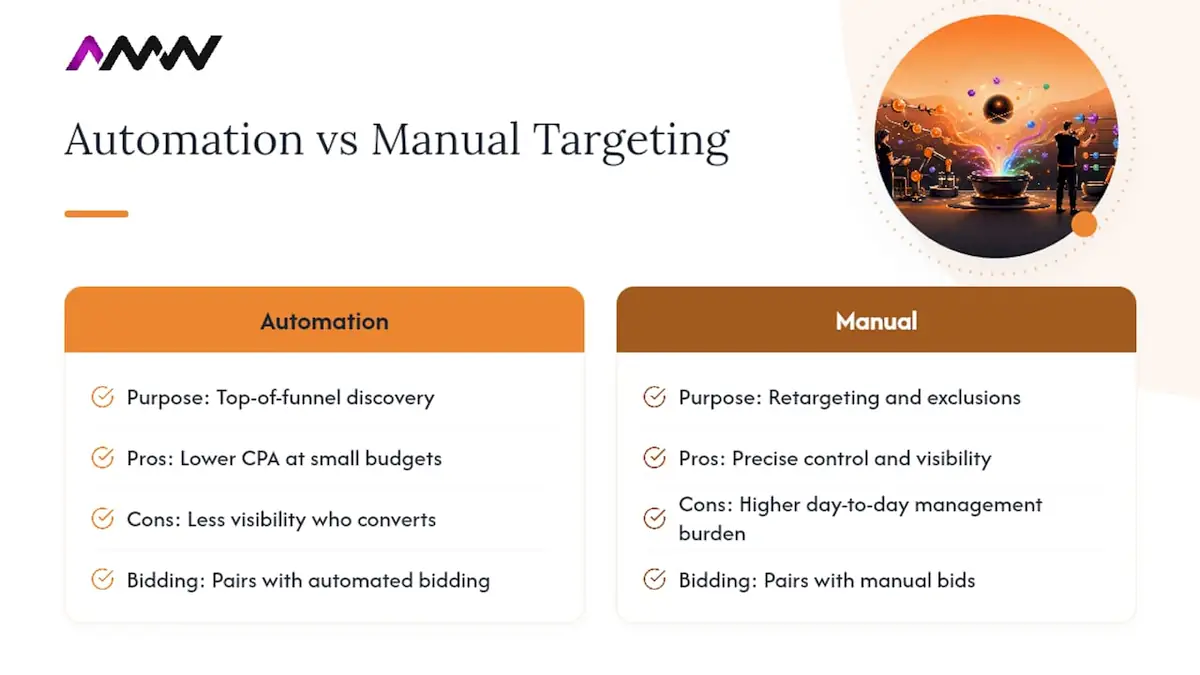
TikTok’s own delivery system already leans heavily on machine learning to match ads to viewers, and that’s pushed advertisers towards automation-first approaches rather than fighting the algorithm with manual filters. Smart+ campaigns and Smart Targeting variants sit at the front of this shift: they hand audience discovery almost entirely to the platform’s models, and industry analysis suggests they can lower cost-per-acquisition at smaller budgets, at the cost of visibility into exactly who’s converting.
That trade-off is worth being honest about. Automation reduces the day-to-day management burden, useful if you’re running lean or managing several accounts, but it also means you can’t always see which segment is driving results. The practical approach most agencies settle on: use automated targeting for top-of-funnel discovery, where broad reach and volume matter more than granular insight, and keep manual custom-audience and lookalike structures for retargeting, where you need precise control over who gets excluded and when.
Automated bidding strategies (cost cap, bid cap, and the platform’s own optimisation modes) interact with targeting choices too. A broad audience paired with automated bidding tends to find efficient pockets faster than a narrow audience paired with manual bids, simply because the model has more room to search. Expect this balance to keep shifting further towards automation as TikTok’s models mature, but don’t hand over every lever at once. Keep exclusions and retargeting logic under manual control even as prospecting becomes more automated.
How TikTok targeting compares with other social platforms
TikTok’s targeting model shares the same broad categories as other major ad platforms (demographics, interests, custom audiences, lookalikes) but the underlying mechanics differ in ways that change strategy. Interest targeting on TikTok draws from ongoing content interaction rather than a static declared-interest graph, meaning it shifts faster and can feel less predictable but also fresher.
The bigger difference is how much weight the algorithm puts on creative-level signals relative to audience filters. On platforms with longer-established interest graphs, tight demographic and interest targeting can carry a campaign a long way on its own. On TikTok, that same tight targeting approach often backfires, because the delivery system needs volume to find its own patterns, and a narrow audience denies it that room. This is part of why advertisers moving budget across from other platforms sometimes see worse initial results with a like-for-like targeting setup: the mechanics reward broad-plus-creative-testing more than filter-stacking. Reports on the platform’s advertising growth describe a market where budgets have shifted quickly towards TikTok’s discovery-driven format, and that discovery-first model is exactly why targeting has to be paired with strong creative rather than treated as a standalone lever.
Retargeting windows also tend to run shorter and tighter on TikTok, given the platform’s faster content cycle. What counts as a “warm” audience on a platform with a slower browsing rhythm might already be cold on TikTok two weeks later.
Privacy rules that shape how you can target on TikTok
Data privacy regulation directly limits what targeting options are available and how custom audiences can be built, and the rules aren’t uniform across markets. In the UK and EU, UK GDPR and the EU’s GDPR require a lawful basis for processing the personal data behind custom audience matching, which is why pixel-based audiences typically rely on hashed customer data and documented consent mechanisms rather than raw personal identifiers.
Practically, this affects a few things. Consent banners and cookie preferences directly influence how much pixel data you actually collect, an account with poor consent opt-in rates will always have a thinner custom audience pool than one with strong consent capture. It’s worth auditing your site’s consent management setup before assuming a pixel problem is a technical one.
Household income and some of the more granular demographic filters TikTok offers in certain markets simply aren’t available everywhere, partly a regulatory question and partly a data-availability one. Always check what’s live in your specific ad account rather than assuming a tactic you read about applies to your market.
The direction of travel is towards less third-party data availability generally, across every platform, not just TikTok. That’s the real argument for leaning into first-party data collection, your own customer lists, your own pixel events, now rather than later, because the targeting options built on data you actually own are the ones least likely to disappear.
Managing exclusions and audience overlap
Overlap is the quiet killer of TikTok account performance, and it’s almost invisible unless you’re specifically checking for it. Running cold prospecting, lookalike, and retargeting audiences without proper exclusions means the same person can end up eligible for three different ad groups simultaneously, and those ad groups end up bidding against each other inside your own account. That inflates your costs and muddies which audience actually deserves the credit for a conversion.
The fix is structural: keep cold, lookalike, and retargeting audiences in separate ad groups with exclusions layered in deliberately. Exclude existing customers from cold prospecting campaigns. Exclude people who’ve already converted from your retargeting pool once they’ve bought. Exclude your warm-audience custom list from your cold campaign’s lookalike seed, otherwise you’re just paying to reach people who were already reachable for less.
A simple exclusion hierarchy works for most accounts: prospecting excludes all site visitors and customers; retargeting-to-purchase excludes anyone who’s already purchased in the relevant window; and lookalikes exclude the seed audience they were built from, since there’s no point paying to re-reach people already inside your custom audience. Review this hierarchy every time you add a new ad group, because it’s easy to launch something new and forget to layer in the same exclusion logic that protects the rest of the account.
Structuring tests and splitting budget across targeting layers
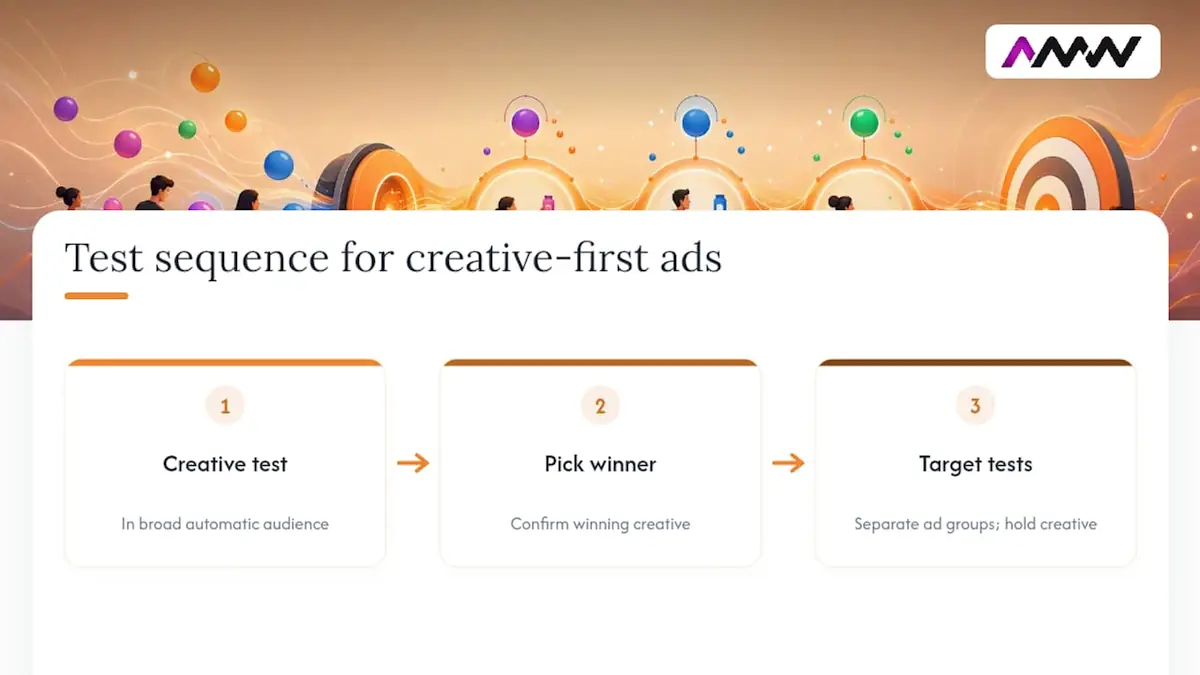
A test only tells you something useful if it isolates one variable. Testing creative and targeting changes inside the same ad group at the same time means you’ll never know which one moved the needle. Structure tests in layers instead: settle on a creative winner inside a broad or automatic audience first, then test targeting variations using that same winning creative across separate ad groups.
Budget allocation should roughly mirror funnel priority. A reasonable starting split for an account without much history: a larger share to broad or automatic prospecting to keep the learning phase fed, a smaller dedicated slice to warm retargeting, and the smallest to hot, high-intent retargeting, simply because that audience is naturally the smallest pool. As accounts mature and the ratio of returning-to-new customers shifts, that split should shift too.
Give every test enough time and volume to clear the exploration phase before making a call. A test stopped after a day or two, before enough conversion events have accumulated, isn’t a test, it’s a guess dressed up as data. Document your test structure (what changed, what stayed constant, how long it ran) so results are comparable across future campaigns rather than scattered notes in someone’s head. A structured creative testing process helps keep this disciplined rather than ad hoc, especially once several people are running tests inside the same account.
Author perspective: the lesson from running live TikTok accounts
The single biggest lesson from running TikTok accounts: the audience you build on paper rarely matters as much as the first three seconds of the ad shown to it. Creative carries more of the targeting burden here than on any other major platform.
This week, try one thing: take your best-performing existing creative, strip the targeting back to broad, and see what the algorithm finds on its own. It usually surprises people. [author credentials: insert here]
Amir
How AMW Media helps you get TikTok targeting right
Getting targeting right on TikTok isn’t really a targeting problem, it’s a creative-and-tracking problem wearing a targeting costume. That’s exactly where AMW Media earns its keep: our social media management team builds the audience structure and pixel foundations properly from day one, our creative production side keeps the hooks and formats fresh enough to actually earn the algorithm’s attention, and our paid social specialists run the test-and-scale process so you’re not guessing which ad group deserves more budget. Woodstock Campers, thirteen months and 2,215 leads at £12.50 each, is the case study on our Banbury marketing page.
If you’re currently running TikTok ads on gut feel, or you’ve got a pixel installed but no real strategy behind your audiences, it’s worth a conversation. Have a look at our social media management services and get in touch, we’ll take a proper look at your account structure and tell you what’s holding it back.
Sources
- Ad Targeting Dimensions
- TikTok Ads Targeting: How the Algorithm Actually Chooses Your Audience (And How to Work With It)
- TikTok Ads Audience Segmentation: A Strategic Guide for 2026, TikAdSuite
FAQ
How are ads targeted on TikTok?
TikTok combines audience filters (demographics, interests, behaviours, custom audiences, and lookalikes) with an algorithm that scores creative performance in real time, meaning the ad shown often depends as much on early engagement signals as on the targeting settings themselves.
Can you turn off targeted ads on TikTok?
Users can limit personalised advertising through TikTok’s in-app ad settings and broader privacy controls, though this reduces relevance rather than eliminating ads entirely, and the exact options available depend on the user’s region and consent settings.
Why does TikTok feel like it’s mostly ads now?
TikTok has expanded its ad inventory significantly as advertiser demand has grown, with reporting describing a rapid shift in ad budgets towards the platform’s discovery-driven format, though perceived ad density varies by user, region, and how much a person interacts with sponsored content.
What is the best strategy for TikTok ads?
Start broad or with Smart Targeting to seed data, test multiple creative hooks concurrently, then refine with custom audiences and lookalikes once your pixel has enough conversion volume; agencies like AMW Media build this creative-first testing structure into every new account for exactly this reason.
Recommended
- Getting TikTok followers: proven strategies for brands 2026
- Examples of engaging social posts that actually work
- How to create engaging social media content that works
- Audience targeting explained: a practical guide for UK marketers
Our free marketing audit looks at your site, your ads and your content, and comes back with a 30 day plan. No pitch deck.

Runs the content calendars and the community side of every social account, and keeps clients posted on what is going out and when. Meet the team.