
 Black Steel Doors
 Woodstock Campers
 Phillips Joinery
Audience targeting is the practice of selecting specific groups from a broader population and delivering targeted messages to each one. It is not the same as segmentation, which is the analytical work of dividing people into groups. Targeting is what happens next: you take those segments and decide which ones to pursue, with what message, on which channel. Get that distinction right and your campaigns stop feeling like guesswork.
Used well, audience targeting sits at the heart of every channel: paid social, PPC, email, display, and organic content. Platforms like Meta Ads, Google Ads, and programmatic networks all rely on it. The criteria you can use span demographics (age, gender, income), interests, location, past behaviour, and purchase intent. Each criterion narrows the pool and sharpens the message.
Audience targeting matters because personalised campaigns boost engagement, conversions, and business growth in ways that broad, untargeted activity simply cannot match.
What is a target audience and why does it matter for your marketing?
Your target audience is the specific group of people most likely to want what you sell. They are the intended recipients of your marketing, not everyone who could theoretically buy from you.
Defining that group clearly is what separates a campaign that converts from one that burns budget. When you know who you are talking to, you can choose the right channel, the right message, and the right moment. A younger first-time buyer in Manchester responds to completely different cues than an older person remortgaging in Edinburgh.
A well-defined target audience is typically described using a combination of:
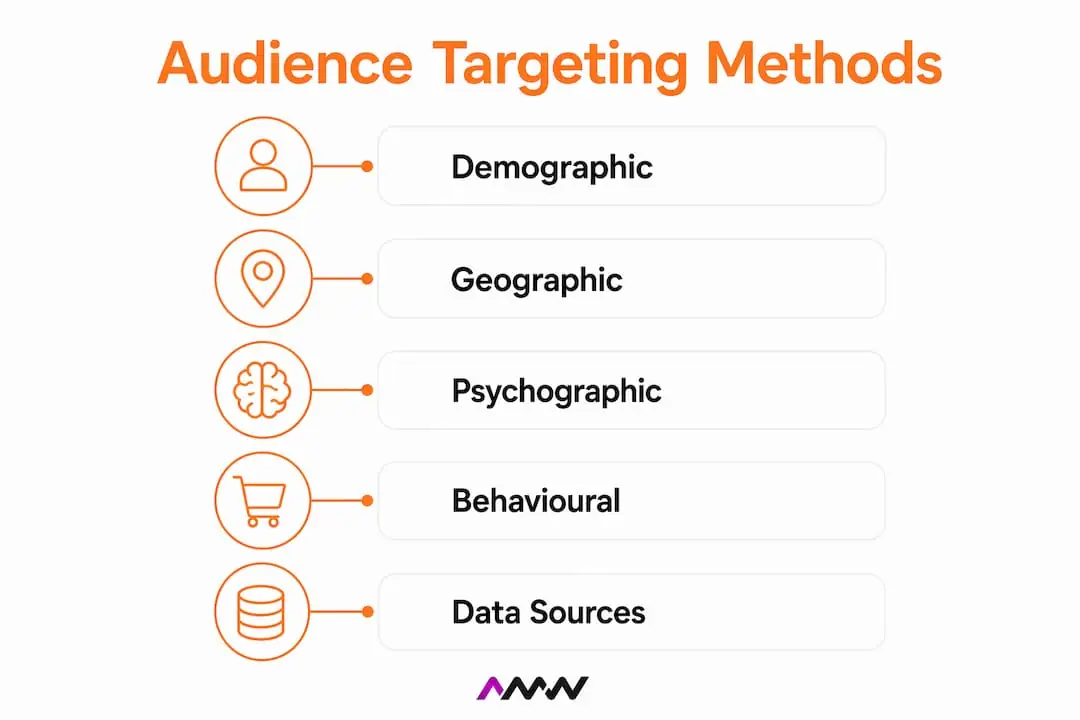
- Demographic traits: age, gender, income, education, occupation
- Geographic location: country, region, city, or even postcode
- Psychographic profile: values, lifestyle, interests, and attitudes
- Behavioural patterns: purchase history, browsing habits, brand loyalty
- Pain points and motivations: what problem they need solving and why now
The clearer this picture, the more precisely you can personalise your messaging. Personalisation is not a nice extra. McKinsey found that the fastest-growing companies derive 40% more revenue from personalisation than their slower-growing peers.
Types of audience targeting methods and how to use them
There is no single correct way to target an audience. Most effective campaigns layer two or more methods together. Here is how each one works and where it earns its keep.

Demographic targeting
Demographic targeting filters audiences by measurable characteristics: age, gender, household income, education level, and family status. It is the most widely used method because the data is relatively easy to collect and most ad platforms expose it natively. The limitation is that demographics tell you who someone is, not why they buy.
Geographic targeting
Geographic targeting reaches people based on where they are or where they live. For UK businesses, this can mean targeting by country, county, city, or postcode. A restaurant in Bristol has no reason to pay for impressions in Newcastle. Location data also feeds into local SEO and Google Business Profile visibility, so geographic targeting extends well beyond paid media.
Psychographic targeting
Psychographic targeting goes deeper than demographics by focusing on values, interests, opinions, and lifestyle. A brand selling sustainable activewear might target people who care about environmental issues and follow fitness content, regardless of their age or income bracket. This lens explains why people buy, which is often more predictive of conversion than demographic data alone.
Behavioural targeting
Behavioural targeting uses actions as the signal: pages visited, products viewed, content downloaded, emails opened, or purchases made. It is arguably the most powerful method because it reflects real intent rather than assumed interest. Someone who has browsed a specific product three times in a week is a fundamentally different prospect from someone who fits the right demographic but has never engaged.
Pro Tip: Layer behavioural signals on top of demographic filters rather than using either in isolation. A user who matches your demographic profile AND has visited your pricing page twice is a far warmer prospect than either signal alone would suggest.
Combining these methods is where the real gains appear. Social media platforms provide tools that let you stack demographics, interests, behaviours, and location into a single audience definition, giving you a tightly scoped group rather than a broad approximation.
Where does audience data actually come from?
Audience data falls into two broad categories, and understanding the difference matters more now than it did five years ago.
First-party data is information you collect directly from your own customers and website visitors: CRM records, email sign-ups, purchase histories, on-site behaviour tracked via Google Analytics 4 or a privacy-respecting tool like Matomo. It is the most reliable data you have because you own it and it reflects real interactions with your brand. Building a strong first-party data foundation is not optional. Failing to do so forces marketers to rely on less reliable third-party data in an environment where privacy restrictions are tightening fast.
Third-party data is aggregated from external sources and sold or shared via data brokers and ad networks. It has historically been used to expand reach beyond your own customer base, but its reliability is declining. Cookie deprecation, Apple’s App Tracking Transparency framework, and stricter enforcement of UK GDPR have all reduced its accuracy and availability.
Other data sources worth building into your targeting include:
- CRM platforms (Salesforce, HubSpot): segment by purchase stage, lifetime value, or product category
- Social media insights: Meta, LinkedIn, and TikTok all surface audience data from your own followers and engagers
- Email platform analytics: open rates, click patterns, and unsubscribes reveal preference and intent
- Website analytics: session depth, scroll behaviour, and conversion paths show what content resonates
Data freshness matters as much as data volume. A segment built on behaviour from 18 months ago may no longer reflect current intent, particularly in fast-moving categories like fashion or consumer electronics.
The real benefits of getting audience targeting right
Focused targeting does not just improve campaign metrics. It changes the economics of your marketing.
When your ads reach people who are likely to buy, your cost per acquisition falls. You are not paying to show a mortgage product to 22-year-old students or a retirement planning ad to teenagers. That focus is where improved ROI comes from: not from spending more, but from wasting less.
The benefits compound across the funnel:
- Higher engagement rates: messages that speak directly to a person’s situation get opened, clicked, and shared more often
- Better conversion rates: reaching people with genuine purchase intent shortens the sales cycle
- Stronger customer relationships: personalised communication builds trust over time, which feeds retention and repeat purchase
- Richer product insights: the data you gather from targeted campaigns tells you what different segments actually respond to, which feeds back into product development and positioning
- More efficient budget allocation: you can shift spend toward segments that convert and away from those that do not, in real time
The data-driven approach to marketing makes all of this measurable rather than assumed.
How to define your target audience and build segments that work
Start with your business goals, not your data. Ask what you are trying to achieve: new customer acquisition, upselling to existing buyers, re-engaging lapsed customers, or entering a new market. The goal shapes which segments are worth building.
From there, the process looks like this:
- Audit what you already know. Pull data from your CRM, website analytics, and email platform. Look for patterns in who buys, who engages, and who churns.
- Gather qualitative insight. Customer interviews, surveys, and sales team feedback reveal motivations that data alone cannot surface.
- Build buyer personas. A persona is a semi-fictional profile representing a key segment. Give it a name, a job, a problem, and a goal. Keep it grounded in real data rather than assumptions.
- Segment by the criteria that matter for your product. A B2B software company might segment by company size and industry. A consumer brand might segment by lifestyle and purchase frequency.
- Test your segments. Run small-budget campaigns to each segment before committing full spend. Let the data tell you which segments respond.
- Refine continuously. Audience behaviour shifts. Review your segments quarterly and update them when the data suggests they have drifted.
For practical guidance on identifying your audience, the process of combining data sources with qualitative research consistently produces more accurate segments than either approach alone.
Audience targeting in practice: real campaign examples
The theory makes sense on paper. Here is what it looks like when it runs.

Social media ad targeting is the most visible application. A UK-based gym equipment retailer might target Facebook users who have expressed interest in home fitness, live near a major city, and have previously visited the retailer’s website. That combination of interest, location, and prior behaviour produces a far tighter audience than a broad interest-based campaign.
Email campaigns become significantly more effective when segmented by behaviour. Sending the same newsletter to your entire list is a missed opportunity. Segmenting by purchase category, engagement recency, or browsing history and then tailoring the content to each group produces measurably better open and click rates. Well-executed email campaigns consistently demonstrate this.
Personalised website content uses behavioural data to show different content to different visitors. A returning visitor who previously viewed a specific product category sees relevant recommendations rather than a generic homepage. Tools like dynamic content blocks in CMS platforms make this achievable without a full engineering project.
Retargeting is one of the highest-ROI applications of behavioural data. Someone who added a product to their basket but did not complete the purchase is a warm prospect. Retargeting ads on display networks or social platforms bring them back, often at a fraction of the cost of acquiring a cold lead.
Cross-channel campaigns layer these approaches. A user might see a social ad, visit the website, receive a targeted email, and then encounter a retargeting display ad. Each touchpoint reinforces the message, and the audience engagement compounds across channels.
Segmentation vs. targeting: expert insights and best practices for UK marketers
Segmentation and targeting are related but distinct. Segmentation is the analytical work of dividing a population into groups based on shared characteristics. Targeting is the activation step: choosing which segments to pursue and how. Conflating the two leads to campaigns that are analytically sound but strategically unfocused.
The most useful way to think about the three main segmentation lenses is this: demographics show who someone is, behaviour shows what they do, and psychographics explain why they do it. Relying on a single lens leaves gaps. A campaign built only on demographics might reach the right age group but miss the people within that group who actually have purchase intent.
UK marketers face specific challenges that their counterparts in other markets do not. UK GDPR, which mirrors the EU regulation but is now administered domestically by the Information Commissioner’s Office (ICO), requires lawful basis for processing personal data, transparency about how data is used, and clear consent mechanisms for marketing communications. Audience targeting built on third-party cookies or purchased data lists carries real compliance risk. The safest and most durable approach is a first-party data strategy: collect data directly from your audience, be transparent about how you use it, and give people genuine control.
AI is changing the targeting picture quickly. Machine learning tools can analyse structured and unstructured data simultaneously to predict customer behaviour, enabling micro-segmentation at a scale no human analyst could manage manually. For smaller businesses, this capability is increasingly accessible through platforms that embed AI into their ad targeting and email tools.
Pro Tip: Before running any targeted campaign in the UK, confirm your lawful basis for processing under UK GDPR. For most marketing activity, this means either legitimate interests (with a documented balancing test) or explicit consent. The ICO’s guidance on direct marketing is the authoritative reference.
Best practices for UK marketers:
- Prioritise first-party data collection through owned channels: website, email, CRM
- Document your lawful basis for every data processing activity used in targeting
- Audit your segments at least quarterly to account for behavioural drift
- Use audience targeting techniques that layer multiple criteria rather than relying on a single dimension
- Test creative and messaging variations within each segment, not just between segments
- Measure incrementally: compare targeted campaign performance against a holdout group where possible
AMW Media’s team holds Google and Meta certifications, which means the targeting strategies applied to client campaigns are built on platform-verified methodology rather than guesswork.
Common audience types you will encounter in practice
Most marketing campaigns work with a handful of recurring audience types. Knowing them by name helps when briefing campaigns or reviewing platform settings.
In-market audiences are people who are actively researching or comparing products in a specific category. Google’s in-market audience segments, for example, identify users whose recent search and browsing behaviour suggests they are close to a purchase decision. These audiences tend to convert well because the intent signal is strong.
Custom intent audiences (available in Google Ads) let you define an audience based on specific keywords and URLs, rather than relying on Google’s pre-built categories. Useful when your product sits in a niche that Google’s standard segments do not cover well.
Lookalike audiences (called “Advantage+ Audience” in Meta’s current interface) use your existing customer data as a seed to find new users who share similar characteristics. They are a practical way to scale beyond your known audience without abandoning the targeting logic that works.
Retargeting audiences are built from people who have already interacted with your brand: website visitors, app users, video viewers, or email subscribers. Because these people already know you exist, the barrier to conversion is lower.
Suppression audiences are the inverse: lists of people you exclude from a campaign. Excluding existing customers from an acquisition campaign, for instance, avoids wasting spend on people who have already converted.
Contextual audiences are defined not by who the person is but by what content they are consuming. A display ad appearing alongside a review of running shoes reaches people in a relevant mindset, even without any personal data.
Tools and platforms used for audience targeting
The tools available to UK marketers span self-serve ad platforms, analytics suites, and specialist data tools.
Google Ads offers demographic, geographic, in-market, custom intent, and remarketing audience options across Search, Display, YouTube, and Performance Max campaigns. Its audience manager centralises all audience lists in one place.
Meta Ads Manager provides detailed demographic and interest targeting, custom audiences built from your own data, and lookalike audiences. It remains one of the most granular self-serve targeting environments available.
Criteo specialises in commerce media and retargeting, using shopper data from its retail media network to reach people based on purchase intent signals across the open web. It is particularly relevant for e-commerce brands looking to reach buyers beyond the major social platforms.
Adobe Experience Cloud integrates audience data across channels, enabling marketers to build and activate segments using first-party data from multiple touchpoints. Adobe’s tools are typically used by larger organisations with complex data environments.
Matomo is a privacy-respecting web analytics platform that gives you full ownership of your visitor data, making it a strong choice for UK businesses prioritising GDPR compliance in their analytics stack.
HubSpot and Salesforce both offer CRM-based audience segmentation, letting you build lists based on contact properties, deal stage, engagement history, and custom fields. These feed directly into email targeting and can sync with ad platforms via native integrations.
How to measure whether your audience targeting is actually working
Targeting without measurement is just spending. The metrics you track should connect directly to the campaign objective.
For awareness campaigns, reach, frequency, and brand recall lift matter. For conversion campaigns, cost per acquisition, return on ad spend (ROAS), and conversion rate by segment are the primary indicators. For retention campaigns, repeat purchase rate, customer lifetime value, and churn rate tell the real story.
A few principles that separate useful measurement from vanity metrics:
Segment-level reporting is more useful than aggregate campaign data. If your campaign reached three audience segments, look at performance by segment. One may be driving the majority of conversions while another is consuming budget with little return.
Incrementality testing measures the true lift from targeting by comparing a targeted group against a holdout group that did not see the campaign. It is more rigorous than last-click attribution and gives you a cleaner read on whether the targeting itself is driving results.
Frequency monitoring prevents over-exposure. Showing the same ad to the same person too many times drives up costs and damages brand perception. Most platforms expose frequency data at the audience level; use it.
Attribution modelling matters more as campaigns become cross-channel. A data-driven attribution model (available in Google Ads and GA4) distributes credit across touchpoints rather than assigning everything to the last click, giving a more accurate picture of which audience segments and channels are contributing.
Review your audience performance data at least fortnightly during active campaigns. Segments that looked strong at launch sometimes plateau or degrade as the most responsive users convert and the remaining pool becomes less engaged.
Key takeaways
Audience targeting is the activation step that turns analytical segmentation into focused, measurable marketing: the sharper your segments and the more relevant your message, the better your return.
| Point | Details |
|---|---|
| Targeting vs. segmentation | Segmentation groups people analytically; targeting is the activation step of choosing which groups to pursue. |
| First-party data is your foundation | Relying on third-party data is increasingly unreliable; build owned data through CRM, email, and web analytics. |
| Layer multiple criteria | Demographics, behaviour, and psychographics each reveal a different dimension; combining them produces more accurate segments. |
| Fastest-growing companies and personalisation | McKinsey found the fastest-growing companies derive 40% more revenue from personalisation enabled by precise segmentation. |
| Measure at segment level | Aggregate campaign data hides which audiences are working; always review performance by individual segment. |
FAQ
What is audience targeting in digital marketing?
Audience targeting is the process of selecting specific groups of people to receive your marketing messages, based on criteria like demographics, behaviour, location, or interests. It differs from segmentation, which is the analytical step of dividing a population into groups.
Why is audience segmentation important?
Segmentation lets you understand the distinct needs and motivations within your broader market, so you can personalise messaging for each group. McKinsey’s research shows the fastest-growing companies generate 40% more revenue from personalisation than slower-growing competitors.
What are the main types of audience targeting?
The four main types are demographic (age, gender, income), geographic (location-based), psychographic (values, interests, lifestyle), and behavioural (actions, purchase intent). Most effective campaigns layer two or more of these together.
How does UK GDPR affect audience targeting?
UK GDPR requires a lawful basis for processing personal data used in targeting, transparency about data use, and clear consent for direct marketing. The ICO is the UK’s supervisory authority and publishes guidance specifically on direct marketing compliance.
What tools do UK marketers use for audience targeting?
Common tools include Google Ads, Meta Ads Manager, Criteo for commerce retargeting, Adobe Experience Cloud for enterprise data environments, and Matomo for privacy-respecting web analytics. CRM platforms like HubSpot and Salesforce feed audience data directly into campaign targeting.
AMW Media’s team of Google and Meta-certified specialists builds audience targeting strategies that connect the right message to the right people, whether that is through PPC campaign management or social media advertising. If you want campaigns that spend less and convert more, get in touch.
Recommended
- What is audience engagement: a 2026 guide for UK marketers | AMW Media
- What is brand engagement? A practical guide for marketers | AMW Media
- SEO trends in 2026: what UK marketers need to know | AMW Media
- The role of UX in marketing: a practical guide | AMW Media
Our free marketing audit looks at your site, your ads and your content, and comes back with a 30 day plan. No pitch deck.

Runs the business alongside Amir: contracts, onboarding and making sure every client knows what is happening and when. Meet the team.