
 Black Steel Doors
 Woodstock Campers
 Phillips Joinery
TL;DR:
- UX shapes how users feel and behave when interacting with digital products or services, directly impacting marketing success. When UX and marketing work together, they lower costs, boost conversions, and strengthen brand trust, unlike when they operate in silos. Aligning both disciplines through shared data, joint planning, and Growth Design improves the entire customer funnel and long-term brand equity.
User experience design is defined as the practice of shaping how people feel and behave when they interact with a product or service. The role of UX in marketing is to ensure that every promise a campaign makes is actually delivered when the customer arrives. Marketing attracts people. UX determines whether they stay, convert, and come back. When these two disciplines work together, the result is lower acquisition costs, higher conversion rates, and customers who trust your brand. When they work in silos, you get a leaky funnel and a growing paid media bill with nothing to show for it.
How does UX impact key marketing metrics?
UX improvements produce direct, measurable changes in marketing performance. A well-crafted UX simplifies the customer journey, reducing bounce rates and increasing session duration. Both of those metrics feed directly into your paid and organic campaign results.
The clearest example is paid search. Google’s Quality Score rewards landing pages that deliver a useful experience. Better UX increases Quality Score in paid search campaigns, which lowers cost-per-click and reduces your cost-per-acquisition. That is not a marginal gain. UX design improvements can improve Quality Score by up to 400%, which directly cuts the cost of every click you buy. For brands running Google Ads or Meta campaigns, that figure changes the economics of the entire channel.
Beyond paid search, UX shapes the metrics that matter to SEO. Dwell time, pages per session, and conversion rate all signal to search engines that your content is worth ranking. Businesses prioritising UX and marketing alignment see significant improvements in these SEO metrics alongside stronger long-term customer retention. That is a compounding advantage. Better rankings bring more organic traffic, which costs less to acquire than paid traffic.
Here are the UX elements that most directly move marketing metrics:
- Page load speed. Slow pages increase bounce rate and reduce Quality Score simultaneously.
- Clear calls to action. Ambiguous buttons and buried forms kill conversion rates regardless of how good the ad creative is.
- Mobile responsiveness. A landing page that breaks on a phone wastes the majority of your paid traffic.
- Consistent messaging. When the ad headline matches the landing page headline, visitors feel they are in the right place. Mismatches cause immediate exits.
- Reduced form friction. Asking for too much information too early is one of the fastest ways to destroy a lead generation campaign.
Pro Tip: Run a conversion rate audit on your top five landing pages before increasing any ad budget. Fixing UX issues first means every additional pound you spend works harder.
What are the common tensions between UX and marketing teams?
Marketing and UX teams often want different things from the same page. Understanding why that tension exists is the first step to resolving it productively.
Marketing teams are measured on short-term results: clicks, leads, and revenue this quarter. UX teams are measured on satisfaction, task completion, and retention. Those incentives pull in opposite directions, and the friction shows up in specific, recurring arguments.
The most common flashpoints are:
- Countdown timers and urgency banners. Marketing wants them because they create short-term conversion spikes. UX resists them because urgency-driven measures create immediate bounce and user frustration once customers realise the deadline was artificial. The short-term gain erodes long-term trust.
- Pop-ups and interstitials. Marketing sees them as high-visibility capture tools. UX sees them as interruptions that damage the experience, particularly on mobile where Google actively penalises intrusive interstitials in search rankings.
- Information density. Marketing wants to communicate every feature, benefit, and offer on a single page. UX advocates for progressive disclosure, showing people what they need at each stage rather than everything at once.
- Personalisation versus privacy. Marketing wants granular data to personalise campaigns. UX must balance that with consent flows and data transparency that do not feel invasive or confusing.
The real cost of leaving these tensions unresolved is a leaky funnel. Traffic attracted by marketing ads bounces quickly when the post-click experience is poor, inflating your cost-per-acquisition with nothing to show for it. Spending more on ads without fixing the experience is the equivalent of filling a bucket that has a hole in the bottom.
Pro Tip: When UX and marketing disagree on a tactic, run a short A/B test rather than debating it. Real user behaviour settles arguments faster than any meeting.
The resolution is not for one team to win. It is for both teams to agree on shared metrics that capture both short-term conversion and long-term satisfaction. Net Promoter Score alongside conversion rate is a good starting point.
How can marketing and UX teams collaborate to optimise the customer journey?
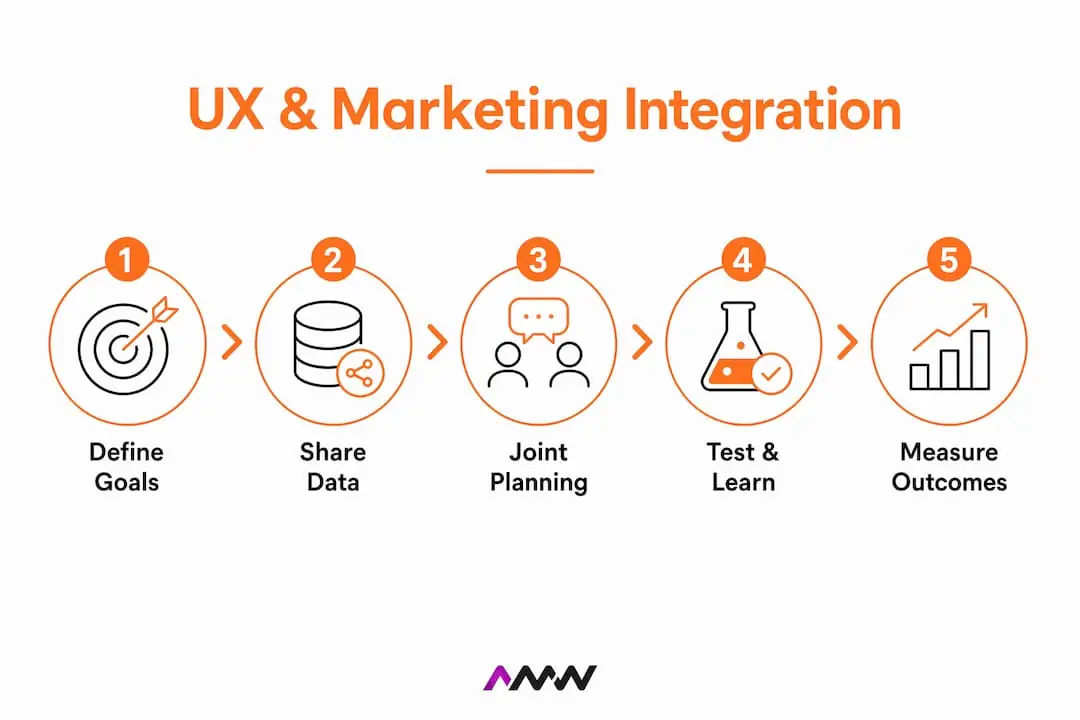
The most effective framework for aligning these two disciplines is Growth Design. Growth Design integrates marketing insights with user-centred design principles to create user journeys that convert well and retain customers over time. It avoids the silo problem by treating acquisition and experience as parts of the same system rather than separate departments.
Shared data as the foundation
The collaboration starts with data. Marketing teams hold audience data: who clicked, from where, with what intent. UX teams hold behaviour data: where people drop off, what confuses them, what they complete. Neither dataset tells the full story alone. When both teams share access to the same analytics platform, session recordings, and user research, they stop optimising different parts of the funnel and start optimising the whole thing.

Tools like Google Analytics 4, Hotjar, and Microsoft Clarity give both teams visibility into the same user behaviour. The key is not the tool itself but the habit of reviewing it together in a regular joint session.
Joint planning and aligned metrics
Collaboration breaks down when teams plan separately and then hand work off to each other. The fix is joint sprint planning at the start of each campaign cycle. Marketing brings the campaign brief, audience targeting, and messaging. UX brings the current experience audit, known friction points, and any recent user research. Together they define what success looks like across both acquisition and retention metrics.
The table below shows how to align goals across both teams:
| Marketing goal | UX equivalent | Shared metric |
|---|---|---|
| Increase click-through rate | Improve ad-to-page message match | Bounce rate on landing pages |
| Lower cost-per-acquisition | Reduce form and checkout friction | Conversion rate |
| Improve ad Quality Score | Enhance page relevance and load speed | Quality Score and page speed |
| Grow email list | Simplify sign-up flow | Sign-up completion rate |
| Increase repeat purchases | Improve post-purchase experience | Customer lifetime value |
Practical collaboration habits that work
- Share user research findings in a brief weekly summary that both teams read.
- Include a UX review step before any new campaign landing page goes live.
- Build a shared component library so marketing can create on-brand pages without breaking the UX.
- Use digital strategy alignment reviews quarterly to check whether the experience still matches the current campaign messaging.
Chatbot UX is a sharp example of where this alignment matters. A chatbot with strong promotional copy but a confusing conversation flow drives users away despite the marketing effort behind it. The message and the experience must match at every touchpoint.
What is the role of UX in brand strategy and long-term customer engagement?
UX is the delivery mechanism for your brand promise. Marketing tells people what your brand stands for. UX proves it. If your campaign promises speed and simplicity but your website is slow and confusing, the brand promise collapses the moment someone clicks through.
Consistent UX across digital touchpoints reinforces brand image and builds the kind of trust that advertising alone cannot buy. Every interaction a customer has with your brand, whether on your website, your app, your emails, or your social content, either confirms or contradicts the story your marketing tells. Consistency is what turns a first purchase into a second one.
The long-term business case for investing in UX within your brand strategy is clear:
- Retention is cheaper than acquisition. Keeping an existing customer costs significantly less than acquiring a new one. A good experience is the most cost-effective retention tool available.
- Word of mouth scales. Customers who have a great experience tell others. That organic referral traffic carries no cost-per-click.
- Brand equity compounds. Each positive interaction adds to the accumulated trust customers have in your brand. That trust makes future marketing more effective because people are already predisposed to believe you.
- UX reduces support costs. Clear, intuitive design means fewer confused customers contacting support, which frees budget for growth activities.
Marketing drives user attraction; UX enables goal completion and satisfaction after acquisition. Focusing on only one side creates either visibility without usage or usability without awareness. Neither produces sustainable growth. The brands that win long-term are the ones that treat UX investment as a marketing multiplier rather than a separate cost centre.
The connection to brand growth through digital marketing is direct. When UX and marketing reinforce each other, every campaign you run benefits from the trust and reputation you have already built. Your cost-per-acquisition falls over time rather than rising, which is the opposite of what happens when you rely on paid media alone.
Pro Tip: Map your customer journey from ad click to post-purchase email. At each stage, ask whether the experience matches the promise made in the campaign. Any gap you find is a UX fix that will improve your SEO and organic performance as well as your paid results.
Key takeaways
UX and marketing alignment is the single most effective way to reduce acquisition costs, improve conversion rates, and build lasting brand loyalty.
| Point | Details |
|---|---|
| UX directly affects paid media costs | Better landing page UX improves Quality Score, cutting cost-per-click and cost-per-acquisition. |
| Urgency tactics damage long-term trust | Short-term conversion spikes from countdown timers often cause bounce and erode brand credibility. |
| Growth Design prevents leaky funnels | Integrating marketing insights with user-centred design optimises the full funnel, not just the top. |
| Consistent UX fulfils the brand promise | Every touchpoint either confirms or contradicts what your marketing says; consistency builds loyalty. |
| Shared metrics align both teams | Agreeing on metrics like conversion rate and customer lifetime value stops UX and marketing pulling in opposite directions. |
Why I think most brands are solving this problem backwards
Most brands I work with treat UX as something you fix after the campaign has launched and the results disappoint. The creative gets blamed, the targeting gets adjusted, and the budget gets increased. Nobody looks at what happens after the click. That is backwards.
The most expensive mistake in digital marketing is spending money to drive traffic to an experience that was never designed to convert. I have seen brands triple their ad spend and watch their cost-per-acquisition rise in parallel, simply because the landing page experience was confusing, slow, or inconsistent with the ad that brought people there.
The mindset shift that actually changes results is treating UX as a pre-campaign investment rather than a post-campaign fix. Before you approve the next campaign brief, ask your UX team to audit the destination. Not after launch. Before. That single change in process has a bigger impact on campaign ROI than almost any targeting or creative optimisation.
The other thing I would push back on is the idea that UX and marketing are fundamentally in conflict. They are not. They have different time horizons. Marketing thinks in campaign cycles. UX thinks in product iterations. When you give both teams a shared metric that spans both horizons, such as customer lifetime value, the conflict largely disappears. They are suddenly working on the same problem from different angles, which is exactly where the best results come from.
The brands that figure this out stop treating UX as a cost and start treating it as the thing that makes their marketing budget go further. That is the shift worth making.
Amir
How AMW Media helps you align UX with your marketing
AMW Media works with ambitious brands that want their marketing and user experience to pull in the same direction. Whether you need a web design service that converts visitors rather than just impressing them, or social media management that keeps your brand experience consistent across every channel, the team builds with both goals in mind.
Every project starts with understanding what your marketing is promising and whether your current digital experience delivers on that promise. From PPC landing pages to full website builds, AMW Media combines creative production with performance thinking to close the gap between what your campaigns say and what your customers actually experience. Get in touch to talk through where UX could be working harder for your marketing. If you are in north west London and would rather hand this to one team, our Harrow marketing page shows how that works.
FAQ
What is the role of UX in marketing?
UX ensures that the experience customers encounter after clicking a marketing touchpoint matches the promise made in the campaign. Without that alignment, marketing spend drives traffic that bounces rather than converts.
How does UX impact conversion rates?
UX improvements reduce friction in the customer journey, making it easier for visitors to complete the action a campaign is designed to drive. Better UX also improves paid search Quality Scores, which lowers cost-per-click directly.
Why do UX and marketing teams conflict?
Marketing teams optimise for short-term metrics like clicks and leads, while UX teams prioritise long-term satisfaction and task completion. Urgency tactics such as countdown timers can spike short-term conversions but damage user trust over time.
What is Growth Design?
Growth Design is a practice that integrates marketing messaging with user-centred design principles to optimise the full customer funnel. It prevents the silo problem where marketing and UX teams optimise different parts of the journey independently.
How does UX support brand strategy?
UX is the mechanism that delivers on the brand promise marketing creates. Consistent, well-designed experiences across all digital touchpoints build trust and loyalty that advertising alone cannot achieve.
Recommended
- Essential digital marketing guide: strategies for brand growth
- Graphic design ideas for marketing: 2026 guide | AMW Media
- What is brand engagement? A practical guide for marketers | AMW Media
- What is marketing innovation? A guide for ambitious brands | AMW Media
Our free marketing audit looks at your site, your ads and your content, and comes back with a 30 day plan. No pitch deck.

Runs the content calendars and the community side of every social account, and keeps clients posted on what is going out and when. Meet the team.