
 Black Steel Doors
 Woodstock Campers
 Phillips Joinery
TL;DR:
- Audience engagement in the UK measures attention, interaction, and emotional connection with a brand.
- Effective strategies include real personalisation, valuable loyalty programmes, and connected digital experiences.
Audience engagement is defined as the level of attention, interaction, and emotional investment an audience has with a brand, its content, or its communications. It is the difference between a customer who buys once and one who becomes a genuine advocate. For UK marketing professionals and brand managers, understanding audience engagement has never been more pressing. 82% of UK consumers are actively discouraged by fragmented digital experiences, and 37% of UK shoppers increased their spending with brands that ran effective engagement and loyalty initiatives. Those two figures alone make the business case for getting this right.
What is audience engagement and why does it matter for brands?
Audience engagement, sometimes called customer engagement in CRM and loyalty circles, describes how deeply an audience connects with a brand across every touchpoint. It goes well beyond a click or a like. True engagement includes emotional connection, repeat behaviour, and a willingness to advocate for a brand without being asked.
The business impact is direct and measurable. Engaged customers spend more, stay longer, and cost less to retain than new customers acquired through paid channels. 37% of UK shoppers increased their spending specifically because of engagement and loyalty programmes. That is not a marginal uplift; it is a material revenue driver.
The importance of audience interaction also shows up in brand resilience. A brand with a engaged audience weathers product missteps and PR challenges far better than one relying purely on transactional relationships. Engagement builds the kind of goodwill that acts as a buffer when things go wrong.
For brand managers, the practical implication is clear. Engagement is not a vanity metric to report in a monthly deck. It is a leading indicator of revenue, retention, and long-term brand health.
How is audience engagement measured?
Measurement sits at the heart of any credible engagement programme. Without it, you are guessing. The metrics that matter fall into three broad categories.
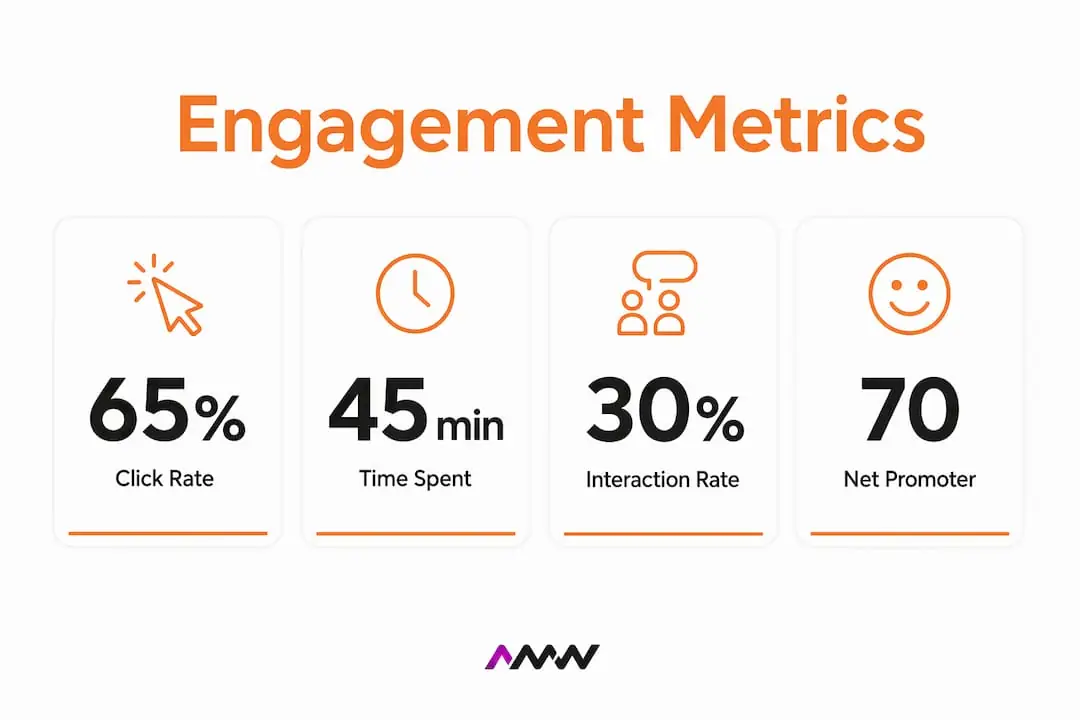
Behavioural metrics capture what audiences actually do: click-through rates, time on page, repeat visit frequency, social shares, and email open rates. These are the easiest to collect and the most commonly reported.
Interaction metrics go one level deeper. They include comments, replies, poll responses, user-generated content submissions, and live event participation. These signals show that an audience is willing to invest effort, not just attention.
Emotional metrics are the hardest to quantify but the most valuable. Net Promoter Score (NPS), customer satisfaction surveys, and sentiment analysis tools help brands understand whether their audience feels a genuine connection or is simply going through the motions.
| Metric category | Examples | What it tells you |
|---|---|---|
| Behavioural | Click-through rate, time on page, repeat visits | Whether content holds attention |
| Interaction | Comments, poll responses, UGC submissions | Whether audiences invest effort |
| Emotional | NPS, sentiment analysis, survey scores | Whether audiences feel connected |
74% of UK marketers cite customer data collection as a key driver for engagement success. That figure reflects a broader shift: the best-performing brands treat data not as a compliance obligation but as the raw material for better conversations with their audiences.
Pro Tip: Set a baseline for each metric category before launching any engagement initiative. Without a starting point, you cannot prove what moved the needle.
Qualitative signals matter just as much as quantitative ones. Reading customer reviews, monitoring social listening tools, and conducting periodic focus groups give context that dashboards alone cannot provide. Numbers tell you what happened; qualitative research tells you why.
What are the most effective audience engagement strategies for UK marketers?
Effective audience engagement methods share one quality: they are built around the audience, not the brand. The following strategies consistently produce results in the UK market.

1. Personalise at the message level, not just the name field
74% of Millennials and 71% of Gen Z in the UK find marketing messages relevant, but they hold brands to a higher standard than older cohorts. They expect content that reflects their behaviour, preferences, and timing. Dropping a first name into a subject line no longer qualifies as personalisation. Segment by purchase history, browsing behaviour, and stated preferences, then tailor the message accordingly.
2. Build loyalty programmes that deliver tangible value
77% of UK adults subscribe to at least one loyalty programme, rising to 85% among women. That level of participation signals high consumer expectation. UK loyalty programmes are increasingly becoming data-driven growth engines focused on measurable returns rather than experimentation. The brands winning in this space offer rewards that feel useful, not just points that expire before anyone redeems them.
3. Use interactive content to drive two-way communication
Live polls, Q&A sessions, quizzes, and interactive video formats shift the dynamic from broadcast to conversation. Industry experts advise shifting from lead funnels to engagement-first marketing, particularly in B2B contexts where interactive digital experiences outperform static content. For brand managers, this means building content calendars that include participation mechanics, not just publishing schedules.
4. Match your social media approach to your audience demographics
Platform choice is a strategy decision, not a default. Younger audiences cluster on TikTok and Instagram. Professional audiences engage more on LinkedIn. Older demographics remain active on Facebook. Publishing the same content across every platform wastes budget and dilutes relevance. For practical inspiration on what actually works, the social post examples AMW Media has documented show how format and platform alignment drive measurably better interaction.
5. Prioritise consistency over campaign bursts
Engagement compounds over time. A brand that shows up consistently with relevant, useful content builds a stronger audience relationship than one that runs a brilliant campaign every six months and goes quiet in between. Consistent social media management is one of the most underrated drivers of long-term audience loyalty.
Pro Tip: Audit your content calendar for the ratio of brand-centric to audience-centric posts. If more than 60% of your posts are about your brand rather than your audience’s interests, rebalance.
Common pitfalls to avoid:
- Treating engagement as a one-way broadcast rather than a dialogue
- Measuring only reach and impressions while ignoring interaction depth
- Running loyalty programmes that reward transactions but ignore emotional connection
- Ignoring negative comments instead of responding and learning from them
How do digital experience and data use influence audience engagement?
A fragmented digital experience is one of the fastest ways to lose an audience. 82% of UK consumers report being actively discouraged by disorganised digital journeys. That is not a small minority with high standards. It is the overwhelming majority of your potential customers walking away because the experience felt broken.
The role of connected platforms and first-party data
Brands that connect their CRM, email platform, website analytics, and social listening tools into a coherent view of the customer can respond to behaviour in real time. A customer who browses a product page three times but does not purchase is signalling intent. A well-configured automation can send a relevant follow-up within hours. That kind of responsiveness feels attentive rather than intrusive when it is based on genuine behavioural signals.
GDPR compliance is not optional, but it is also not the ceiling. Collecting first-party data ethically and using it to personalise experiences is both legally sound and commercially effective. Effective audience engagement in UK marketing involves using GDPR-compliant first-party data to personalise experiences and activating behavioural triggers through automation.
Micro-moments and connected customer journeys
Brands with organised digital experiences that convert micro-moments into connected customer interactions consistently outperform those with siloed channels. A micro-moment is any instance where a customer turns to a device to learn, do, discover, or buy. Capturing those moments with relevant, fast, and frictionless content is what separates high-engagement brands from the rest.
| Digital experience type | Engagement outcome |
|---|---|
| Fragmented, siloed channels | High drop-off, low loyalty, poor NPS |
| Connected, personalised journeys | Higher retention, increased spend, stronger advocacy |
Pro Tip: Map your customer journey from first touch to post-purchase. Identify every point where the experience breaks or requires the customer to repeat themselves. Each of those points is an engagement leak.
The benefits of organised digital branding extend beyond aesthetics. A coherent digital presence signals reliability and builds the kind of trust that keeps audiences coming back without being prompted.
How can brands balance AI and authenticity to keep audience trust?
AI adoption in marketing is accelerating, but UK consumer sentiment is not keeping pace. 60% of UK social media users prefer brands that do not use AI in their advertising. That is a significant majority expressing a clear preference for human-feeling content. Ignoring that preference in pursuit of production efficiency is a credibility risk.
“Consumer trust hinges on perceived authenticity. Brands that prioritise transparency and realness when using AI avoid reputational damage. Those that do not are increasingly called out by the very audiences they are trying to reach.”
UK Social Media Brand Engagement 2026
The practical answer is not to avoid AI entirely. It is to use it where it improves the customer experience rather than where it merely reduces production costs.
AI uses that tend to build rather than erode trust:
- Personalised product recommendations based on purchase history
- Automated responses to simple customer service queries with clear disclosure
- Behavioural triggers that send relevant content at the right moment
- Sentiment analysis to identify and escalate negative experiences quickly
AI uses that tend to damage trust:
- AI-generated creative that feels generic or uncanny
- Chatbots that pretend to be human without disclosure
- Personalisation that feels surveillance-like rather than helpful
- Automated social media replies that miss the emotional tone of a complaint
Transparency is the deciding factor. Audiences are more forgiving of AI use when brands are upfront about it. The brands that get into trouble are those that use AI to cut corners on authenticity while claiming to offer a personal connection. That gap between promise and reality is exactly what erodes the trust that engagement depends on.
Key takeaways
Audience engagement is the measurable combination of attention, interaction, and emotional connection that drives customer loyalty, increased spending, and long-term brand growth.
| Point | Details |
|---|---|
| Define engagement beyond clicks | True engagement includes emotional connection and repeat behaviour, not just surface metrics. |
| Measure across three categories | Track behavioural, interaction, and emotional metrics to get a complete picture of engagement health. |
| Personalise with real data | Use GDPR-compliant first-party data and behavioural triggers to make communications feel relevant, not generic. |
| Fix the digital experience first | 82% of UK consumers disengage because of fragmented journeys. A connected experience is the foundation of everything else. |
| Use AI with transparency | 60% of UK social media users prefer non-AI advertising. Disclose AI use and apply it where it helps the customer. |
The perception gap nobody talks about enough
Here is the thing that keeps me up at night when I look at UK engagement data. Only 54% of UK consumers agree that loyalty programmes make them feel valued. Meanwhile, 86% of marketers believe their programmes do exactly that. That is not a small misalignment. That is a 32-point gap between what brands think they are delivering and what customers actually experience.
I have seen this pattern play out repeatedly with brands that invest heavily in loyalty mechanics but skip the harder work of understanding what their audience actually values. A points system is not a relationship. A birthday discount is not personalisation. Genuine engagement requires brands to ask uncomfortable questions about whether their programmes are built for the customer or for the brand’s own data collection needs.
The brands I have seen close that gap share one habit: they talk to their customers regularly and actually change things based on what they hear. Surveys that feed a quarterly report do not count. It means dialogue that shapes product decisions, content strategy and service design.
The future of audience engagement in the UK will belong to brands that treat their audiences as collaborators rather than recipients. AI will play a role, but only as a tool that makes genuine human connection more efficient, not as a replacement for it. The marketers who thrive will be the ones who use data to understand people, not just to segment them.
Amir
How AMW Media helps brands build genuine audience engagement
Building real audience engagement requires more than a good content idea. It takes a connected digital presence, consistent social activity, and content that earns attention rather than demanding it. If your business is in Berkshire and you want a team to run this, our Reading page sets out how we work, with the numbers attached.
AMW Media works with ambitious UK brands to create exactly that. From custom web design that removes friction from the customer journey to SEO services that put your brand in front of the right audience at the right moment, every service is built around measurable outcomes. The team also handles social media management for brands that want consistent, two-way engagement without the internal overhead. If you want to close the gap between where your engagement is now and where it needs to be, get in touch with AMW Media to talk through what that looks like for your brand.
FAQ
What is audience engagement in marketing?
Audience engagement is the level of attention, interaction, and emotional connection an audience has with a brand across its content and communications. It includes behavioural signals like clicks and repeat visits, as well as deeper indicators like NPS scores and user-generated content.
Why do audience engagement strategies matter for brand loyalty?
Engaged audiences spend more and stay longer. Shoppers spend more with brands that run engagement programmes properly, which makes engagement a direct driver of revenue and retention rather than a soft metric.
What are the key engagement metrics in marketing?
The three core categories are behavioural metrics (click-through rates, time on page), interaction metrics (comments, poll responses, UGC), and emotional metrics (NPS, sentiment scores). Tracking all three gives a complete picture of how an audience actually connects with a brand.
How do you improve audience engagement on social media?
Match your content format and tone to the platform and the audience demographic using it. Use interactive formats like polls and Q&A sessions, respond to comments consistently, and publish on a regular schedule rather than in campaign bursts. Practical social media engagement tips from AMW Media cover the tactical detail behind each of these approaches.
Does AI help or hurt audience engagement?
AI can improve engagement when used transparently for personalisation, behavioural triggers, and customer service efficiency. However, 60% of UK social media users prefer brands that do not use AI in advertising, so disclosure and genuine human oversight remain non-negotiable for maintaining trust.
Recommended
- What is brand engagement? A practical guide for marketers | AMW Media
- Examples of engaging social posts that actually work | AMW Media
- SEO trends in 2026: what UK marketers need to know | AMW Media
- How to master your digital marketing process for 2026
Our free marketing audit looks at your site, your ads and your content, and comes back with a 30 day plan. No pitch deck.

Founded AMW Media in 2024 and runs strategy, paid media and the CRM builds. The reason everything here is in house and measured in revenue. Meet the team.