
 Black Steel Doors
 Woodstock Campers
 Phillips Joinery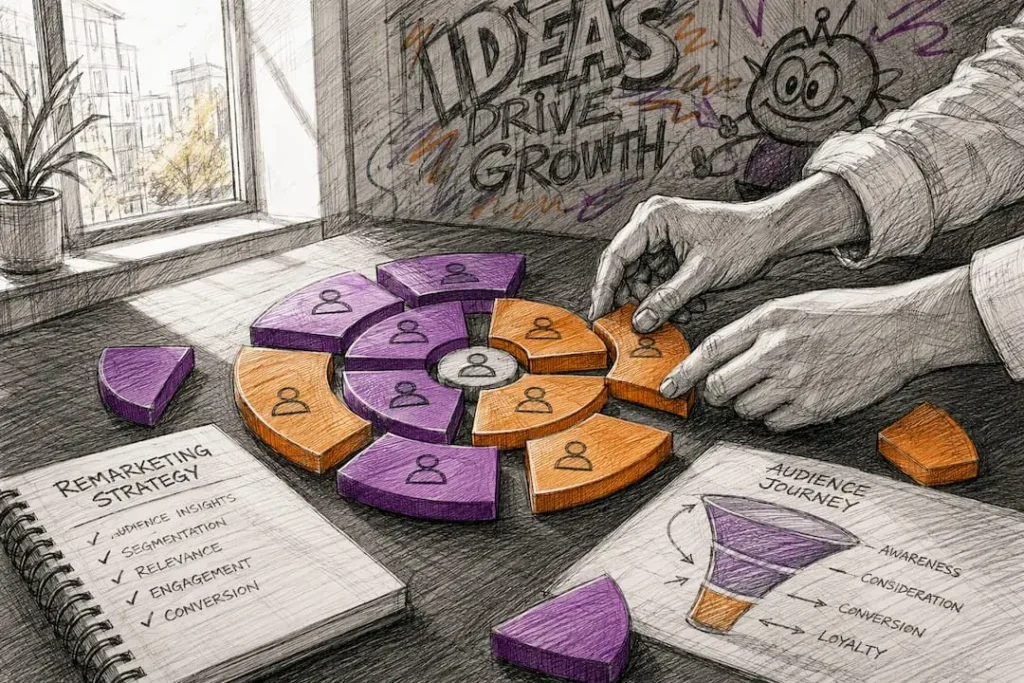
The single most effective remarketing strategy is not a clever ad or a discount code. It’s segmentation, split your visitors into high, medium, and low engagement lists before you spend another penny, then match each tier to a specific channel and creative set.
Do this today: build three audience lists based on engagement (cart abandoners, product viewers, and blog readers work well as a starting split). Then launch one campaign targeting the highest-engagement tier first. Global cart abandonment sits around 70 to 80%, and well-run remarketing recovers roughly 15 to 20% of those lost sales. Segmented audiences also convert 32% better than broad remarketing lists, which is the whole argument for doing this before anything else.
High engagement (cart abandoners, pricing page visitors): direct response ads, tight window, aggressive frequency.
Medium engagement (product viewers, repeat blog readers): educational content, case studies, longer window.
Low engagement (single-page visitors): brand awareness only, low frequency, no hard sell.
Quick stat: Multi-channel stacks combining email, dynamic ads, and search remarketing can recover a cumulative 13 to 19% of abandoned carts, which is roughly double what any single channel manages alone.
Key Takeaways
Segmenting audiences by engagement level and matching each to a specific channel and creative set is the single highest-impact remarketing strategy available.
| Point | Details |
|---|---|
| Segment before spending | Build high, medium, and low engagement lists before launching any remarketing campaign. |
| Stack channels for recovery | Email, dynamic ads, and RLSA together can recover 13 to 19% of abandoned carts. |
| Match windows to decay | Cart abandoners need 3 to 7 day windows; low-engagement visitors can run 60 to 90 days. |
| Prove it with a holdout | Exclude 10% of your audience for several weeks to measure true incremental ROAS. |
| Get expert execution | AMW Media builds segmented lists, dynamic feeds, and holdout tests as part of its PPC service. |
Remarketing strategies start with knowing your channels
Remarketing means showing ads or emails to people who’ve already interacted with your brand, whether they visited your site, opened an email, or watched part of a video. Retargeting is often used interchangeably, but in practice most marketers use “retargeting” for paid ads specifically and “remarketing” for the broader mix that includes email. Adobe’s definition draws this same line: re-engaging past visitors through ads, email, or both. Nobody’s going to fail an exam over the distinction, but knowing it stops confusion when you’re briefing a team or an agency.
Here’s the practical map of channels worth your time:
- Google Display (static and dynamic): broad reach, low cost, good for top-of-funnel reminders.
- RLSA (Remarketing Lists for Search Ads): bids adjusted for people who’ve already visited, shown when they search again. High intent, high value.
- Meta Dynamic Product Ads (DPA): automatically pulls product feed data into ads, strong for ecommerce cart recovery.
- LinkedIn: expensive per click but the only serious option for B2B decision makers browsing on desktop during work hours.
- Email: cheapest channel by far, ideal for cart abandonment and nurture sequences.
- YouTube and video: builds familiarity for longer B2B sales cycles where trust matters more than instant clicks.
- Programmatic and contextual: useful for scale once your core channels are proven, less precise for small budgets.
Ecommerce brands tend to lean on Meta DPA and email because purchase intent is immediate and the product feed does the creative heavy lifting. B2B businesses get more mileage from LinkedIn and RLSA, since the buying committee is smaller, the sales cycle longer, and a flashy display ad rarely closes a five-figure deal on its own.
High-impact remarketing strategies to prioritise
Once your segments exist, the order you tackle these in matters more than trying to run all of them at once.
Nail the engagement tiers first. Define high engagement as add-to-cart or demo-request behaviour within the last 7 days. Medium engagement covers product page views or content downloads within 30 days. Low engagement is anyone else who’s visited in the last 90 days. These windows aren’t arbitrary; they roughly track how fast purchase intent decays.
Use dynamic remarketing where you have a product feed. Dynamic ads pull in the exact item someone viewed, and aggregated data puts dynamic ads at 15 to 20% higher conversions than static creative. If you’re selling a service rather than SKUs, skip this and lean on case-study-led creative instead.
Put RLSA to work on warm searchers. Someone who visited your pricing page and later searches your brand name plus “reviews” is about as close to converting as a cold audience gets. RLSA campaigns show CTR uplifts as high as 37% compared with standard search, so raise bids for this segment specifically rather than letting your automated bidding treat everyone the same.
Build a proper email abandonment sequence. Three emails tends to outperform one: a reminder within an hour, a social-proof or FAQ-style follow-up at 24 hours, and a modest incentive at 72 hours if the first two haven’t worked. Pairing this with strong audience targeting data means you’re not blasting the same message to someone who already bought.
Stack channels instead of picking one. Multi-channel retargeting that combines email, DPA, and RLSA can lift overall conversion by roughly 24% compared with single-channel approaches. The sequencing matters: email fires first because it’s cheapest, DPA reinforces the visual, and RLSA catches the searcher when they go looking again.
For ecommerce, this looks like: cart abandoner gets an email within the hour, a DPA ad within the day, and an RLSA bid boost if they search your brand name later that week. For B2B, swap the DPA for a case study served on LinkedIn, and stretch every window because nobody signs a contract from a single ad impression.
Pro Tip: Don’t build a fourth “everyone else” list and forget about it. Low-engagement visitors still deserve exclusion from your highest-frequency campaigns, otherwise you’re paying to annoy people who were never close to buying.
Implementation checklist: windows, exclusions and creative rotation
Get the mechanics wrong and even the best strategy underperforms. This is the runbook.
Audience windows by segment:
- Cart abandoners: 3 to 7 days maximum. Intent decays fast; after a week they’ve usually bought elsewhere or moved on.
- Product viewers (no cart action): 14 to 30 days.
- Category browsers: 30 to 60 days.
- Low-engagement, single-page visitors: 60 to 90 days, low frequency throughout.
Frequency caps and creative rotation: Cap high-engagement audiences at 3 to 5 impressions per week and refresh creative every 7 to 10 days. Repeating the same ad past that point tends to increase negative brand reactions rather than drive clicks, according to the pattern most media buyers report from campaign fatigue data. Medium and low tiers can run lower frequency, once or twice a week, with creative refreshed monthly rather than weekly.
Build exclusion lists properly. Anyone who’s already converted needs to come off your remarketing pool immediately, and that includes people who bought a low-margin item you don’t want to keep chasing. Opt-outs and unsubscribes need to be excluded across every channel, not just email. Employees and existing clients should be excluded from cold-acquisition creative, since nothing looks worse than your own sales team seeing the ad meant for prospects.
Match landing pages to the ad. If your remarketing ad promises 20% off, the landing page needs that discount visible above the fold, not buried three clicks deep. A mismatch between ad promise and landing page reality is one of the fastest ways to torch a conversion rate, and it’s worth reviewing your broader digital strategy if this keeps happening across campaigns.
Benchmark note: Industry allocation tables recommend matching window length to natural decay curves per platform rather than using one blanket window across Google, Meta, and RLSA. Treat each channel’s benchmark separately.
Measurement, benchmarks and proving incrementality
Track five numbers, not fifteen. ROAS and CPA tell you efficiency. Conversion rate tells you whether the creative and landing page are aligned. Assisted conversions show where remarketing supports a sale that another channel technically closed. Customer lifetime value tells you whether you’re recovering one-off purchases or building repeat buyers.
| Metric | What good looks like |
|---|---|
| ROAS | Remarketing typically outperforms cold prospecting by a wide margin, since the audience already knows you |
| Conversion rate | Segmented lists convert notably better than broad remarketing pools |
| Cart recovery | Multi-channel stacks recover roughly 13 to 19% of abandoned baskets |
| Assisted conversions | Higher on longer B2B cycles where remarketing nurtures rather than closes |
The only way to know if remarketing is adding sales, rather than just claiming credit for people who’d have bought anyway, is a holdout test.
- Exclude 10% of your retargeting-eligible audience from all remarketing activity, chosen at random.
- Run this for at least two to four weeks, longer for B2B cycles.
- Compare the conversion rate of the excluded group against the remarketed group. The gap is your incremental lift, and it’s usually smaller than your platform-reported ROAS suggests.
For longer sales cycles, don’t wait for the final sale to judge performance. Track mid-funnel signals such as demo requests, content downloads, and email opens weekly, then review full-funnel numbers monthly.
Optimisation and testing that actually shifts the numbers
Test one variable at a time: creative image, headline, or CTA button, never all three together or you won’t know what worked. Run structured A/B tests for at least a week before calling a winner.
- Keep product feeds clean: accurate pricing, current stock status, and consistent taxonomy stop dynamic ads showing sold-out or mispriced items.
- Raise bids for high-intent audiences and let automated bidding handle the rest, but review it monthly rather than setting and forgetting.
- AI personalisation can tailor creative per segment automatically, and one study found it reduces ad fatigue more effectively than manual rotation. The guardrail: don’t personalise so specifically that it feels invasive, referencing exact browsing behaviour in a way that spooks people rather than reassures them.
Pro Tip: If your feed images look dated, that’s often a bigger conversion killer than your bid strategy. Refresh creative assets before you touch your bids.
Sector considerations: B2B vs B2C
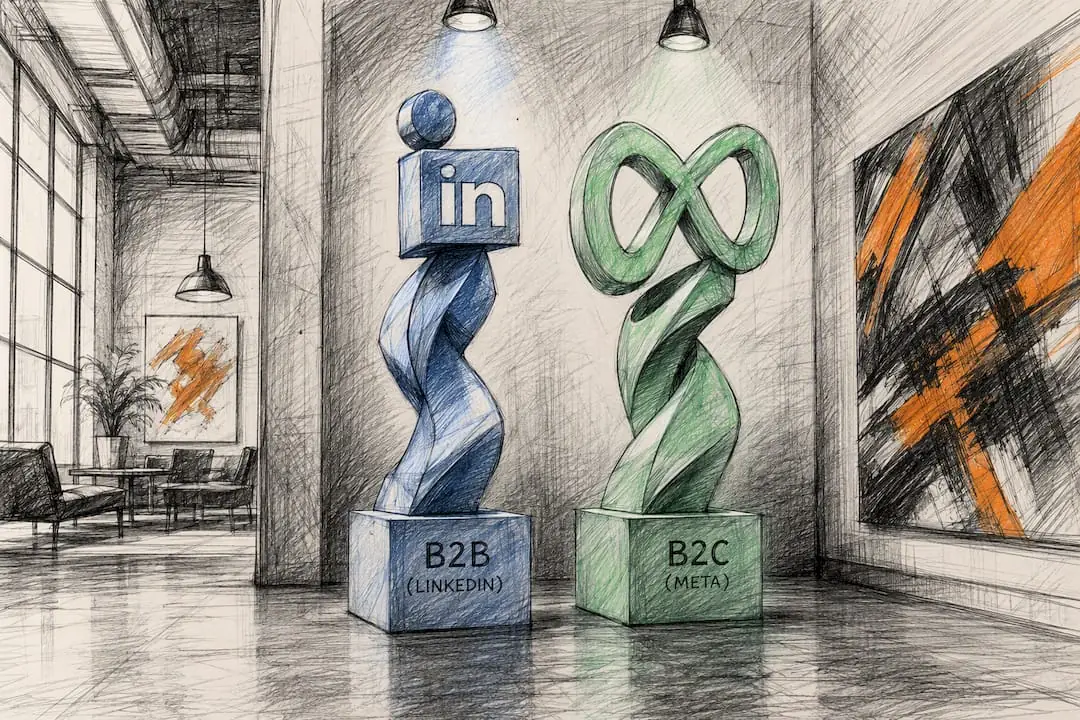
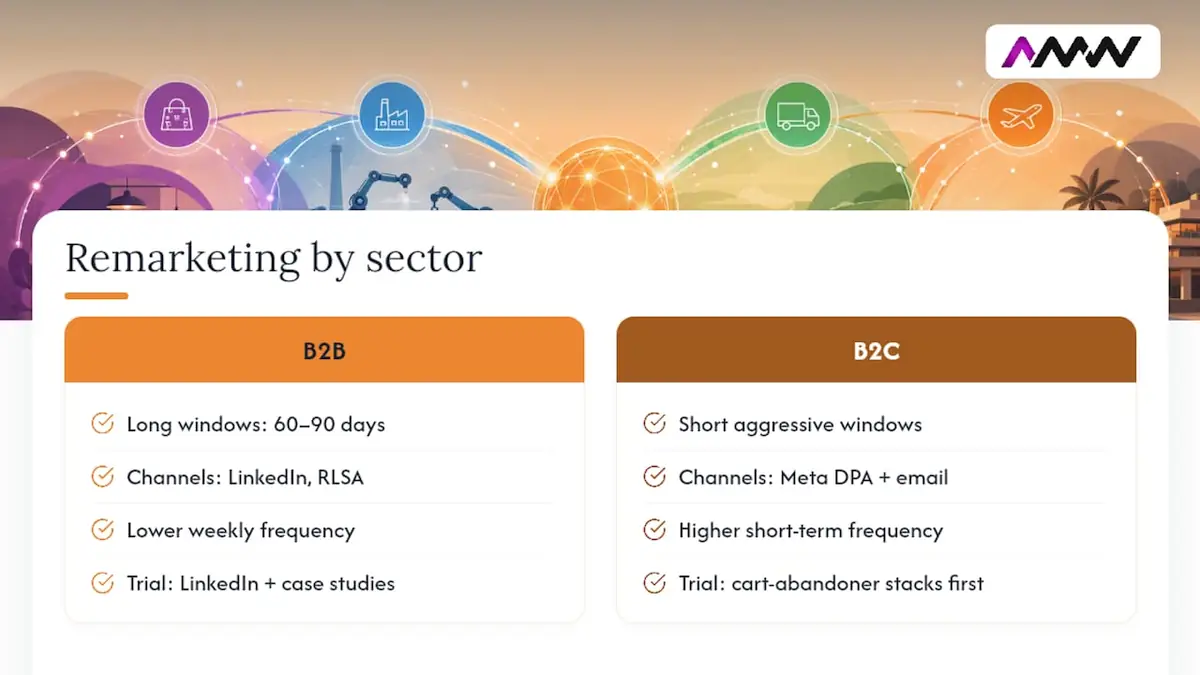
B2B remarketing needs patience: longer windows (60 to 90 days), heavier reliance on LinkedIn and RLSA, and lower weekly frequency since nobody wants to see the same demo ad five times a day at work. B2C, especially ecommerce, works best with short aggressive windows on cart abandoners, Meta DPA paired with email, and higher short-term frequency because purchase decisions happen in hours, not months.
Budget-wise, trial B2C stacks on cart abandoners first since the recovery maths is fastest to prove. B2B budgets should trial LinkedIn plus case-study remarketing on your highest-value prospect list before scaling wider. Sector-specific modelling also shows service businesses often get more from mobile app reach and dynamic creative than manufacturing does, so don’t copy a manufacturing budget split onto a services business by default.
How AMW Media runs remarketing programmes
We build segment-first from day one: high, medium, and low engagement lists, each with its own creative brief and rotation schedule, refreshed on a testing cycle rather than left to run stale. Holdout testing is standard practice on every retainer, not an optional extra… For B2B clients, our messaging tiers typically run “direct demo CTA” for hot leads, “case study nurture” for warm, and “brand awareness only” for the rest.
Amir
Get remarketing set up properly with AMW Media
Building segmented audiences, matching creative to intent, and running holdout tests every month takes real ongoing attention, and that’s exactly where most in-house teams run out of hours in the week. AMW Media is the alternative to hiring an extra in-house media buyer: we handle PPC campaign management, dynamic feed setup, and creative rotation as one connected service rather than three separate freelancers who never talk to each other. Our Google Ads and Meta Ads management is priced as a flat monthly fee, from £599 and £299 a month, never a percentage of your advertising budget.
If your current remarketing is one static ad running on autopilot since last year, that’s costing you conversions you’re not seeing. Our PPC campaign management service builds the segmented lists, sets the exclusions, and runs the incrementality tests covered above, so you get proof of what’s actually working rather than a platform dashboard telling you everything’s “optimised”. Get in touch for a review of your current remarketing setup and a plan for what to fix first. Our marketing agency Reading page asks the question that follows from all of this: what should small business marketing actually earn?
Sources
- Retargeting Benchmarks 2026 + Free Allocation Calculator
- 100+ Remarketing Statistics: 2026 Research Report
- Remarketing, what it is, how it works, benefits, and more (Adobe Business)
FAQ
What is remarketing in marketing?
Remarketing means re-engaging people who’ve already visited your site, opened an email, or interacted with your brand, using targeted ads or follow-up emails rather than reaching cold audiences.
What are the main remarketing strategies to start with?
Segment audiences by engagement level, use dynamic ads for product-based businesses, layer in RLSA for warm searchers, and build an email abandonment sequence, then stack all three for the biggest lift.
How long should a remarketing campaign run?
Windows should match how fast intent decays: 3 to 7 days for cart abandoners, up to 60 to 90 days for low-engagement visitors who need longer to warm up.
Which channels work best for remarketing?
Meta DPA and email suit ecommerce cart recovery, while LinkedIn and RLSA suit B2B nurture sequences with longer sales cycles; most brands get the best results stacking two or three together.
How do you avoid ad fatigue in remarketing?
Cap frequency at 3 to 5 impressions weekly for high-engagement audiences and refresh creative every 7 to 10 days, since repeating the same ad too often tends to increase negative brand reactions rather than clicks.
Recommended
- Conversion optimisation: a practical guide for UK SMEs | AMW Media
- Facebook A/B testing for marketers: run reliable experiments | AMW Media
- Email Marketing Services That Convert | AMW Media London | AMW Media
- Essential digital marketing guide: strategies for brand growth
Our free marketing audit looks at your site, your ads and your content, and comes back with a 30 day plan. No pitch deck.

Runs the content calendars and the community side of every social account, and keeps clients posted on what is going out and when. Meet the team.