
 Black Steel Doors
 Woodstock Campers
 Phillips Joinery
Most UK advertisers pay a moderate to high cost per click on Google Ads, with legal and finance keywords being among the most expensive. For a realistic monthly picture, budget £500 to £3,000+ in ad spend for a small business, plus a management fee if you’re using an agency or freelancer, following local online marketing budget tips for small businesses. The smart move: set a modest test budget for 4 to 6 weeks, measure your cost per acquisition (CPA), then scale what actually converts.
- Headline UK cost per click range falls within a broad mid-range, with higher costs in legal, finance, and B2B sectors.
- Typical SME monthly ad spend generally starts from a few hundred pounds to several thousand, excluding VAT and management fees.
- Quick action: run a short test campaign before committing to a bigger budget
According to Whito’s UK research, sector averages vary enormously, so a single national “average CPC” figure is nearly useless without knowing your industry.
Key Takeaways
UK Google Ads costs hinge on Quality Score and industry competition more than on raw bid size, so budgeting well means planning for CPA, not just CPC.
| Point | Details |
|---|---|
| Headline CPC range | Most UK sectors sit between £0.66 and £5.00 per click, with legal and finance far higher. |
| Minimum viable budget | Aim for at least £500 to £1,000 monthly ad spend to generate enough data for optimisation. |
| VAT adds 20% | Google and most agencies quote figures excluding VAT, so factor this into your total cost. |
| London carries a premium | Expect 15 to 30% higher CPCs in London versus the rest of the UK. |
| Work with a specialist | AMW Media runs audit-first PPC engagements scaled to your budget band, from setup to ongoing management. |
How does Google Ads pricing work in the UK?
You don’t pay your maximum bid. You pay just enough to beat the advertiser below you in the auction, and that figure is driven by Ad Rank, not bid size alone. Ad Rank combines your bid with your Quality Score, plus the expected impact of ad extensions and formats, and Google uses that to calculate your actual CPC.
Quality Score is Google’s 1 to 10 rating of your ad relevance, expected click-through rate, and landing page experience. A higher score can mean paying less than a competitor bidding more but scoring lower, according to Google’s own Quality Score documentation.
- Formula in plain English: your bid × Quality Score → Ad Rank → actual CPC
- Ad Rank thresholds set a reserve price for each auction slot, and Google notes this can also set a minimum billable unit in your local currency
- For UK accounts, that unit is GBP, meaning you’ll never see fractional pence billing below Google’s set threshold
Google’s guidance on Ad Rank thresholds explains that these reserve prices exist partly to filter out low-quality ads, not just to extract higher fees. On the billing side, Google Ads invoices UK advertisers exclusive of VAT by default, so your dashboard spend figure isn’t your final cost.
Every figure is published: Google Ads management starts at £599 a month, and the full rate card is on our pricing page, where you can tick what you need and see the total before you speak to anybody.
What do Google Ads cost by industry in the UK?
Cost per click swings hard depending on what you sell and who’s bidding against you. A personal injury solicitor and a local dog groomer are playing in completely different auctions.
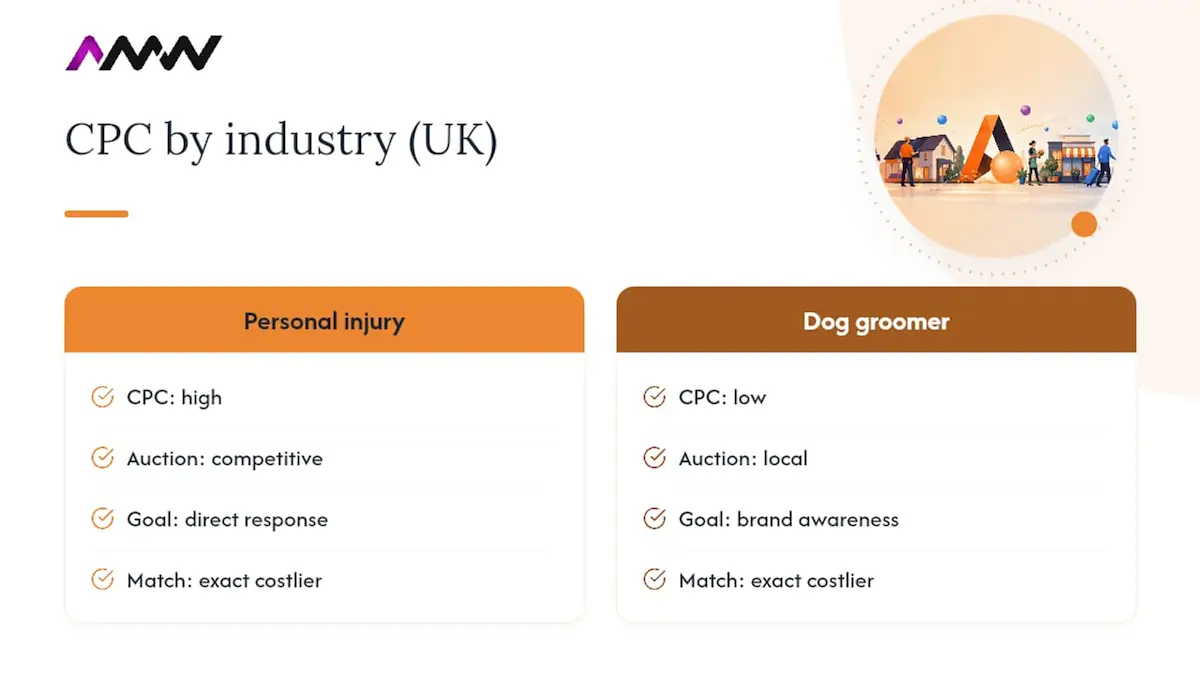
That doesn’t make Display worse value, just a different job: brand awareness rather than direct response.
Match type matters more than most advertisers realise. Broad match keywords tend to pull cheaper, less relevant clicks, while exact match on high-intent phrases costs more but converts better.
Pro Tip: *Check your industry’s benchmark before setting a budget.
How much should you budget monthly for Google Ads?
Anything under £500 a month rarely generates enough click volume for Google’s algorithms to optimise properly. You need sufficient data for the system to learn from, as very low click volumes are insufficient for effective optimisation.
Here’s roughly how UK businesses of different sizes tend to structure their spend:
- Micro businesses (sole traders, local shops): £500 to £1,000 ad spend, often self-managed or with a freelancer charging £150 to £400/month
- Small businesses: £1,000 to £3,000 ad spend, with agency fees typically £300 to £800/month or 10 to 15% of spend
- Medium SMEs: £3,000 to £10,000 ad spend, agency fees often £800 to £2,000/month or a flat retainer negotiated on scope
- Larger businesses: £10,000+ ad spend, with dedicated account management and fees scaled accordingly
Beyond the obvious ad spend and management fee, a few costs catch people out:
- One-off account setup or audit fees (some agencies charge, some don’t)
- Conversion tracking implementation, especially if you need server-side tracking
- Landing page design or optimisation work, often billed separately
- VAT on top of every invoice, agency and Google alike
Agency pricing surveys show flat monthly retainers and percentage-of-spend models both remain common, with the split usually coming down to account size and complexity.
How do you calculate your Google Ads budget?
Work backwards from your goal rather than picking a round number that feels comfortable.
- Decide your target CPA (what you can afford to pay per sale or lead)
- Estimate your website’s realistic conversion rate (2 to 5% is a reasonable starting assumption for most sectors)
- Divide your target number of conversions by that conversion rate to get required clicks
- Multiply required clicks by your industry’s benchmark CPC to get your ad spend
- Add management fees and 20% VAT to reach your total monthly investment
For the plumber, add a £400 management fee and VAT, and you’re looking at roughly £2,400 total monthly investment. The Google Ads budget calculator is a decent sanity check for these numbers, though real account data from your own campaigns will always beat a generic tool once you’ve got a few months of history.
How can you reduce your Google Ads costs?
Quality Score is your biggest lever. Improve ad relevance, tighten your ad groups around specific keyword themes, and make sure your landing page actually matches what the ad promises, and your expected CTR climbs, which usually pulls your CPC down.
- Write ad copy that mirrors the exact search query, not generic brand messaging
- Use Smart Bidding (Target CPA or Target ROAS) once you’ve got 30+ conversions a month; stick with manual bidding below that, where you need tighter control
- Build a negative keyword list from week one to stop wasting spend on irrelevant searches
- Adjust ad scheduling and device bids based on when and where conversions actually happen
- Test at least two ad variations per group and kill the underperformer within 2 weeks
- Review conversion tracking monthly. Broken tracking silently wrecks your optimisation data
Pro Tip: Before touching your bids, audit your conversion tracking. Half the “high CPC” complaints we hear are actually tracking issues making campaigns look worse than they are.
Seasonal bid adjustments matter too. Ease off aggressive bidding in slow periods and lean in harder around your peak season, rather than running flat bids year-round.
Does location affect what you pay in the UK?
London campaigns typically carry a 15 to 30% CPC premium over the rest of the UK, driven by denser competition and higher average order values in the capital.
- Use geo-targeting to separate London from the rest of the UK if your budget allows
- Apply bid adjustments (reducing bids by a set percentage) rather than excluding regions entirely
- Run separate campaigns per city only once you’ve got enough volume to justify the extra management overhead; otherwise, national campaigns with location bid modifiers do the job fine
What does AMW Media do for UK PPC clients?
AMW Media is registered on Companies House and manages Google Ads accounts for SMEs across a range of UK industries, from home services to e-commerce. Our approach starts with an audit, not a pitch.
A good PPC audit tells you where your Quality Score is weak, whether your tracking is trustworthy, and whether your current spend actually matches your sector’s realistic CPC range. If an agency skips straight to “we can beat your current numbers” without checking any of that, treat it as a red flag.
Typical AMW Media PPC engagements include account structure, keyword research, ad copywriting, landing page recommendations, and ongoing bid management, with fees scaled to the budget bands covered earlier in this piece.
- Watch for agencies quoting fees with no reference to your actual spend level
- A proper audit checks Quality Score, conversion tracking, and account structure before recommending changes
- Ask what reporting cadence you’ll get; monthly is standard, weekly for larger accounts
Our PPC campaign management service covers exactly this kind of structured, audit-first approach.
What minimum spend or setup fees should you expect?
Google itself sets no official minimum spend for Google Ads. You can technically run a campaign on a few pounds a day. In practice, that’s rarely a good idea, because the auction system needs enough data (clicks, conversions, impressions) to optimise your campaigns properly.
Most UK agencies and freelancers set their own practical floor, usually somewhere around £500 to £1,000 in monthly ad spend, purely because anything lower doesn’t generate enough volume to justify active management. Below that threshold, you’re often better off managing the account yourself or using Google’s automated Smart campaigns, which require less hands-on optimisation.
Setup fees vary considerably across the market. Some agencies fold account setup into the first month’s management fee. Others charge a separate one-off fee, typically £200 to £600, covering conversion tracking installation, initial keyword research, and campaign structure. Freelancers tend to charge less for setup but may lack the infrastructure for advanced tracking work like server-side conversion APIs.
Google Ads itself has no account creation fee. You can set up an account for free and start bidding immediately once you’ve added billing details. The costs that catch new advertisers out tend to be indirect: paying for a landing page build, investing in proper tracking setup, or commissioning professional ad copy before the campaign even goes live.
If you’re working with a freelancer or a smaller agency, always ask whether their quoted fee includes conversion tracking setup. It’s a common gap, and one that quietly undermines everything else you’re paying for, since a campaign without reliable tracking can’t be optimised with any confidence.
How does Google Ads compare with Meta, Instagram and other UK platforms?
Facebook and Instagram ads in the UK generally cost less per click, often £0.30 to £1.50, but they’re built for a different job. Google Ads captures people actively searching for a solution; Meta platforms interrupt people scrolling who weren’t necessarily looking to buy anything.

That distinction shapes where your budget works hardest. A business with clear, searchable demand (a plumber, a solicitor, a software tool with a known category) tends to see stronger returns from Google Ads because intent is already there. A business selling something more discovery-led (a new fashion brand, a lifestyle product) often does better starting with Instagram promotion or Meta ads, where visual creative can build desire before someone searches.
Cost per click isn’t the only comparison that matters. Meta’s cost per thousand impressions (CPM) tends to run lower than Google Display, but conversion rates on Search campaigns are usually higher because the audience has already expressed intent through their search query.
Most SMEs we work with eventually run both. Google Ads captures existing demand efficiently; Meta and Instagram build the top of the funnel and support retargeting once someone has already visited your site. Treating them as competitors for the same budget usually misses the bigger opportunity of using each for what it does best.
Do Google Ads costs change with the seasons?
Yes, and the swings can be sharp enough to blow a fixed monthly budget off course if you’re not planning for them.

January often brings a different kind of spike, driven by New Year fitness, finance, and self-improvement searches. Travel searches surge from January through March as people book summer holidays, pushing CPCs up in that sector specifically. B2B and legal sectors tend to see quieter auctions over the August and December holiday periods, when decision-makers are out of office and search volume drops.
The practical takeaway: build seasonal flexibility into your budget rather than locking in a flat monthly figure for the year. If Black Friday matters to your business, plan for a temporary spend increase in November rather than trying to hit the same targets with a static budget stretched too thin. Conversely, quieter periods are often a good time to test new ad copy or keyword expansions at lower cost, since competition (and therefore CPC) tends to soften.
Reviewing your account’s performance against the same period last year, where you have the data, is far more useful than comparing month to month within a single year.
An honest take on UK Google Ads budgeting
The conventional advice, “spend more, get more”, misses what actually separates good accounts from wasteful ones. Two businesses can spend identical £2,000 monthly budgets in the same sector and get wildly different results, purely because one has a Quality Score of 8 and the other is stuck at 4. Bid size is often the least interesting lever in the whole system.
Where most guidance falls short is treating CPC benchmarks as a target rather than a diagnostic. If your CPC sits well above your sector’s average, that’s not necessarily bad luck. It’s usually a signal that your ad relevance or landing page needs work before you throw more budget at the problem.
Prioritise tracking accuracy and Quality Score fundamentals before you touch bidding strategy or increase spend. A modest budget on a well-optimised account beats a large budget on a sloppy one every time, and it’s far cheaper to fix now than to discover six months into an underperforming campaign.
Amir
Want a straight answer on what your Google Ads budget should actually be?
If you’ve read this far, you’ve probably worked out that guessing your way to a Google Ads budget rarely ends well. AMW Media runs audit-first PPC campaigns for UK SMEs, meaning we check your Quality Score, tracking setup, and sector benchmarks before recommending a single pound of spend, not after.

We handle everything from account structure and keyword research through to landing page recommendations and ongoing bid management, with fee structures scaled to the budget bands covered earlier. If you’re also weighing up your website’s conversion performance alongside your ad spend, our web design team can review whether your landing pages are pulling their weight before you commit more budget to clicks that might not convert. Get in touch through our PPC services page for a simple audit of your current account, or your proposed budget if you haven’t launched yet.
Sources
- About Quality Score and its components, Google Ads Help
- Google Ads budget & cost calculator, Google Business (UK)
- Google Ads Cost UK 2026: What a click really costs, Whito research
FAQ
Is Google Ads worth it for UK businesses?
For most businesses with clear, searchable demand, yes. Google Ads captures people actively looking for a solution, which typically converts better than interruption-based advertising, provided your Quality Score and tracking are solid.
Is £10 a day enough for Google Ads in the UK?
It depends heavily on your industry. In a low-CPC sector like e-commerce, £10 a day might get you 8 to 10 clicks; in legal or finance, it might buy less than one click, which isn’t enough data for the algorithm to optimise.
Is £20 a day a good Google Ads budget?
£20 a day (roughly £600 a month) sits near the practical minimum for generating useful optimisation data in most sectors, though competitive industries like legal or finance will still find this tight.
How much do Google Ads pay per 1,000 views?
This confuses two different things: Google Ads charges advertisers per click (CPC) for Search campaigns, not per view. Display and YouTube campaigns can be billed on a CPM (cost per 1,000 impressions) basis, typically far cheaper than Search CPCs.
Cost per click also moves with where you are advertising. If you are bidding in one city rather than nationally, our PPC agency in Milton Keynes page sets out what local competition does to the numbers above.
Recommended
- Best marketing methods for UK businesses in 2026 | AMW Media
- Google Business Profile SEO: local ranking guide for UK small businesses | AMW Media
- Best automation tools for digital marketing: 2026 UK guide | AMW Media
- Top digital marketing tools for business in 2026 | AMW Media
Our free marketing audit looks at your site, your ads and your content, and comes back with a 30 day plan. No pitch deck.

Runs the content calendars and the community side of every social account, and keeps clients posted on what is going out and when. Meet the team.