
 Black Steel Doors
 Woodstock Campers
 Phillips Joinery
A high CPC only matters if it’s making your acquisition unprofitable, so before you touch a single bid, run a five-minute audit: pull up your change history and Auction Insights report right now. The all-industry average CPC for Google Search sits at $5.42, but that number tells you almost nothing about your account until you compare it against what a customer is actually worth to you.
TL;DR:
- Your actual CPC is only problematic if it exceeds your calculated breakeven cost, which depends on your average order value, target CPA, and conversion rate.
- Account changes, increasing competition, declining Quality Score, or broad match drift often cause CPC spikes, which should be diagnosed via audit rather than guesswork.
- Fixes that lower CPC include refining ad groups and landing pages, tightening match types, adding negative keywords, and setting bid limits on Smart Bidding strategies.
- Regular monitoring, including change history and auction insights, along with automation alerts, helps prevent costly CPC spikes before they escalate.
- Most accounts find their CPC issues resolve by analysing search terms, review of Quality Score components, and understanding channel-specific benchmarks rather than relying solely on the industry average.
Current CPC benchmarks and what they actually mean for you
Here’s the number everyone quotes: the 2026 all-industry average CPC for Google Search is $5.42, a sharp climb from a decade ago. It’s a useful anchor point, but it’s also nearly meaningless in isolation, because a £5 click can be highly cost-effective for a solicitor but less so for a low-margin product seller.
Network matters just as much as industry. Search CPCs run several times higher than Display, so judging your Display campaign against your Search average is comparing apples to a completely different fruit. Always benchmark a channel against its own historical baseline first.
Industry spread is the other piece of the puzzle. Legal and finance keywords sit at the high end, often into double digits, while e-commerce and travel typically land far lower. None of that tells you whether YOUR CPC is a problem, though. Only your breakeven CPC does that.
Pro Tip: Work out your breakeven CPC in under a minute: divide your average order value by your target cost-to-acquire ratio, then multiply by your conversion rate. If your actual CPC sits comfortably below that number, you don’t have a CPC problem, no matter what the benchmark says.
To make this concrete, here’s how to read your own numbers against the noise:
- Calculate breakeven CPC as (average order value × target CPA ratio) × conversion rate.
- Compare Search CPC only against past Search CPC, never against Display or social.
- Check your sector’s typical range before panicking about a single figure.
- Treat the £5.42 average as orientation, not a target.
Why does Google Ads CPC go up, spike, or stay stubbornly high?
CPC problems come in three flavours, and mixing them up wastes hours. Chronic high CPC is a structural issue: your niche is competitive, or your Quality Score has been mediocre for months. A gradual rise usually means competition or relevance is slowly eroding. A sudden spike is almost always something changing account-side or in the auction overnight.
Several mechanisms explain most cases, and they compound:
- Auction competition. Google Ads runs a second-price-style auction, so you effectively pay just enough to beat the advertiser ranked below you. More bidders chasing the same terms pushes that floor up regardless of anything you do.
- Quality Score components. Expected CTR, ad relevance, and landing page experience all feed your Quality Score, and a weak score inflates the price you pay for the same position. Check these under the “Status” column in Keyword details, not the composite score itself.
- Match-type drift. Broad match keywords quietly expand into pricier, less relevant queries over time. Pull your search terms report and look for spend creeping into territory you never intended to bid on.
- Automated bidding effects. Smart Bidding strategies can bid more aggressively when they’re optimising for volume or when conversion tracking gaps confuse the algorithm, and there’s no hard internal ceiling stopping an individual auction bid from climbing.
- Account structure and landing pages. Bloated ad groups with mismatched keywords and slow, irrelevant landing pages both drag Quality Score down, which drags CPC up.
Rising CPCs typically reflect a combination of these factors rather than one single cause, which is exactly why a proper audit beats guessing.
The 30 to 60 minute audit checklist to diagnose your CPC
Run this in order. Each step either clears a suspect or points you straight at the culprit.
- Check change history first. Anything you or Google’s automated recommendations altered in the last 30 days (bid strategy switches, budget changes, new ad copy) is the most common trigger behind an overnight jump.
- Pull Auction Insights month by month. Look at impression share, overlap rate, and outranking share for your top keywords. A new competitor showing up in this report explains a lot on its own.
- Export your Search Terms report. Sort by cost, then flag every irrelevant query eating budget. Add these as negative keywords immediately; this is usually the single fastest CPC reduction available.
- Review Quality Score components for your top-spend keywords. Segment by “Quality Score” columns in the keyword view and note which of the three components (CTR, relevance, landing page) is dragging each one down.
- Audit your bid strategy and learning period. If you switched to a Smart Bidding strategy recently, check whether it’s still inside its typical learning window, since volatility during that phase is normal and temporary.
- Confirm conversion tracking is complete. A bidding algorithm optimising against partial or broken conversion data will often chase volume instead of value, which quietly inflates CPC.
Things to have open on screen while you do this:
- Change history report (last 30 to 90 days)
- Auction Insights, segmented by month
- Search Terms report, sorted by cost
- Keyword-level Quality Score columns
- Bid strategy report showing status and learning period
Most accounts find their answer somewhere in steps 1 to 3. It’s rarely a mystery once you actually look.
Tactical fixes that reduce CPC without killing conversions
Fixing Quality Score takes the longest but pays off the most. Restructure bloated ad groups into tighter themes, rewrite ad copy so it mirrors the actual search query, and make sure the landing page matches the ad’s promise. Expect movement within days to a few weeks, not overnight; Quality Score responds to sustained signals, not a single edit.
Targeting and match types offer the fastest wins. Tighten broad match where it’s expanding into irrelevant queries, build out your negative keyword list from the search terms audit, and refine audience layers so you’re not paying premium prices for clicks unlikely to convert.
Bid strategy choice matters more than most advertisers admit. Manual CPC (or Enhanced CPC) gives you a hard ceiling and suits accounts with thin conversion data or tight margins. Smart Bidding strategies like Target CPA or Target ROAS work well once you have enough conversion volume feeding them, but they need constraining, not just switching on and forgetting about.
- Set portfolio bid limits if you’re on Smart Bidding and want a practical cap back.
- Give any new bid strategy at least one full learning cycle before judging it.
- Never switch strategy and change budget in the same week; you won’t know which caused what.
Ad creative and extensions are cheap CPC medicine. Sitelinks, callouts, and structured snippets all lift CTR, and a higher CTR feeds directly back into Quality Score. Test two or three headline variations against each other and keep the winner.
Landing pages deserve their own attention here too. Page speed, message match, and a single clear call to action all shift the numbers on conversion rate, which changes your breakeven maths even if CPC doesn’t budge. A conversion optimisation pass alongside your PPC audit often does more for profitability than another round of bid tweaks. If you want to go deeper on testing methodology, this CRO guide covers useful ground.
Pro Tip: Before you cut CPC anywhere, check average order value on that keyword. A £15 CPC that reliably closes a £2,000 contract isn’t a problem to solve, it’s a budget to protect.
There’s a decision point worth naming explicitly: sometimes the right move is to accept a higher CPC because the conversion value justifies it. Chasing a lower number for its own sake, at the cost of quality traffic, is how good campaigns quietly get worse.
Monitoring and prevention: how to stop the next spike
Set granular alerts at both campaign and keyword level for CPC and CPA thresholds, so you hear about a problem the day it starts rather than at month end. Auction Insights and impression share deserve a monthly look even when nothing seems wrong; competitors entering your space rarely announce themselves first.
Automation guardrails are worth building into your routine:
- Use budget pacing alerts to catch runaway daily spend early.
- Apply portfolio bid limits on Smart Bidding campaigns where a hard ceiling matters to your margins.
- Document every bid strategy change with its start date, so you know when a learning window has closed.
- Track CPC, CPA, ROAS, conversion rate, and your top five most expensive search terms in one recurring report.
None of this needs to be complicated. A simple monthly checklist, reviewed properly rather than skimmed, catches most CPC problems while they’re still cheap to fix.
Why benchmarks tell you less than a proper audit
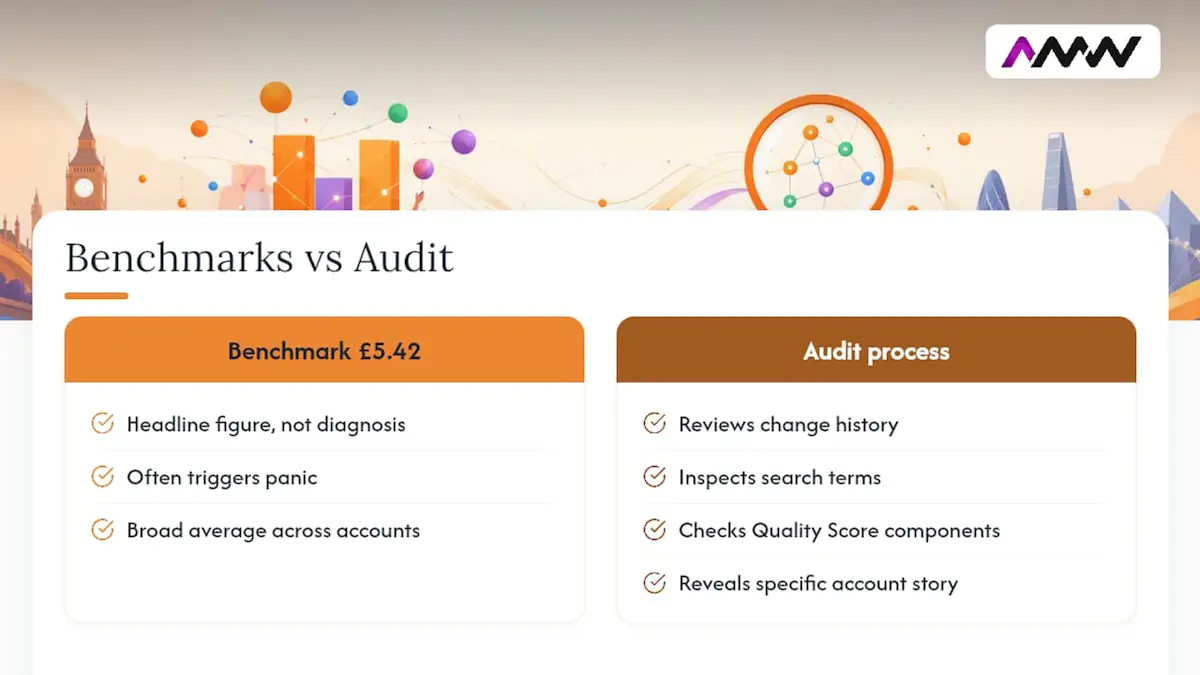
Amir, AMW Media’s PPC lead, has seen the same pattern play out across dozens of accounts: the businesses that panic over benchmark averages rarely have a real CPC problem, and the ones that ignore a broken account usually do.
Google Ads certifications and hands-on management across PPC campaigns for UK SMEs inform this view: a £5.42 average is a headline figure, not a diagnosis. Every account that’s come through AMW Media’s audit process tells its own story once you look at change history, search terms, and Quality Score components together, and that story is almost always more specific than “CPC is high, fix it.”
What high CPC actually tells you (and what it doesn’t)
Most advice on this topic treats a rising CPC as inherently bad news, and that’s the part I’d push back on hardest. CPC is a cost, not a verdict. The number only matters relative to what a click is worth to your business, and plenty of advertisers chase a “healthy” CPC while quietly starving their best-performing, higher-cost keywords of budget.
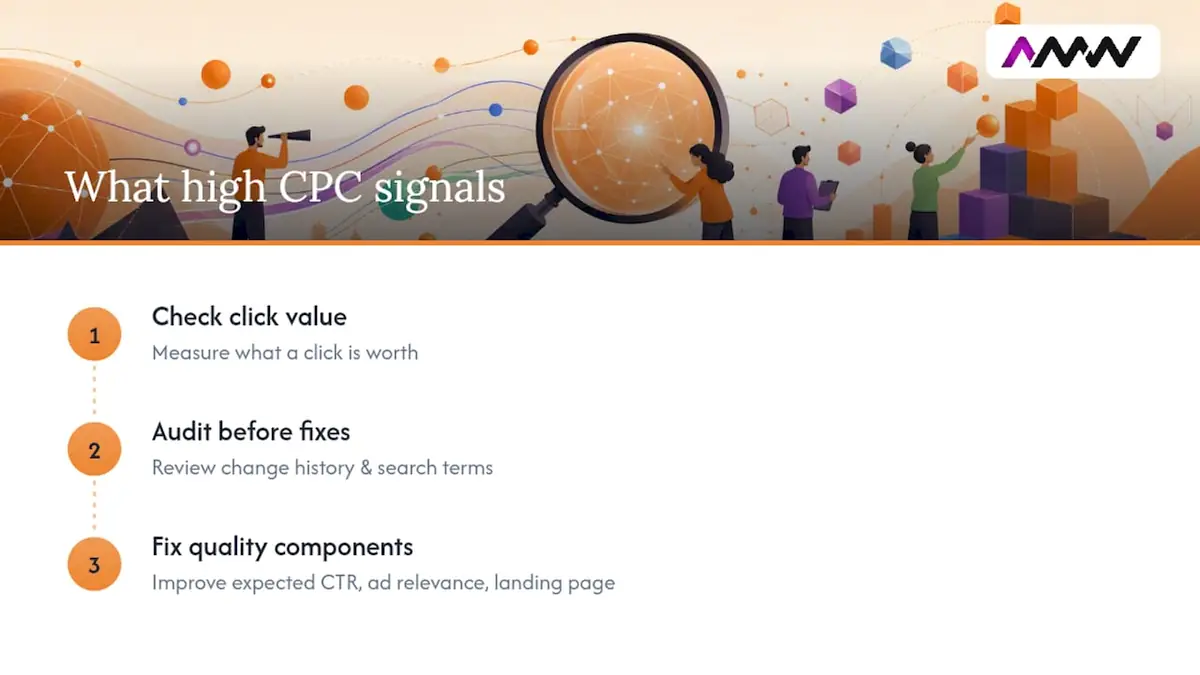
Where conventional wisdom really falls short is in treating Quality Score as the composite number to obsess over. It isn’t. The three components underneath it (expected CTR, ad relevance, landing page experience) are where the real gains sit, and fixing those takes weeks of consistent work, not a single afternoon of bid adjustments.
If you take one thing from this: prioritise the audit before the fix. Most accounts I’d expect to see chasing a lower CPC haven’t actually confirmed where the money is leaking. Change history and search terms first. Bidding tweaks second.
Amir
How AMW Media handles high CPC problems for you
Right, if you’ve run the audit above and you’re still staring at a CPC that doesn’t add up, that’s usually a sign the fix needs proper hands-on attention rather than another tutorial. AMW Media runs full PPC campaign management for SMEs across a range of sectors, and a CPC problem rarely turns up on its own.

A first engagement typically covers:
- A full account audit: change history, Auction Insights, search terms, and Quality Score components for every top-spend keyword.
- Campaign restructuring and bid strategy review, matched to your actual margins rather than a generic template.
- Landing page recommendations, drawing on AMW Media’s web design team where page speed or message match is part of the problem.
- A monitoring cadence set up from day one, so the next spike gets caught before it costs you money.
If cutting acquisition costs matters to your business right now, get in touch through the PPC services page and AMW Media will run the audit with you.
Sources
- Google Ads Benchmarks for YOUR Industry Updated!
- What Is a Good CPC? 2026 Cost-Per-Click Benchmarks
- Why Your Google Ads CPC Spiked Overnight (And How to Prevent It)
- What Is a Good CPC for Google Ads? 2026 Benchmarks Guide
FAQ
Why is my CPC so high on Google Ads?
Usually one of four things: strong auction competition, weak Quality Score components, broad match keywords drifting into irrelevant queries, or a Smart Bidding strategy optimising for volume over efficiency.
How much CPC is good for Google Ads?
There’s no universal figure; a good CPC is any amount below your breakeven CPC, calculated from your average order value and target acquisition cost, regardless of where the $5.42 all-industry average sits.
How do I fix high CPC?
Run the audit first: check change history, Auction Insights, and search terms, then fix whichever cause it reveals, whether that’s Quality Score, match types, or bid strategy constraints.
What is the maximum CPC bid for Google Ads?
You set your own ceiling through Manual CPC or Enhanced CPC bidding; Smart Bidding strategies have no fixed internal cap, so portfolio bid limits are the practical way to restore one.
A high cost per click hurts most in a dense local market where a handful of advertisers bid on the same few terms. Milton Keynes is one of those markets, and our PPC page for the city explains how we work around it.
Recommended
- PPC campaign setup steps for competitive success
- Conversion optimisation: a practical guide for UK SMEs
- What is PPC advertising? A 2026 guide for business growth
Our free marketing audit looks at your site, your ads and your content, and comes back with a 30 day plan. No pitch deck.

Runs the content calendars and the community side of every social account, and keeps clients posted on what is going out and when. Meet the team.