
 Black Steel Doors
 Woodstock Campers
 Phillips Joinery
The tools worth your time right now are Semrush for SEO, HubSpot for CRM and automation, Brevo for email, Buffer or Sprout Social for social scheduling, Canva for design, GA4 for analytics, and either Wix or Shopify depending on whether you sell services or products. That covers the core categories most UK businesses actually need.
Here is a quick shortlist by business need:
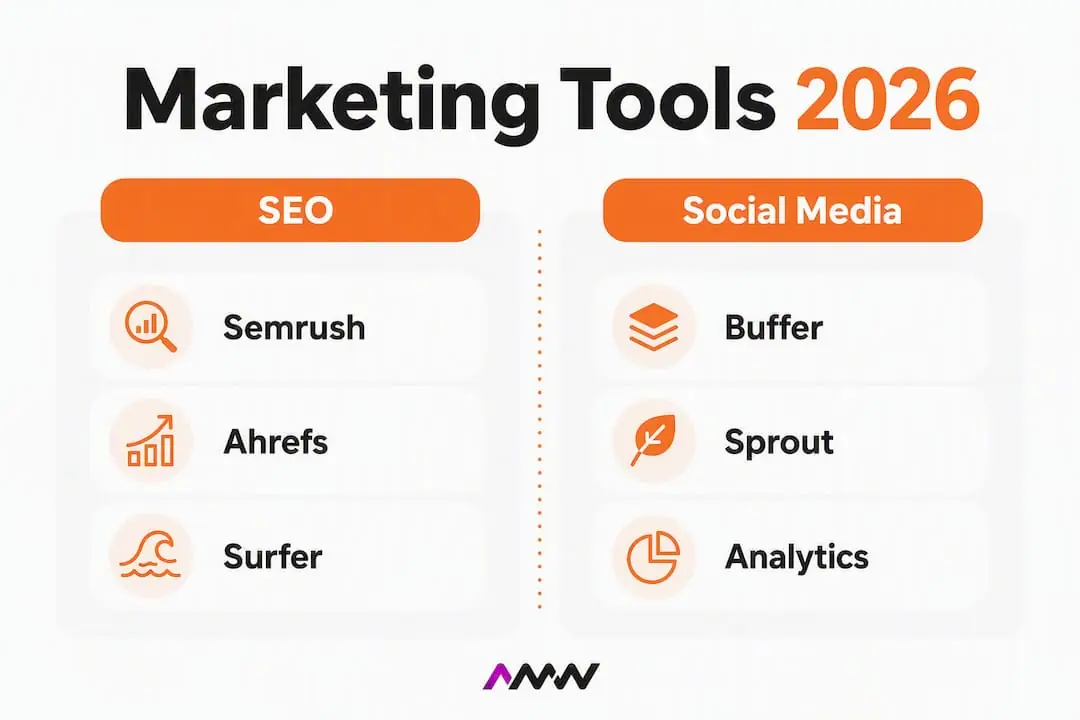
- SEO and content visibility: Semrush or Ahrefs for keyword research and site auditing; Surfer SEO if you want AI-assisted content briefs baked into your writing workflow.
- Social media management: Buffer for lean teams on a budget; Sprout Social when you need reporting depth and multi-account oversight.
- Email and lifecycle marketing: Brevo (formerly Sendinblue) for affordable automation with solid GDPR-friendly data hosting options.
- CRM and marketing automation: HubSpot, which has a usable free tier and scales without forcing an immediate upgrade.
- Design and content creation: Canva for fast, on-brand visuals without a designer on call.
- Website and commerce: Wix for service businesses wanting speed; Shopify if you are selling physical or digital products at any meaningful volume.
Nearly all of these offer a free plan or a trial period, so you can test before committing. Every tool listed stores or processes data, so GDPR compliance and UK data-handling policies matter, check each vendor’s data processing agreement before you sign up.
How do the top tools compare at a glance?
| Category | Best for | Pricing / free plan | Core features | Ease of use | Key integrations |
|---|---|---|---|---|---|
| SEO | Growth teams, agencies | Semrush from ~£99/mo; free limited tier | Keyword research, site audit, backlink analysis | Moderate learning curve | GA4, Google Search Console, CMS |
| Social media | SMEs, freelancers | Buffer free tier; Sprout Social from ~£199/mo | Scheduling, inbox, analytics | Buffer: easy; Sprout: moderate | Meta, LinkedIn, X, GA4 |
| Email & lifecycle | SMEs, e-commerce | Brevo free up to 300 emails/day | Email campaigns, automation, SMS | Easy | Shopify, WooCommerce, CRM |
| CRM & automation | SMEs to enterprise | HubSpot free CRM; paid from ~£41/mo | Contact management, pipelines, workflows | Moderate | GA4, Shopify, ad platforms |
| Design | All business sizes | Canva free tier; Pro ~£10/mo | Templates, brand kit, video | Very easy | Slack, Google Drive, social platforms |
| Website builder | Service businesses | Wix free; paid from ~£9/mo | Drag-and-drop, SEO tools, booking | Very easy | GA4, Mailchimp, Wix apps |
| E-commerce | Product businesses | Shopify from ~£25/mo; 3-day free trial | Store, payments, inventory, apps | Easy to moderate | GA4, Meta, email tools, CRM |
| Analytics | All business sizes | GA4 free; Looker Studio free | Traffic, conversions, audience | Moderate | CRM, ad platforms, CMS |
| Ads / PPC | Growth, enterprise | Google Ads / Meta Ads; no fixed licence | Campaign management, targeting, bidding | Steep | GA4, CRM, landing page tools |
| Conversion optimisation | Growth teams | Microsoft Clarity free; paid A/B tools vary | Heatmaps, session recordings, A/B testing | Easy to moderate | GA4, CMS, CRM |
Quick selection tip: Most UK SMEs work best with a compact core stack: a light CRM, a basic email tool, GA4, and a consent management solution. Research from Business Talking suggests starting with five to eight well-chosen tools rather than dozens. Licence costs for that kind of stack are generally affordable for a small team, often estimated within a moderate monthly range.
The best digital marketing tools by category
SEO: Semrush and Ahrefs
Semrush is the most widely used SEO platform for UK businesses that want everything in one place. Keyword research, technical site auditing, backlink analysis, position tracking, and competitor gap analysis are all there. The G2 reviews for Semrush consistently highlight the breadth of data and the quality of the keyword database as its strongest points. The trade-off is price: the entry plan is around £99 per month, which is a real commitment for a sole trader. The free tier exists but is heavily restricted.
Pros: Comprehensive data, strong reporting, good integrations with GA4 and Google Search Console. Cons: Expensive for small teams; the interface takes time to learn. Who it suits: Growth-stage SMEs, in-house marketing managers, and agencies managing multiple clients.
Ahrefs is the preferred choice for backlink analysis and content gap research. Its G2 profile reflects strong satisfaction among SEO professionals who rely on link data. No free plan, but a limited free tool set is available via Ahrefs Webmaster Tools.
Surfer SEO sits in a different lane: it focuses on content optimisation rather than full-site auditing. You paste a draft, and it scores it against top-ranking pages for your target keyword. UK SMEs can access entry-level Surfer SEO for approximately £30 per month, making it one of the more affordable paid tools in a lean stack.
Social media: Buffer and Sprout Social
Buffer is the sensible starting point for most small businesses. It handles scheduling across Meta, LinkedIn, X, and Pinterest, has a clean interface, and the free plan covers three channels. The Essentials tier fits neatly into a budget-conscious stack with a low monthly cost.
Pros: Simple, fast to set up, good mobile app. Cons: Reporting is basic; no social listening or inbox management on lower tiers. Who it suits: Freelancers, small teams, founders managing their own channels.
Sprout Social is a different proposition. G2 reviewers rate Sprout Social highly for its unified inbox, reporting depth, and team collaboration features. The starting price places it firmly in the mid-market bracket. If you are managing multiple brand accounts or need to report social ROI to a board, the data quality justifies the cost.
Pros: Excellent analytics, strong inbox management, good for teams. Cons: Expensive; overkill for a single-channel business. Who it suits: Marketing managers at growth-stage companies, agencies, and brands with active community management needs.
Email and lifecycle marketing: Brevo
Brevo (formerly Sendinblue) has become the go-to recommendation for UK SMEs who want email automation without paying HubSpot prices. The free plan allows a limited number of emails per day with no contact limit, which is useful for early-stage businesses. Paid plans start at a modest monthly cost.
Pros: Affordable, solid automation builder, SMS included, GDPR-friendly with EU data hosting options. Cons: Template design is less polished than some rivals; deliverability requires attention on shared IP plans. Who it suits: SMEs, e-commerce businesses, and anyone running lifecycle sequences on a tight budget. Integrations: Shopify, WooCommerce, WordPress, and most CRMs via Zapier or native connectors.
UK compliance note: Under UK GDPR, you need a lawful basis for email marketing and a clear opt-in mechanism. Brevo’s consent management features and EU-based data hosting make it easier to stay compliant, but always review your data processing agreement before sending to UK contacts.
CRM and marketing automation: HubSpot
HubSpot is the most commonly recommended CRM for UK SMEs, and the free tier is the reason. You get contact management, deal pipelines, email templates, and basic automation at no cost. G2 reviewers of HubSpot Marketing Hub frequently cite ease of use and the breadth of the free offering as the main draws.

Pros: Excellent free CRM, strong ecosystem, good onboarding resources, integrates with almost everything. Cons: Costs escalate quickly once you move to paid tiers; some features are locked behind higher plans. Who it suits: SMEs wanting a single platform for sales and marketing; growth teams that need pipeline visibility. Integrations: GA4, Shopify, Slack, ad platforms, and hundreds of third-party tools natively.
Good automation is visible and easy to pause: treat it as a discipline rather than a set-and-forget feature. HubSpot’s workflow builder makes this easier than most, with clear visual logic and audit trails.
Pro Tip: Before you build any automation in HubSpot, map the workflow on paper first. Knowing exactly what triggers what, and who owns each step, prevents the “mystery email” problem where nobody knows why a contact received a sequence.
Analytics and reporting: GA4 and Looker Studio
Google Analytics 4 is free and non-negotiable. Every UK business with a website should have it installed and configured. G2 reviews for GA4 reflect a mixed experience: the event-based model is more powerful than Universal Analytics, but the learning curve is steeper.
The critical point most businesses miss: GA4 alone rarely tells the full story. You need CRM outcomes linked to your analytics to connect website enquiries to actual revenue. Pairing GA4 with HubSpot or a similar CRM closes that gap. For reporting, Looker Studio (also free) lets you pull GA4 data into visual dashboards that non-technical stakeholders can actually read.
For session recordings and heatmaps, Microsoft Clarity is free and integrates directly with GA4. It shows you where users drop off, which is often more useful than knowing they dropped off.
Content and design: Canva
Canva has made professional-looking design accessible to businesses that cannot justify a full-time designer. The free tier is capable: templates, basic brand kit, and export to most formats. G2 reviewers of Canva consistently highlight ease of use and the template library as its defining strengths. Canva Pro at around £10 per month adds brand kit locking, background removal, and a larger asset library.
Pros: Fast, intuitive, huge template library, good for social graphics and presentations. Cons: Not a substitute for custom brand design; output can look generic if you rely on default templates. Who it suits: Founders, marketing assistants, and anyone producing regular social or email content without a designer.
For deeper content production, including video and photography, that is where specialist agency support tends to pay off more than any software subscription.
Website builders and e-commerce: Wix and Shopify
Wix suits service businesses that want a professional site without touching code. The drag-and-drop editor is easy, SEO tools are built in, and the app market covers booking, forms, and basic e-commerce. Paid plans start at a low monthly cost.

Shopify is the stronger choice the moment you are selling products at any real volume. Its ecosystem of apps, payment integrations, and inventory management is built specifically for commerce. Plans start at a modest monthly cost, and the free trial is enough to test a basic store. AMW Media holds a Shopify partnership, which means the team can build and configure stores to a certified standard.
Pros (Shopify): Purpose-built for commerce, strong app ecosystem, excellent payment options, scales well. Cons: Monthly costs add up with apps; not ideal for pure service businesses.
Ads and PPC: Google Ads and Meta Ads
There is no single “tool” for paid advertising in the way there is for email or SEO. Google Ads and Meta Ads Manager are the two platforms most UK businesses start with, and both are free to access (you pay for the media, not the platform). The learning curve on Google Ads is steep: campaign structure, match types, Quality Score, and bidding strategies all require real attention to avoid wasting budget.
This is the category where agency support most often pays for itself. A poorly structured Google Ads account can burn through budget in days with nothing to show for it.
Conversion optimisation: Microsoft Clarity and A/B testing
Microsoft Clarity is free, installs in minutes, and gives you heatmaps and session recordings that show exactly how visitors interact with your pages. It connects natively to GA4. For A/B testing, most website builders (Wix, Shopify) have basic built-in testing, and dedicated tools exist for more complex experiments.
UK data note: Any tool that records user sessions or stores behavioural data must be disclosed in your privacy policy and cookie consent banner. This applies to Clarity, GA4, and any heatmap tool. Under UK GDPR, consent must be freely given, specific, and informed.
How to choose the right tools for your UK business
The single most useful piece of advice from software selection experts: define the measurable outcome before you pick a category. “We need a CRM” is not a problem statement. “We are losing leads because nobody follows up within 48 hours” is.
Once you have the problem framed, work through this checklist:
- Define the outcome in measurable terms. What does success look like in 90 days? A specific metric (lead response time, email open rate, organic traffic) beats a vague goal every time.
- Map your existing data flows. Which systems already hold your customer data? Any new tool needs to connect to those, or you create duplicate entry and broken reporting.
- Check integration depth before you buy. Some integrations are native and included; others require Zapier or Make, which adds cost and fragility. Ask vendors specifically which integrations are native.
- Calculate total cost of ownership over two years. Include per-user fees, add-on costs, and any middleware. A £20/month tool with £50/month of required integrations is a £70/month tool.
- Run a four-week pilot on real data. Demo accounts with sample data tell you almost nothing. Picking tools on demo accounts instead of real workflows is one of the most common and costly mistakes. Use your actual contacts, your actual content, your actual campaigns.
- Assign a tool owner. A well-designed stack has a clear centre of gravity, and each tool has a named owner responsible for configuration and adoption. Without this, tools go stale within three months.
- Confirm GDPR compliance. Check the vendor’s data processing agreement, where data is stored, and whether they offer a UK or EU data residency option.
Typical price ranges for UK SMEs (monthly):
- Starter stack (free tools + one paid): £30 to £60
- Core stack (CRM, email, SEO, scheduling): £100 to £200
- Growth stack (above + paid social, analytics, CRO): £250 to £500
UK SMEs can assemble an effective stack for under £100 per month by combining one or two paid tools with strong free options like GA4, Canva’s free tier, and Google Search Console.
Red flags to watch for:
- Per-user pricing that escalates sharply after five seats
- Automation features that are opaque or impossible to audit
- Integrations listed on the pricing page that are only available on the top tier
- No UK or EU data residency option for tools handling personal data
Pro Tip: Run your pilot with a real campaign, not a test one. Pick a live email sequence or a current SEO project and run it through the new tool for four weeks. Adoption signals (are your team actually using it?) matter as much as feature performance.
How we picked and evaluated these tools
The shortlist above was built against a consistent set of criteria:
- Feature depth vs. complexity trade-off: does the tool do what it claims without requiring a specialist to configure it?
- Integration quality: are key connections (GA4, CRM, CMS, ad platforms) native, or do they require paid middleware?
- Pricing transparency: are costs predictable at SME scale, or do they escalate unpredictably with seats or contacts?
- UK relevance: does the vendor offer UK or EU data hosting, a GDPR-compliant data processing agreement, and support in UK business hours?
- Adoption signals: is the tool widely used by UK SMEs and marketing professionals, with active user communities and published reviews?
- Vendor stability: is the company established enough that the product is unlikely to be discontinued or significantly repriced in the near term?
Sources used include published user reviews, vendor documentation, independent SME marketing research, and AMW Media’s own experience advising UK businesses on their marketing stacks. Pricing figures are indicative and subject to change; always verify current plans directly with the vendor. If you want a specific stack recommendation for your specific business, get in touch with AMW Media.
Key takeaways
The most effective digital marketing stack for a UK business in 2026 starts with a clear measurable outcome, a compact core of five to eight tools, and a named owner for each.
| Point | Details |
|---|---|
| Define the outcome first | Frame the problem you want solved before choosing any tool or category. |
| Start with a compact core stack | A CRM, email tool, GA4, and a consent solution cover most SME needs from day one. |
| Check integrations before committing | Native integrations save cost; middleware like Zapier adds fragility and monthly fees. |
| Run a four-week pilot on real data | Demo accounts mislead; only live campaigns reveal whether a tool fits your workflow. |
| AMW Media as your agency alternative | AMW Media handles SEO, PPC, social, web design, and automation for UK businesses that want expert implementation rather than a DIY stack. |
The honest truth about tool stacks most articles skip
Most “best tools” lists are written as if the tools do the work. They do not. A well-chosen stack with a clear owner and a defined outcome will outperform a bloated stack of premium tools every time.
The pattern that comes up repeatedly with businesses that struggle: they bought the tool, skipped the pilot, and then blamed the software when leads still fell through the gaps. The problem was almost never the tool. It was the absence of a process the tool was meant to support.
The other thing worth saying plainly: most SMBs in 2026 find a hybrid approach works best, blending an AI-assisted platform for volume and consistency with specialist agency help for high-stakes work like paid campaigns, technical SEO, or a site rebuild. Trying to DIY everything is not a cost saving if your time has a real opportunity cost attached to it.
For UK businesses specifically, the compliance angle is not optional. Consent management and measurement integrity are as important as the creative tools you choose. A beautiful email campaign sent without proper consent records is a liability, not an asset.
The tools in this list are good. But the decision that matters most is not which tool you pick. It is whether you have defined what you want it to do, assigned someone to own it, and committed to testing it properly before you build your whole workflow around it.
When agency help makes more sense than another subscription
There is a point where adding another tool to your stack stops being a solution and starts being a distraction. If you recognise any of these signals, agency support will likely get you to results faster than another software trial: no internal capacity to manage campaigns consistently, a site migration or rebuild on the horizon, a need for custom integrations between your CRM and ad platforms, or multi-channel paid campaigns that need daily attention to avoid wasted spend. Our marketing agency Reading page asks the question that follows from all of this: what should small business marketing actually earn?
AMW Media works with UK businesses across exactly these situations. The team holds certifications from Google, Meta, Shopify, WordPress, and Framer, and covers SEO, PPC campaign management, social media management, web design, email marketing, and custom automation. Rather than handing you a tool and wishing you luck, the focus is on building and running the system so you can see results without the learning curve.
If you are ready to move faster than a four-week pilot allows, talk to the AMW Media team about which services fit your current stage.
Useful sources and further reading
- Top martech tools for UK SMEs | Business Talking, UK-focused stack recommendations with a sensible minimal starter set.
- How to optimise your digital strategy | AMW Media, aligning tools to strategy and measuring campaign outcomes.
- How to analyse marketing results for digital growth | AMW Media, practical steps for linking analytics data to commercial outcomes.
- Top automated marketing strategies to accelerate growth | AMW Media, explains automation workflows and how to evaluate automation features before committing.
- What is automation in marketing? | AMW Media, a clear primer on automation concepts, useful before configuring any CRM or email workflow.
FAQ
What are the most popular digital marketing tools for businesses in the UK?
The most widely used tools among UK businesses are Google Analytics 4, Canva, HubSpot, Semrush, and Buffer. Most businesses combine a free analytics layer (GA4) with one or two paid tools covering email, SEO, or social scheduling.
What is the 3-3-3 rule in marketing?
Definitions of the 3-3-3 rule vary across sources and there is no single canonical version. One common interpretation applies it to email: three seconds to capture attention, three lines to make the point, and three words in the call to action. Treat it as a useful heuristic rather than a fixed standard.
What are the five marketing tools every business should consider?
A practical core set for most UK SMEs is: a CRM (HubSpot), an email platform (Brevo), website analytics (GA4), a design tool (Canva), and an SEO tool (Semrush or Surfer SEO). This covers lead management, communication, measurement, content, and search visibility.
Which digital tools are most likely to boost business sales?
CRM and email automation tools tend to have the most direct impact on sales, because they reduce lead drop-off and keep prospects engaged between touchpoints. Pairing HubSpot with Brevo and GA4 gives most SMEs a solid foundation for connecting marketing activity to revenue.
How much should a UK SME budget for digital marketing tools?
A lean but effective stack typically costs between £100 and £200 per month, depending on which paid tools you include. UK SMEs can build a capable AI-assisted stack for under £100 per month by combining one or two paid tools with free options like GA4, Canva’s free tier, and Google Search Console.
Recommended
- How to master your digital marketing process for 2026
- Key benefits of digital marketing for brand growth | AMW Media
- Types of digital marketing: strategies for growth
- Digital presence strategy guide for brand growth in 2026 | AMW Media
Our free marketing audit looks at your site, your ads and your content, and comes back with a 30 day plan. No pitch deck.

Runs the content calendars and the community side of every social account, and keeps clients posted on what is going out and when. Meet the team.