
 Black Steel Doors
 Woodstock Campers
 Phillips Joinery
A good marketer turns insight into measurable growth by combining empathy, commercial thinking and disciplined measurement. They don’t just make things look nice or sound clever. Three things separate them from someone who’s merely busy:
- They turn audience insight into tests, not assumptions.
- They can draw a straight line from what they did to what it earned or saved.
- They know when to lead the strategy and when to just get the work done.
The rest of this piece breaks down the traits, the technical skills, the career reality (including pay), and a practical roadmap for getting better at the job.
Key Takeaways
A good marketer combines empathy, commercial judgement and disciplined measurement, then proves it with a results-led portfolio rather than a job title.
| Point | Details |
|---|---|
| Traits come before tools | Empathy, curiosity and clear communication predict success more reliably than any single software skill. |
| Know enough to direct, not just do | Understand analytics, SEO, paid media and CRM well enough to question specialists, even without doing every task yourself. |
| Objectives must map to outcomes | Use SMART objectives tied to commercial results, then test, learn and scale rather than launching once and hoping. |
| Portfolios beat certificates alone | Build case studies framed as objective, test, outcome; use credentials like CIM or Chartered Marketer to reinforce, not replace, proof. |
| AMW Media pairs strategy with delivery | AMW Media applies these same skills through social media, SEO, PPC and web design services built around measurable results. |
What traits make someone a good marketer?
Technical skills get you in the room. Traits are what keep you useful once you’re there. The Chartered Institute of Marketing’s Global Professional Marketing Framework frames great marketing as a mix of direction, capability and professionalism, and that mix starts with how someone thinks, not just what they know.
- Empathy and audience-first thinking: good marketers research real people before they write a single headline, and it shows in messaging that sounds like it understands the reader rather than talking at them.
- Curiosity and a test-and-learn habit: rather than guessing, they form a hypothesis, run a small test, and let the result (not their ego) decide what happens next.
- Clarity in communication and storytelling: they can explain a campaign to a finance director and a designer in the same afternoon, using language each one actually understands.
- Adaptability and continuous learning: channels shift, algorithms change, and AI tools appear monthly. MarketingSherpa’s research points to curiosity and humility, not certainty, as what separates good marketers from merely confident ones.
- Collaboration, time management and commercial judgement: the best marketing ideas die in committee if nobody manages the timeline or the budget conversation.
Pro Tip: If you want a fast read on someone’s empathy, ask them to describe their target customer’s actual day. Vague answers (“busy professionals who value quality”) are a red flag. Specific ones (“scrolls Instagram on the train, skips ads longer than six seconds”) mean they’ve actually done the research.
Which technical skills does a good marketer need?
You don’t need to be an expert in everything. You do need to understand enough to direct specialists and spot nonsense when you see it. The Skills England occupational profile for marketing roles lists exactly this kind of working fluency: running channels, planning to objectives, producing content, managing stakeholders, and reading the data.
- Analytics and measurement: basic comfort with dashboards, attribution logic and setting the right KPI for the right goal (traffic isn’t the same as revenue).
- Content and copywriting fundamentals: writing a decent brief, editing someone else’s draft, and knowing why one headline outperforms another.
- SEO and organic search basics: understanding how content and search intent connect, even if you’re not the one doing keyword research.
- Paid media literacy: knowing how campaign structure and targeting affect cost, without necessarily building the campaigns yourself.
- CMS, CRM and automation familiarity: comfortable enough with the tools to ask smart questions, whether that’s a website backend or an email platform.
Coursera’s analysis of marketing skills makes a similar point: successful marketers blend technical ability with workplace skills like collaboration and adaptability, and neither one compensates for a total absence of the other. Generative AI now speeds up drafting, reporting and even analytics work, but it accelerates good judgement rather than replacing it. CIM’s own Digital Marketing Skills Benchmark found that confidence in digital skills frequently outpaces actual ability, especially around analytics and content, which is worth remembering the next time someone tells you they’re “great with data.”
How do good marketers turn strategy into results?
CIM draws a useful line between leadership and management: leadership sets the direction, management delivers it. A good marketer needs both modes, not just one.
- Set the strategy. Decide what you’re trying to achieve and why it matters commercially.
- Write SMART objectives. Specific, measurable, achievable, relevant, time-bound targets that map directly to revenue, leads or retention, not vanity metrics.
- Build the plan. Turn the objective into channels, budget and timeline.
- Test. Launch small, measure early, and resist the urge to declare victory after three days.
- Learn and scale. Kill what doesn’t work, double down on what does.
This isn’t a one-off exercise. CIM’s framework treats it as a repeating cycle, and marketers who skip the “learn” step tend to repeat the same mediocre campaign forever, just with a new headline.
What’s the fastest way to become a better marketer?
Getting better isn’t about learning everything. It’s about going deep in a couple of areas while staying competent everywhere else, a “T-shaped” profile that most hiring managers now expect.
- Pick two or three specialisms to go deep on, whether that’s paid media, content strategy or lifecycle email, and stay conversational in the rest.
- Build a learning routine. Short, regular practice beats occasional binge-reading. Try a real project, not just a course, and get feedback from someone more senior.
- Build a portfolio around outcomes, not tasks. Frame each case study as objective, test, result. “Grew Instagram following” tells a hiring manager nothing. “Cut cost-per-lead by testing three ad angles” tells them everything.
- Consider certification once you have some real work behind you. Google, HubSpot and CIM qualifications are useful signals, but most employers weigh a working portfolio more heavily than a certificate on its own. CIM’s Chartered Marketer status is the more senior version of this: it requires ongoing continuous professional development and is widely seen as the point where a practitioner shifts from tactician to strategist.
Pro Tip: Volunteer or low-cost projects are underrated portfolio-builders. A local charity’s social media account or a friend’s small business website gives you real metrics to talk about, which beats a hypothetical case study every time.
Do marketers make a lot of money?
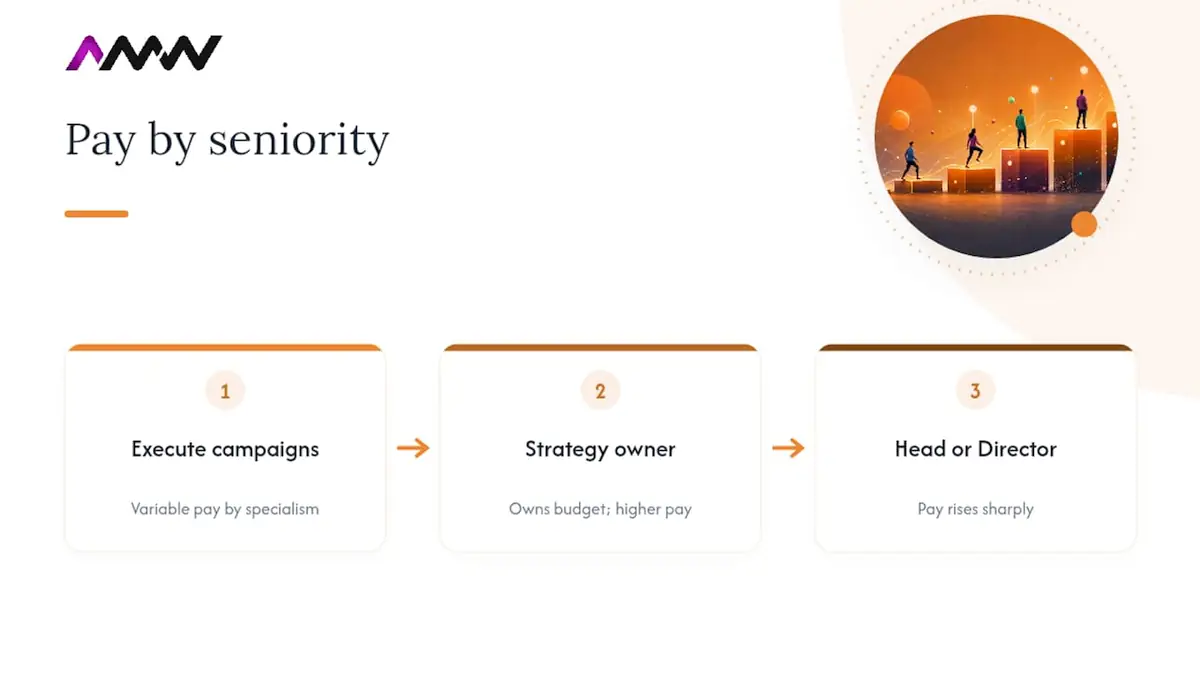
It depends heavily on seniority, specialism and whether you can prove impact rather than just describe it. Progression typically runs from executive to manager, then on to head of function, and eventually director or CMO, with the biggest pay jumps usually arriving once someone starts owning budget and strategic decisions rather than just executing a plan.
Specialism matters too. Marketers who can demonstrate commercial results, particularly in analytics, paid media or AI-assisted workflows, tend to command more than generalists doing the same job title. The AMA’s 2026 State of Marketing Careers Report singles out adaptability, strategic thinking and AI fluency as the skills most likely to hold or increase their value over the next few years, largely because they’re harder to automate than execution tasks. As a rough contextual range, junior marketing executives in the UK typically start well below senior heads of marketing or CMOs, with the gap widening sharply once someone reaches director level. Treat any specific figure you see online as a starting point for research, not gospel.
How can you tell if someone is actually a good marketer?
Anyone can talk confidently about “brand awareness.” Fewer people can show you the test that proved it worked.
- Ask for case studies structured around objective, test and outcome, not just a portfolio of pretty screenshots.
- Set a short take-home task: a one-page brief, an analytics interpretation exercise, or a quick copy edit, all of which reveal more than a CV ever will.
- Watch for red flags: overconfidence about channels they’ve never actually measured, an inability to explain why a campaign failed, or zero history of running tests.
- Combine credentials with practical proof. A CIM or Chartered Marketer qualification is a good signal of professionalism, but pair it with a real task before you make a decision, because running a useful social campaign takes more than a certificate.
How AMW Media applies these qualities in client work
We’ve found the marketers who deliver best are the ones who treat creativity and measurement as the same job, not two separate ones. On a recent brand refresh, that combination turned a scattered social presence into a consistently performing content engine within a few months.
If you need a hand: what an agency like AMW Media does differently
Reading about good marketing and actually having the time to execute it well are two very different things, and that’s usually where a specialist team earns its keep. AMW Media builds the strategy, then delivers the measurable execution behind it, which is the exact combination this whole article has been talking about. Our Birmingham page is built around considered purchases, where nobody signs off eleven thousand pounds of anything from a stock photograph.
That means social media management that’s built around objectives rather than posting for the sake of it, SEO and PPC campaigns run with proper testing cadences, and websites designed to actually convert rather than just look tidy. If you’d rather have people who live this stuff every day handle it for you, take a look at our full range of services and get in touch about your next campaign.
Sources
- CIM Global Professional Marketing Framework | CIM
- Marketing occupations overview (Skills England)
- The right marketing skills can be an asset across roles and industries | Coursera
- 2026 State of Marketing Careers Report | AMA
- What makes a good marketer? 9 qualities | MarketingSherpa
How to become a marketer worth hiring
The traits above describe the job. The route in is a separate question, and it has changed.
The old path was a degree, an agency graduate scheme and three years of doing what you were told. That still exists and it is now the slower option. The faster one is to pick a single skill people pay for, paid media, SEO, video, email, and get demonstrably good at it on something real, whether that is your own project or a local business you help for free. A portfolio of results beats a qualification in every hiring conversation we have ever had, because results are checkable and a certificate is not.
FAQ
What are the qualities of a good marketer?
Empathy, curiosity, clear communication, adaptability and commercial judgement, backed by enough technical understanding of analytics, content and paid media to direct the work confidently.
Who are the big four in marketing?
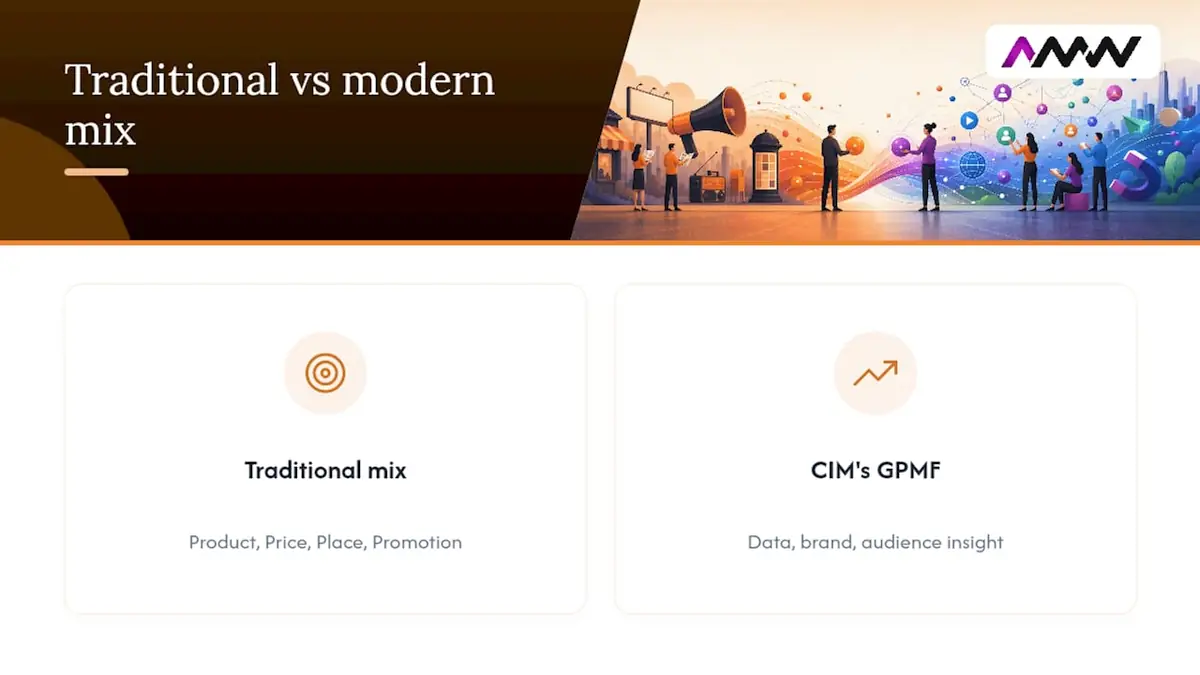
This phrase usually refers to the traditional marketing mix, product, price, place and promotion, though modern frameworks like CIM’s GPMF now fold these into broader capability areas like data, brand and audience insight.
Do marketers make a lot of money?
Pay varies widely by seniority and specialism, typically rising sharply once someone moves from executing campaigns to owning strategy and budget at head of function or director level.
How do you become a good marketer?
Focus on a T-shaped skill profile: go deep in two or three areas, stay competent elsewhere, build a results-led portfolio, and consider recognised credentials like Chartered Marketer status once you have real work to show for it.
Recommended
- The role of certified marketers in brand growth | AMW Media
- How to choose a good marketing company for growth
- What is marketing innovation? A guide for ambitious brands | AMW Media
- How to analyse marketing results for digital growth | AMW Media
Our free marketing audit looks at your site, your ads and your content, and comes back with a 30 day plan. No pitch deck.

Runs the business alongside Amir: contracts, onboarding and making sure every client knows what is happening and when. Meet the team.