
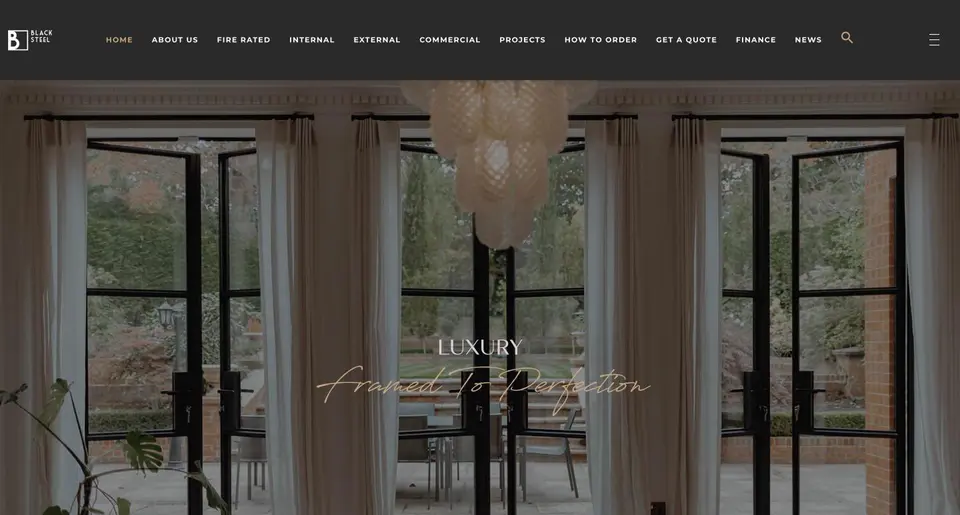
 Black Steel Doors
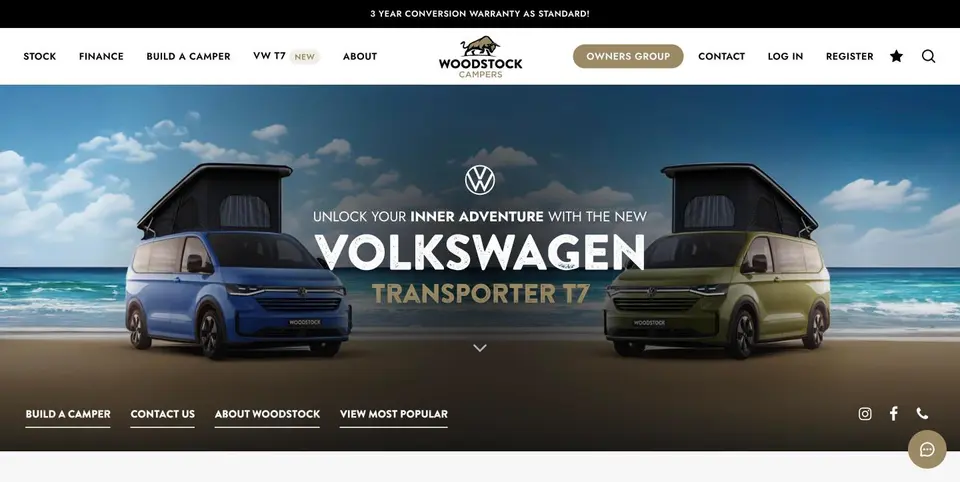 Woodstock Campers
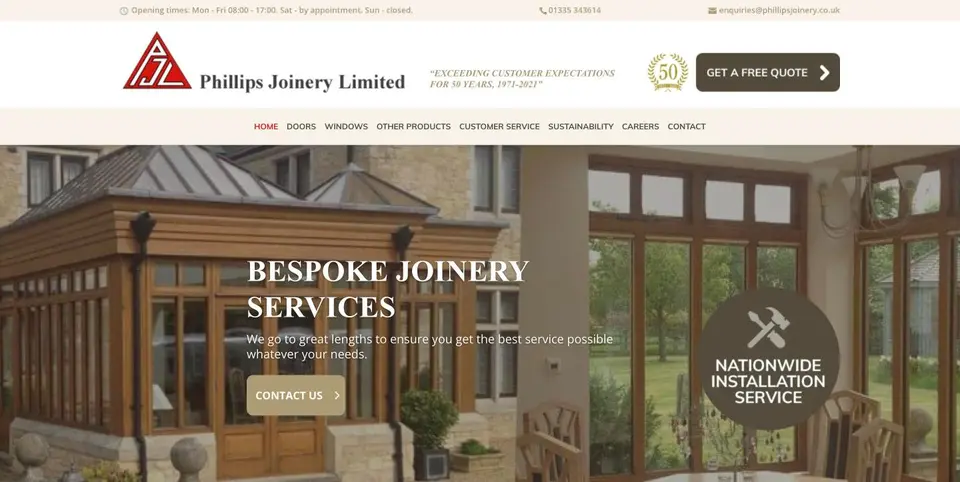 Phillips Joinery
TL;DR:
- Investing in web design significantly enhances credibility, conversions, and long-term revenue for businesses. High-quality, responsive, and speed-optimised websites build trust and facilitate user engagement, directly influencing business growth. Ongoing, strategic design investments outperform one-off projects by reducing obstacles, aligning with marketing goals, and adapting to evolving digital standards.
Investing in web design is one of the highest-return decisions a business can make, directly improving credibility, conversion rates, and long-term revenue. Your website is not a digital brochure. It is the primary touchpoint between your brand and every potential customer, and poor design costs real money. Plenty of customers stop buying from a brand after one poor website experience, and most never say why. When you understand why invest in web design matters as a strategic priority, the question shifts from “can we afford it?” to “can we afford not to?” Tools like Google PageSpeed Insights, frameworks from Shopify, and the expertise of agencies like AMW Media exist precisely to help businesses answer that question with data.
Why invest in web design: the direct impact on conversions
Your site has one job: turn attention you already paid for into an enquiry. Judge it on that, not on how it looks.
Good web design is defined by its ability to remove friction from the user journey and guide visitors towards a decision. That is the core of user experience (UX) design, the recognised industry term for the discipline behind effective websites. When friction disappears, conversion rates rise.
The mechanics are simple. A visitor lands on your site with a specific intent. If your navigation is confusing, your calls to action are buried, or your page takes four seconds to load, that visitor leaves. Effective web design reduces these obstacles by creating clear pathways through your content, logical information architecture, and prominent CTAs that tell users exactly what to do next.
Mobile responsiveness is no longer optional. Over 60% of web traffic now comes from mobile devices, which means a site that looks broken on a phone is actively losing more than half its potential audience. Responsive design adapts layouts to any screen size, keeping the experience consistent whether someone visits on a desktop in an office or a phone on the Tube.
Speed is equally non-negotiable. A one-second delay in page load time reduces conversions by up to 7%. That figure becomes alarming when you apply it to a site generating £50,000 per month in revenue. Professional design, built with clean code and optimised assets, directly protects that number.
Key UX design elements that drive conversions include:
- Clear navigation structure that lets users find what they need in under three clicks
- Prominent, specific CTAs such as “Get a free quote” rather than a vague “Learn more”
- Accessible design that meets WCAG standards and serves users with disabilities
- Fast-loading pages built with optimised images, minimal render-blocking scripts, and efficient hosting
- Consistent visual hierarchy that guides the eye from headline to benefit to action
Pro Tip: Go beyond bounce rate when measuring UX performance. Google Analytics GA4 replaced the traditional bounce rate with engagement metrics that account for time on page, scroll depth, and conversion events. A visitor who reads your entire pricing page and then leaves is not a “bounce” in any meaningful sense. Use GA4’s engagement rate as your primary UX health indicator.
What is the role of web design in building brand credibility?
Every extra second of load time loses buyers. Our builds target under two seconds on a phone; most sites we audit take five or more.
Brand credibility is built or destroyed within seconds of a visitor arriving on your site. Research confirms that 75% of consumers judge a company’s credibility based on its website design alone. That is not a soft, intangible metric. It is the deciding factor in whether someone reads your content, contacts your team, or clicks away to a competitor.
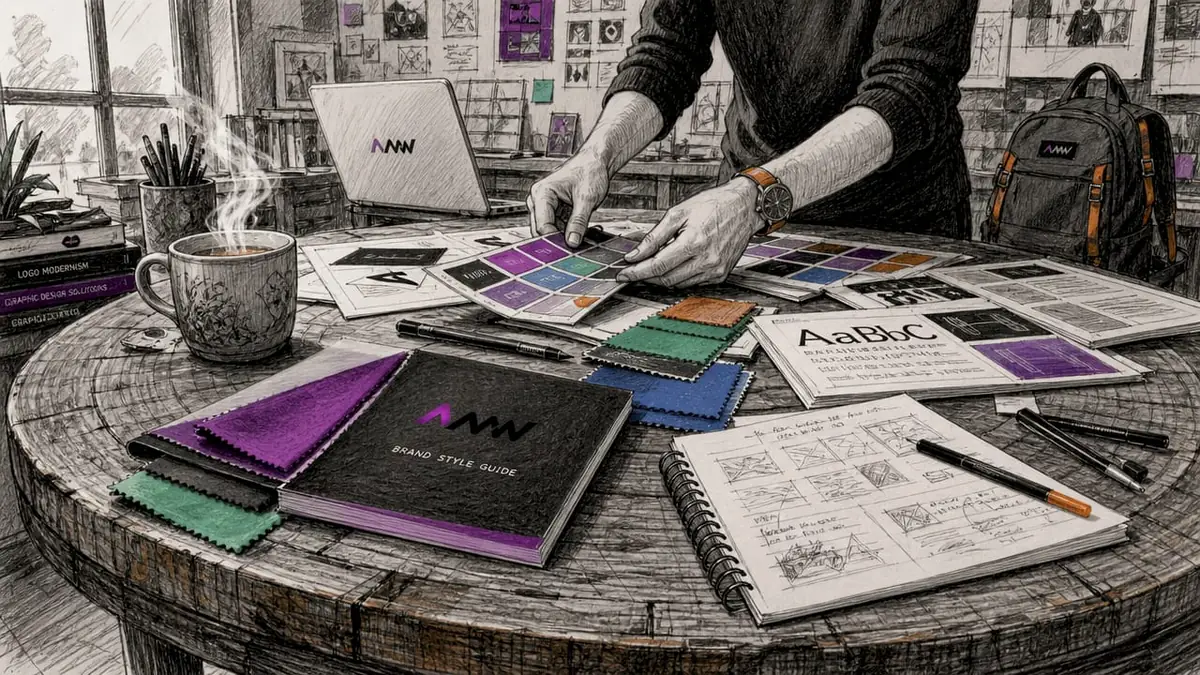
Visual continuity is the mechanism behind this. When your typography, colour palette, imagery style, and tone of voice remain consistent across every page, users build familiarity with your brand. Familiarity reduces cognitive effort. Reduced cognitive effort increases trust. Consistent branding across a professionally designed site leads to measurably higher customer engagement and revenue growth compared to off-brand or outdated sites.
The contrast between a custom professional site and a generic template becomes obvious to visitors even when they cannot articulate why. Template-based sites often share visual patterns with thousands of other businesses, which signals interchangeability rather than authority. A custom design communicates that your business has invested in its own identity, and customers interpret that investment as a signal of quality and reliability.
Interactive elements amplify this effect. Animations, galleries, and video can increase user engagement by 50%, encouraging visitors to spend more time with your brand and absorb more of your message. Longer, more engaged visits correlate directly with higher conversion likelihood and stronger brand recall.
The business outcomes of credibility-driven design include:
- Higher customer retention because users return to sites they trust
- More referrals because satisfied customers recommend brands they perceive as professional
- Greater perceived value which supports premium pricing and reduces price sensitivity
- Lower churn because trust built through design carries into the post-purchase relationship
The benefits of digital branding extend well beyond aesthetics. A professionally designed site is a brand asset that compounds in value over time, much like a well-maintained physical premises.
How does investing in web design improve SEO?
Rankings come from structure, speed and content that answers the question. A client side site with one title tag on every page cannot rank, however good the SEO agency.
Search engine optimisation and web design are not separate disciplines. They are deeply intertwined, and the technical decisions made during a website build have direct consequences for your organic search rankings.
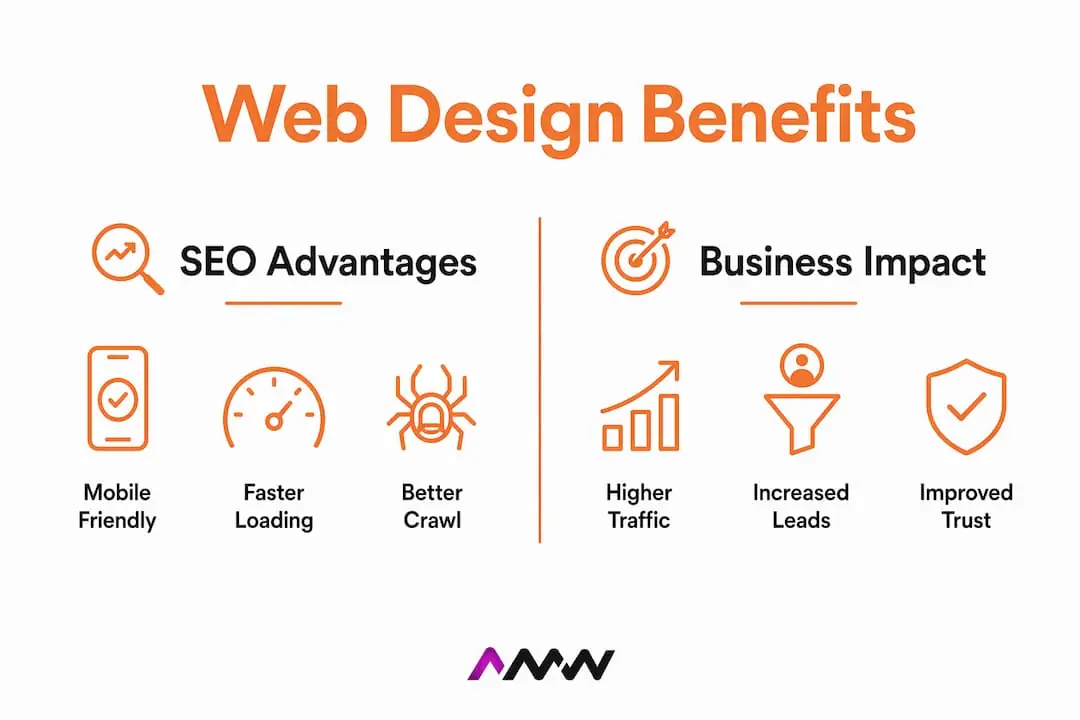
Google’s mobile-first indexing means the mobile version of your site is the primary version Google crawls and ranks. A responsive, fast-loading mobile design is therefore a prerequisite for competitive SEO performance, not a nice-to-have. Sites built without this in mind are structurally disadvantaged in search before a single piece of content is published.
Site architecture and crawlability are equally important. A well-structured site with logical URL hierarchies, clean internal linking, and properly implemented heading tags allows Google’s crawlers to understand your content and index it accurately. Poorly structured sites, common in DIY builders and bloated templates, create crawl inefficiencies that suppress rankings.
Google’s Search Generative Experience prioritises structured data and clean code hierarchies, which are standard features of professionally designed sites. As AI-driven search results become more prominent, the technical quality of your site’s code becomes a direct ranking factor.
Page speed ties the SEO and UX arguments together. Slow sites rank lower, receive fewer visitors, and convert those visitors at a reduced rate. The compounding effect of a fast, well-structured, mobile-responsive site is significant: more organic traffic, lower bounce rates, and higher conversion rates all working simultaneously.
Key design factors that support SEO performance:
- Responsive, mobile-first layouts that satisfy Google’s indexing requirements
- Optimised page speed verified through Google PageSpeed Insights
- Clean semantic HTML with proper use of H1, H2, and H3 tags
- Structured data markup that helps search engines interpret your content
- Logical internal linking that distributes authority across key pages
Pro Tip: Run your site through Google PageSpeed Insights before any redesign conversation. The report identifies specific technical issues, from image compression to render-blocking JavaScript, that a professional developer can address systematically. Pair this with AMW Media’s SEO services to align your technical improvements with a broader organic growth strategy.
For a deeper look at how technical SEO and design work together to build long-term visibility, the connection between site structure and search performance is worth exploring in detail.
Custom web design vs templated solutions: what pays off?
One clear action per page, a form that asks for four things, and proof next to every claim. That is most of conversion rate optimisation.
The choice between a custom-built website and a template or DIY solution is fundamentally a question of long-term ROI versus short-term cost. Both have their place, but the trade-offs are significant and often underestimated.
Professional design can increase conversion rates by two to three times compared to DIY solutions. That multiplier, applied to your existing traffic, represents a concrete revenue figure. A site converting at 1% that moves to 2.5% through professional design has effectively added revenue without increasing its marketing spend.
Custom sites are built to scale. They integrate with CRM platforms, marketing automation tools, e-commerce systems, and analytics stacks without the workarounds that template sites require. Custom architectures reduce the need for full redesigns every two to three years, which is a hidden cost that template users consistently underestimate.
| Feature | Custom professional design | Template or DIY solution |
|---|---|---|
| Conversion rate potential | 2 to 3x higher than DIY | Limited by template constraints |
| Scalability | Built to grow with your business | Often requires full rebuild to scale |
| SEO technical quality | Clean code, structured data, optimised | Variable, often bloated or poorly structured |
| Brand differentiation | Unique to your business | Shared visual patterns with thousands of sites |
| Long-term cost | Lower due to reduced rework | Higher due to recurring fixes and rebuilds |
| Integration capability | Full compatibility with marketing stack | Limited or requires costly workarounds |
Template solutions are appropriate for early-stage businesses testing a concept with minimal budget. Once a business has validated its model and is actively investing in growth, the limitations of templates become a ceiling rather than a foundation.
Professional web design saves time, avoids costly technical mistakes, and provides the scalability that growing businesses need. The upfront investment in custom design typically pays for itself within the first year through improved conversion rates alone.
How to measure and prioritise ROI in web design
A slow, generic site quietly taxes every pound you spend on ads and content. The cheapest fix is usually the site.
Web design investment should be tied to specific, measurable business goals. Without this connection, design decisions become subjective and budgets become difficult to justify. Shopify’s approach to web design ROI emphasises tracking measurable outcomes to differentiate high-impact changes from those that simply consume resources.
Here is a practical framework for measuring and prioritising design ROI:
Establish baseline metrics before any changes. Record your current conversion rate, average session duration, pages per session, and average order value. These are your control figures.
Map design changes to specific KPIs. A navigation redesign should improve pages per session. A checkout flow improvement should reduce cart abandonment. A landing page redesign should increase form completions. Each change must have a corresponding metric.
Use GA4 engagement metrics rather than bounce rate alone. GA4’s engagement model considers time on page, scroll depth, and conversion events, giving a far more accurate picture of whether users are finding value in your content. Bounce rate in isolation can actively mislead design decisions.
Prioritise changes by revenue impact. A 0.5% improvement in conversion rate on a high-traffic page is worth more than a visual refresh on a page that receives minimal visits. Use your analytics data to rank design improvements by their potential revenue contribution.
Run A/B tests on significant changes. Tools like Google Optimise (or its successors) allow you to test design variations against each other with statistical rigour. This removes guesswork from design decisions and builds an evidence base for future investments.
Review performance quarterly. Web design ROI is not a one-time calculation. User behaviour evolves, competitors improve their sites, and your own product or service offering changes. A quarterly review cycle keeps your design aligned with current business objectives.
Connecting your digital strategy to measurable outcomes is the difference between treating web design as a cost and treating it as an investment. The data is always there. The question is whether you are structured to use it.
Key takeaways
Five questions to ask before you spend anything. If you answer no to three, it is time.
Professional web design is a direct revenue driver, not a cosmetic expense, and businesses that measure its impact systematically outperform those that treat it as a one-off project.
| Point | Details |
|---|---|
| Design drives conversions | A one-second load delay cuts conversions by up to 7%; fast, clear design protects revenue directly. |
| Credibility is visual | 75% of consumers judge business credibility by website design, making professional design a trust signal. |
| SEO and design are linked | Mobile-first, clean-code design improves search rankings and organic traffic simultaneously. |
| Custom beats template at scale | Custom sites convert 2 to 3x better than DIY solutions and cost less over time due to reduced rework. |
| Measure with GA4 metrics | Use engagement rate, session depth, and conversion events rather than bounce rate to evaluate design ROI. |
What web design budgets actually buy
I have worked with enough businesses to notice a consistent pattern. Companies that treat web design as a one-time project, something to tick off and revisit in five years, almost always end up spending more than those who treat it as ongoing infrastructure. They pay for emergency fixes, rushed redesigns, and lost revenue from sites that quietly stopped performing while nobody was watching.
The misconception I encounter most often is that good design is primarily about aesthetics. It is not. It is about removing obstacles between your visitor and your goal. A beautifully designed site that buries its contact form or loads slowly on mobile is not a good design. It is an expensive decoration.
What I have found actually works is aligning your design decisions to your marketing and sales objectives from the outset. Before any conversation about colours or layouts, the questions should be: what do we want visitors to do, and what is currently stopping them? That framing turns design from a creative exercise into a problem-solving exercise, and problem-solving exercises have measurable outcomes.
The other thing worth saying plainly is that the gap between a well-designed site and a template site is widening, not narrowing. As AI-driven search results and faster website performance become standard expectations, the technical and experiential bar keeps rising. Businesses that invested in custom, scalable design two years ago are now sitting on a compounding advantage. Those still on a £10-per-month website builder are falling further behind with every passing quarter.
Invest in design the way you invest in your team. Continuously, with clear objectives, and with a genuine expectation of return.
Amir
Ready to turn your website into a growth asset?
If this article has made one thing clear, it is that web design is not a cost centre. It is a revenue lever. AMW Media builds custom websites designed specifically to convert visitors, rank in search, and scale with your business. Every project starts with your commercial objectives, not a template library.
From responsive, SEO-friendly builds to full UX audits and redesigns, the AMW Media team brings together web development, content strategy, and search visibility expertise under one roof. Starting from scratch or overhauling an underperforming site: the conversation starts with your goals. Get in touch to find out what a professionally designed website could do for your revenue.
FAQ
How much does professional web design cost in the UK?
Professional web design in the UK typically ranges from £2,000 for a simple brochure site to £20,000 or more for a custom e-commerce or SaaS platform. The return on that investment depends on your current conversion rate and traffic volume, but professional design can increase conversions by two to three times compared to DIY solutions.
How long does a web design project take?
A standard professional website build takes between four and twelve weeks depending on complexity, content readiness, and the number of revision rounds. Custom e-commerce or web application projects can take longer, particularly when integrations with CRM or marketing tools are required.
Does web design directly affect Google rankings?
Yes. Google’s mobile-first indexing, Core Web Vitals, and structured data requirements all favour professionally designed sites with clean code, fast load speeds, and responsive layouts. Poor technical design actively suppresses search rankings regardless of content quality.
What is the difference between web design and web development?
Web design covers the visual and UX decisions: layout, typography, colour, navigation, and user flow. Web development is the technical implementation of those decisions in code. Effective websites require both disciplines working together, which is why agencies like AMW Media combine them within a single project team.
How do I know if my current website is underperforming?
Run your site through Google PageSpeed Insights to identify technical issues, and review your GA4 engagement metrics to assess user behaviour. If your engagement rate is below 50%, your conversion rate is under 2%, or your mobile experience scores poorly, your site is likely costing you revenue and warrants a professional review.
The business case is easiest to make where the site is the main way customers find you. See what that looks like in practice on our web design page for Milton Keynes.
Recommended
- how to design a website a practical guide for 2026 | AMW Media
- Web Development and Design That Elevates Your Brand | AMW Media
- Digital presence strategy guide for brand growth in 2026 | AMW Media
- Web design process guide: steps, tools, and tips | AMW Media
Our free marketing audit looks at your site, your ads and your content, and comes back with a 30 day plan. No pitch deck.

Owns how everything looks and feels, from a brand identity to the grade on a reel, and makes the animated films such as Blue Light Services' Journey to Net Zero. Meet the team.