
 Black Steel Doors
 Woodstock Campers
 Phillips Joinery
Most UK small businesses should budget £50 to £150 a month for proper website maintenance, with brochure sites sitting lower and ecommerce or business-critical platforms running considerably higher. Those figures are usually quoted ex VAT and often exclude hosting. Anything under about £30 a month is typically an automated-only plan, with no human checking the work.
TL;DR:
- Proper website maintenance costs in the UK typically range from £50 to over £150 a month, depending on site complexity and criticality.
- Automated plans under £30 usually lack human review and do not include testing updates before deployment, increasing the risk of site issues.
- Main cost drivers include traffic demands, custom code, payment integrations, third-party tools, and data security obligations.
- Essential features of a quality plan are off-site backups, staging test environments for updates, and clear response times, not just monthly fees.
- Combining hosting, security, and maintenance into a single retainer often proves more cost-effective and reliable for sites generating revenue or holding customer data.
How much does website maintenance cost in the UK?
The honest answer depends entirely on what kind of site you’re running, but the bands below give you a realistic starting point for building your own budget.
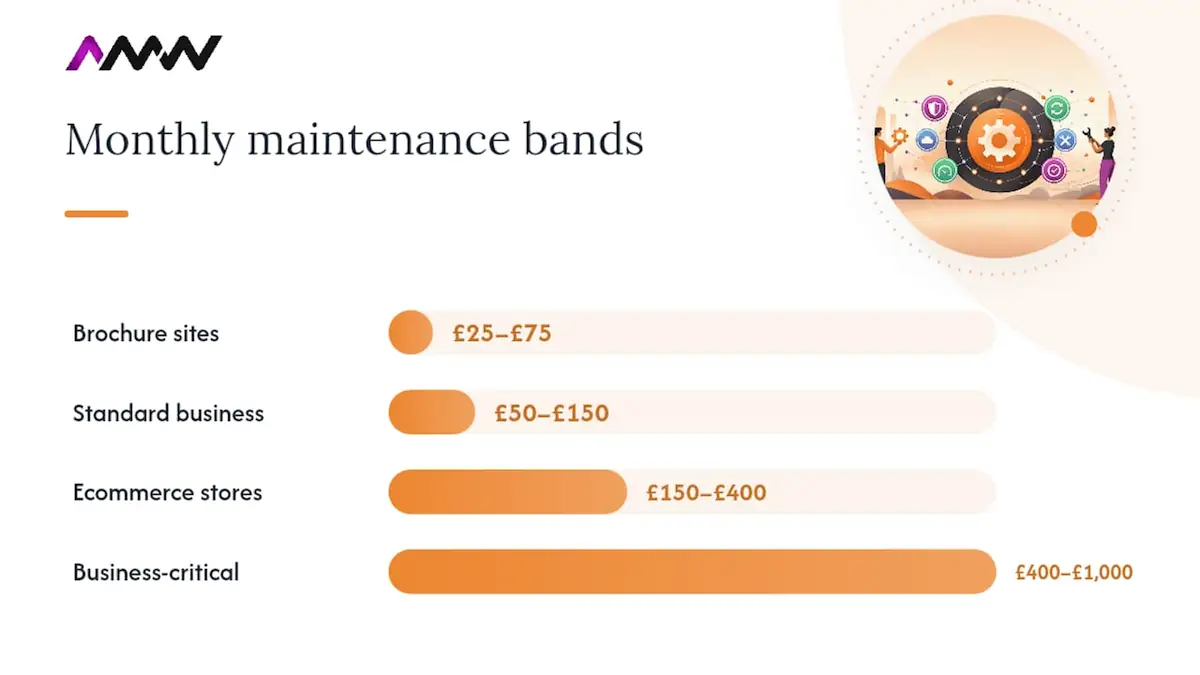
- Brochure sites (a handful of pages, no ecommerce): £25 to £75 a month, or roughly £300 to £900 a year.
- Standard business sites (blog, forms, some integrations): £50 to £150 a month, or £600 to £1,800 a year.
- Ecommerce stores: £150 to £400 a month, or £1,800 to £4,800 a year.
- Business-critical platforms (high traffic, payments, complex integrations): £400 to £1,000+ a month, which can top £12,000 a year.
These bands come from real UK market data on maintenance pricing for 2026, and they line up with what most agencies quote once you look past the headline “from £15/month” ads.
Picture three typical clients. A local plumber with a five-page site and a contact form sits comfortably in the brochure band. A regional accountancy firm with a blog, booking widget, and a couple of third-party integrations lands in the standard business band. A boutique clothing retailer running Shopify or WooCommerce with 200+ SKUs is squarely in ecommerce territory, and probably paying towards the top of that range once payment security and stock syncing are factored in.
One thing catches almost everyone out: VAT. A quoted price of £100 a month typically increases by VAT, and hosting is very often billed separately on top of that. Always ask whether a quote is inclusive or exclusive before you compare two providers side by side.
What does website maintenance actually include?
A proper maintenance plan isn’t just “someone checks the site occasionally.” It should cover a defined set of recurring tasks, done on a schedule, by someone who actually looks at the results. Our web design High Wycombe page explains why most websites fail in month eighteen rather than at launch, and how owning the site and being trained on it prevents that.
Standard inclusions typically cover:
- Software and plugin updates (WordPress core, themes, third-party plugins)
- Security scans and malware checks
- Daily off-site backups
- Uptime monitoring, usually with alerts if the site goes down
- Small content edits (swapping an image, updating a phone number, fixing a typo)
What most plans exclude, often buried in the small print: hosting itself, premium plugin licences, major design or development work, and out-of-hours emergency labour. If your site goes down at 11pm on a Saturday, check whether that’s covered or billed as a call-out.
There’s a real difference between “automated-only” plans and human-reviewed maintenance. Automated plans run scripts that back up your site and flag obvious issues, but nobody checks whether an update broke your checkout page. Human-reviewed maintenance, commonly starting around £40 to £150 a month for WordPress sites, includes someone actually looking at what changed.
Pro Tip: Ask any prospective provider whether updates get tested on a staging copy of your site before going live on the real thing. If they can’t answer that clearly, assume they don’t do it.
What pushes your site into a higher cost band?
Your maintenance cost isn’t really about how many pages you have. It’s about how much can go wrong, and how expensive it is when it does.
- Traffic and uptime demands. A site that loses you money every minute it’s down needs faster response times, which costs more.
- Custom code. Off-the-shelf themes and plugins are relatively cheap to maintain. A site built with custom functionality needs a developer who understands that specific codebase, not a general support technician.
- Payment processing and ecommerce. Handling card payments brings PCI compliance into scope, and stock, order, and checkout integrations all need monitoring.
- Third-party integrations. Every CRM, booking system, or marketing tool connected to your site is another thing that can break when it updates on its own schedule.
- Data protection exposure. Sites collecting customer data carry GDPR obligations, and inadequate security raises real regulatory risk with the ICO if something goes wrong.
As a rough guide, UK retainer pricing tends to follow site criticality: small brochure retainers around £80 to £250 a month, standard business sites £300 to £750, ecommerce £600 to £1,200, and mission-critical platforms £1,500 to £5,000+ depending on the SLA and how many developer hours are allocated each month. If a provider won’t tell you how many hours you’re actually getting, that’s a conversation worth having before you sign anything.
What are the line-item costs behind the headline price?
Breaking maintenance down into its components makes it much easier to sanity-check a quote, or to work out whether DIY makes sense for your situation.
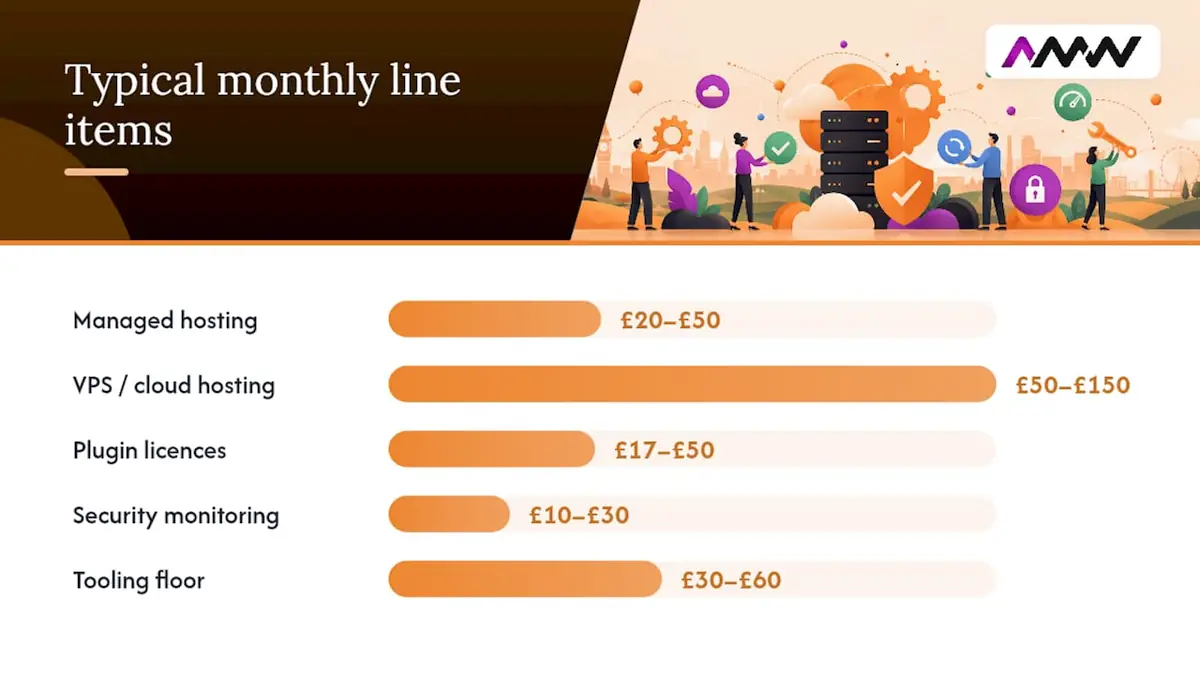
- Hosting: shared hosting from a few pounds a month, managed WordPress hosting typically £20 to £50 a month, VPS or cloud hosting £50 to £150, dedicated servers considerably more. “Managed” usually means the host handles server updates and security patching, but not your plugins or content.
- Backups: off-site, restore-tested backups are worth paying for. A backup stored on the same server as your site is worthless if that server gets compromised, and an untested backup might not actually restore when you need it.
- Plugin and tool licences: premium plugins and tools commonly add £200 to £600 a year, which works out to roughly £17 to £50 a month once you spread it out.
- Security monitoring: often bundled into a maintenance fee, but standalone monitoring tools typically run £10 to £30 a month.
- Developer time: UK freelancers commonly charge £40 to £80 an hour, agencies more like £75 to £150 an hour, usually sold as blocks of monthly hours within a retainer.
Page speed is quietly becoming a bigger line item too. Industry benchmarks on mobile page speed show expectations have tightened, and a site that’s never actively monitored for performance will slip behind in both user experience and search rankings over time.
Add hosting, backups, licences, and monitoring together and you get a bare tooling floor of roughly £30 to £60 a month before anyone’s labour gets paid for. That’s why sub-£30 plans exist: they cover the tools, not the person checking them.
How do you choose the right maintenance plan?
Comparing quotes on headline price alone is how businesses end up paying for a plan that doesn’t actually protect them. Work through this checklist before you sign anything:
- Is there a written SLA? Check the guaranteed response time for both routine requests and emergencies.
- Are backups off-site and restore-tested? Ask when they last actually restored a backup, not just took one.
- Are updates tested on staging before going live? This is the single biggest predictor of whether an update breaks your site.
- How many developer hours are allocated? Vague answers like “as needed” usually mean very few.
- What’s the incident response process? Who do you actually call at 2am, and what happens next?
- Is hosting bundled or separate? Get the total cost, not just the maintenance fee.
- How often do you get a report? Monthly reporting on what was updated, checked, and fixed is a basic transparency marker.
Ask prospective providers directly: “Can I speak to the person who’ll actually be working on my site?” A red flag worth taking seriously is a provider who can’t name who does the work, or who bundles maintenance as an afterthought to a much bigger contract.
Pro Tip: If your site takes payments or holds customer data, insist on a named technical contact rather than a generic support inbox. Business-critical sites need someone accountable, not a ticket queue.
AMW Media’s view on where maintenance spend actually goes
Some agencies build and support websites for UK SMEs, and one pattern shows up constantly: businesses that bundle hosting, staging-tested updates, and monthly reporting into one retainer tend to spend less overall than those juggling separate hosting, security, and freelance developer invoices.
Bundling makes financial sense once your site earns real revenue or holds customer data, because the cost of a preventable hack or a botched update almost always exceeds a year of proper retainer fees. Web design and SEO teams often work from Google, Meta, Shopify, WordPress, and Framer partnerships, which matters when an update touches search visibility as well as functionality.
Website maintenance cost UK 2026: what actually matters
The industry loves to quote a single “average” figure, and that’s exactly the wrong way to think about this. What separates a £50 plan from a £150 plan doing the identical set of tasks isn’t the price tag. It’s whether anyone actually tests an update before it goes live, and whether a backup has ever been restored to prove it works.
Conventional advice tells readers to “compare three quotes and pick the middle one.” Ignore that. Compare scope line by line instead: hours allocated, backup testing frequency, SLA response time. Two providers charging the same £120 a month can differ wildly in what you actually get.
If you take one thing from this article, prioritise restore-tested backups and staging-tested updates over everything else, including price. A cheap plan that’s never tested a restore isn’t a maintenance plan. It’s a false sense of security with a monthly invoice attached.
Amir
Want an honest audit of what your site actually needs?
Some agencies offer an alternative to piecing together hosting, security tools, and a freelancer on retainer separately: one team handles your web design and development, keeps updates staging-tested, and reports back monthly so you know where your money went.

If your site brings in enquiries or sales, ongoing SEO work matters just as much as keeping the lights on. AMW Media’s SEO services sit alongside maintenance retainers so your rankings don’t quietly slide while updates get handled. For SMEs weighing up how a broader retainer fits their existing spend, the breakdown of a typical online marketing package is a useful comparison point.
The simplest next step is a quick chat about what your site currently costs to run and where that money is actually going. Get in touch through AMW Media’s contact page and ask for a maintenance audit. No obligation, just a clearer picture of your options.
Sources
- Website Maintenance Cost UK: £25 Plans to £1,000+ (2026)
- What’s included in a website maintenance retainer? (UK, 2026)
- Website Maintenance Costs UK 2026: Know Before You Pay, DevsTree UK
FAQ
How much does it cost to maintain a website in the UK?
Most small businesses pay £50 to £150 a month for proper maintenance, with brochure sites nearer £25 to £75 and ecommerce or business-critical sites running £150 to £1,000+ a month, ex VAT.
How much should website maintenance cost?
It depends on site type and risk: a simple brochure site can be maintained for £25 to £75 a month, while a site handling payments or heavy traffic typically needs £400 a month or more to cover proper SLA and developer hours.
How much should I charge for a website in the UK?
Building a website and maintaining one are priced separately; most UK agencies charge maintenance as a monthly retainer starting around £80 for small sites, with build costs quoted as a separate one-off project fee.
How much should I pay someone to host my website?
Basic shared hosting can cost a few pounds a month, but managed WordPress hosting typically runs £20 to £50 a month, and that figure often sits outside your maintenance retainer rather than inside it.
Recommended
- Website advertising packages for SMEs: a clear guide
- Online marketing package for UK SMEs: how to choose
- Step by step web design for small businesses: a guide
Our free marketing audit looks at your site, your ads and your content, and comes back with a 30 day plan. No pitch deck.

Leads the WordPress, Shopify and custom builds, and the integrations that connect them to your CRM. Fast, accessible and yours to keep. Meet the team.