
 Black Steel Doors
 Woodstock Campers
 Phillips Joinery
Strategic thinking is the discipline of choosing where to focus before deciding what to do, and for marketers, it means identifying the single most significant obstacle between your brand and its goal, then building everything around solving that one thing.
Three things to know before you read further:
- The V.I.P.A.R. framework (Vision, Issues, Program, Accelerator, Result) gives teams a repeatable structure to move from vague ambition to a defensible one-page strategy.
- Rich Horwath of the Strategic Thinking Institute argues that being strategic is a learnable skill, not a personality trait, it shows up in how you interpret information, not how much of it you collect.
- AMW Media applies this discipline daily: blending strategic clarity with creative execution for brands that want results, not just activity.
What is strategic thinking, and how does it differ from planning?
Strategic thinking is an interpretive, upstream discipline. It reads shifting environments, frames the right problem, and decides where to compete. Strategic planning, by contrast, is the administrative roadmap that follows: budgets, timelines, channel allocations.
Henry Mintzberg put it well: strategic thinking is about synthesis, “connecting the dots,” while planning is about implementing what the thinking produced. Confuse the two and you end up with beautifully formatted slides and no actual strategy.
Here is the practical difference:
- Strategic thinking asks: Why are we doing this? What is the one problem we must solve?
- Strategic planning asks: How do we execute? What are the milestones and budgets?
- Thinking is ongoing and iterative; planning is periodic and administrative.
- Thinking requires tolerance for ambiguity; planning rewards precision and detail.
- Thinking produces a crux and a direction; planning produces a Gantt chart.
Pro Tip: Block 60 minutes every week, on the calendar, non-negotiable, for thinking time with no agenda. Rich Horwath calls this “carving out time for framing rather than solutioning.” Without it, planning fills every available hour.
Why strategic thinking matters for marketers and brand managers
Without it, marketing strategy becomes a shopping list: ten initiatives, no hierarchy, and a budget spread so thin that nothing lands. François Bazini, writing in Marketing Week, argues that most brands fail not from lack of ideas but from refusing to choose which problem matters most.
The shopping-list outcome is predictable. A team runs five campaigns simultaneously, each underfunded, none with a clear success metric. Six months later, the results are mediocre across the board, so the team rewrites the strategy, producing fresh slides rather than solving the underlying obstacle.
When marketers adopt genuine strategic thinking, three behaviours shift:
- They stop adding initiatives and start cutting them, building an explicit “no” list.
- They connect every piece of creative to a single strategic objective rather than a channel calendar.
- They measure outcomes (awareness lift, conversion rate, customer acquisition cost direction) rather than outputs (posts published, emails sent).
Andrea Rubik frames this as a leadership discipline: strategy must be protected from short-term internal pressure long enough for compound effects to appear. That protection is the marketer’s job, not the CFO’s.
What are the three core strategic thinking skills to develop?
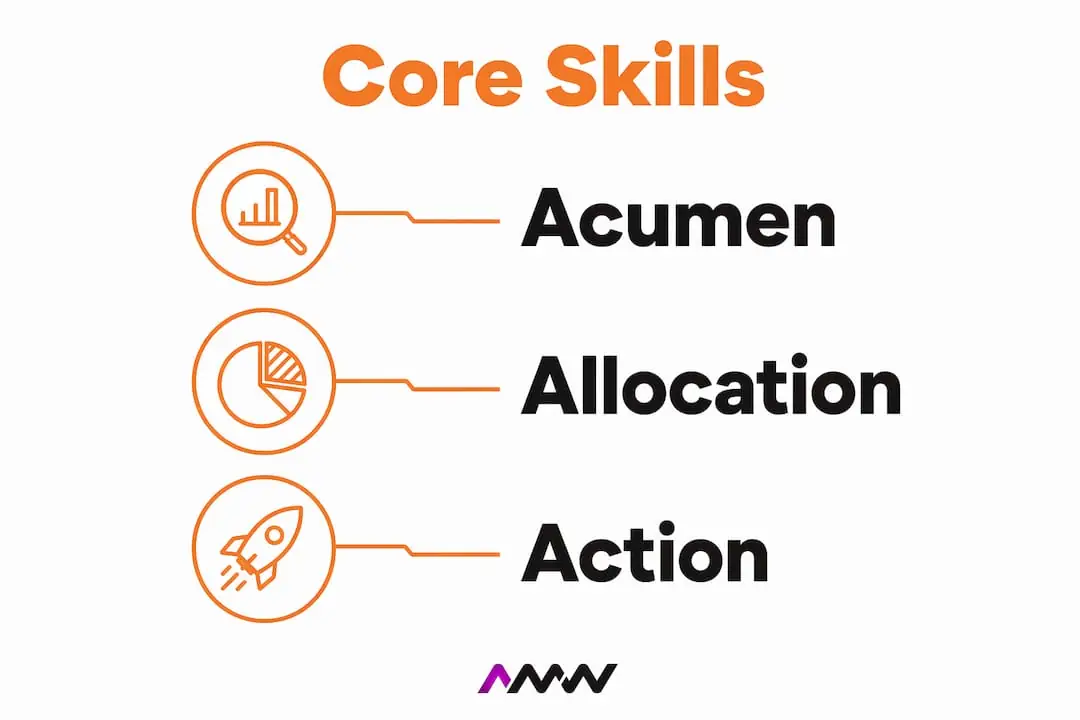
Rich Horwath identifies three areas: Acumen, Allocation, and Action. Each is teachable.
Acumen: how you think
Acumen is context awareness plus insight. A marketer with strong acumen reads the market, spots the pattern others miss, and reframes the problem before jumping to solutions.

Weak signal: the team always starts with “What should we post next?” rather than “What does the market actually need from us right now?”
Exercise: spend 15 minutes each Monday reading one piece of category news and writing a single sentence: “This changes our strategy because…”
Allocation: how you focus resources
Allocation is the courage to concentrate. It means saying no to the channel that feels exciting but does not serve the crux, and doubling down on what does.
Weak signal: the budget is spread across eight channels with no channel owning more than 15% of spend.
Exercise: list every current initiative and rank them by direct contribution to the crux. Cut the bottom third.
Action: how you execute collaboratively
Action means doing with alignment rather than simply doing. Everyone on the team must know their role in delivering the strategy, or execution fragments.
Weak signal: different team members describe the strategy differently when asked.
Exercise: ask three colleagues to write the strategy in one sentence, independently. Compare. The gaps are your alignment problem.
Pro Tip: Run the one-sentence strategy test quarterly. If you get five different answers, you do not have a strategy, you have a mood board.
How does the V.I.P.A.R. framework work in practice?
The V.I.P.A.R. framework turns strategic thinking into a structured session your team can run in 90 to 180 minutes. Skip any element and you risk producing a wish list rather than a defensible strategy.
| Element | Purpose | Key question | Typical deliverable |
|---|---|---|---|
| Vision | Define the ideal future state | Where do we want to be in 3 years? | One-sentence ambition statement |
| Issues | Surface the real obstacles | What is stopping us getting there? | Ranked list of barriers; the crux identified |
| Program | Allocate resources to the crux | Where do we invest time, money, people? | Prioritised initiative list with budget direction |
| Accelerator | Identify the force multiplier | What one move opens up disproportionate progress? | Named accelerator with owner and timeline |
| Result | Define measurable success | How will we know it worked? | 2 to 3 KPIs with targets and review cadence |
A 90-minute session agenda:
- Silent problem-mapping (15 min): each participant maps Vision and Issues independently, no discussion yet.
- Crux identification (20 min): share maps, debate, agree on the single most important obstacle.
- Program drafting (30 min): build the initiative list; allocate notional budget proportions.
- Accelerator selection (15 min): identify the one move that changes the game.
- Result definition (10 min): agree KPIs. For marketing teams, useful metrics include awareness lift, conversion rate, and customer acquisition cost direction.
For the brand identity work that feeds the Vision element, teams often find a 30-minute pre-read on brand positioning sharpens the ambition statement considerably.
How do you embed strategic thinking into team routines?
Frameworks only survive if they become habits. Here is a simple governance structure:
Recurring rituals:
- Weekly thinking slot (60 min, Mondays): one strategic question per week, no operational updates allowed.
- Monthly crux review (45 min): has the crux shifted? Review evidence, not opinions.
- Quarterly accelerator checkpoint (90 min): is the accelerator still the right lever? Adjust the “no” list.
Roles:
- Vision owner (usually the marketing lead): guards the ambition statement and prevents scope creep.
- Issues tracker (a senior strategist or planner): monitors whether the crux is still the crux.
- Trade-off resolver (the decision-maker): calls the “no” when two initiatives compete for the same resource.
The governance rule from Andrea Rubik is worth adopting verbatim: maintain an agreed “no” list reviewed each quarter, and trigger a strategy refresh only when evidence shows the crux has shifted, not when the calendar says it is Q4.
Is your work actually strategic? A 10-question diagnostic
Score one point for each “yes.”
- Can you state the strategy in a single sentence?
- Have you identified the single most important obstacle (the crux)?
- Does every current initiative connect directly to the crux?
- Do you have a written “no” list of things you will not do this period?
- Is your budget concentrated (one channel or initiative owns the majority of spend)?
- Can every team member describe the strategy consistently?
- Are your success metrics outcomes, not outputs?
- Has the strategy survived at least one internal pressure to broaden it?
- Do you review the crux monthly rather than rewriting the whole strategy?
- Does your accelerator have a named owner and a deadline?
Scoring:
- 8 to 10: strategic. Protect it from the next planning cycle.
- 5 to 7: Partially strategic. Focus on whichever “no” answers cluster together, that is your weakest pillar.
- 0 to 4: Planning theatre. Run a V.I.P.A.R. session before the next campaign brief lands.
Common mistakes marketers make, and how to fix them
- Annual planning theatre: rewriting strategy every October regardless of whether the crux has changed. Fix: only refresh when evidence shows the obstacle has shifted.
- No “no” list: adding initiatives without removing others. Fix: for every new initiative approved, retire one.
- Confusing activity with progress: measuring posts published instead of awareness lift. Fix: replace output KPIs with outcome KPIs in the next sprint review.
- Broadening under pressure: expanding the strategy when a stakeholder asks “but what about X?” Fix: the trade-off resolver role exists precisely for this moment, use it.
- Skipping the crux: jumping from vision straight to tactics. Fix: make crux identification a mandatory agenda item before any campaign brief.
- Treating strategy as a document: filing the strategy deck and returning to it only at the next planning cycle. Fix: print the one-page strategy and put it on the wall.
- Misreading information as insight: collecting more data instead of reframing the problem. Fix: apply Horwath’s framing test, “What does this data change about how we see the problem?”
How AMW Media applied V.I.P.A.R. for a growing UK brand
A mid-sized UK consumer brand approached AMW Media with a familiar brief: awareness was flat, the team was running multiple campaigns simultaneously, and no single channel was performing. Classic shopping-list strategy.
Vision: become the category’s first-choice brand for 25 to 40-year-old urban professionals within 24 months.
Issues: the crux was not awareness, it was trust. Existing customers loved the brand; new audiences had never heard a credible reason to try it.
Program: three initiatives, not six. Organic social was paused on two channels. Budget concentrated on one platform where the audience already spent time.
Accelerator: a content series featuring real customer stories, distributed via social media and supported with targeted paid amplification through PPC.
Result: engagement rate lifted, cost per acquisition moved in the right direction, and the team stopped debating which channel to add next.
AMW Media holds certifications with Google, Meta, Shopify, WordPress, and Framer. [Insert Amir’s specific biography or credentials.] [Insert proprietary case studies authored by Amir.]
Key takeaways
Strategic thinking is a learnable discipline that requires choosing one problem, protecting that choice from tactical pressure, and measuring results rather than activity.
| Point | Details |
|---|---|
| Definition | Strategic thinking identifies the single most important obstacle before deciding what to do. |
| V.I.P.A.R. framework | Vision, Issues, Program, Accelerator, Result gives teams a 90-minute session structure to build a defensible strategy. |
| Three skill areas | Acumen, Allocation, and Action are each teachable through deliberate weekly practice. |
| Protect the “no” list | Review it quarterly; only refresh the whole strategy when evidence shows the crux has shifted. |
| AMW Media | AMW Media applies V.I.P.A.R. with UK brands to move from shopping-list plans to crux-centred strategies with measurable outcomes. |
The thing most strategy guides get wrong
Most strategy content tells you to think bigger. The actual problem is almost always the opposite: teams think too broadly, spread too thinly, and measure the wrong things.
The hardest moment in any strategy session is not generating ideas. It is the moment someone says “we should also do X” and the room has to say no. That moment is where strategy lives or dies. Frameworks like V.I.P.A.R. are useful not because they generate better ideas but because they create a structure that makes saying no feel legitimate rather than defeatist.
The other thing worth saying plainly: strategy without protected time is just aspiration. If your calendar has no recurring slot for thinking, not planning, not reviewing, not reporting, but actual thinking, then your strategy will be written once a year and ignored for eleven months. The ritual matters as much as the framework.
Start with one question this week: what is the single most important obstacle between your brand and its goal? Write it in one sentence. If you cannot, that is your strategy problem. Our High Wycombe marketing page lists the Buckinghamshire businesses we work with and the number behind each one.
AMW Media helps marketing teams move from plans to strategy
Most agencies will build you a plan. AMW Media builds the thinking behind it first.
For UK brands that are tired of spreading budget across too many channels with too little to show for it, AMW Media offers strategy-to-execution programmes that start with a V.I.P.A.R. session, identify the crux, and then deliver the creative and channel work to solve it. That includes social media management, PPC campaign management, SEO, content production, and web design, all aligned to a single strategic objective rather than a calendar. The team holds certifications with Google, Meta, Shopify, WordPress, and Framer, and the portfolio spans brands across competitive UK markets. Get in touch via amwmedia.co.uk/contact to book a strategy conversation.
Useful sources
- Marketing Week, Is your marketing strategy little more than a shopping list? The source for the crux concept, François Bazini’s analysis, and the diagnostic structure (Diagnosis, Crux, Ambition, Strategy, “no” list). Use for definitions and the pitfalls section.
- Beloved Brands, V.I.P.A.R. Strategic Thinking Framework Primary reference for the V.I.P.A.R. breakdown, session timing, and the one-page strategy output. Use for the framework section and the comparison table.
- Beloved Brands, Strategic ThinkBox (Rich Horwath) Horwath’s framing on Acumen, Allocation, and Action as learnable skills. Use for the core skills section and the “thinking time” pro tip.
- Andrea Rubik, What strategic marketing actually means in practice Frames strategy as a leadership discipline requiring protection from short-term pressure. Use for the “why it matters” section and the governance rule.
- Schulich Executive Education, Strategic thinking in leadership Grounds the upstream, interpretive definition of strategic thinking. Use for the BLUF definition and the planning distinction.
FAQ
What is strategic thinking in simple terms?
Strategic thinking means choosing the single most important problem your brand must solve before deciding what to do. It operates upstream from planning and focuses on why rather than what.
How does strategic thinking differ from strategic planning?
Strategic thinking identifies the crux and direction; strategic planning builds the roadmap to execute it. Thinking is interpretive and ongoing; planning is administrative and periodic.
Can strategic thinking be learned?
Yes. Rich Horwath of the Strategic Thinking Institute describes it as a learnable skill developed through deliberate practice in three areas: Acumen, Allocation, and Action.
What is the V.I.P.A.R. framework?
V.I.P.A.R. stands for Vision, Issues, Program, Accelerator, and Result. It is a five-step structure that produces a defensible one-page strategy linked to measurable outcomes, and can be run as a 90-minute team session.
How can AMW Media help with strategic thinking?
AMW Media runs V.I.P.A.R. strategy sessions with UK brands and then delivers the creative and channel execution, social media, PPC, SEO, and content, aligned to the identified crux rather than a generic channel calendar.
Recommended
- What is marketing strategy and how to build one in 2026
- Essential digital marketing guide: strategies for brand growth
- What is content strategy? Foundations for brand growth | AMW Media
- What is marketing innovation? A guide for ambitious brands | AMW Media
Our free marketing audit looks at your site, your ads and your content, and comes back with a 30 day plan. No pitch deck.

Founded AMW Media in 2024 and runs strategy, paid media and the CRM builds. The reason everything here is in house and measured in revenue. Meet the team.