
 Black Steel Doors
 Woodstock Campers
 Phillips Joinery
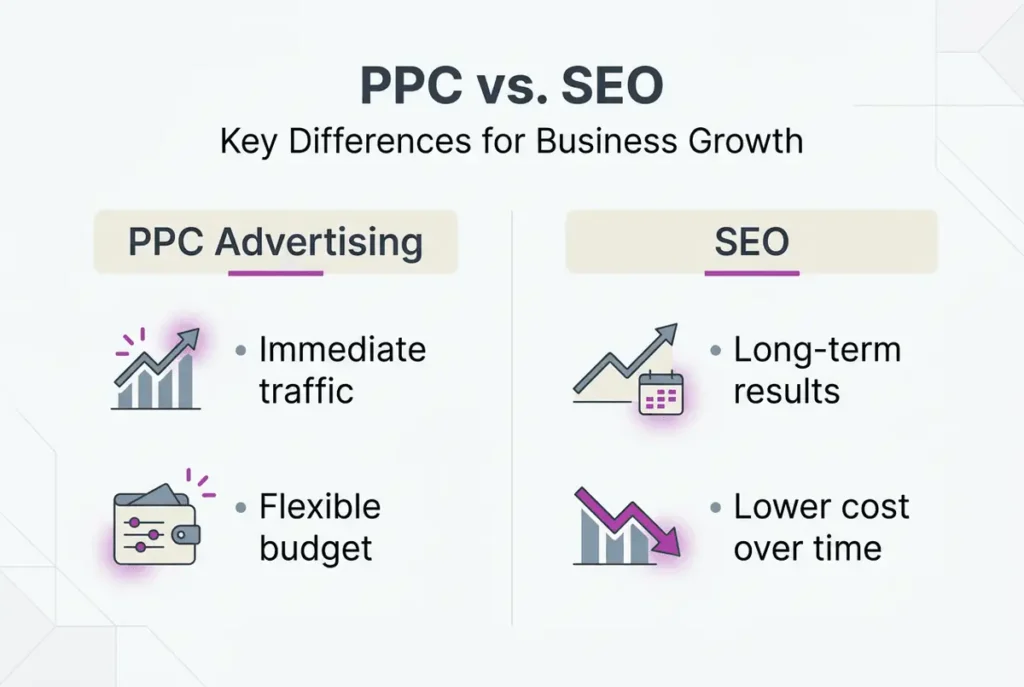
If customers already search Google for what you sell, PPC gets you in front of them this week and SEO makes those visits cheaper over time. If they do not search for it yet, neither will help much on its own, and Meta Ads are usually the better first spend. That is the short answer. The rest of this guide shows the real numbers behind it, so you can decide where your first pound goes.
SEO vs PPC: the short answer
SEO (search engine optimisation) earns your place in the organic search results. PPC (pay per click) buys a place in the paid ads above and below them. Both put you on the same search results page. The difference is how you pay and what happens when you stop.
- Choose PPC first when people already search for your service, you need enquiries within weeks, and your website has a page that converts.
- Choose SEO first when you can wait a few months, your clicks are expensive, or you want leads that do not stop the day the budget does.
- Choose Meta Ads first when your product is something people buy once they see it, not something they type into Google.
- Run both when you can afford to. Each one makes the other more effective.
SEO vs PPC side by side
| SEO | PPC (Google Ads) | |
|---|---|---|
| How you pay | Time and work on your site, content and Google Business Profile | Every click, at a price set by an auction |
| How fast it starts | Months, not weeks | As soon as the ads are approved |
| What happens when you stop | Rankings fade slowly | Ads disappear the same day |
| Who decides your position | Google’s organic ranking systems | Ad Rank: your bid, ad quality, landing page and more |
| Can you pay Google to rank higher? | No | Yes, within the auction |
| Best for | Long term growth and lower cost per lead | Immediate traffic and testing an offer |
Google is clear that the two are separate. In its own guidance on hiring an SEO it says: “Advertising with Google won’t have any effect on your site’s presence in our search results.” Buying ads does not improve your organic rankings, and organic rankings do not lower your ad prices.
What a click actually costs in the UK
The cost per click decides how far a PPC budget stretches, and it varies enormously by trade. Here is live Google Ads data for the UK, pulled on 4 November 2026 and converted from Google’s US dollar figures at the Bank of England rate of $1.3416 to the pound (2 November 2026):
| Search | Monthly UK searches | Average cost per click |
|---|---|---|
| family solicitor | 4,400 | £20.96 |
| emergency plumber | 12,100 | £17.30 |
| boiler repair | 5,400 | £8.43 |
| accountant near me | 12,100 | £6.75 |
| electrician near me | 74,000 | £5.01 |
| roofer near me | 33,100 | £3.94 |
| driveway cleaning | 1,600 | £3.39 |
| wedding photographer | 8,100 | £2.56 |
| mercedes specialist | 2,900 | £2.21 |
| car detailing near me | 12,100 | £1.33 |
A click for “family solicitor” costs nearly sixteen times a click for “car detailing near me”. Put another way, £500 of ad budget buys about 29 clicks at the average price for “emergency plumber” and about 376 for “car detailing near me”. Same budget, same platform, a completely different campaign.
This table is the single most useful thing to look at before choosing. If your clicks cost a few pounds and your average job is worth hundreds, PPC can pay for itself from the first month. If your clicks cost £15 or more, every wasted click hurts, and SEO becomes far more attractive over time because organic clicks have no price at all.
How PPC works, and what you control
With Google Ads you choose the searches you want to appear for, write the ad copy, set a budget and pay when someone clicks. Google ranks the ads with Ad Rank. Google’s help centre lists six factors behind it, including your bid, “the quality of your ads and landing page” and “the context of the person’s search”. Its assessment of ad quality is summarised as a Quality Score in your account.
Two practical points catch small businesses out.
Your daily budget is an average, not a cap. Google’s help centre explains that on a given day you can be charged up to “two times your average daily budget for most campaigns”, with a monthly limit of “30.4 times your average daily budget”. A £20 a day campaign can spend £40 on a busy Tuesday, but will not go over about £608 across the month.
The landing page matters as much as the ad. Google scores the page people land on. Sending paid clicks to your home page, rather than a page about the exact service they searched for, wastes budget. Our guide to PPC landing pages shows what a page built for ads needs.
The strengths of PPC campaigns are speed, control and data. You can switch them on for a seasonal push, pause them when you are fully booked, and see within weeks which searches turn into enquiries. The weakness is simple: the moment you stop paying, the traffic stops.
How SEO works, and why it compounds
SEO is the work that helps Google understand and trust your pages: fixing technical problems, writing a page for each service and area you cover, keeping your Google Business Profile complete, earning genuine reviews and earning links from relevant sites. Keyword research tells you which searches are worth the effort.
Nobody can buy their way up the organic listings. Google says it plainly: “No one can guarantee a #1 ranking on Google.” What you can do is make your site the best answer for the searches that matter, then measure the result in Search Console.
The payoff is that organic traffic keeps coming without a cost per click. One example from our own work: Wheels VT, a Mercedes specialist garage, had 233 Google clicks in October 2026, the best month in sixteen months on record, and ranks first for “Mercedes specialist High Wycombe”. If those clicks had been bought at the UK average for “mercedes specialist” (£2.21 in the table above), that would be about £515 of ad budget in a single month. The garage paid nothing per click.
The cost of SEO is time. Rankings take months to build, and a business that needs enquiries next week cannot wait for them. That is why so many of the strongest search marketing plans start with PPC and build SEO underneath it. Our guide to what SEO costs in the UK breaks down what each level of budget buys.
Where Meta Ads fit: Google Ads vs Meta Ads
The SEO vs PPC question assumes people are searching for you. Many products are bought on impulse, or by people who did not know the product existed until they saw it. Nobody types “campervan conversion” into Google until they have already decided they want one, but plenty of people stop scrolling when they see a good one.
That is the real difference between Meta Ads and Google Ads:
- Google Ads capture demand. Someone has a need and searches for it. You pay to be there when they do.
- Meta Ads create demand. Facebook and Instagram show your ad to people likely to want it, based on who they are and what they do, before they search.
Meta runs its own auction. According to Meta’s Business Help Centre, the ad that wins combines the advertiser’s bid, “estimated action rates” (how likely the person is to respond) and ad quality, which is judged partly on “feedback from people viewing or hiding the ad”.
For the right product the results can be strong. Escape Campers received 1,293 Meta Ads leads between August 2025 and August 2026, with the cost per lead falling from £25 to £5.76. Cotswold Gloss, a mobile valeter, received 243 Meta Ads leads from July to October 2026 at an average of £6.61 each. Neither business could have bought that volume from people searching Google, because the searches do not exist in those numbers.
So the honest answer to “is Meta Ads or Google Ads better?” is that they do different jobs. An emergency plumber should be on Google. A campervan converter, a garden room company or a mobile valeter with a strong before and after video should test Meta first.
Which should you pay for first?
| Your situation | Start with | Why |
|---|---|---|
| Emergency or urgent service (plumber, locksmith, boiler repair) | Google Ads | The searches exist and the customer needs someone today |
| Established local trade with steady searches | SEO, with Google Ads to fill gaps | Organic and map pack clicks keep coming without a price per click |
| Brand new business with no reviews or rankings | Google Ads, plus Google Business Profile setup | Ads bring enquiries while the profile and site earn trust |
| Expensive clicks (legal, finance, specialist B2B) | SEO, with tightly targeted PPC | Every organic click saves a large cost per click |
| Visual product people buy when they see it | Meta Ads | The demand has to be created before anyone searches |
| Seasonal offer or one off launch | PPC or Meta | You need volume for weeks, not years |
| Website that does not convert | Fix the website first | Paid or organic, traffic to a weak page is wasted |
The last row matters more than any of the others. Before you spend on either channel, make sure the page you send people to explains the service, shows proof and makes it easy to call or enquire. Without that, you are paying to send traffic to a page that leaks it.
Combining SEO and PPC
Running both is not about doubling your budget. It is about each channel feeding the other.
- PPC tells SEO what converts. The search terms report in Google Ads shows the exact searches that led to enquiries. Those are the keywords worth building SEO content around.
- SEO lowers what PPC has to cover. Once you rank organically for a search, you can reduce bids on it and move budget to searches you do not rank for yet.
- Both share the same landing pages. A page that converts well for ads usually converts well for organic visitors, and Google rewards a good landing page in both.
- Both need conversion tracking. If you cannot see which channel produced each enquiry, you cannot decide where the next pound goes. Our guide to conversion tracking in Google Ads covers the setup.
Showing in both the ads and the organic listings for the same search also means you take up more of the page, so a competitor has less room.
Mistakes that waste the budget
- Judging SEO after six weeks. Technical fixes can show quickly, but content and links take months. Watch impressions and positions in Search Console each month.
- Running Google Ads without conversion tracking. Clicks are not customers. Optimise to enquiries, calls and sales.
- Bidding on broad searches. “Plumber” attracts students and job seekers. “Emergency plumber High Wycombe” attracts customers.
- Judging Meta Ads on clicks. Meta should be measured on cost per lead and on what those leads become in your CRM.
- Letting an agency own the accounts. Your Google Ads, Meta, Search Console and Google Business Profile should be in your name.
What it costs with AMW Media
We publish every price on our pricing page. Our SEO service starts from £349 a month, Google Ads management from £599 a month, Meta Ads management from £299 a month and a Google Business Profile setup from £500. All figures exclude VAT and any advertising budget, which goes straight to Google or Meta and never touches us. Monthly services run month to month with 30 days notice either way.
We are a Google Partner and a Meta Business Partner based in High Wycombe, with 30+ five star reviews. We run SEO, Google Ads and Meta Ads for small businesses, which means we have no reason to push you towards one channel over another. If you are unsure where to start, our free audit looks at your site, your ads and your content and ends with a 30 day plan that tells you which spend comes first.
Frequently asked questions
Is PPC better than SEO?
Neither is better in general. PPC is faster and easier to control. SEO is slower but keeps working without a cost per click. The right first choice depends on how much your clicks cost, how quickly you need enquiries and whether your customers search for what you sell.
Is PPC just Google Ads?
No. Google Ads is the biggest PPC platform, but Microsoft Advertising also runs search ads, and Meta, LinkedIn and TikTok all sell ads that can be bought per click. In everyday use, “PPC” usually means Google Ads.
Is PPC part of SEO?
No. They are separate channels on the same results page. Google states that advertising with Google has no effect on your organic rankings.
Does PPC improve SEO?
Not directly. Indirectly, the search terms data from PPC shows which keywords bring enquiries, which helps you decide where to focus your SEO.
Is SEO still worth it in 2026?
Yes, for any business whose customers search for its services. AI answers have changed how some searches look, but they still draw on websites, business listings and reviews. A clear site with a page for each service, genuine reviews and a complete Google Business Profile helps in both.
How quickly will I see results?
Google Ads can bring clicks as soon as the ads are approved. SEO takes months to build, and the timing depends on how competitive your searches are and the state of your site. Meta Ads go through a learning phase while the system finds the right people, so judge them on weeks of data, not days.
Our free marketing audit looks at your site, your ads and your content, and comes back with a 30 day plan. No pitch deck.

Founded AMW Media in 2024 and runs strategy, paid media and the CRM builds. The reason everything here is in house and measured in revenue. Meet the team.