
 Black Steel Doors
 Woodstock Campers
 Phillips Joinery

TL;DR:
- Marketing ROI measures the financial return generated from marketing activities relative to their costs, guiding smarter budget decisions. It can be calculated using various formulas, including revenue, gross profit, net profit, and CLV-based ROI, each suited for different business contexts. Accurate measurement requires comprehensive attribution, careful cost tracking, and understanding that higher ROAS does not always equate to positive ROI once all expenses are considered.
Marketing ROI is one of those concepts that sounds simple until you actually try to measure it. At its core, what is marketing ROI? It is the financial return your business generates from marketing activity relative to what you spent. But that clean definition hides a tangle of decisions: which costs to include, which revenue to count, and whether the sales you are attributing to marketing would have happened anyway. This guide cuts through the noise to give you a grounded, practical understanding of how marketing return on investment works, how to calculate it properly, and how to use it to make smarter decisions.
Key takeaways
| Point | Details |
|---|---|
| ROI is a profitability metric | Marketing ROI links your spend directly to financial return, not just clicks or impressions. |
| Multiple formulas exist | Revenue ROI, gross profit ROI, and CLV-based ROI each serve different business decisions. |
| Attribution inflates results | Attributed revenue and incremental revenue are not the same thing. Most teams confuse them. |
| Broader costs change the picture | Overlooking agency fees, staff time, and tech costs produces misleadingly high ROI figures. |
| ROI should guide budget decisions | Use ROI data to compare channels and shift spend toward what drives profit. |
What marketing ROI really means
Marketing ROI quantifies the financial return generated by marketing activities relative to their costs. The formal industry term you will see in academic and finance contexts is ROMI: return on marketing investment. Whether you call it marketing ROI or ROMI, both refer to the same core idea. You spent money on marketing. Did it make you more money than it cost?
What makes this metric useful is that it forces marketing out of the world of vanity metrics. Impressions, reach, and follower counts tell you people saw something. Marketing ROI tells you whether seeing it made your business more money.
There are a few perspectives worth distinguishing:
- Revenue ROI measures the ratio of attributed revenue to marketing spend. Simple, widely used, but prone to overestimation.
- Gross profit ROI subtracts the cost of goods sold before calculating return. More conservative and more honest about profitability.
- Net profit ROI goes further, deducting all relevant overheads. The most accurate view of true financial gain.
- CLV-based ROI factors in customer lifetime value rather than just the first purchase. Particularly relevant for subscription models and repeat-purchase businesses.
“Marketing ROI must be connected to financial outcomes for it to be actionable. Integration of marketing with finance is not optional. It is what makes the number mean something.”, NetSuite
The importance of marketing ROI goes beyond justifying budgets to sceptical finance directors, though it absolutely helps with that too. It gives you a shared language between marketing and the rest of the business. And it keeps your team focused on what actually matters: profitable growth.
How to calculate marketing ROI
The basic marketing ROI formula
The standard marketing ROI formula is:
Marketing ROI = [(Gain from investment − Cost of investment) / Cost of investment] × 100
Here is what that looks like in practice. Say you spend £10,000 on a paid social campaign and it generates £50,000 in attributed sales. Your ROI calculation is: (50,000 − 10,000) / 10,000 × 100 = 400%. For every pound spent, you generated four pounds in return. Sounds brilliant. But hold on.
That figure assumes every pound of that £50,000 is caused by your campaign. It assumes your cost figure is complete. And it ignores what the profit margin on those sales actually is. None of those assumptions are usually safe, which is why the basic formula is a starting point, not an ending point.
ROI variants used in practice
Different situations call for different approaches. Here is a breakdown of the most common variants:
- Revenue ROI uses total attributed revenue as the numerator. Quick to calculate, widely understood, but easily inflated by attribution models that over-credit marketing.
- Gross profit ROI replaces revenue with gross profit (revenue minus cost of goods). More realistic for product businesses where margins vary significantly by channel.
- Net profit ROI deducts all associated costs including staff time, agency fees, software, and creative production. The most conservative and most trustworthy version.
- CLV-based ROI replaces single-purchase revenue with the projected lifetime value of customers acquired. This is particularly powerful for B2B and subscription businesses where payback periods extend well beyond the first sale.
| ROI type | What it measures | Best used for |
|---|---|---|
| Revenue ROI | Attributed revenue vs spend | Quick campaign comparisons |
| Gross profit ROI | Gross profit vs spend | Product-heavy businesses |
| Net profit ROI | Net profit vs total investment | Accurate profitability reporting |
| CLV-based ROI | Lifetime value vs acquisition cost | Subscription and repeat-purchase models |
ROI vs ROAS: an important distinction
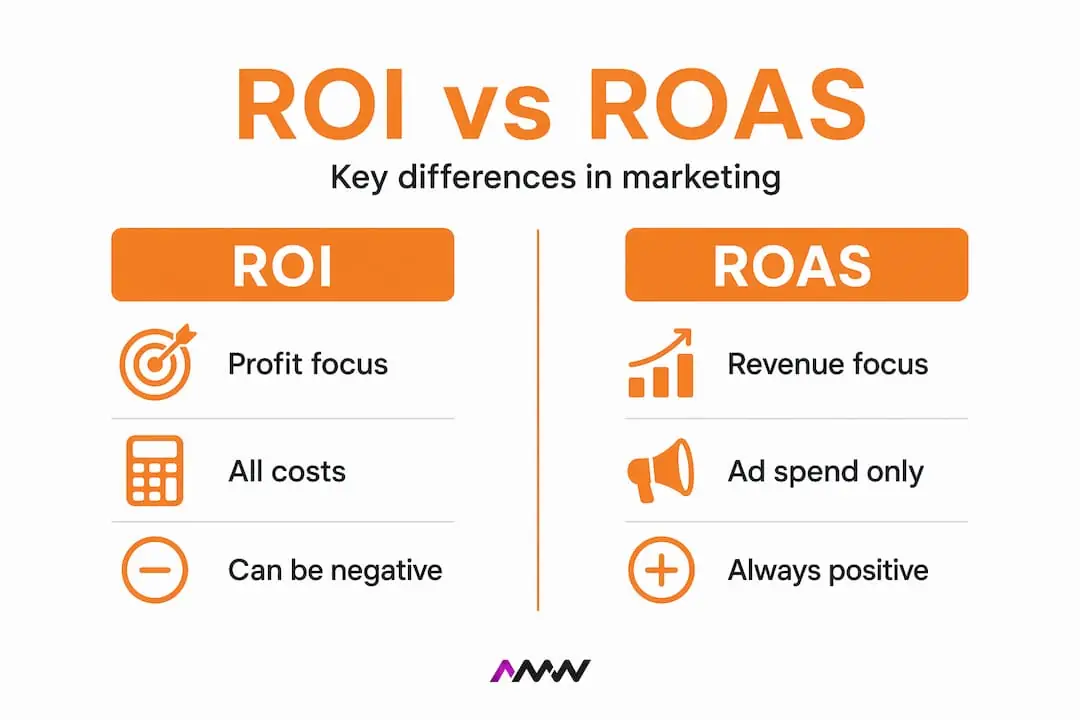
Many marketing teams treat ROAS and ROI as interchangeable. They are not. ROAS (return on ad spend) is simply revenue divided by ad spend. It tells you how much revenue each advertising pound generated, but it ignores every other cost involved: fulfilment, customer service, agency fees, and platform subscriptions. A campaign with a 10x ROAS can still produce a negative ROI once you account for everything else.
ROI can also turn negative when your marketing costs exceed attributed revenue. A £10,000 spend that returns only £7,000 in revenue produces a negative 30% ROI. That is not always catastrophic. If you are acquiring high-value customers whose lifetime spend will more than compensate, a short-term negative ROI can be a deliberate and sensible strategy. Context matters.

Pro Tip: Always state which ROI variant you are using when reporting to stakeholders. “We achieved 400% ROI” means very different things depending on whether it is revenue-based or net-profit-based. Specify clearly to avoid misaligned expectations.
Challenges in measuring ROI accurately
Attribution and the incrementality problem
The single biggest problem in marketing ROI analysis is confusing attributed revenue with incremental revenue. Attribution models over-credit marketing more often than not. Last-click attribution gives all the credit to the final touchpoint. Multi-touch models spread it more fairly but still cannot tell you whether the customer would have purchased without any marketing at all.
Incrementality measurement asks a harder and more honest question: how much additional revenue did this marketing activity generate beyond what would have happened anyway? Answering it requires experiments and control groups. You hold out a portion of your audience from seeing a campaign, then compare their conversion rate to the group that did see it. The difference is your true incremental lift.
This kind of test takes planning and costs you some short-term revenue. But it produces ROI numbers you can trust and defend in a boardroom.
Defining the true cost of marketing
Another place where ROI figures quietly fall apart is in the cost denominator. Most teams count media spend and agency fees, then stop. But a complete marketing investment figure should include:
- Staff time and salaries attributable to the campaign
- Creative production costs including video, photography, and copywriting
- Technology and software subscriptions used in campaign delivery
- Overheads such as project management, reporting, and internal review time
B2B marketing ROI measurement is especially prone to undercooked cost definitions because sales cycles are long and influenced revenue (deals where marketing played a supporting role but was not the sole driver) is hard to separate from direct revenue.
Pro Tip: Build a cost template that captures every input before a campaign launches, not after. Retrofitting costs into a finished ROI report is where numbers get conveniently forgotten.
B2B versus B2C measurement challenges
In B2C, the attribution window is often short. Someone sees an ad, clicks, buys, done. In B2B, a single deal might involve six months of touchpoints across multiple stakeholders before it closes. Both direct and influenced revenue need to be captured, and short reporting windows can produce dangerously misleading negative ROI conclusions for campaigns that are actually working well over a longer cycle. If you cut a B2B demand generation programme after 60 days because the 60-day ROI looks weak, you may be killing something that would have paid off handsomely at the six-month mark.
Applying ROI data to improve marketing performance
Using ROI to compare and reallocate
The most practical benefit of tracking marketing ROI is the ability to compare across channels and campaigns on the same financial basis. When you have consistent ROI data, budget decisions become much cleaner. You can see that your SEO programme is generating a higher net profit ROI than your display advertising, and shift spend accordingly.
Here is a structured approach to doing this well:
- Establish a consistent ROI framework across all channels before comparing. Different teams using different cost definitions will produce numbers that cannot be meaningfully compared.
- Set a minimum acceptable ROI threshold for each channel type. Brand awareness campaigns will naturally show lower short-term ROI than performance campaigns. Comparing them without context leads to bad decisions.
- Look at trends, not just snapshots. A campaign showing improving ROI month on month is often more valuable than one showing a high but static number.
- Factor in customer lifetime value before cutting campaigns that appear unprofitable. Acquiring a customer at a short-term loss can still be the right call if their retention and repeat purchase value is high.
- Report ROI with confidence intervals, not just point estimates. Telling a stakeholder “our ROI was 320%” is less useful than “our ROI was between 250% and 400%, with our best estimate at 320%.” It is more honest, and it builds more trust over time.
“The temptation to optimise for a high ROAS number is real. But analytics that drive ROI require looking at the full picture: what you spent, what you caused, and what it was worth to your business.”
Avoiding the ROAS trap is one of the most practically important things a marketing team can do. High ROAS does not mean profitable ROI. A channel can look excellent on ad spend alone and quietly destroy margin once you account for fulfilment costs, returns, and customer service load.
Tools and technology for ROI measurement
Getting ROI measurement right is as much a data infrastructure problem as it is a methodology problem. The tools you use determine the quality of the numbers you can produce.
Here is a breakdown of the key categories:
- CRM platforms (such as Salesforce or HubSpot) connect marketing touchpoints to actual closed revenue. Without CRM integration, your attribution is guesswork dressed as data.
- Marketing analytics platforms aggregate cross-channel performance data and apply attribution models, giving you a single view of which campaigns drove which outcomes.
- Accounting system integration is the step most teams skip. Aligning financial data with marketing attribution prevents the common mismatch between what your ad platform says you earned and what your finance team actually booked. They are almost never the same number.
- Experimentation and holdout tools support incrementality testing by managing control groups and measuring lift across campaigns.
- Automation and real-time reporting dashboards reduce the lag between campaign activity and ROI insight, which matters when you are making active budget decisions.
One important caution: platform-reported data is almost always optimistic. Google Ads, Meta, and other platforms each claim credit for conversions using their own attribution windows, which frequently overlap. If you add up the revenue each platform claims, the total will often exceed your actual revenue. This is not fraud. It is just how attribution works when you run multi-channel campaigns without a unified tracking layer.
| Tool category | What it adds to ROI measurement |
|---|---|
| CRM integration | Links touchpoints to real revenue data |
| Analytics platform | Cross-channel attribution and reporting |
| Accounting sync | Matches financial records to marketing data |
| Experimentation tools | Measures true incremental impact |
| Real-time dashboards | Faster decision-making on live campaigns |
Learning more about data-driven marketing and how it connects to ROI tracking is worth the time. The gap between teams who treat data as an afterthought and those who build it into their workflow is enormous. The latter consistently make better budget decisions.
My honest take on marketing ROI
I have spent a long time working with marketing teams across different industries, and the pattern I keep seeing is this: most teams are measuring ROI in a way that makes them feel good rather than a way that tells them the truth.
The attributed revenue problem is real and it is widespread. I have seen campaigns that looked like they were generating a 600% ROI on the dashboard, only to discover through a proper incrementality test that the true causal lift was closer to 80%. The customers who “converted” because of the ad were mostly going to buy anyway. That is not a small discrepancy. That is a fundamentally different business case.
What has actually worked for me when communicating ROI to sceptical executives is radical transparency. Present your methodology before your number. Tell them what costs you included, which attribution model you used, and what assumptions you made. Executives who have been burned by inflated marketing claims before will respect honesty over impressive figures. And if your honest number is still good, it carries far more weight.
The other thing I find consistently underappreciated is the value of embracing ROI complexity rather than flattening it. Yes, having a single tidy ROI figure is convenient. But real performance insight lives in the nuance: which customer segments are most profitable to acquire, which channels contribute at different stages of the funnel, and what the true payback period looks like over six or twelve months.
The teams who do this well do not just measure ROI better. They make better decisions about where to spend money. And that is the whole point.
Amir
How AMW Media can improve your marketing ROI
If the complexity of measuring and improving your marketing return on investment feels like a task you do not have the bandwidth to tackle alone, that is exactly where AMW Media comes in. If your business is in Berkshire and you want a team to run this, our Reading page sets out how we work, with the numbers attached.
At AMW Media, we build specific digital marketing strategies that are designed to be measurable from day one. Whether that means specialist PPC management that maximises every pound of ad spend, SEO packages that drive sustained organic growth, or social media management built around performance rather than vanity metrics, our work is always tied to outcomes that matter to your bottom line. We also integrate analytics and reporting into every service so you always know what is working. If you want marketing that earns its keep, get in touch with us and we will build a strategy around your goals.
FAQ
What is marketing ROI in simple terms?
Marketing ROI measures how much financial return your business gets from its marketing spend. The basic formula is: (Revenue generated minus marketing cost) divided by marketing cost, multiplied by 100 to get a percentage.
What is a good marketing ROI benchmark?
A commonly cited benchmark is 5:1, meaning £5 of revenue for every £1 spent, which translates to a 400% ROI. However, acceptable ROI varies significantly by industry, channel, and whether you are using revenue-based or profit-based calculations.
How is marketing ROI different from ROAS?
ROAS (return on ad spend) only measures revenue generated against advertising spend, ignoring all other costs. ROI provides a fuller picture by factoring in production costs, agency fees, software, and overheads, making it a more accurate measure of true profitability.
Why can marketing ROI be misleading?
Marketing ROI figures can be misleading when they rely on attribution models that over-credit marketing touchpoints. Attributed revenue often overstates the actual causal impact of marketing, especially when customers would have purchased regardless of exposure.
How can I improve my marketing ROI?
Start by tightening your cost definitions to include all marketing inputs, then use incrementality testing to identify which campaigns drive additional revenue. Redirecting budget from channels with low net profit ROI to those with higher returns consistently improves overall performance.
Recommended
- How marketing analytics truly drives ROI for brands
- How to analyse marketing results for digital growth
- What is marketing strategy and how to build one in 2026
- What is storytelling in marketing: a 2026 guide
Our free marketing audit looks at your site, your ads and your content, and comes back with a 30 day plan. No pitch deck.

Runs the content calendars and the community side of every social account, and keeps clients posted on what is going out and when. Meet the team.