
 Black Steel Doors
 Woodstock Campers
 Phillips Joinery
TL;DR:
- Creative direction involves strategic leadership that establishes a unified vision, tone, and storytelling across all brand communications. It differs from art direction by focusing on meaning and brand consistency rather than execution details, and it requires ongoing active management rather than a one-time process. Developing strong creative direction skills involves studying branding, practising briefs, building vocabulary, and maintaining continuous reflection.
Most people assume creative direction is about making things look good. Pick a colour palette, choose a typeface, approve the hero image, done. That misconception is costing brands real campaign coherence. What is creative direction, really? It is the strategic leadership function that sets the vision, tone, and storytelling framework across everything a brand produces. It is the difference between a campaign that feels like one thing and a campaign that feels like twelve people working in separate rooms. For marketing professionals and brand strategists, understanding this distinction is not a nice-to-have. It is fundamental.
Key takeaways
| Point | Details |
|---|---|
| Creative direction is strategic leadership | It sets vision, tone, and narrative across all channels, not just visual style. |
| The creative director role is a translator | They convert marketing goals into creative ideas that designers and writers can execute coherently. |
| A four-axis framework prevents drift | Mapping tone register, aesthetic philosophy, audience relationship, and sensory ambition keeps decisions consistent. |
| Clarity beats control in creative teams | Strong creative direction relies on collaboration and clear briefs, not a single person dictating taste. |
| Marketers can develop these skills | Strategic thinking, clear communication, and structured briefing processes are learnable and worth investing in. |
What creative direction actually means
The creative direction definition that most marketing textbooks offer is frustratingly shallow. Something along the lines of “guiding the visual and conceptual output of a creative team.” That covers about half of it. The fuller picture is this: creative direction is the practice of establishing and maintaining a unified vision across every touchpoint where a brand communicates, from a paid social ad to a trade show stand to an email subject line.
Creative direction sits at the intersection of art direction, design, and strategy. It blends creative vision with practical marketing needs. That is why it is so frequently misunderstood. It borrows vocabulary from art, but it operates in service of business outcomes.

How it differs from art direction
Art direction and creative direction are not the same thing, though they are often used interchangeably. Art direction is concerned with execution. It answers questions like: what does this ad look like? How is this product photograph composed? What typeface goes here? Creative direction answers different questions entirely: what should this campaign mean? What feeling should it leave someone with? Does this piece of work reflect where the brand is heading?
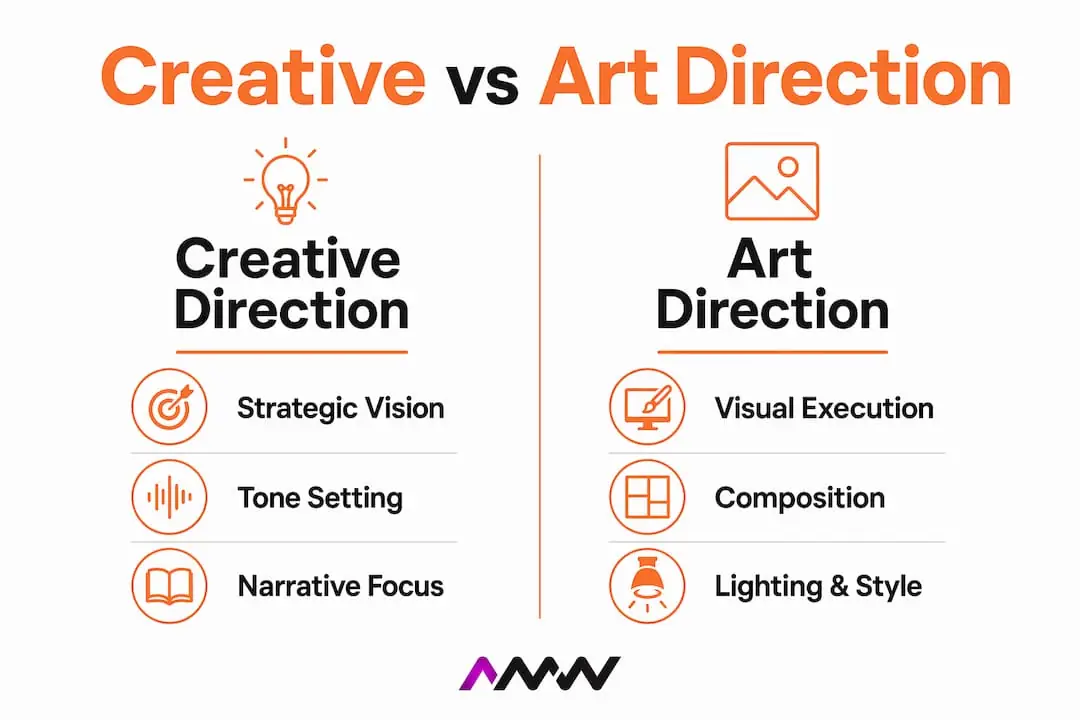
Think of it this way. The art director decides how the hero image is lit and framed. The creative director decided three months earlier that the campaign should feel warm and human rather than slick and aspirational, and that every asset should make the viewer feel seen rather than sold to.
Core responsibilities in the role
The role of a creative director spans several distinct functions that go well beyond approving design mockups:
- Translating marketing goals into creative ideas. A brief that says “increase trial sign-ups by 15%” needs to become a campaign concept that resonates with real people. That translation is creative direction.
- Setting tone, style, and storytelling guidelines. These are the guardrails that stop a campaign from drifting. Without them, every team member is making micro-decisions based on personal taste.
- Leading and aligning cross-functional teams. Creative leaders act as translators between marketing goals and expressive creative outcomes, ensuring designers, copywriters, and producers share a clear vision rather than creating disconnected assets.
- Maintaining brand consistency. Creative directors lead concept development and guide storytelling tone, style, and brand consistency while managing teams and aligning creative output with strategic business problems.
- Keeping the work honest. When a piece of creative drifts from the brief or contradicts the brand’s personality, the creative director calls it out. That editorial function is underrated.
Understanding what does a creative director do at a practical level helps marketing teams structure collaboration far more effectively.
Creative direction across multi-channel campaigns
Here is where things get particularly relevant for brand strategists. A campaign rarely lives in one place. It runs across paid social, organic content, email, web landing pages, PR coverage, and possibly retail or wholesale environments. Each of those channels has different format constraints, different audience expectations, and different production teams. Without clear creative direction, each channel ends up with a slightly different version of the brand.
Creative direction integrates marketing goals with storytelling across multiple channels. It translates marketing objectives into creative ideas and leads campaigns across paid, email, web, and organic touchpoints. That integration is what separates a campaign that feels coherent from one that looks like the brand had an identity crisis halfway through the month.
What coherent creative direction looks like in practice
A useful way to see this in action: imagine a fashion brand launching a new product line. With strong creative direction, the campaign photography, the email copy, the paid social video, and the product page all carry the same emotional register. The language feels consistent. The colour choices feel deliberate. The customer journey from first touchpoint to conversion does not feel like travelling between four different brands.
Without it, the photography team goes bold and editorial, the email team writes warm and conversational copy, the paid social team uses a completely different tagline, and the product page looks like it was built for a different audience altogether. Each piece might be good in isolation. Together, they undermine each other.
Here is a practical process for maintaining coherence across channels:
- Agree the creative platform before any execution begins. This is the big idea and the emotional territory the campaign occupies. Everything else flows from here.
- Write channel-specific guidance within the master brief. Each channel team needs to know how the central idea translates to their format without reinventing it.
- Build a simple visual and verbal reference document. Mood boards, tone of voice examples, and do-and-don’t comparisons are far more useful than a 40-page brand guideline nobody reads.
- Schedule regular creative reviews across channels. Catch drift early, before assets go live, rather than noticing the inconsistency after the campaign launches.
- Involve the creative director at key decision points, not just at sign-off. Late-stage feedback is expensive and demoralising for teams.
Pro Tip: Keep a shared “creative temperature check” document that all channel leads update weekly. A simple traffic-light rating against tone, visual style, and message consistency catches problems before they compound.
Effective project management in creative agencies plays a significant role here. Creative direction only lands when the operational infrastructure supports it.
Frameworks for keeping creative decisions coherent
One of the most practical problems in creative direction is this: how do you make hundreds of small decisions, across weeks or months and multiple team members, that all feel like they came from the same brain? Gut instinct and good taste help, but they do not scale.
The answer lies in creating explicit decision frameworks before execution begins. A four-axis creative direction framework helps align small decisions consistently to one underlying creative vision. The four axes are:
| Axis | What it defines | Example at opposing ends |
|---|---|---|
| Tone register | The emotional pitch of communications | Serious and authoritative vs. playful and irreverent |
| Aesthetic philosophy | The underlying design logic | Minimal and functional vs. layered and expressive |
| Audience relationship | How the brand positions itself relative to the audience | Peer and equal vs. expert and guide |
| Sensory ambition | The richness of the experience delivered | Simple and efficient vs. immersive and dramatic |
By mapping where a brand sits on each axis before a campaign starts, the creative director gives the entire team a shared reference point. When a copywriter wonders whether a headline should be direct or allusive, or a designer wonders whether a layout should be dense or spacious, the framework answers the question without requiring a meeting.
Vocabulary and brief discipline
Separating vision from execution is one of the most underrated practices in good creative direction. Specifically, it means that the brief (the what and why) is written and owned separately from the execution notes (the how). When those two things collapse together, art directors start making strategy decisions and strategists start micromanaging typography. Neither outcome is good.
One useful tactic is building a short “rejection list” alongside the creative brief. These are the creative territories the brand is explicitly not entering: the tones it will not adopt, the visual references it is not drawing from, the emotional registers it is leaving to competitors. Clarifying vocabulary and separating brief from execution prevents art direction from absorbing strategy decisions incorrectly, improving campaign coherence considerably.
Pro Tip: Write your rejection list with the same care as your direction list. Knowing what a campaign should not feel like is often more clarifying for a team than knowing what it should.
Common misconceptions about creative direction
Several persistent myths make creative direction harder than it needs to be in marketing teams. Addressing them head-on saves a lot of frustration.
- The creative director makes everything. This is perhaps the most damaging misconception. Creative direction involves articulating what needs to be done clearly and leading teams with vision, not control. The director’s job is to guide and curate, not to personally produce every asset. A creative director who tries to do all the making quickly becomes a creative bottleneck.
- Creative direction is about personal taste. A creative director’s aesthetic preferences are a starting point, not the destination. The work exists to serve the brand and its audience, not to express the director’s sensibility. Taste without commercial and strategic grounding is just preference.
- Strong creative direction means everyone follows orders. Creative direction is collaborative leadership, not a monopoly on the creative process. Creative directors curate, guide, and sell ideas, managing conflicts and motivating teams in the process. The best creative cultures are ones where the director sets the territory and the team finds ways to push within it.
- Creative direction is only for large teams or agencies. Even a two-person marketing team benefits from explicit creative direction. In fact, small teams drift faster precisely because there is less formal structure to catch inconsistency.
- Vision and budget are separate concerns. Balancing vision with commercial viability, deadlines, and team dynamics is central to the role. A brilliant campaign concept that cannot be produced within budget is not a brilliant concept. It is an unfinished idea.
How to develop strong creative direction skills
For marketing professionals looking to build or sharpen these capabilities, the good news is that creative direction is not a gift you either have or do not. It is a set of skills that can be developed deliberately. The creative campaign process is a good place to start understanding how direction feeds execution at every stage.
- Study brand storytelling systematically. Look at campaigns you admire and reverse-engineer the decisions behind them. What was the underlying idea? What tone choices were made consistently? What was clearly ruled out? Understanding brand storytelling at a structural level is the foundation of good direction.
- Practise writing creative briefs before you write creative work. Articulating direction clearly in writing, before anyone starts making anything, is a discipline that separates good creative leaders from reactive ones.
- Build your vocabulary for describing creative work. Words like “warmer”, “more premium”, or “less busy” are almost useless as direction. Learning to describe precisely what you mean, with examples and references, is a learnable skill that transforms creative conversations.
- Seek cross-functional experience. Creative directors who have worked in strategy, production, and client management are considerably better at the role than those who have only ever sat in one part of the process. If your current role keeps you in a silo, find ways to participate in adjacent work.
- Get comfortable with creative leadership challenges, including negotiating with stakeholders, managing creative disagreements, and defending work against requests that would undermine it. These are leadership skills as much as creative ones.
- Use retrospectives. After every campaign, ask: where did the work drift from the direction? What caused it? Was it a brief problem, a process problem, or a communication problem? Systematic reflection builds directional instinct faster than any other method.
My honest take on creative direction
I have worked with a lot of marketing teams, and here is what I have noticed: the ones that consistently produce work they are proud of almost always have someone in the room who is playing the creative director function, whether or not that is their job title.
In my experience, the biggest mistake marketing professionals make with creative direction is treating it as a phase rather than an ongoing function. They do a big brand workshop, produce guidelines, and then expect everyone to self-direct from there. It does not work that way. Creative direction has to be active. Someone has to be watching the work across all channels, noticing when things drift, and making the call to correct it. That is not a one-off exercise. It is a continuous editorial responsibility.
What I have also found is that the importance of creative direction tends to become visible in its absence. Teams notice they have a problem when the paid social ads do not feel like the website, or when a new campaign piece looks like it was made by a completely different brand. By that point, the drift has usually been accumulating for months.
The other thing newcomers consistently underestimate is how much of creative direction is persuasion. Getting a sales team to understand why the campaign cannot use their preferred stock photography, or convincing a client that the bolder concept is the right call commercially, these conversations require confidence, clarity, and genuine authority. Creative direction requires balancing taste with leadership skills including negotiating with clients, managing team dynamics, and handling project constraints. That balance is where it gets interesting, and hard.
Amir
How AMW Media supports your creative direction
At AMW Media, we work with ambitious brands that want their marketing to feel like one coherent thing rather than a collection of disconnected campaigns. Our team blends strategic thinking with hands-on content production to support strong creative direction at every stage of a campaign. If you are in north west London and would rather hand this to one team, our Harrow marketing page shows how that works.
Whether you need social media management that stays on brand across every post, graphic design services that translate creative vision into polished assets, PPC campaigns built around a coherent creative platform, or SEO strategy that speaks in a consistent brand voice, AMW Media brings all of these together under one roof. That integration is what makes the difference between marketing that looks assembled and marketing that feels intentional. Get in touch to talk about how we can support your brand’s creative leadership.
FAQ
What is creative direction in marketing?
Creative direction is the strategic leadership practice of setting and maintaining a unified vision, tone, and storytelling framework across all of a brand’s marketing communications. It goes well beyond visual style to encompass narrative, emotional register, and campaign coherence.
What does a creative director do on a day-to-day basis?
A creative director translates marketing objectives into creative concepts, writes and oversees briefs, reviews work across channels for consistency, leads creative teams, and makes decisions that keep the work aligned with the brand’s strategic goals.
How is creative direction different from art direction?
Art direction concerns itself with execution: how something looks, how it is composed, and how it is produced. Creative direction operates at a higher level, defining what a campaign should mean and feel, and setting the parameters within which art directors and other specialists then work.
Why does creative direction matter for campaigns?
Without clear creative direction, teams working across different channels produce assets that feel disconnected, which dilutes brand recognition and weakens campaign impact. Consistent direction ensures every touchpoint reinforces the same idea and emotional territory.
Can smaller marketing teams benefit from creative direction?
Absolutely. Small teams often drift faster than large ones because there is less formal structure to catch inconsistency. Appointing one person to hold the creative direction function, even part-time, makes a significant difference to how coherent the output feels.
Recommended
- The role of creative agencies in digital brand growth
- Creative content production steps for marketing success in 2026
- Essential digital marketing guide: strategies for brand growth
- Creative branding ideas list: top strategies for 2026 | AMW Media
Our free marketing audit looks at your site, your ads and your content, and comes back with a 30 day plan. No pitch deck.

Owns how everything looks and feels, from a brand identity to the grade on a reel, and makes the animated films such as Blue Light Services' Journey to Net Zero. Meet the team.