
 Black Steel Doors
 Woodstock Campers
 Phillips Joinery

Yes, you can sell to other businesses on an app best known for dancing and dogs in raincoats. The trick is to stop thinking of it as a place to broadcast a brochure and start treating it as a place to show people (real ones, with job titles) how you think, how you work and what you know. Below are the TikTok content ideas we’d actually put in front of a UK B2B brand, grouped by what they’re good for, plus how to plan them and how to tell whether they’re working.
TL;DR
- B2B TikTok works when you teach, show the people behind the company and borrow the platform’s playful style, rather than pushing product.
- Start with four buckets: people, teaching, proof and trends. Two or three ideas from each is plenty for a first month.
- Recurring series beat one-off posts. Pick a format, give it a name and make it for one specific role, such as finance directors or operations managers.
- Judge success on watch-through, shares, comments and the quality of the people engaging, not raw views.
- You don’t need a film crew. You do need a clear point of view and a hook in the first couple of seconds.
Table of Contents
- Why B2B brands bother with TikTok at all
- How B2B content should feel on TikTok
- People ideas: let them meet the humans
- Teaching ideas: be the useful one
- Proof ideas: show, don’t claim
- Trend ideas: borrow the format, keep your expertise
- A quick map of which idea does which job
- Our take: stop trying to look like a B2B brand
- Planning a month without losing your mind
- Measuring what matters
- Mistakes that quietly kill B2B TikTok
- Need a hand getting it filmed?
- FAQ
- Sources
Why B2B brands bother with TikTok at all
Fair question. Nobody opens TikTok at 10pm thinking, “I’d love to compare procurement software.” But the person who does the buying is still a person, and people scroll. The advice from Sprout Social’s UK guide to B2B on TikTok is that relatable formats such as confessional POVs and Q&As are core to the platform, and that thought leadership doesn’t have to be a whitepaper: podcast snippets, webinar clips and employee explainers can do the same job in video.
The other reason is that very few of your competitors are doing it well. That’s not a guarantee of anything, but a quiet feed is easier to stand out in than a crowded one.
One honest caveat before we get into ideas. TikTok will rarely be the place where someone signs a contract. It’s a place where a buyer meets you early, remembers you and, weeks later, recognises your name in an email or on a shortlist. Treat it as the warm-up, not the closing call.
How B2B content should feel on TikTok
The platform’s own B2B team has a useful steer here. As reported by The Drum, TikTok markets to marketers in a TikTok-first way: creativity, authenticity, playfulness, community storytelling and education, rather than straight product evangelism. In other words, if your video would work equally well as a slide in a sales deck, it probably isn’t a TikTok.
A few ground rules that come up again and again in the research:
- Keep it short. MarTech’s guide to B2B on TikTok recommends short videos, a strong call to action, mobile-first framing and a consistent brand voice.
- Memorable beats viral. CopyCut’s strategy guide argues B2B should aim to be remembered by the right people rather than seen by everyone, and to favour a clear point of view over polish.
- Series beat singles. The same guide favours recurring series over one-off posts, which is also much easier on your brain when you’re deciding what to film on a Tuesday morning.
If you haven’t set up your video files yet, it’s worth knowing the vertical format basics. We’ve covered social video aspect ratios separately, so you don’t end up with a tiny letterboxed rectangle floating in the middle of the screen.
People ideas: let them meet the humans
B2B buying is risky for the buyer. If it goes wrong, it’s their name on the purchase order. Showing the people they’d be working with takes some of that fear out.
Day in the life
Film a normal working day: the commute, the first coffee, the client call, the slightly chaotic afternoon. Sprout Social’s list of TikTok video ideas for UK marketers puts day-in-the-life videos on the recommended list, and cites TikTok’s own figure that they get 2.2 times more shares than standard lifestyle videos. Treat that as encouraging rather than a promise, since it comes from the platform and your niche may behave differently.
Pick a role people are curious about. “A day as a project manager at a logistics firm” is more interesting than “a day at our company”.
Staff takeovers and founder videos
Let an engineer, an account manager or an apprentice run the account for a day. MarTech recommends using personal brands such as founders and employees, and it makes sense: people trust people faster than logos. The same UK list from Sprout Social includes staff takeovers as a format worth trying.
Tip for nervous founders: you don’t need to be a natural. Talk to the camera as if you’re explaining something to a new starter. That tone works.
Behind the scenes
Show how the thing gets made, packed, tested, installed or fixed. If you run a warehouse, a lab or a workshop, you are sitting on a goldmine. If you sell software or services, show the whiteboard, the planning session, the messy first draft. Process is oddly watchable.
Customer-interaction sketches
The “client says, we say” sketch is a UK B2B staple for a reason. Act out the awkward things everyone in your industry recognises: the brief that arrives at 5.55pm on a Friday, the “can we just make the logo bigger” request. Light humour, a bit of self-awareness, and the right people will tag a colleague. Sprout Social lists customer-interaction sketches among its UK formats.
Event content
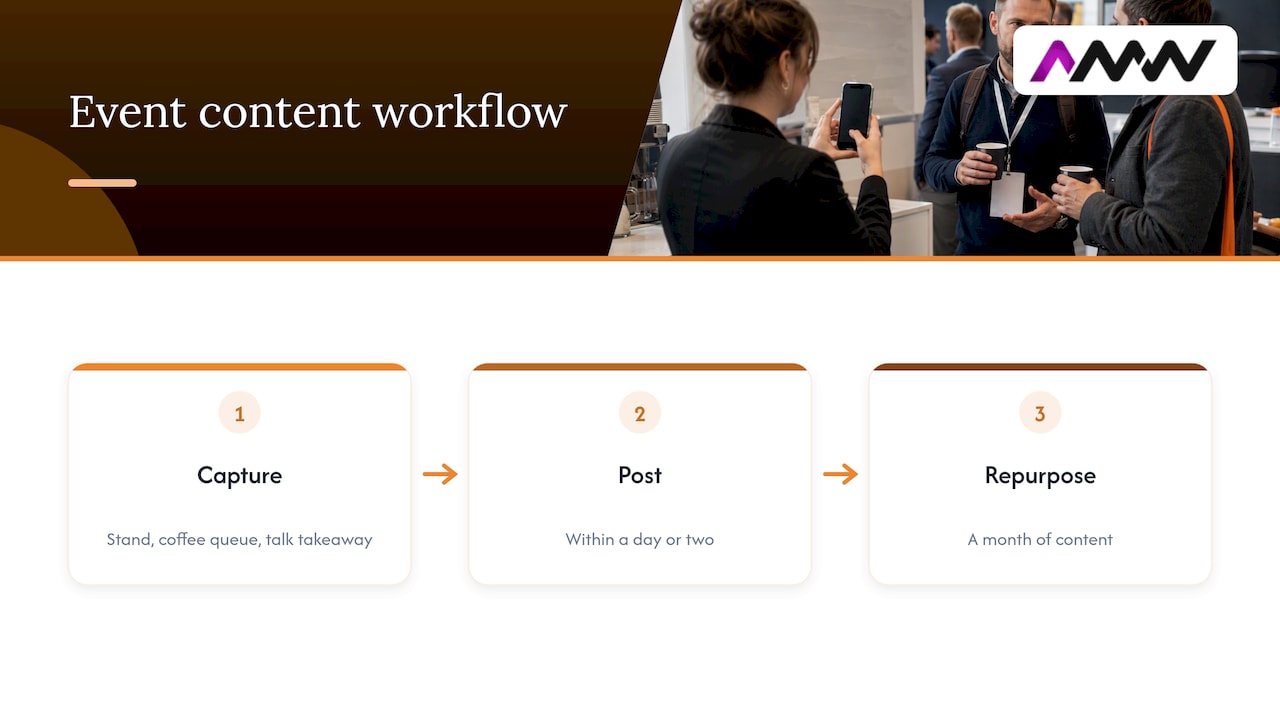
Trade shows, conferences and networking nights are made for short video: the stand build, the queue for the coffee, a thirty-second takeaway from a talk. Film it while you’re there, post within a day or two, and you’ve turned an expensive event into a month of content.
Teaching ideas: be the useful one
This is where B2B brands tend to do best, because you already know things your buyers need to know.
Role-specific explainers
CopyCut recommends tailoring recurring educational series to decision-making roles, such as security, operations or finance, so the content speaks to buyer-specific worries early. Name the role in the hook: “If you’re a finance director and your supplier invoices still arrive as PDFs, watch this.” The person you want feels called out in the best way.
Problem-first mini stories
Start with the problem, not the product. “Here’s why your quote-to-cash process takes three weeks” gets attention. “Introducing our new platform” does not. The same CopyCut guide suggests problem-first narratives as a recurring format.
Myth busting and hot takes
Pick something your industry believes that isn’t quite true and say so, politely. A clear point of view is what makes a video memorable, and a mild disagreement in the comments is not a disaster, it’s engagement.
Q&A and replies
Answer questions from your sales calls, your inbox or the comments. Sprout Social mentions Q&As as a core TikTok format, and they have a built-in supply of topics: whatever customers keep asking. If three people asked it, hundreds are wondering.
Slices of webinars, demos and podcasts
Don’t make a fresh video from scratch if you’ve already recorded a forty-minute session. Pull out the thirty seconds where someone says the sharpest thing, add captions and post it. Both CopyCut and Sprout Social suggest short clips from webinars, demos and podcasts as a way to show expertise without starting from zero.
Quick demos for software and tools
If you sell a product, show it solving one small problem in real time. One feature, one result, no jargon. Sprout Social points out this works especially well for SaaS, where a short screen recording is more convincing than a paragraph of claims.
Proof ideas: show, don’t claim
Buyers want evidence. TikTok is fine with evidence, as long as it doesn’t look like a press release.
Honest growth stories
Sprout Social’s UK list includes honest case studies of growth. “We took this client from X enquiries to Y, here’s what we changed, and here’s the bit that didn’t work” is far more credible than a glossy results slide. Include the wobbles. They’re what make people believe the rest.
If you’re short on case-study inspiration, our post on content marketing examples that boost a brand is a good place to pick up structure ideas.
Customer testimonials, short and specific
Skip the corporate “they were great to work with” and ask for one concrete detail: what changed, how long it took, what surprised them. Twenty seconds, filmed on a phone, is fine. MarTech lists testimonials and user-generated content among the formats B2B brands use.
Numbers and process visuals
CopyCut suggests showing evidence through frameworks, demonstrations, numbers and process visuals. A simple on-screen diagram, a before-and-after screenshot or a timeline does the job. Keep it to one idea per video.
Creator partnerships
This one is underused. Buffer recommends B2B companies work with creators and user-generated content from people aligned with the brand and audience, because it lends credibility and reach. Think tradespeople, accountants, developers, recruiters, anyone who already has your buyers’ attention.
There’s a UK example worth knowing. According to a TikTok case study, the industrial storage brand BiGDUG worked with a creator known as @TheP00lGuy, who featured its shelves and boxes in his usual trade content. The campaign reached 1.5 million views, 152,900 likes and a 10.19% engagement rate, and the brand went on to work with him four more times. The lesson is not “buy a creator”. It’s that the product turned up inside content the audience already liked, rather than interrupting it.
Trend ideas: borrow the format, keep your expertise
Trends are where B2B brands either shine or cringe. The difference is relevance.
Buffer’s advice is to adapt viral sounds, trends and challenges creatively to your niche, keeping them funny and relevant, and its view is that a trend works when it’s translated into your specialist context rather than copied without any connection to what you do. Here’s how that looks in practice:
- A trending sound plus an industry in-joke. The sound is the packaging; the joke only your buyers get is the point.
- UK culture reactions. Sprout Social’s UK list suggests reacting to British television or culture moments. A reality show finale becomes a metaphor for a tender process. Do it quickly, because these have a short shelf life.
- UK-specific moments. Budget day, the end of the tax year, bank holiday chaos, the first heatwave that breaks the office air con. If your buyers feel it, you can make something about it.
- Challenges with a work twist. “Explain your job in one sentence versus what your mum thinks you do” has worked for so many industries that it’s practically a rite of passage.
A quick test before posting any trend video: remove the sound and the on-screen text. Is there still something useful or recognisable for your buyer? If not, skip it.
A quick map of which idea does which job
| Idea | Best for | Effort | Good first role to target |
|---|---|---|---|
| Day in the life | Trust and recruitment | Low | Anyone on your team |
| Role-specific explainers | Showing expertise | Medium | Finance, operations, IT |
| Webinar or podcast clips | Reusing content | Low | Subject experts |
| Customer-interaction sketches | Shares and tags | Medium | Account managers |
| Quick product demos | Consideration stage | Medium | Product or sales |
| Honest growth case studies | Proof | Medium | Founders, delivery leads |
| Creator partnership | Reach and credibility | Higher | Whoever owns the budget |
| Trend with industry twist | Awareness | Low to medium | Social lead |
If you can only do three, start with a role-specific explainer, a day in the life and one webinar clip. That mix covers expertise, personality and efficiency.
Our take: stop trying to look like a B2B brand
We work with brands on video, social and paid campaigns every week, and the pattern is consistent: the B2B accounts that struggle on short-form video are the ones that try hardest to look serious. They post a logo animation, a stock-photo quote and a link to a whitepaper, then conclude TikTok “isn’t for us”.
The ones that do well start from a simpler question: what would our best salesperson say if a prospect asked them this over coffee? That answer, filmed in 30 seconds with decent sound, is nearly always better than a scripted campaign. Sound matters more than people think. A slightly shaky shot with clear audio beats a beautifully lit video you can’t hear.
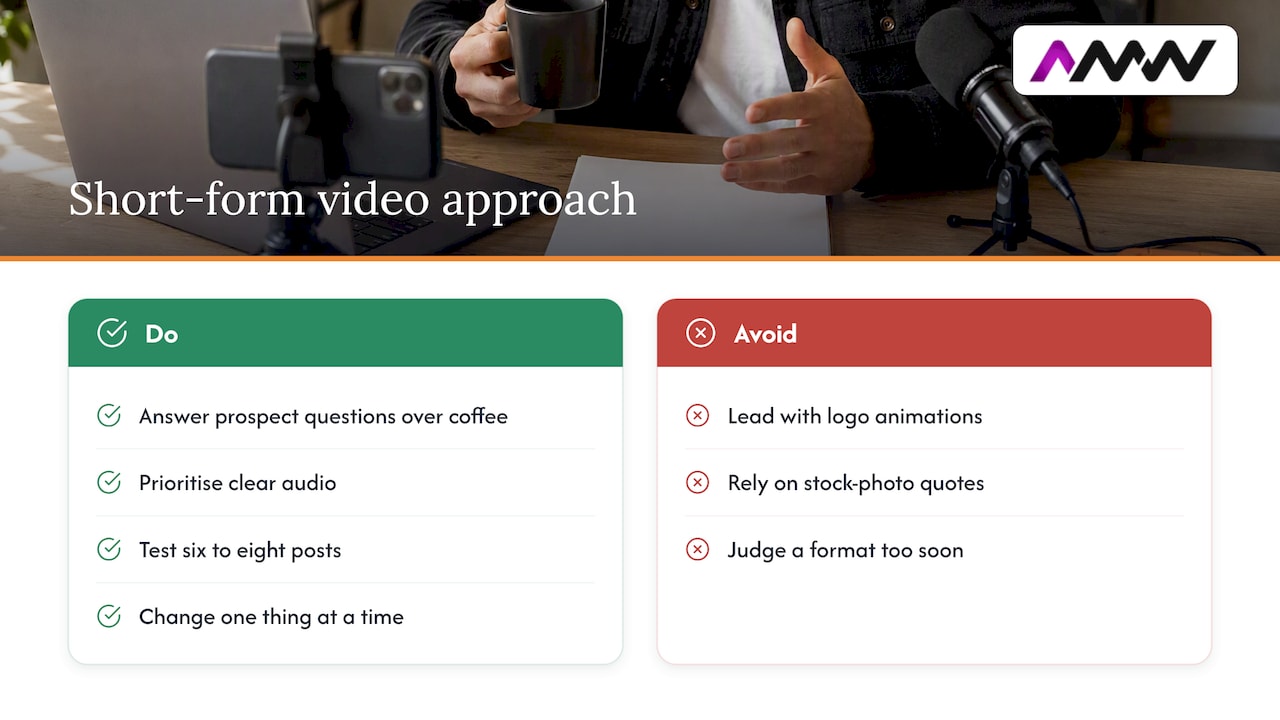
Our other habit is to be blunt about measurement. You can plan a lovely series and still get a quiet first month. That’s normal. Give a format six to eight posts before deciding it has failed, change one thing at a time (the hook, the length, the face on camera), and keep the ones that earn comments from the right people. If you want to see how we think about formats more broadly, our guide to brand video types walks through when each one earns its place.
And please, nobody needs a B2B brand to do a dance. Unless your product is dance software. Then, obviously, go on.
Amir Wanas, founder of AMW Media
Planning a month without losing your mind
Consistency is the part that sinks most accounts. Here’s a simple way to set it up.
- Pick two series. For example, “Finance Friday” (a tip for finance directors) and “Behind the desk” (a day-in-the-life clip). Give them names so people know what they’re getting.
- Write ten hooks in one sitting. A hook is the first line or visual. Sort them by series.
- Batch film. An hour with a phone, a tripod, a lavalier mic and a few outfit changes can give you a month of clips. Cheaper than it sounds.
- Edit light. Add captions, trim the pauses, put the point in the first two seconds.
- Post a steady number, not a punishing one. Press Gazette reported TikTok UK’s publisher-operations head Edward Lindeman saying there’s no magic formula for reach and that quality can outperform simply posting more often. Better three strong videos a week you can sustain than daily posting that burns out by week three.
- Review monthly. Keep what worked, retire what didn’t, and note which comments came from people who look like buyers.
If you want more general inspiration for the non-TikTok side of your calendar, our list of social media content ideas and our piece on creating engaging social content should help.
Measuring what matters
Views are lovely and mostly irrelevant if the wrong people are watching. The Press Gazette piece mentions completion, rewatching, sharing, commenting and liking as important signals for the platform. For a B2B brand, we’d add a few of our own commonsense checks:
- Who’s commenting? Ten comments from job titles you recognise beat a thousand drive-by views.
- Do people mention it elsewhere? A prospect saying “I saw your video” on a sales call is a result.
- Are branded searches or direct visits creeping up? Not a perfect link, but a useful direction of travel.
- Does profile traffic go anywhere? Make sure your bio link lands somewhere sensible, ideally a fast, clear page. If your site is slow or confusing, that’s a job for web design and development rather than another video.
When you’re ready to add paid support, our guide on TikTok ads targeting covers creative-first approaches, and our piece on getting TikTok followers covers growing the account organically.
Mistakes that quietly kill B2B TikTok
- Starting with the logo. Start with the hook. Branding can come at the end or sit lightly in the corner.
- Talking to everyone. “Business owners” is too broad. “Owners of 10-person construction firms” is a person.
- Reading a script. Write bullet points, not paragraphs, and talk.
- Ignoring the comments. Replying with a video to a good comment is one of the easiest ways to generate your next idea.
- Overproducing. A clean, clear, slightly rough video from a real person outperforms a studio piece that feels like an ad. Polish is nice; point of view is essential.
- Giving up after four posts. Short-form compounds slowly. Treat the first month as practice.
Need a hand getting it filmed?
If you’d rather spend your week running the business than hunting for a tripod, that’s what we do. We handle video and content production and social media management, from planning series and scripting hooks to filming, editing and reporting in plain English. We don’t tie clients into long-term contracts, and you can see the kind of work we produce on our projects page or browse the full list of services. Tell us who your buyers are and we’ll tell you honestly whether TikTok is worth your time yet.
FAQ
Does TikTok work for B2B at all?
It can, as long as your expectations match what the platform does well. It builds familiarity and trust with buyers early in their thinking, rather than closing deals directly. UK guidance from Sprout Social argues that B2B brands can use it for authenticity, thought leadership and product demos.
How long should B2B TikTok videos be?
Short enough to say one thing well. MarTech recommends keeping videos short, and in practice that usually means somewhere between 15 and 60 seconds for most business content, with the main point landing in the first few seconds. If a topic needs more depth, split it into a mini series.
How often should a B2B brand post?
Often enough to build a habit, not so often that quality drops. TikTok UK’s publisher-operations head told Press Gazette that more isn’t always more, so start with two or three good videos a week and adjust once you see what the audience responds to.
Do I need to show my face?
No. You can use screen recordings, hands-only demos, voiceovers over footage, text-led explainers or a team member who’s happy on camera. That said, MarTech suggests personal brands such as founders and employees are effective, so it’s worth finding at least one willing colleague.
Should I use influencers or creators?
It’s worth testing if you have a budget and an audience that follows particular voices. Buffer recommends creator partnerships and aligned user-generated content for credibility and reach. Pick someone whose audience genuinely overlaps with your buyers rather than whoever has the biggest following.
Sources
- B2B marketing on TikTok: What you need to know (MarTech)
- TikTok B2B Marketing in the UK (Sprout Social)
- TikTok Video Ideas UK Marketers Can Trust (Sprout Social)
- 8 Ideas for Your TikTok as a B2B Company (Buffer)
- B2B on TikTok: Complete Strategy Guide (CopyCut)
- From culture to conversion: inside TikTok’s B2B marketing playbook (The Drum)
- BiGDUG TikTok creator case study
- Why ‘more isn’t always more’ for publishers on TikTok (Press Gazette)
Recommended
- How to build a social media presence for your business
- Getting TikTok followers: proven strategies for brands 2026
- How to create engaging social media content that works
- 3 TikTok Targeting Recipes Marketers Actually Use for Creative First Ads
Our free marketing audit looks at your site, your ads and your content, and comes back with a 30 day plan. No pitch deck.

Founded AMW Media in 2024 and runs strategy, paid media and the CRM builds. The reason everything here is in house and measured in revenue. Meet the team.