
 Black Steel Doors
 Woodstock Campers
 Phillips Joinery
Content pillars are the three to five recurring themes that shape everything you post, so your feed reads as one coherent voice instead of a grab bag of random updates. They’re subject lanes, not formats. Most brands do best with a few pillars, and if you’re a solo operator or a small team just getting your system in place, start with a small number and add more once you’ve got the workflow down.
Why does this matter? Because platforms and audiences both reward consistency. When your content keeps circling back to the same handful of themes, platforms classify your account more clearly and surface it to the right people, and your followers start to know what they’re going to get from you. That’s the whole game.
Two important metrics to track from day one are engagement by pillar and conversion by pillar. Not engagement per post, per pillar. That distinction changes what you measure and, eventually, what you post.
- Definition: pillars are recurring themes (education, community, behind the scenes), not formats like Reels or carousels
- Verdict: 3 pillars if you’re small, 5 if you’ve got the resourcing to sustain them
- Track this: engagement rate and conversion rate, broken down by pillar, not just by post
Key Takeaways
Social media content pillars work because they turn scattered posting into three to five consistent themes that platforms recognise, audiences trust, and teams can measure and improve over time.
| Point | Details |
|---|---|
| Pick 3 to 5 pillars | Start with three if you’re small; add more once your workflow can sustain it. |
| Pillars are topics, not formats | Keep subject lanes separate from delivery methods like video or carousels. |
| Measure by pillar, not by post | Track engagement rate, saves/shares, and conversion rate broken down by theme. |
| Map format to pillar, not the reverse | Choose the platform and format after you’ve picked the topic. |
| Refresh quarterly | Treat pillars as living frameworks and rebalance cadence based on real performance. |
| Get agency support if needed | AMW Media’s social media management service builds and runs pillar strategy end to end. |
What are social media content pillars, exactly?
A content pillar is a subject, not a style. “Product education” is a pillar. “Carousel posts” is not, it’s a format you’d use to deliver several different pillars. This mix up trips up more teams than you’d think, and it’s usually the reason a content calendar feels busy but directionless.
Think of pillars as the topics you’re always willing to talk about, and formats as the outfit that topic wears on a given day. A “behind the scenes” pillar might show up as a Reel on Tuesday and a LinkedIn text post on Thursday. Same theme, different clothes.
There’s a signal-processing angle here too. Platforms watch what you post over time and build a picture of what your account is “about.” Consistent pillars sharpen that picture, which is part of why themed content tends to get classified and surfaced more effectively than content that jumps topic every post. It also makes your life easier: once a pillar exists, repurposing gets simpler because you’re not reinventing the topic each time, just the angle.
- Pillars = topics (educational, community, promotional)
- Formats = delivery methods (video, carousel, text, Stories)
- Confusing the two is the single most common planning mistake
Pro Tip: Build your pillars around what your audience actually asks you (DMs, comments, sales calls), not what your brand feels like talking about. The two overlap less often than you’d hope.
What are some real content pillar examples?
Here’s the shortlist of pillar types that show up again and again, across almost every industry:
- Educational: how-tos, explainers, myth busting
- Inspirational: results, transformations, aspirational framing
- Promotional: offers, launches, direct sales messaging
- Community: user generated content, polls, shoutouts
- Behind the scenes: process, team, workspace
- Social proof: reviews, case studies, testimonials
- Commentary: opinions on industry news and trends
None of these are pillars on their own for every brand. You pick a handful that map to your actual audience and business goals, then build cadence around them. Below are four ready-made pillar packs you can adapt without starting from a blank page.
- B2B SaaS: Educational (40%) explaining feature use cases and workflows; Commentary (25%) reacting to industry shifts; Social proof (20%) sharing client outcomes; Community (15%) spotlighting user questions and feedback.
- Retail/ecommerce: Inspirational (35%) styling and use-case content; Promotional (25%) offers and drops; Community (25%) reposting customer photos; Behind the scenes (15%) sourcing and production stories.
- Creative agency: Behind the scenes (30%) process and pitch decks; Social proof (25%) case studies and results; Educational (25%) design or marketing tips; Commentary (20%) opinions on trends in the craft.
- Solo creator: Educational (40%) core expertise delivered simply; Inspirational (30%) personal story and wins; Community (30%) direct audience engagement through Q&A and polls.
Each pack assumes a weekly cadence share, meaning the percentage tells you roughly what proportion of your posting slots that pillar should fill, not that you need to hit it exactly every single week. Treat it as a rolling average across a month.
How do you create your content pillars step by step?
This is the workshop sequence AMW Media runs with clients building a pillar system from scratch, and it holds up whether you’re a one-person marketing department or a five-person team.
- Define audience and goals first. Map your personas against the funnel: what does someone need to see at the top (TOFU, awareness), middle (MOFU, consideration) and bottom (BOFU, decision)? A workable starting mix, adapted from B2B social frameworks, is roughly 50% TOFU, 35% MOFU, 15% BOFU, though B2C brands often lean heavier on TOFU and inspiration.
- Audit what you’ve already posted. Pull your last 60 to 90 days of content into a spreadsheet and tag each post by theme, not format. Patterns emerge fast, you’ll usually spot two or three themes you’ve been posting without realising, plus gaps where you’ve said nothing at all.
- Pick three to five pillars and write a brief for each. One paragraph per pillar covering the audience need it serves, the formats it suits, and its cadence share. Semrush’s research backs the three to five range as the sweet spot most brands settle on.
- Assign cadence share and platform priority. Decide what percentage of your weekly output each pillar gets and which platforms it belongs on. Not every pillar needs every channel.
- Pilot for 30 to 60 days, then review. Track engagement and conversion by pillar across the pilot window before making it permanent.
A structural trick worth stealing: build one narrow “core” pillar you’re known for, then let one or two adjacent pillars sit around it. This concentric approach speeds up how quickly you build authority in your core topic while still giving you room to post about related things without diluting what you’re actually known for.
- Personas and funnel stage come before pillar selection, always
- Audit real posting history, don’t guess from memory
- Write the brief before you write a single post
- Pilot, measure, then commit
How should you map pillars to platforms and formats?
Pillar first, format second. Pick the topic, then ask which platform and format suit that topic best, never the other way round. Trying to force a deep educational pillar into a 15-second TikTok slot usually produces something too thin to be useful.
Different platforms reward different content shapes, so the same pillar often needs a different outfit depending on where it lands.
| Pillar type | Best-fit platform and format |
|---|---|
| Deep educational | LinkedIn long-form posts or carousels |
| Quick tips | Reels, TikTok, or Shorts |
| Community | Stories, polls, comment prompts |
| Behind the scenes | Stories, short vertical video |
| Social proof | Feed posts, carousels, LinkedIn case study threads |
| Promotional | Feed posts paired with paid boosts |
Repurposing one pillar across three platforms usually means changing the format, not the message. Take an educational pillar on “how to price your services”: on LinkedIn it becomes a carousel walking through a framework, on Instagram it becomes a 60 second talking-head Reel hitting the same three points faster, and on your blog or newsletter it becomes the full breakdown with worked examples. Same pillar, three completely different outfits. AMW Media’s guide to creative content formats is a decent starting point if you want a wider menu of format options to draw from.
How do you measure content pillar performance?
Track pillars, not just posts. If you’re only looking at individual post metrics, you’ll never spot that your “community” pillar quietly drives half your saves while your “promotional” pillar barely gets a shrug.

The core KPI set: engagement rate by pillar, saves and shares, reach, conversion rate by pillar, and direct message volume where relevant. Tracking metrics by theme rather than by individual post is what actually tells you which themes are earning their spot in the calendar.
Tagging is the unglamorous bit that makes this possible. Use a consistent naming convention in your file names and analytics tags, something like PILLAR_EDU for educational content, so you can filter by pillar in your reporting tool without manually sorting posts every month.
| Reporting cadence | What to check |
|---|---|
| Weekly | Quick dashboard glance, catch anything tanking |
| Monthly | Full review of engagement and conversion by pillar |
| Quarterly | Pillar refresh, retire or rebalance cadence shares |
A pillar audit measuring content volume, engagement, and conversion by theme gives you the evidence to redistribute cadence toward what’s working and shrink or retire what isn’t.
Pro Tip: Watch out for the vanity metric trap. A pillar with huge reach but zero saves, shares, or DMs might be entertaining without actually building the audience relationship you need.
What templates and cadence help you run pillars day to day?
A pillar brief should include: the audience need it serves, two or three go-to formats, its weekly cadence share, and one sentence on the tone or angle that makes it distinctly yours.
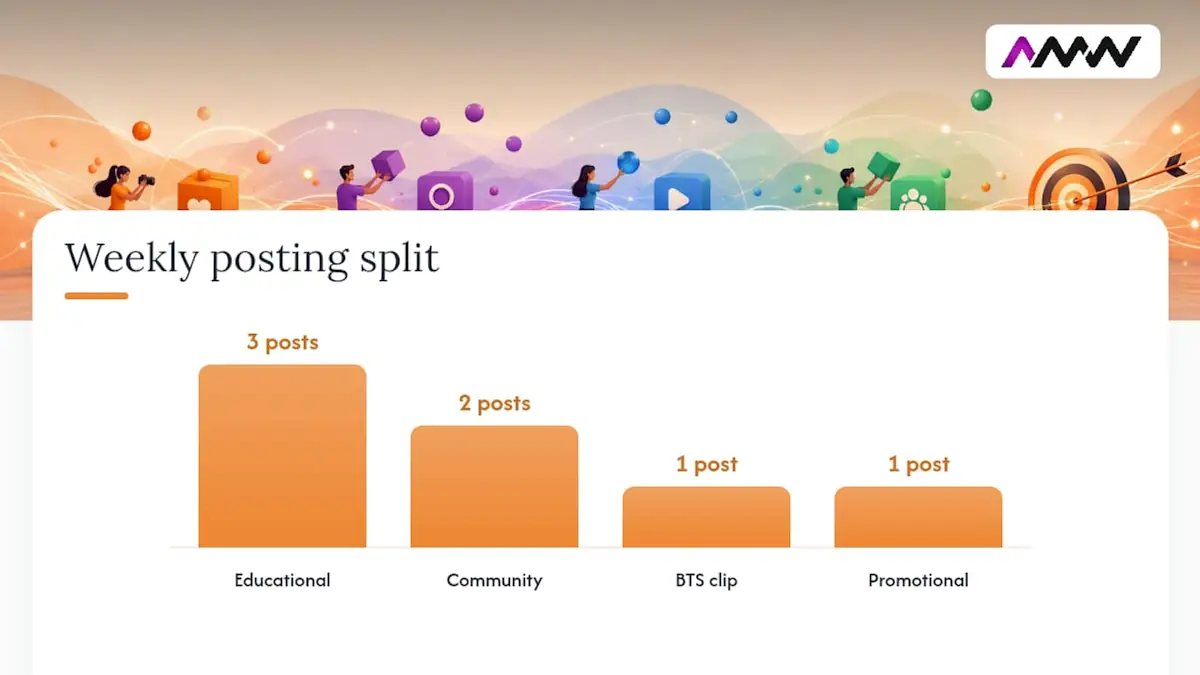
For posting slots, a simple weekly split working from the sample cadence shares above might look like three educational posts, two community touches, one behind-the-scenes clip, and one promotional push, adjusted to your own pillar mix.
Three templates worth keeping on file:
- Educational carousel: hook slide, three to five value slides, one recap or CTA slide
- Behind-the-scenes short video: 15 to 30 seconds, one clear “why this matters” line
- Community poll: binary or multiple choice question tied directly to your core pillar
Solo creators do better sticking to three pillars and leaning hard on templates. Teams with more hands can sustain five with clearer ownership per pillar. AMW Media’s content ideas roundup and this content calendar planning guide are both worth a look if you want more scaffolding before you build your own.
What has AMW Media learned from building pillar strategies?
AMW Media builds and runs social media strategy, content production, and pillar systems for SME clients across a range of industries, backed by Google, Meta, and Shopify partnerships that keep the team current on how platforms actually reward content.
The most common mistake we see isn’t a lack of ideas, it’s too many pillars with no cadence behind any of them. A client comes in posting seven different “themes” with no rhythm, and engagement is flat because the audience never learns what to expect. Cutting to three sharp pillars with a clear weekly rhythm consistently does more for engagement than adding another content idea ever does.
- Fewer, sharper pillars beat a long list every time
- Cadence discipline matters more than volume
- A quick pillar audit usually surfaces the fix within a week
A quick note from Amir
The mistake I see most often isn’t a bad pillar, it’s too many good ones with no hierarchy between them. Teams pick five interesting themes and treat them as equally important, then wonder why nothing breaks through. Pick one you’re willing to be known for, let the rest support it, and give the system 60 days before you judge it. If you want a second opinion on your mix, AMW Media’s team is always happy to have a look.
Want an agency to build and run your pillars for you?
If reading all this made you think “great, now I need to actually do it,” that’s the fair reaction. AMW Media runs pillar strategy and content production as one joined-up service, so you’re not stitching together a strategy doc, a freelance videographer, and a scheduling tool yourself. For a north west London business, our digital marketing agency Harrow page lists the results we can show and the area we cover.
Doing it yourself makes sense if you’ve got the time and someone on the team who enjoys the analytics side. Hiring an agency makes sense when you’d rather have a system running properly in a fortnight than half-built in three months, or when you want the strategy, the filming, and the reporting handled by people who do it for a living. AMW Media’s social media management service covers exactly this: pillar design, content production, and monthly performance reporting, so pillars stop being a one-off workshop exercise and start being something that actually gets run. If your pillar strategy needs a content hub or landing pages to match, AMW Media’s web design team can build that alongside it. Get in touch through the contact page and tell us where your current content feels scattered, that’s usually the fastest way to spot which three pillars you should start with.
Sources
- A guide to social media content pillars | Sprout Social
- Content pillars for social media: How to create & use them | SEMrush
- Content pillars for social media | ClickUp
- How to use content pillars to build your social strategy | Later
FAQ
What are the five pillars of social media?
There’s no single fixed set, but the five most commonly used are educational, inspirational, promotional, community, and behind-the-scenes content, each serving a different part of the audience relationship.
What are the four pillars of social media content?
When brands work with four, they typically drop to educational, promotional, community, and social proof, trimming behind-the-scenes or commentary depending on what their audience actually engages with.
What are the 5 pillars of content strategy?
At a strategic level this usually means audience research, pillar definition, format mapping, a publishing cadence, and performance measurement, the same skeleton this guide walks through step by step.
What are examples of content pillars for social media?
Common examples include educational how-tos, behind-the-scenes process content, community-driven polls and user generated content, social proof through testimonials, and promotional posts tied to offers or launches.
How many content pillars should a small business use?
Most brands do well with three to five, and Semrush’s guidance suggests starting at three if your team’s capacity is limited, then expanding once the system runs smoothly.
Recommended
- How to create engaging social media content that works | AMW Media
- How to build a social media presence for your business | AMW Media
- Your essential social media strategy checklist for growth | AMW Media
- How to boost your online presence for lasting brand growth | AMW Media
Our free marketing audit looks at your site, your ads and your content, and comes back with a 30 day plan. No pitch deck.

On site with the cameras most days of the week. Installs, interviews, products and events, from London to Liverpool. Meet the team.