
 Black Steel Doors
 Woodstock Campers
 Phillips Joinery
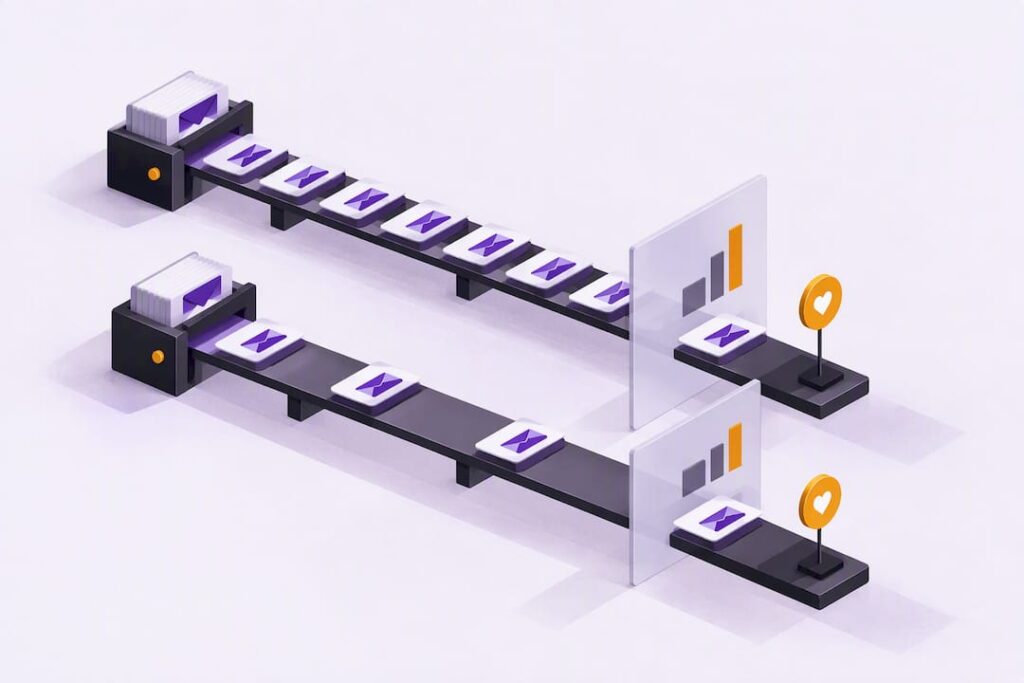
Most regular newsletters do well starting at once a week or once a fortnight, with content rhythm and audience preference deciding which. The rule for changing it is simple: watch engagement signals, especially disaffection rate, rather than a fixed calendar. Before any of that, make sure you’ve got proper consent at signup and an unsubscribe link that actually works.
TL;DR:
- Track disaffection, unsubscribes divided by opens, to see how readers respond; a climb across four to six consecutive sends warrants lower frequency or tighter segmentation.
- Any rise in spam complaints needs immediate attention because complaints hurt deliverability more than unsubscribes; an unsubscribe spike after a large send may be noise.
- Send more often to subscribers who open and click, reduce contact with dormant readers, and use triggered messages to add touchpoints without raising everyone’s cadence.
- Ramp cadence changes over four to eight weeks with a control group, then compare engagement across several sends rather than reacting to one result.
- Get informed consent at signup and include a single click unsubscribe in each marketing email; requiring login to opt out falls short of PECR requirements.
Table of Contents
- Typical cadences and the use cases they suit
- Signals and metrics that tell you to speed up or slow down
- Best practices to make higher frequency sustainable and respectful
- How to test and reach a final cadence: low-risk experiments
- Impact of newsletter frequency on deliverability and spam filtering
- How to align newsletter frequency with different audience segments and preferences
- The role of content type and length in determining optimal frequency
- Case studies or examples showing frequency adjustments and their outcomes
- How we approach newsletter cadence for our clients
- How AMW Media can help set and test the right cadence
- FAQ
- Sources
Typical cadences and the use cases they suit
There’s no single correct newsletter frequency. The right one depends on what you’re sending, who’s reading it, and how much editorial effort you can sustain without burning out your team or your list.
Daily sends suit time-sensitive content: market updates, breaking news, daily lessons in a course, or flash deals with a genuine expiry. They demand a steady supply of fresh material and a team that can produce it without cutting corners. Daily is unforgiving: miss the bar on quality even a few times and fatigue sets in fast.
Two to three times a week can work for lifestyle brands, editorial curation, or retailers running frequent promotions. It needs real editorial capacity, someone whose job is partly to keep the content pipeline full, because thin, repetitive emails at this frequency get noticed quickly.
Weekly is the dependable default for a lot of B2B and B2C newsletters. It’s frequent enough to stay relevant, infrequent enough that one so-so edition won’t sink you, and it fits neatly into most teams’ existing content and reporting cycles.
Fortnightly suits teams with less capacity but still want consistent presence. Subscribers adjust quickly to a fortnightly rhythm and it still feels familiar rather than sporadic.
Monthly fits high-value updates, low-touch services, or audiences who only need to hear from you occasionally (a B2B software company sharing product updates, for example). The trade-off is that a month is a long time between touchpoints. If something urgent needs saying, you’ll need a separate send anyway, and monthly cadences can leave people forgetting why they subscribed.
A few things to weigh before settling on one:
- Match the cadence to how often you genuinely have something worth saying, not to a schedule you’ve picked out of habit.
- Consider your production capacity honestly: a cadence you can’t sustain for six months isn’t a strategy, it’s a countdown to burnout.
- Think about what your audience expects from your sector: industry updates read differently to daily deal alerts.
Industry guidance for 2026 points towards a bigger shift than picking a single number: moving away from one big general newsletter and towards always-on, personalised journeys triggered by what someone actually does. Cadence still matters, but it increasingly applies per segment rather than to your whole list at once, something we’ll come back to shortly.
Signals and metrics that tell you to speed up or slow down
Once you’ve picked a starting cadence, the real work is watching how your list responds and adjusting before small problems become big ones.
The core metrics to track:
- Open rate: tells you whether subject lines and sender reputation are working, though it’s a blunt instrument on its own.
- Unique clicks: a better proxy for genuine interest than opens alone.
- Unsubscribe rate: the number of people leaving per send, useful but easy to misread in isolation.
- Complaint rate: people marking you as spam rather than unsubscribing, a much louder warning sign.
- Disaffection rate: unsubscribes divided by opens, which tells you how your actively engaged audience is reacting, not just your whole list.
Disaffection rate matters more than it gets credit for, because it isolates people who were opening your emails and then chose to leave. A rising unsubscribe count on a shrinking list can look stable in raw numbers while disaffection quietly climbs.
Statistic: 22% of UK consumers unsubscribe from at least one brand’s emails every week, which shows how little patience many subscribers have for volume they don’t want. That’s a strong argument for checking your own numbers against reality rather than assuming your list is more forgiving than most.
The trick is separating noise from trend. A single week with higher unsubscribes after a big send (a Black Friday blast, say) is usually just volume doing what volume does. A steady climb in disaffection rate over four to six consecutive sends is a different story and worth acting on. Rules of thumb that work well in practice:
- Treat a one-off spike after an unusually large or unusually timed send as noise unless it repeats.
- Treat a sustained rise in disaffection rate across several consecutive sends as a signal to reduce frequency or tighten segmentation.
- Treat any uptick in complaint rate, however small, as urgent: complaints affect deliverability far more than unsubscribes do.
Best practices to make higher frequency sustainable and respectful
If you want to send more often without wearing your list out, the fix usually isn’t cleverer copywriting. It’s better targeting.
- Segment by engagement and mailing history. Let your most engaged subscribers receive more frequent sends while pulling back on cadence for people who rarely open anything.
- Personalise and use dynamic content. Swapping in relevant products, topics, or updates per segment keeps frequent sends feeling tailored rather than repetitive.
- Set expectations at signup. Tell new subscribers roughly how often they’ll hear from you, and make sure every message includes a clear, one-click unsubscribe. The ICO’s guidance on electronic mail marketing is explicit that marketing emails need informed consent and a straightforward way to opt out, and that forcing people to log in or jump through hoops to unsubscribe falls short of what’s required under PECR.
- Balance batch sends with triggered automation. A weekly newsletter plus automated journeys (welcome sequences, abandoned cart reminders, post-purchase follow-ups) lets you increase total touchpoints without increasing manual workload, because the triggered messages run themselves once they’re built.
- Repurpose content across formats. A single piece of long-form content can become a newsletter feature, a short social post, and a follow-up email, cutting the production burden of sending more often.
The DMA’s broader point for 2026 reinforces this: the most effective way to increase cadence without hurting engagement is shifting volume towards your engaged segments and backing it with genuinely personalised content, rather than simply mailing everyone more.
Pro Tip: Tag subscribers by mailing history (opens, clicks, purchases) and build frequency rules around those tags rather than treating your whole list as one audience.
How to test and reach a final cadence: low-risk experiments
You don’t need to guess your way to the right frequency. A few structured, low-risk tests will tell you more than any industry benchmark.
- Run an A/B cadence test. Split a representative, similar-sized chunk of your list into two groups, send one your current cadence and the other a higher or lower one, then compare disaffection rate and engagement over several weeks.
- Use a holdout group. Keep a small control group on the old cadence throughout the test so you can spot delayed effects that only show up after the initial change has settled.
- Ramp gradually rather than jumping. Increase frequency for a small cohort over four to eight weeks, watching disaffection and revenue trends rather than reacting to any single week’s numbers.
- Give it enough time and enough people. A test that runs for one send or covers a tiny slice of your list won’t tell you much: aim for several sends and a sample large enough that the results aren’t just noise.
Impact of newsletter frequency on deliverability and spam filtering
Deliverability and frequency are more closely linked than most senders assume. Mailbox providers watch engagement patterns closely, and a sudden jump in volume, especially to subscribers who rarely open your emails, can trigger spam filtering before a human ever sees the message.
The mechanism isn’t about frequency alone. It’s about how recipients respond to it. If you increase sends and people start deleting without opening, marking as spam, or letting messages pile up unread, that behaviour tells inbox providers your mail is less wanted, which can hurt deliverability for your entire list, not just the new messages. Consistent cadence to engaged segments tends to protect sender reputation better than high volume to everyone.
This is one more reason segmentation matters before you touch your overall frequency. Sending more often to subscribers who already click regularly is low risk. Sending more often across your whole list, including the people who haven’t opened anything in months, is how deliverability problems start. If you’re already seeing bounces or inconsistent inbox placement, frequency changes alone won’t fix it. You can diagnose common deliverability issues before adjusting how often you send, since piling more volume onto an existing deliverability problem usually makes it worse.
How to align newsletter frequency with different audience segments and preferences
Treating your whole list as one audience with one ideal frequency is probably the single most common mistake in this area. A new subscriber who signed up last week and a loyal customer who’s opened every email for two years have very different tolerances for volume.
A practical approach:
- New subscribers often respond well to a slightly higher frequency early on (a short welcome series) before settling into your standard cadence.
- Highly engaged subscribers, identified by consistent opens and clicks, can usually handle more frequent contact without increased disaffection.
- Dormant or low-engagement subscribers should see less, not more: increasing frequency to people who’ve stopped opening rarely revives them and often accelerates unsubscribes or complaints.
During particularly busy sending periods, preferences split in a telling way: some subscribers want the same frequency but better content, while others would rather receive fewer, higher-quality messages, a pattern documented in analysis of holiday-period email behaviour. That split is exactly why a single blanket frequency rarely satisfies everyone, and why segment-level cadence decisions tend to outperform one-size-fits-all scheduling.
The role of content type and length in determining optimal frequency
What you’re actually sending should shape how often you send it, more than any generic rule of thumb. A short, punchy deal alert and a 1,500-word industry roundup don’t belong on the same schedule.
Short, scannable content (quick updates, single offers, short tips) tends to tolerate higher frequency because it asks little of the reader’s time. Longer, more substantial content (deep dives, multi-topic roundups, detailed case studies) usually needs more breathing room between sends, both because it takes longer to produce well and because readers need time to actually engage with it before the next one lands.
This is also where format flexibility helps. A single piece of strong content, a video, a client project writeup, a guide, can be adapted into a short update for a more frequent cadence and a longer feature for a monthly deep dive, letting you vary length without starting from scratch each time. If your team is already stretched, planning content types around your intended frequency from the outset, rather than trying to retrofit short content into a daily schedule, saves a lot of last-minute scrambling. Our thoughts on strategies for engaging your audience go into this content planning side in more depth.
Case studies or examples showing frequency adjustments and their outcomes
Frequency changes tend to play out in a fairly predictable pattern, whichever direction they go.
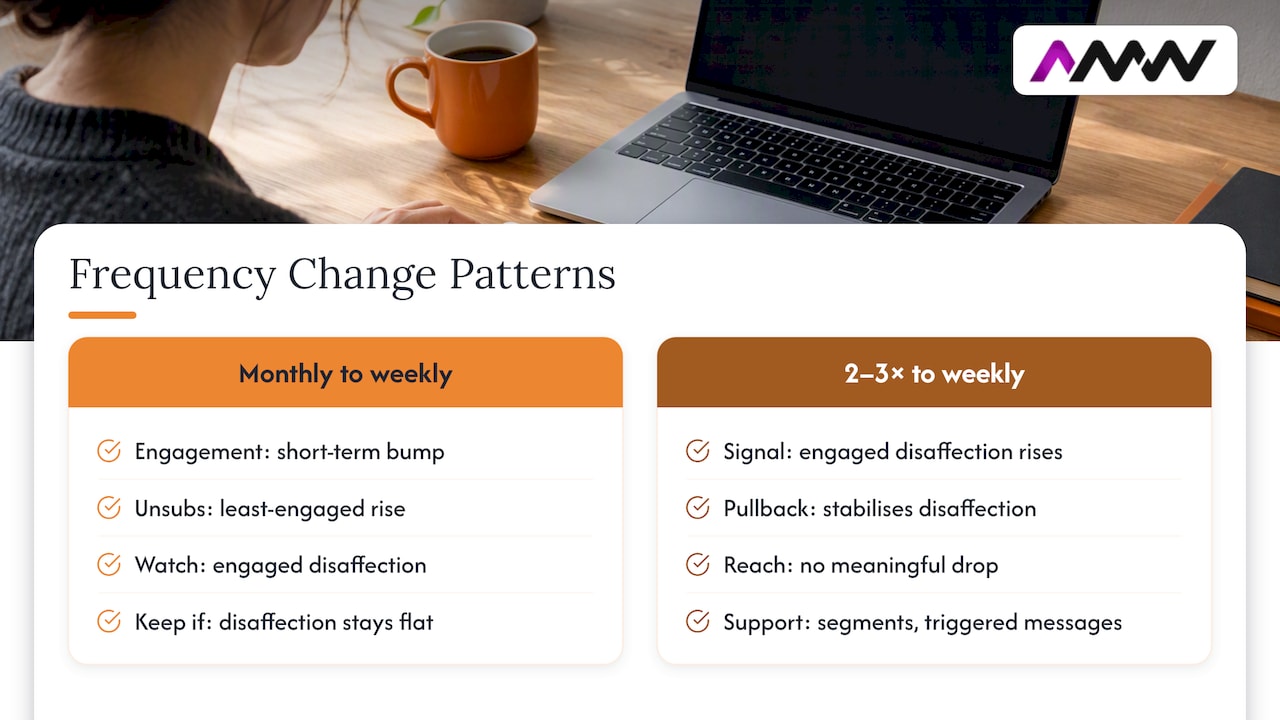
When a sender on a monthly cadence steps up to weekly, often to support a product launch or a seasonal push, the short-term effect is usually a bump in total engagement (more sends means more opportunities to open and click), paired with a modest rise in unsubscribes among the least engaged portion of the list. The outcome that actually matters is what happens over the following months: if disaffection rate among engaged subscribers stays flat, the higher cadence is sustainable. If it climbs steadily, that’s the sign to dial back.
The reverse pattern shows up just as often. A brand sending two or three times a week notices disaffection creeping up among subscribers who open regularly, not just casual ones. Pulling back to weekly, paired with tighter segmentation so the most engaged cohort still gets extra content through triggered automation, tends to stabilise disaffection without a meaningful drop in overall reach. Triggered, behaviour-based messages (abandoned browsing, post-purchase follow-ups) are a good example of our drip campaign examples worth looking at if you want to raise total touchpoints without pushing everyone onto a higher blanket frequency.
The pattern that holds across most examples: frequency changes made gradually, measured against disaffection rather than raw unsubscribe counts, and backed by segmentation produce steadier results than sudden, list-wide shifts.
How we approach newsletter cadence for our clients
We start with a data-first audit of a client’s existing sends and audience segments rather than guessing at a number. From there, we combine content production, automation, and ongoing measurement so a higher-frequency plan is actually achievable, not just aspirational on paper.
— Amir
How AMW Media can help set and test the right cadence
If working out the right newsletter frequency sounds like one more thing competing for your time, that’s exactly the gap our email marketing work is built to close. We handle the segmentation, automation, and content production side so testing a cadence change doesn’t mean rebuilding your whole process from scratch.
Our team pairs that setup with ongoing content production to keep frequent sends feeling fresh rather than repetitive, and with reporting that tracks disaffection rate alongside the usual opens and clicks. If you’d like a second pair of eyes on your current schedule, get in touch through our services page to talk through what a sustainable cadence would look like for your list.
FAQ
How should a newsletter be?
A good newsletter is consistent, relevant to what subscribers actually signed up for, and sent at a frequency your content and team can sustain long-term. It should also carry a clear unsubscribe option and respect the consent given at signup, in line with PECR requirements.
What is the 80/20 rule for email marketing?
The principle is a rough guideline rather than a fixed formula, and it reflects a widely shared principle: over-promotional newsletters tend to fatigue subscribers faster.
Are newsletters still relevant in 2026?
Yes, though the format is shifting towards more personalised, behaviour-triggered sends rather than one generic message to everyone, a trend highlighted in 2026 email and CRM guidance. Newsletters remain a direct, owned channel that doesn’t depend on social algorithms, which keeps them valuable even as sending strategies evolve.
What is the best frequency for email marketing?
There isn’t one universal best frequency: weekly or fortnightly suits most regular newsletters, while daily or near-daily sends only work for genuinely time-sensitive content. The better approach is starting with a sustainable cadence and adjusting based on disaffection rate and engagement trends rather than chasing a fixed number.
Sources
- Electronic mail marketing | ICO
- Email & CRM in 2026 | Trends, Innovation & Strategy
- 22% of UK consumers unsubscribe, at least once a week – Customer Experience Magazine
Recommended
- Email deliverability issues: diagnose and fix them fast
- Examples of email marketing campaigns that actually work
- Email Marketing Agency | Flows and Campaigns
- Segment first, then match channel: remarketing strategies that convert
Our free marketing audit looks at your site, your ads and your content, and comes back with a 30 day plan. No pitch deck.

Founded AMW Media in 2024 and runs strategy, paid media and the CRM builds. The reason everything here is in house and measured in revenue. Meet the team.