
 Black Steel Doors
 Woodstock Campers
 Phillips Joinery

Track marketing ROI by setting clear commercial goals, connecting campaign data to revenue, and triangulating attribution, experiments and marketing mix modelling (MMM), as IPA triangulation guidance recommends. Consent choices leave gaps, as GOV.UK’s GA4 setup shows, so platform counts are not automatically incremental. We use this method at AMW Media.
TL;DR:
- For subscriptions and repeat buyers, include customer lifetime value; use contribution margin instead of revenue when product margins vary in ROI calculations.
- Pass conversion events, revenue values, campaign identifiers, consent status, and deduplicated sales into the CRM, while counting media, creative, agency, and tool costs.
- Use attribution to adjust ads, controlled experiments to prove added sales, and marketing mix modelling to guide annual budgets across channels.
- Declined analytics consent leaves conversions out of GA4, so compare its monthly totals with CRM sales and disclose the gap in reports.
Table of Contents
- What is marketing ROI and how do you calculate it?
- How do you turn business goals into marketing KPIs?
- How do you connect marketing data to sales and cost?
- Which marketing performance metrics should you track?
- Attribution, experiments and MMM: which method answers which question?
- What does a consent-safe measurement plan look like?
- How do you design incrementality experiments?
- What does marketing mix modelling deliver?
- How should you report ROI and build a learning agenda?
- What is a practical measurement playbook for this quarter?
- How we approach measurement in practice
- How we can help you track marketing ROI
- FAQ
- Sources
What is marketing ROI and how do you calculate it?
The standard formula is simple: ROI = (revenue from marketing − marketing cost) ÷ marketing cost, shown as a percentage. For example, if a campaign’s revenue exceeds its total cost, it has a positive ROI. These figures are illustrative, not market data.
ROAS (return on ad spend) is just revenue divided by ad spend, so you can calculate its ROAS by dividing revenue by ad spend. It is handy for day-to-day ad tweaking, but it ignores everything except media cost.
Scope matters. Revenue-based ROI flatters low-margin products, so where you can, use profit or contribution margin instead. For subscriptions or repeat buyers, a single order undersells the customer, so bring in lifetime value (LTV). IPA research on the business case for advertising also supports looking at longer-term commercial effects alongside immediate purchases.
How do you turn business goals into marketing KPIs?
ROI only means something when it is tied to what the business actually wants. Start with the outcome (growth, retention or margin), then pick the metric that proves it. If you cannot name the decision a number will change, skip the number.
Here is how common goals map to KPIs:
- Awareness: brand lift and share of search, because clicks barely capture it.
- Acquisition: customer acquisition cost (CAC) set against LTV.
- Retention: churn rate and customer lifetime value.
- Margin: contribution margin per channel, so cheap sales do not hide thin profits.
- Lead generation: cost per qualified lead, and the share that becomes a paying customer.
For targets, begin with your own history. Last year’s CAC, conversion rate and average order value are a far better yardstick than a generic industry figure. Use industry norms as a sense-check, not a goal. Then write the target down with a clear time window, so nobody argues about success later. Our guide on analysing marketing results for digital growth goes deeper on KPI selection.
How do you connect marketing data to sales and cost?
A conversion in an ad platform is not revenue until it meets your sales records. The fix is a clean hand-off from website to CRM, plus honest cost tracking. Here is what to do:
- Pass the conversion event, such as form submit or purchase, from your site into the CRM.
- Attach a revenue value: order total for e-commerce, an estimated lead value for enquiries, or an LTV proxy for subscriptions.
- Store the campaign ID and UTM parameters alongside each record, so revenue traces back to its source.
- Record consent status, so you know which conversions are missing from analytics and why.
- Deduplicate conversions, because the same sale often gets claimed by several platforms at once.
- Log full campaign cost: media, creative production, agency fees and tools, not just ad spend.
For lead-based businesses, update the estimated lead value as deals close. A lead’s estimated value may differ from the average value once real sales come in, and your ROI picture changes with it. Partner Baby Love Growth’s piece on content marketing ROI has useful ideas if content is a big part of your mix.
Which marketing performance metrics should you track?
Keep the list short and clear on purpose:
- Cost and revenue by channel
- ROAS and ROI
- CAC
- LTV or CLV
- Conversion rate
- Margin or contribution
Split them by time horizon. ROAS, conversion rate and cost per lead tell you whether a campaign is running efficiently this week. CAC against LTV, margin and ROI tell you whether the business is getting richer over months.
Comparisons are where people get burned. Check the scope before putting two ROI figures side by side: different time windows, offline sales left out, or revenue versus profit will all distort the picture. As Think with Google’s media effectiveness guide points out, digital attribution is granular but can miss offline and upper-funnel effects.
Do not compare channel ROI figures without checking what each one includes.
Attribution, experiments and MMM: which method answers which question?
No single method gives you the “true” ROI. Each answers a different question and has different blind spots, which is exactly why IPA’s effectiveness guidance recommends a learning agenda rather than a hunt for one perfect number.
- Attribution splits credit across touchpoints. It is excellent for fast, tactical decisions such as which ad or keyword to adjust, but it can miss offline activity and brand effects.
- Experiments (incrementality tests) compare a group that sees your marketing with one that does not. They give causal proof of what your spend really added.
- MMM uses aggregated historical data to estimate what drove sales across online and offline channels. It suits annual budgets and forecasting, but not tweaking individual ads.
A quick decision guide:
- “Which creative should I scale this week?” Use attribution.
- “Did this channel actually create extra sales?” Run an experiment.
- “How should I split next year’s budget?” Use MMM.
- “Can I trust my attribution numbers?” Test them with an experiment.
The method should match the decision, as the IPA triangulation article explains. Experiments also feed back into the other two: they validate attribution and give MMM firm anchor points.
Pro Tip: Start with attribution for daily steering, then pick one big-spend channel and test it properly. A clean experiment can be more useful than a confident dashboard.
What does a consent-safe measurement plan look like?
Before touching any tags, write a measurement plan. Then work through this checklist:
- Name the business outcome you care about.
- Define the conversion event that signals it.
- Set the revenue value for that event.
- Choose the campaign identifier, usually consistent UTMs.
- Map the CRM hand-off, as covered above.
- Confirm where cost data will come from.
- Record consent status for each visitor.
GOV.UK’s GA4 documentation shows a dataLayer and Google Tag Manager pattern where events are sent only after consent, and its consent handling record shows tags being blocked when the consent cookie does not indicate usage consent. The practical upshot: if a visitor declines analytics cookies, GA4 reports nothing about them, so reported conversions undercount reality. GOV.UK’s cookie categories make the same point, with analytics disabled when usage consent is declined. That is an implementation pattern, not legal advice, so get proper privacy advice for your own set-up.
Keep UTMs consistent (lower case, fixed naming), and consider enhanced conversions or server-side fallbacks to recover some signal. Our walkthroughs on Consent Mode v2 and GA4 not tracking cover the fiddly bits, and our note on Google Ads conversion tracking is worth a read.
Pro Tip: Compare your CRM sales count against GA4 conversions each month. The gap is your blind spot, and it tells you how much to trust the dashboard.

How do you design incrementality experiments?
Incrementality asks one question: what extra outcome did this marketing cause that would not have happened anyway? Google’s experimentation playbook describes three ways to split test and control groups:
- User-based: randomly hold back some people from seeing ads. Best when the platform can randomise reliably.
- Geo-based: compare non-overlapping regions, with ads running in some and paused in others. Handy for offline or local sales.
- Time-based: compare before and after, using the pre-period to estimate what would have happened. Quickest, but outside events can muddy it.
A few habits keep results honest. Decide the success metric before launch. Make sure the test group is big enough to show a real difference, because small tests produce noise. Protect the holdout, so nobody quietly advertises to the control group. And never read platform-reported conversions as proof of extra sales; the playbook is clear that they are evidence for optimisation, not causal proof.
Typical uses include conversion lift, brand lift and search lift. A paused-region test for a local campaign, for example, tells you whether enquiries really dip without the ads.
What does marketing mix modelling deliver?
MMM uses historical data to estimate how much each channel contributed to sales. According to Google’s MMM handbook, it answers strategic questions: what drove sales, what the ROI was and how to optimise investment. Typical outputs are historic ROI by channel, marginal ROI (what the next pound would return) and response curves showing where extra spend stops paying off.
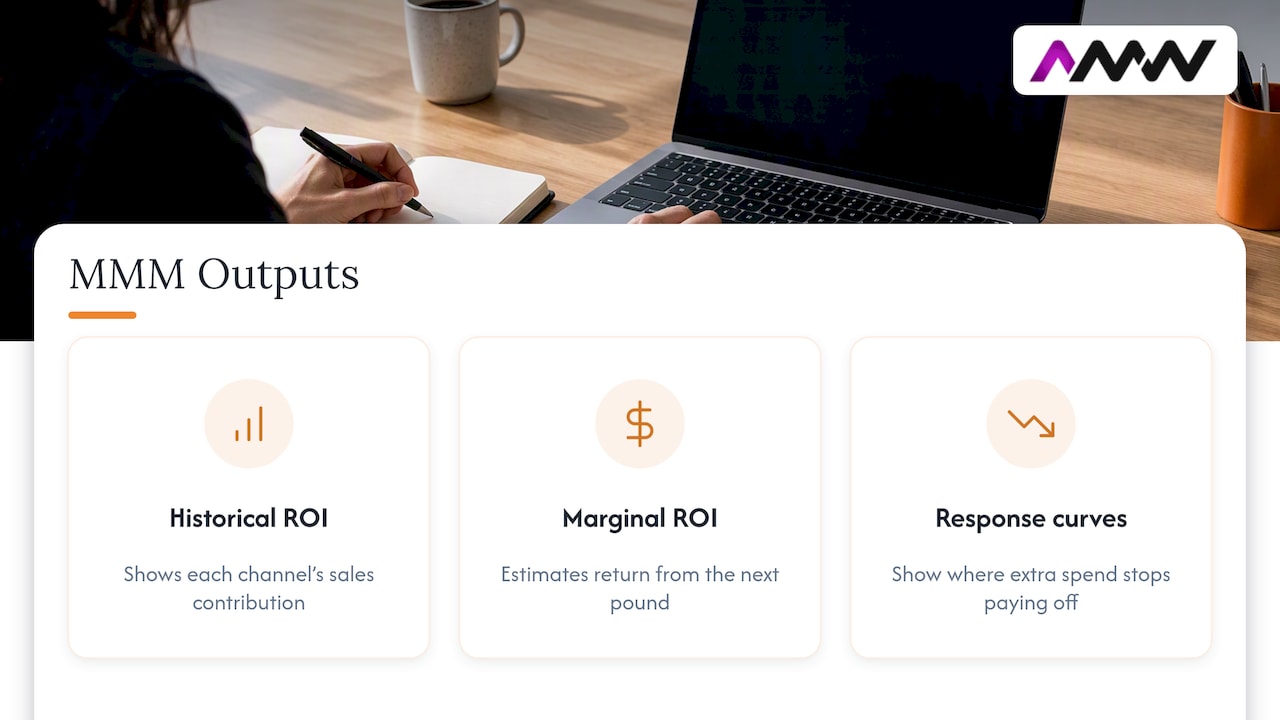
Those outputs shape budgets. If a channel’s curve flattens, move money elsewhere. Google’s MMM guide for CMOs adds that MMM can model short and long-term ROI, and that enriching it with brand lift studies improves interpretation.
It has limits. Channels that rise and fall together (collinearity) are hard to separate, and MMM cannot tell you which ad variant won. It also needs business context: a price change, a stock shortage or a competitor launch can all skew a model. Use MMM to set the broad budget split, then let campaign-level attribution steer the details, with experiments calibrating both.
How should you report ROI and build a learning agenda?
Report on two clocks: weekly or monthly dashboards for efficiency metrics, and quarterly reviews for long-term value, CAC against LTV and MMM findings. IPA’s guidance on learning culture argues that success depends less on one universal ROI and more on an evidence-based habit of managing blind spots.
Present uncertainty rather than hiding it. Show the scope of every figure, flag what is missing (such as declined-consent traffic) and give ranges where precision is fake. Stakeholders trust a number more when they know its limits.
Then set up a test-and-learn pipeline:
- Keep a ranked list of open questions, such as “does paid social add sales or just claim them?”
- Give each test an owner, a start date and a decision it will inform.
- Review results at a fixed monthly slot and record what changed.
- Name who owns data quality, who owns budgets and who signs off decisions.
What is a practical measurement playbook for this quarter?
Resource-light teams should start with the foundations, since they unlock everything else.
- Write down commercial goals and the KPIs that prove them.
- Build the measurement plan and agree revenue values.
- Fix tagging, UTMs, consent handling and the CRM hand-off.
- Pull together full cost data per channel.
- Build a dashboard with efficiency and long-term metrics.
- Run an incrementality test on a priority channel.
- Review results, adjust budgets and plan the next test.
How we approach measurement in practice
We start with the measurement plan, not the dashboard. Fixing tracking first means the numbers you act on can be trusted, and our team has experience with analytics and marketing platforms. Our write-up on how marketing analytics drives ROI shows the thinking, and our projects page shows the work. Happy to talk through a measurement review whenever suits you.
— Amir
How we can help you track marketing ROI
If you would rather hand the technical heavy lifting to people who do it daily, we can help. Current prices are on our website.

- Measurement plans tied to your commercial goals
- Analytics audits to find the gaps in your current tracking
- Experiments and campaign reporting you can take to the board
Browse our services or get in touch to book a review.
FAQ
What is the best way to measure marketing ROI?
There is no single best method. Start with clear goals and connected sales data, then combine attribution for optimisation, experiments for causal proof and MMM for budgets. IPA’s effectiveness guidance recommends this blend because each method has different blind spots.
How do you calculate marketing ROI?
Subtract marketing cost from the revenue it generated, divide by the cost, and express it as a percentage. Use profit rather than revenue where margins vary. Include every cost, such as media, creative and agency fees.
What is the difference between ROI and ROAS?
ROAS is revenue divided by ad spend only, so it suits quick campaign decisions. ROI accounts for all costs and, ideally, margin, so it suits business-level judgements.
Why are platform conversion numbers not the same as extra sales?
Platforms report conversions they can attribute, not the ones they caused. Google’s experimentation guidance says controlled tests are needed to show incremental impact. Declined cookies add a further gap.
Sources
- IPA | Making measurement triangulation work
- govuk_publishing_components: GA4 and cookie consent – GOV.UK Developer Documentation
- A media effectiveness guide for CMOs (and CFOs)
Recommended
- Conversion optimisation: a practical guide for UK SMEs
- How to analyse marketing results for digital growth
- Best marketing methods for UK businesses in 2026
- Best automation tools for digital marketing: 2026 UK guide
Our free marketing audit looks at your site, your ads and your content, and comes back with a 30 day plan. No pitch deck.

Founded AMW Media in 2024 and runs strategy, paid media and the CRM builds. The reason everything here is in house and measured in revenue. Meet the team.