
 Black Steel Doors
 Woodstock Campers
 Phillips Joinery
If your business plays live or recorded music where the public can hear it, you almost certainly need TheMusicLicence from PPL PRS. That’s your legal basis under the Copyright, Designs and Patents Act 1988, and it covers both the songwriters (via PRS for Music) and the recording rights holders (via PPL). Exemptions are narrow: private domestic listening, public-domain works, or music you’ve cleared directly with the creator.
TL;DR:
- Most businesses playing music in public spaces, including shops, cafes, gyms, and offices, need TheMusicLicence from PPL PRS to avoid copyright infringement.
- The licence covers both recorded music and live performances using both PRS and PPL rights, with costs varying based on premises size, uses, and sector specifics.
- Personal streaming subscriptions do not license commercial public performances, requiring businesses to obtain a dedicated business tier or licence.
- Using music in advertising or media content requires separate sync licenses, which are not included in TheMusicLicence, and must be negotiated individually.
- Playing music without proper licensing leads to legal action, backdated fees, and potential court proceedings, making proper licensing a necessary business expense.
Table of Contents
- Who needs a music licence: shops, cafés, gyms and offices
- PRS, PPL and TheMusicLicence: what each one actually covers
- How much does TheMusicLicence cost?
- How to get TheMusicLicence for your business
- Events, hired venues and local authority permissions
- What happens if you skip the licence
- A practical checklist before you press play
- Streaming services and digital music at work
- Does Brexit change how UK music licensing works?
- Sync licensing: using music in adverts and media
- Where the licence fee actually goes
- Background music vs live performance: does it change your licence?
- Why licensing is worth the cost
- Need help with music in your marketing content?
- Sources
- FAQ
Who needs a music licence: shops, cafés, gyms and offices
The rule of thumb is simple: if anyone outside your immediate household can hear the music, you’re in licensing territory. That covers far more businesses than most owners assume.
- Shops and salons playing background playlists over speakers
- Cafés, restaurants and pubs with radios, TVs, or curated playlists
- Hotels and gyms piping music into public areas or changing rooms
- Offices where music plays in shared spaces staff and visiting clients can hear
- Live venues and events with bands, DJs, or backing tracks
There’s a genuine grey area with offices: music playing quietly in a staffroom that only employees ever enter is a different case to music audible in a reception area where clients wait. When in doubt, assume it counts as public.
One trap catches out a lot of small business owners: your personal Spotify or Apple Music subscription is licensed for private, non-commercial listening only. It does not cover playing that same music in your shop or café, no matter how much you’re already paying for it each month.
PRS, PPL and TheMusicLicence: what each one actually covers
Two separate sets of rights sit inside every track you hear. PRS for Music represents the songwriters and composers who wrote the melody and lyrics. PPL (Phonographic Performance Limited) represents the performers and record labels who created that specific recording. Play a recorded song in your shop and you’re using both sets of rights at once, which is why most businesses end up needing permission from both bodies.
That’s exactly the problem PPL PRS Ltd was set up to solve. It’s a joint venture between PPL and PRS for Music, created so businesses deal with one licence, one contact point, and one invoice instead of negotiating with two separate organisations. The product they sell is TheMusicLicence, and for the vast majority of businesses playing background or live music, it’s the only permission you need.
Quick reference: what needs covering
- Recorded music played through speakers, radios or TVs → needs both PRS and PPL rights (TheMusicLicence covers both)
- Live cover versions performed by a band → needs PRS (the composition rights)
- Original live music with no recorded elements → may only need PRS, but check
- Music used in adverts, dubbing, or broadcast content → usually needs a separate, specialised sync licence
If your use case strays outside standard background or live performance, such as using a track in a TV advert or dubbing it into video content, contact PPL PRS directly rather than assuming TheMusicLicence covers it.
How much does TheMusicLicence cost?
Fees are not one-size-fits-all. PPL PRS sets pricing based on sector, premises size, and how the music gets used, which means your quote depends on details specific to your business rather than a flat national rate.
Factors that move your fee up or down include:
- Your business sector (retail, hospitality, fitness, and offices are priced differently)
- The size of your premises and how many separate areas play music
- Number of staff and, in some sectors, number of customers
- How many devices or speaker zones are running music simultaneously
- Whether you hold live events, and their capacity
A small independent café with one till area and a single radio will pay considerably less than a multi-floor gym with music in every studio and changing room. Because the variables shift so much between sectors, PPL PRS publishes indicative examples rather than a single price list, and the only reliable way to know your actual cost is to request a specific quote.
One thing worth flagging for your bookkeeper: TheMusicLicence fee is subject to VAT at the standard rate, so factor that into any budget comparison you’re doing against other overheads.
How to get TheMusicLicence for your business
Getting set up is simpler than most owners expect. Here’s the practical sequence:
- Check first whether your venue already holds a licence. If you’re renting space, hiring a hall, or performing at someone else’s premises, ask the venue manager before you buy anything. Many venues already hold cover through their own annual licence, which can save you the cost entirely.
- Get a quote from PPL PRS either online through their site or by phone. Have your business type, premises size, opening hours, and how you play music (radio, streaming, live acts) ready, since they’ll ask for these to calculate your fee.
- Pay and keep the paperwork. Store your licence certificate and payment confirmation somewhere your team can find it, in case of a spot check or a change of ownership.
- For one-off events, ask about a temporary event permit rather than a full annual licence, which is usually the cheaper and more sensible route for a single gig or party.
Pro Tip: Set a calendar reminder a month before your licence renewal date. Businesses that let it lapse without realising often only find out when a PPL PRS compliance visit flags it, which is a far more awkward conversation than a quick renewal.
Events, hired venues and local authority permissions
Running an event brings a second layer of licensing that catches people out constantly: your local council’s entertainment licence and your music copyright licence are two entirely different things, and you can need both.
- A premises licence from your local authority covers noise, safety, and permitted hours for entertainment. It has nothing to do with paying royalties to music creators.
- TheMusicLicence covers the copyright side, meaning permission to actually play the music.
- If you’re hiring a room, marquee, or outdoor site, always ask whether the venue’s existing PPL PRS licence covers performers using that space. Community halls and outdoor pop-up sites are the ones most likely to be unlicensed, so check early rather than assuming.
- If neither licence exists for a one-off event, PPL PRS can issue a temporary permit rather than a full annual arrangement.
What happens if you skip the licence
Playing music without the right permissions is copyright infringement under the Copyright, Designs and Patents Act 1988, and it carries real legal exposure, from compliance visits and backdated fees through to court action in persistent cases. It’s not a theoretical risk either. PPL PRS runs active compliance checks, and unlicensed premises do get caught.
The safe exemptions are narrower than people assume:
- Music played purely for private, domestic enjoyment with no public or staff audience
- Compositions in the public domain (rare in practice for anything you’d recognise)
- Tracks you’ve cleared directly with the rights holder, in writing
The mistake we see most often isn’t wilful rule breaking. It’s business owners assuming their personal streaming subscription already sorts it, then discovering years later that it never covered commercial premises at all.
If you want music without the licensing headache, properly cleared royalty free music UK libraries or commissioning custom music with a clear rights transfer are both legitimate routes. Just check the terms carefully. Plenty of “royalty free” catalogues still require attribution or restrict commercial use in ways that surprise people.
A practical checklist before you press play
Cut through the theory with a simple sequence you can run through this week:
- Map every place music plays in your business, from the shop floor to the phone hold music.
- Check whether your venue or landlord already holds cover if you don’t run the whole premises yourself.
- Request a quote from PPL PRS with your sector and usage details to hand.
- Pay and file your certificate somewhere accessible to whoever manages your premises.
- Track your renewal date and any change in premises size or staff numbers that might affect your fee.
- Keep setlists or playlists for live events, since accurate reporting helps royalties reach the right artists.
Pro Tip: If music is central to your brand experience (a boutique gym with a signature playlist, a bar known for its DJ nights) it’s worth treating licensing the same way you treat your food hygiene certificate: a fixed operating cost, reviewed annually, not an afterthought.
If you’re producing marketing content that features music, from social clips to full campaign videos, that’s a separate creative and rights question from your premises licence, and it’s where a team experienced in video production earns its keep.
Streaming services and digital music at work
Consumer streaming platforms like Spotify, Apple Music, and YouTube Premium are licensed for personal, non-commercial listening. None of them extend that licence to a shop, café, gym, or office simply because you’re paying a monthly subscription. The moment that music becomes audible to staff, customers, or the public, you’ve moved outside what your personal account permits.
Some streaming providers do sell dedicated business tiers built for exactly this situation, with the public performance rights baked into the subscription. If you go that route, read the terms closely. A “business plan” from a streaming provider isn’t automatically the same as holding TheMusicLicence, and it may not cover live performance or events on top of background playback.
The safest working assumption for any UK business: your personal or family streaming account stays personal. If music plays anywhere customers or the public can hear it, that’s a commercial use case, and it needs commercial-grade permission, whether that’s TheMusicLicence, a licensed business streaming tier, or a properly cleared royalty free music UK library. Digital delivery hasn’t changed the underlying legal question. It’s simply added more ways to accidentally get the answer wrong.
Does Brexit change how UK music licensing works?
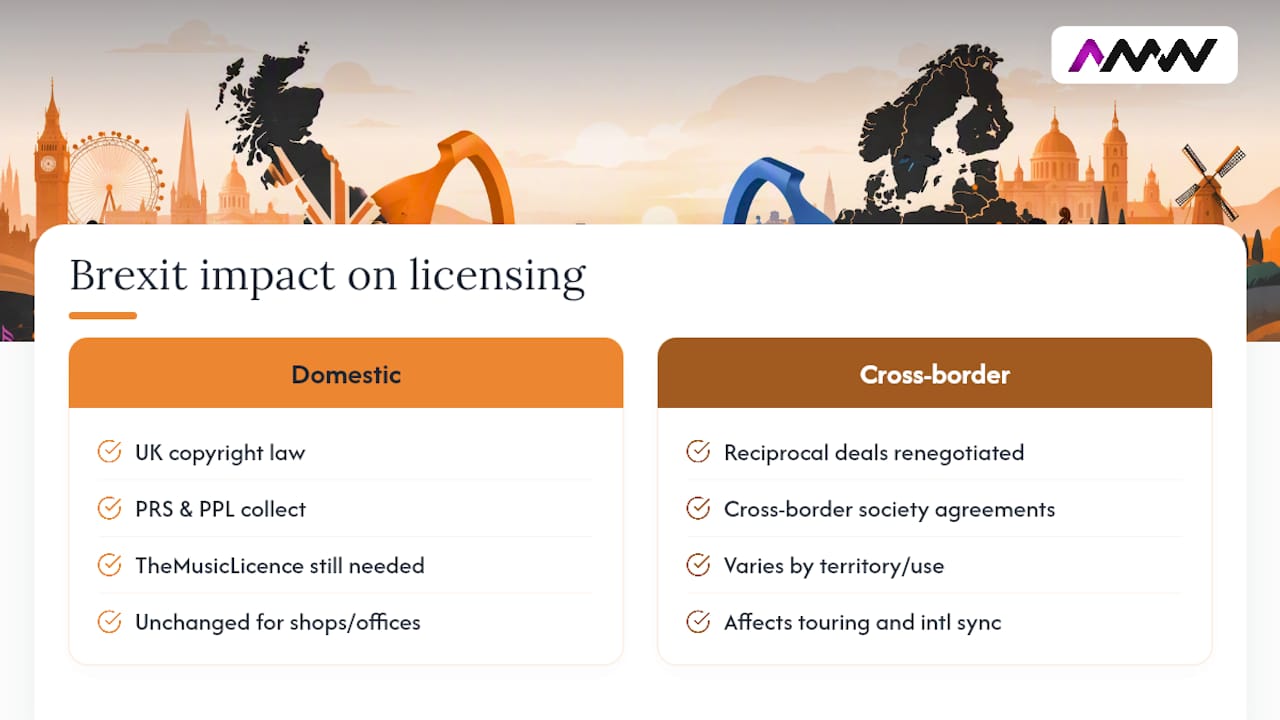
Brexit changed a fair amount about UK trade and regulation, but the core mechanics of UK music licensing UK businesses deal with day to day have stayed largely intact. PRS for Music and PPL are UK-based collecting societies operating under UK copyright law, and the Copyright, Designs and Patents Act 1988 remains the governing legislation regardless of the UK’s relationship with the EU.
Where Brexit has had more impact is in cross-border reciprocal arrangements. Historically, UK collecting societies had agreements with EU counterparts to ensure royalties flow correctly when music gets used across borders, covering things like touring performances, cross-border broadcasts, and international sync deals. Those reciprocal relationships have needed renegotiation and adjustment since the UK left the EU’s single market, which matters far more for touring musicians, international labels, and companies licensing music for cross-border advertising campaigns than it does for a café playing background music.
For the average UK business simply looking to license music for a shop, office, or event, the practical requirement hasn’t shifted: you still need TheMusicLicence from PPL PRS, and the legal basis is still domestic UK legislation, not EU law. Where Brexit bites is in more specialised territory, so if your business licenses music for international distribution, cross-border sync deals, or touring, it’s worth a direct conversation with PPL PRS or a specialist rights adviser about how current reciprocal arrangements apply to your specific case.
Sync licensing: using music in adverts and media
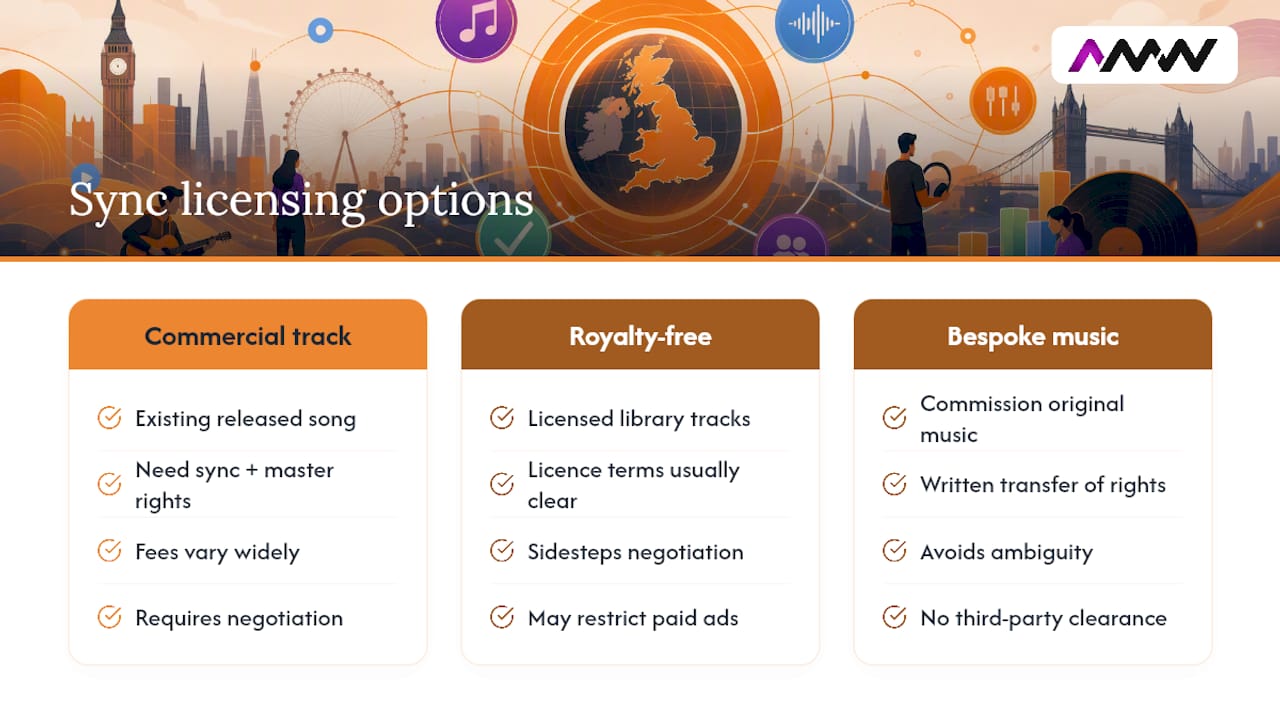
Sync licensing (short for synchronisation) is a different beast entirely from TheMusicLicence, and it’s a common point of confusion for UK business owners producing their own marketing content. TheMusicLicence covers playing existing recorded or live music in your premises. Sync licensing covers pairing a piece of music with visual media, such as a TV advert, a promotional video, a podcast, or social content.
If you’re producing a video for your business and want to use a specific commercially released track, whether that’s a chart hit or a lesser-known indie release, you need explicit sync rights from both the composition owner (usually a publisher) and the recording owner (usually a label). TheMusicLicence does not cover this use case at all. Sync deals are negotiated individually, and fees vary enormously depending on the track’s popularity, how widely you’re distributing the content, and for how long.
This is exactly why so many businesses turn to properly licensed royalty free music UK libraries for marketing content instead. It sidesteps the negotiation entirely, since the licence terms are usually clear and immediate, though it’s still worth reading exactly what usage rights you’re getting (some libraries restrict paid advertising use even within a “royalty free” tier).
If music matters to your brand identity, commissioning custom music with a clear, written transfer of rights is often the cleanest route for advertising and media use. It avoids any ambiguity about what you can and can’t do with the finished track, and it means the piece is yours. Agencies working across advertising and social content, including teams like the one behind AMW Media’s advertising work in London, routinely factor sync rights into campaign planning precisely because getting it wrong after a campaign launches is far costlier than sorting it before.
Where the licence fee actually goes
The money businesses pay through TheMusicLicence doesn’t sit with PPL PRS. It flows back to the people who made the music, split between two distinct royalty streams that correspond to the two sets of rights involved.
PRS for Music collects the songwriter and composer share and distributes it based on reported usage: radio play data, setlists from live events, and broadcast logs all feed into working out who gets paid for what. That’s part of why keeping accurate setlists and playlists matters if you run live events. Sloppy reporting means royalties can get misallocated, and the songwriters behind a lesser-known support act can lose out to whoever’s easiest to track.
PPL collects the recording rights share and pays it out to performers and record labels, again based on usage data gathered across licensed premises, broadcasters, and public performance venues. The exact split between performer and label depends on their own contractual arrangements, which sit outside PPL’s role.
The practical upshot for a business owner is this: your licence fee isn’t a toll for the privilege of playing music. It’s the mechanism that gets money to the people who wrote and recorded the songs your customers enjoy. Skip the licence, and you’re not just risking legal action, you’re taking music without paying the people who made it, which is precisely the harm copyright law exists to prevent.
Background music vs live performance: does it change your licence?
Both background music and live performance sit under the same licensing regime, TheMusicLicence, but the details of what you’re covered for shift depending on which one you’re running.
Background music, whether that’s a curated playlist, radio, or streaming TV audio, is the simpler case. TheMusicLicence covers the recorded music you’re playing, and your fee is calculated largely around premises size, sector, and how many zones are playing music simultaneously.
Live performance introduces an extra layer. If a band plays a covers set, you need PRS coverage for the compositions they’re performing, since PRS represents the songwriters regardless of who’s performing the song on the night. If they’re also using any backing tracks or recorded elements, PPL rights come into play too. Original, entirely live performances with no recorded elements typically only trigger PRS rights, since there’s no existing recording being used.
The other key difference is reporting. Background music usage is generally covered under your blanket licence with no ongoing reporting obligation. Live performance often requires you to submit setlists, since PRS uses that data to work out exactly which songwriters get paid for that specific event. It’s a small extra step, but skipping it doesn’t get you out of needing the licence. It just means the royalty distribution ends up less accurate for the performers who played that night.
Why licensing is worth the cost
Licensing isn’t red tape for its own sake. It’s the mechanism that keeps songwriters and performers paid while your customers get the atmosphere that keeps them in your shop or café a little longer. Treat it like insurance: a routine, predictable cost rather than a surprise. Working with brands on marketing content, we’ve seen how often music choices get made without anyone checking the rights first, and it’s always cheaper to ask before you publish than to fix it after.
Amir
Need help with music in your marketing content?
Sorting your business premises licence is one thing. Getting the music right in your adverts, social videos, and campaign content is a different challenge entirely, and it’s one Amwmedia deals with regularly for clients who want their brand to sound as good as it looks. We’re not a licensing body and we don’t sell TheMusicLicence, but we do help brands plan and produce content where the music choices are sorted properly from the start, rather than flagged as a problem after the campaign’s already live. If your business is in Berkshire and you want a team to run this, our Reading page sets out how we work, with the numbers attached.
Whether that’s a social media campaign built around the right soundtrack or a full video production with custom or properly cleared music underneath it, our content team factors rights into the planning conversation before a single frame gets shot. If you’re building marketing content that leans on music and want it done right the first time, get started with AMW Media and tell us what you’re planning.
Sources
FAQ
What are the music licensing laws in the UK?
UK businesses playing live or recorded music in public need TheMusicLicence from PPL PRS, under the legal basis set out in the Copyright, Designs and Patents Act 1988.
What music can I play without a licence in the UK?
Only music played purely for private, domestic use with no public or staff audience, genuine public-domain compositions, or tracks you’ve cleared directly with the rights holder in writing.
Can you check if a business already has a music licence?
Yes. Ask the venue or business manager directly, since many venues already hold TheMusicLicence, which can cover performers or events held on their premises.
How can I avoid paying PPL and PRS fees?
You can’t legally avoid the fee if you’re playing music publicly. The only lawful alternatives are using properly licensed royalty free music UK libraries or commissioning custom music with a clear rights transfer.
Do I need a separate licence for a one-off event?
Often yes, unless the venue’s existing annual licence already covers it. PPL PRS can issue a temporary permit for one-off events rather than requiring a full annual licence.
Our free marketing audit looks at your site, your ads and your content, and comes back with a 30 day plan. No pitch deck.

Founded AMW Media in 2024 and runs strategy, paid media and the CRM builds. The reason everything here is in house and measured in revenue. Meet the team.