
 Black Steel Doors
 Woodstock Campers
 Phillips Joinery
Digital PR backlinks are earned editorial links from journalists and publications who cover your story because it’s newsworthy, not because you paid for placement. They matter most when you need durable authority signals rather than quick wins: industry data shows digital PR ranks among the most effective link building tactics, and agencies use it precisely because those links compound over time rather than decay like rented ones.
TL;DR:
- Digital PR backlinks, earned through newsworthy coverage, provide long-lasting authority signals and tend to accumulate over time rather than decay quickly.
- Placement context and link destination are crucial; links inside the article body and pointing to relevant deep pages carry significantly more SEO value.
- Campaigns driven by original data, reactive expert commentary, and targeted media lists yield the most reliable editorial backlinks and longer-term SEO benefits.
- SEO impacts from digital PR typically manifest within 30 to 90 days, with quick referral traffic spikes in the first week and gradual ranking improvements afterward.
- Ensuring transparent methodology, avoiding paid placements disguised as organic coverage, and maintaining strong journalist relationships are key to ethical and effective digital PR efforts.
Table of Contents
- What are digital PR backlinks, and how do they differ from link building?
- Why digital PR backlinks matter for SEO and brand signals
- Key digital PR tactics that earn editorial backlinks
- Step-by-step campaign checklist: idea to earned link
- Measuring success: KPIs, tools and reporting template
- Common mistakes, red flags and when digital PR won’t work
- How Amwmedia approaches digital PR backlinks
- Legal and ethical considerations in digital PR backlink acquisition
- Case studies and examples of successful digital PR backlink campaigns
- When digital PR makes more sense than other backlink tactics
- How Amwmedia can help with your next digital PR campaign
- Further reading and primary sources
- Sources
- FAQ
What are digital PR backlinks, and how do they differ from link building?
A digital PR backlink is a link a journalist or editor adds because your data, comment, or story earned a spot in their coverage. Nobody paid for it. Nobody negotiated a placement fee. That’s the entire distinction that matters here. Our High Wycombe SEO page argues that in a town like that the town name is not the market, and shows what to target instead.
Traditional link building tends to work through arrangement: you pay for a guest post slot, you buy a placement, or you insert a link into someone’s existing content for a fee. Digital PR for SEO flips that model. Instead of buying space, you give journalists something they’d want to write about anyway, and the link comes as a natural by-product of the coverage.
Not every editorial link carries equal weight, though. A few technical factors decide how much SEO value a given placement actually delivers:
- Placement context, a link buried in a footer or author bio does far less than one sitting inside the body copy where the journalist references your data directly.
- Link destination, links to a relevant deep page (your report, your data hub) tend to outperform links dumped on your homepage.
- Follow status, a followed link passes ranking signal directly; a nofollow link still builds authority and referral traffic, just not the same direct SEO lift.
- Editorial framing, a link inside a sentence that credits your research reads as more trustworthy to both readers and search engines than a passing mention.
Quick stat: research on link building tactics consistently ranks digital PR among the highest-performing approaches for earning authoritative links, ahead of most transactional tactics.
The mechanics matter because contextual, deep-linked placements carry more SEO value than header or footer mentions. When you’re briefing a campaign or an agency, ask specifically for links in the body copy, pointing at the actual asset, not a generic homepage nod.
Why digital PR backlinks matter for SEO and brand signals
Editorial links move rankings, but that’s only half the story now. The other half is brand visibility inside AI-generated answers, and that’s changing faster than most SEO teams have adjusted for.
Backlinks from reputable outlets still function as one of the clearest authority signals search engines use to decide who deserves to rank. That’s not new. What’s shifted is how much unlinked brand mentions matter alongside them. Brand mentions correlate more strongly with AI overview citations than raw backlink counts, which means a campaign that gets your brand quoted in twenty articles, even without a link in every single one, is doing real work for how AI tools describe your business when someone asks.
A few things worth bearing in mind before you set expectations:
- Editorial links from a genuine news story tend to hold their value for years, unlike paid placements that can vanish when a contract ends.
- Referral traffic from a well-placed story often spikes in the first week, then settles into a smaller but steady trickle for months afterwards.
- Ranking movement for target keywords usually shows up somewhere in a 30 to 90 day window, not overnight.
That timeline matters because it’s the single most common source of frustration with digital PR: clients want to see rankings shift in a fortnight, and it rarely works that fast. What you can measure quickly is coverage volume and referring domains. What takes longer to show is the compounding SEO lift, and that’s the part worth being patient for. Building this into your broader SEO strategy from the outset avoids the mismatch between what a campaign delivers in week one and what it delivers by month three.
Key digital PR tactics that earn editorial backlinks
Some tactics earn links reliably. Others waste a lot of outreach hours for very little return. Here’s what actually works, in order of how much difference each one makes.
-
Original data and research. A single striking statistic, backed by a transparent methodology, is still the most repeatable engine for earning coverage. Data-led campaigns with a clear headline number consistently earn editorial links because journalists need something quotable, and a proprietary number is exactly that.
-
Reactive commentary. Responding to journalist requests, whether through a source platform or direct pitching, costs almost nothing beyond your time and expertise. Reactive PR can earn placements from major outlets at a fraction of the cost of building a full campaign asset, because you’re supplying an answer someone already needs, right when they need it.
-
Thought leadership bylines. Getting a named expert to write for a trade publication builds both a link and a reputation. It’s slower to arrange than reactive PR, but the placements tend to stick around longer and carry more editorial weight.
-
Press-ready visuals and downloadable assets. Journalists are busy. If you hand them a chart they can drop straight into a story, plus a short quote from a named expert, you remove the friction that kills most pitches before they’re even read. Long-form research assets and annual reports earn backlinks over an extended period, acting as a reference other writers keep coming back to.
-
Targeted outlet prioritisation. Relevance-ranked media lists consistently outperform volume-based blasts. Pitching fifteen well-matched journalists beats emailing three hundred generic addresses, every time. Look at who’s covered your sector in the last six months, not who has the biggest subscriber count.
Pro Tip: Keep one “always ready” reactive asset on hand, such as a data point or expert quote on a topic in your industry that comes up in the news cycle repeatedly. When a journalist request lands with a two-hour deadline, having something prepared beats writing from scratch every single time.
Step-by-step campaign checklist: idea to earned link
Running a digital PR campaign isn’t complicated once you’ve done it a few times, but skipping a step almost always shows up later as a disappointing coverage report. Here’s the sequence that actually holds up.
- Define the goal and target pages. Decide which money pages or topic clusters need the authority boost before you pick an angle. Chasing coverage with no destination in mind wastes the SEO value entirely.
- Pick your angle and asset type. A statistic, a survey, or a plain-English explainer of something confusing in your industry all work, provided the angle is new.
- Build press-ready materials. Include a headline number, a clear methodology note, at least one visual, and a short quote from a named expert.
- Assemble a relevance-ranked media list. Sort by beat and recent coverage, not by follower count or domain rating alone.
- Pitch, then follow up. Most coverage comes from the second or third follow-up, not the first email.
- Reclaim unlinked mentions. When a journalist quotes you without a link, a polite follow-up asking them to credit the source with a hyperlink often works, especially within the first week of publication.
A few extra things worth flagging before you set a budget:
- Long-form research assets and annual reports tend to earn more backlinks over time than one-off press releases.
- A single well-run campaign can generate dozens of referring domains and measurable ranking movement within 30 to 90 days for the pages it targets.
- Digital PR placements typically cost more per link than low-quality guest posts, but deliver higher authority and better referral traffic in return.
Measuring success: KPIs, tools and reporting template
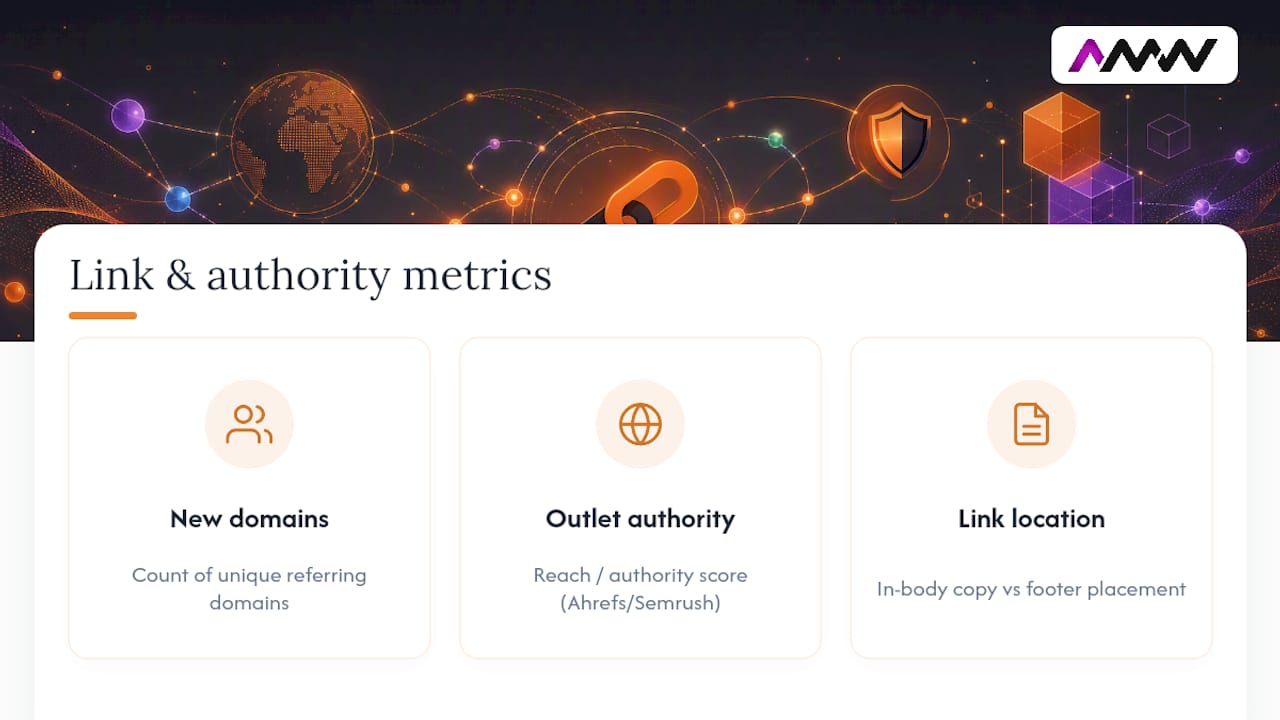
The KPIs that matter fall into three buckets, and mixing them up is how campaigns get judged unfairly.
Link and authority metrics: unique referring domains gained, the reach or authority of each outlet, and whether links land in body copy or footers.
SEO metrics: ranking movement for target keywords and overall visibility change, viewed across a 30 to 90 day window rather than the week after launch.
Brand metrics: branded search volume lift and share of voice against competitors mentioned in the same coverage.
Quick stat: guides on running digital PR campaigns recommend tracking referring-domain growth, referral sessions, and ranking movement together, rather than any single metric in isolation, since coverage volume alone tells you almost nothing about SEO impact.
For tools, Ahrefs or Semrush handle link tracking and domain authority proxies well. GA4 covers referral traffic from each placement. A media monitoring tool catches unlinked brand mentions you’d otherwise miss entirely. Report monthly during an active campaign, with referring domains, referral sessions, keyword movement, and branded search volume as your four standing line items.
Common mistakes, red flags and when digital PR won’t work
Most failed campaigns share the same handful of problems. Watch for these before you commit budget:
- Weak angles. If your own team wouldn’t share the story, a journalist won’t either.
- Untargeted mass pitching. Blasting five hundred generic contacts burns your sender reputation for a fraction of the response rate a specific list gets.
- Ignoring link context. Chasing volume of mentions while ignoring where the link actually sits (or whether there’s a link at all) leaves real SEO value on the table.
- Vendor red flags. Be wary of anyone promising guaranteed links, private blog networks, or “exclusive placement deals” they won’t explain. Genuine digital PR can’t guarantee outcomes, because you’re pitching real editors, not buying inventory.
Digital PR also isn’t the right tool for every situation. A tiny one-off budget with no data, no story, and no expert to quote won’t produce coverage worth the spend. In that case, a reactive PR pilot or a simple outreach campaign usually makes more sense than trying to force a full campaign into existence.
Pro Tip: If you’re unsure whether you have a genuine story, ask a journalist friend or a PR contact to react before you spend a penny on assets. A blunt “I wouldn’t cover this” from someone in the industry saves weeks of wasted outreach.
How Amwmedia approaches digital PR backlinks
Amwmedia treats digital PR as one part of a wider SEO engine rather than a standalone tactic bolted on at the end. A typical starter scope for an SME client covers:
- Content production for the campaign asset, including data visuals and written copy
- Media list research and outreach matched to the client’s sector
- SEO integration, making sure links point to the right target pages, not just the homepage
- Reporting against referring domains, referral traffic, and ranking movement over a 30 to 90 day window
Case studies and author credentials for specific campaigns sit alongside this article where relevant. The measurement approach stays consistent throughout: link quality and SEO movement over raw coverage volume, every time.
Legal and ethical considerations in digital PR backlink acquisition
Digital PR sits on far safer ground than paid link schemes, but it still carries rules worth knowing before you start pitching.
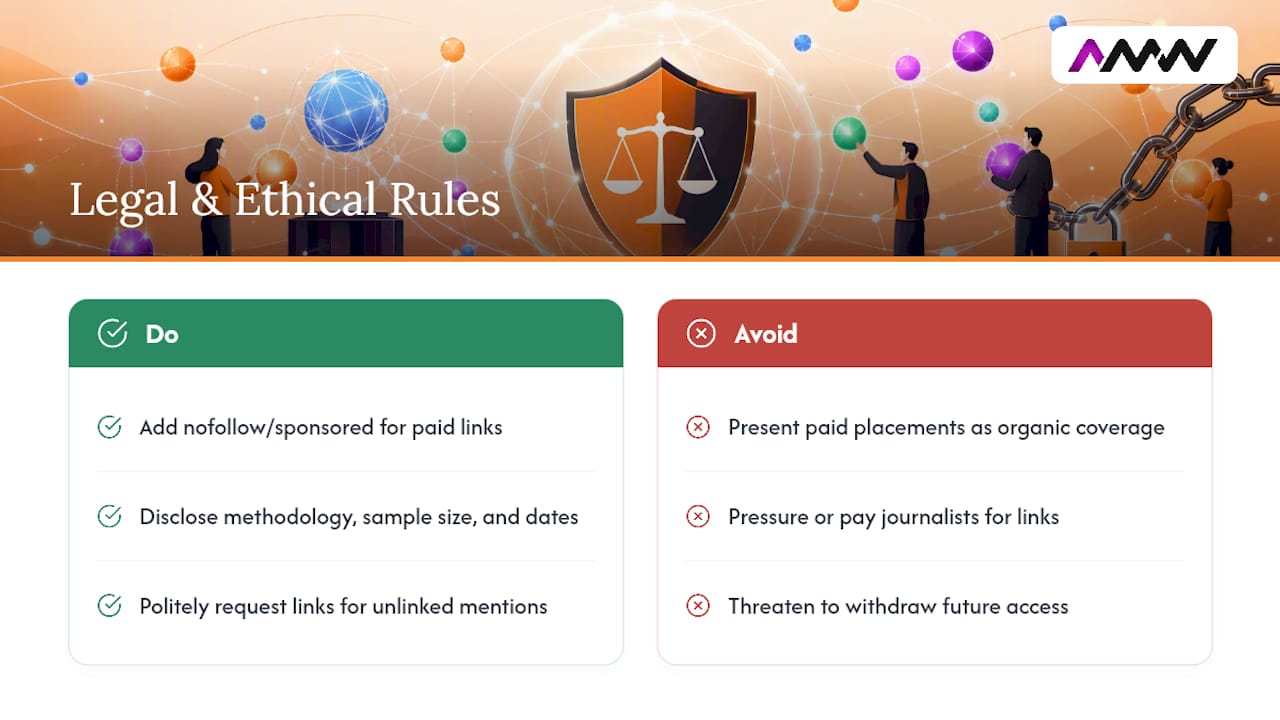
Search engines penalise manipulative link schemes, and that includes paying for placements disguised as editorial coverage. If a link exists because money changed hands rather than genuine editorial interest, it’s supposed to carry a nofollow or sponsored tag under most publishers’ disclosure policies and search engine guidelines. Presenting a paid placement as organic coverage isn’t just risky for rankings; it also misleads the outlet’s own readers.
Data accuracy matters just as much. If your campaign centres on a survey or a proprietary statistic, the methodology has to hold up. Journalists who discover a shaky number after publishing will remember, and future pitches from your brand get a colder reception. Transparent methodology notes, sample sizes, and survey dates aren’t just good practice; they’re what stops a story unravelling under scrutiny.
There’s also a quieter ethical line around unlinked mentions. Politely requesting a journalist add a link to a mention they’ve already published is completely standard practice. Pressuring them, offering payment for it after the fact, or threatening to withdraw future comment access crosses into territory that damages relationships you’ll need again. The best digital PR relationships are built on repeat trust with specific journalists and outlets, not one-off transactions, and that trust is worth protecting more than any single link.
Case studies and examples of successful digital PR backlink campaigns
The campaigns that consistently earn coverage share a similar shape: a clear number, a credible methodology, and a story angle a journalist can lift with minimal rewriting.
Data-led campaigns built around one headline statistic remain the most reliable pattern across the industry. A retailer publishing a seasonal spending survey, a software company releasing usage benchmarks, or a property firm sharing regional price movement data all follow the same logic: give journalists a number worth quoting, and the link tends to follow naturally because citing the source is standard editorial practice.
Reactive PR success stories tend to look different but follow the same underlying principle. An expert responding within hours to a journalist’s request on a breaking topic, whether that’s an economic shift or a sudden industry change, often lands coverage in outlets that would never have responded to a cold pitch. The speed and relevance of the answer matter more than the size of the company giving it.
A single well-executed campaign can generate dozens of referring domains and visible ranking movement within a 30 to 90 day window for the pages it targets, provided the asset was strong and the outreach list was matched to the right beats. The pattern holds whether the campaign comes from an in-house team or an agency: strong asset, tight media list, patient follow-up.
When digital PR makes more sense than other backlink tactics
Digital PR earns its keep when you need authority that lasts and a brand story worth repeating, not just a quick link count bump. If your budget is thin, your story is thin too, or you need links fast for a tiny local project, outreach or guest posting might serve you better. My rule of thumb: if a journalist would cover it without being asked, run digital PR; if they wouldn’t, fix the story first.
Amir
How Amwmedia can help with your next digital PR campaign
If you’ve read this far, you already know digital PR isn’t a quick fix, it’s a compounding asset that keeps paying off long after the story drops off the news cycle. Amwmedia builds that asset for clients as part of an integrated approach: content production for the campaign piece, media outreach to the right journalists, and SEO work that makes sure the links land on pages that actually shift the numbers for your business.
A typical starter engagement begins with a short audit: what story or data you already have sitting unused, which competitors are winning coverage you should be winning instead, and which target pages need the authority most. From there, Amwmedia scopes a campaign with clear deliverables, a realistic timeline, and reporting against referring domains and ranking movement, not vague promises about “visibility.” If distribution matters too, social amplification often runs alongside the press outreach to stretch the asset’s reach further.
The next step is simple: get in touch for a scoping call, or head straight to the SEO services page to see how digital PR fits into a broader plan for your site. If you’re not sure where to start, the contact page is the fastest route to a real conversation.
Further reading and primary sources
For a deeper look at how digital PR fits into modern SEO, Search Engine Land’s explainer on digital PR covers the shift from link-centric tactics to reputation-focused campaigns. The campaign guide from Search Score walks through practical steps from asset creation to outreach. For the numbers behind the claims, BuzzStream’s link building statistics roundup is a solid reference point, and Amwmedia’s own piece on AI SEO strategy and citations explains how brand mentions feed AI visibility.
Sources
- What is digital PR for SEO?
- How to run a digital PR campaign that earns authoritative links
- 80 Link Building Statistics (Updated for 2026), BuzzStream
FAQ
What is a backlink in digital marketing?
A backlink is a link from one website to another, used by search engines as a signal of trust and authority for the page it points to.
What is digital PR in SEO?
Digital PR is the practice of earning editorial coverage and links through data-led stories, expert commentary, and journalist outreach, rather than paying for placements directly.
Are backlinks still relevant in 2026?
Yes. Industry research continues to rank editorial backlinks, especially those from digital PR, among the most effective link building tactics, and brand mentions alongside them now also feed AI citation signals.
What are examples of digital PR campaigns?
Common examples include original data surveys with a headline statistic, reactive expert commentary on breaking news, and thought leadership bylines placed in trade or national publications.
How long does a digital PR campaign take to show SEO results?
Most campaigns show measurable ranking movement for target pages within a 30 to 90 day window after coverage lands, though referral traffic often peaks in the first week.
Recommended
- SEO in marketing: strategies for long-term growth
- How to analyse marketing results for digital growth
- How to optimise digital strategy for marketing success
- Grow your small business with social media: a 90-day plan
Our free marketing audit looks at your site, your ads and your content, and comes back with a 30 day plan. No pitch deck.

Founded AMW Media in 2024 and runs strategy, paid media and the CRM builds. The reason everything here is in house and measured in revenue. Meet the team.