
 Black Steel Doors
 Woodstock Campers
 Phillips Joinery
Yes, most commercial shoots in London need permission, and small handheld filming often still needs a courtesy call to the local authority even when a formal permit isn’t required. The first thing to do, before anything else, is phone your Borough Film Service or Film London to check viability for your exact location. Insurance and drone clearances are separate matters entirely, and you’ll need to sort both on top of whatever permit you get.
TL;DR:
- Permits depend on the location type, with public roads needing a filing notice for small shoots and full applications for larger setups.
- Larger locations like bridges, parks, and stations each have specific permission processes that may involve fees and up to 21 days for approval.
- Drone filming requires Civil Aviation Authority clearance, with the most flexible “Open” category for lighter drones and limited fly zones within London’s dense airspace.
- Insurance requirements include at least five million pounds in public liability coverage and may demand additional safety and risk management documentation.
- Early phone contact with the relevant authorities significantly reduces approval time, and coordination by specialists can save days of permit hassles.
Table of Contents
- Who to contact for filming permits in London
- Permissions by location: highway, private land, bridges and stations
- What filming permits actually cost, and how long they take
- Do you need CAA clearance for drone filming in London?
- What insurance and safety documents do productions need?
- Step-by-step: applying for a London filming permit
- Practical tips from running location shoots
- Why permissions are production insurance, not paperwork
- How AMW Media handles location permissions and production logistics
- Sources
- FAQ
Who to contact for filming permits in London
London doesn’t have one office handing out filming permits. It has a patchwork of authorities, each guarding their own patch, and knowing which one to call first saves you days.
- Borough Film Service (BFS): your usual first stop for on-street filming and council-managed land. Every London borough has one.
- Film London: handles wider location support and points you toward the right contact when land ownership is unclear, via its permission guidance.
- City of London Film Office: covers the Square Mile and several City-managed estates.
- Transport for London (TfL) Film Office: required for anything involving the Underground, buses or TfL-owned stations.
- Port of London Authority (PLA): governs the tidal Thames, from riverboat shoots to bridge approaches.
- The Royal Parks and Greater London Authority (GLA): cover the parks and the big civic squares.
Ring before you write a single application. A five-minute call often tells you whether a location is even feasible that week.
Permissions by location: highway, private land, bridges and stations
The permission you need depends entirely on what sort of ground you’re standing on, and the rules shift more than most first-time production coordinators expect.
- Public highway. A Notice of No Objection can cover small handheld shoots with no obstruction and no crew furniture. Anything bigger, or anything that blocks a pavement or road, needs a full application through your BFS.
- Private land and interiors. Public-looking spaces are frequently privately managed, arcades, estates, shopping centres, and you’ll need written consent from the landlord or location representative, plus whatever contract terms they attach. Film London’s location directory is worth checking before you assume a spot is council land.
- City Corporation properties and bridges. Tower Bridge, Millennium Bridge and similar landmarks sit under a separate City application process, often with their own location fees and access restrictions.
- Royal Parks, Trafalgar Square and Parliament Square. These run on distinct application forms and byelaws. The GLA’s own Parliament Square Gardens application process sets out fees and conditions, and can take up to 21 days to determine.
- Stations and TfL assets. Anything on the Underground network or at a TfL-owned station needs sign off from the TfL Film Office, usually with extra safety planning layered on top.
Green spaces bring their own quirks too. Epping Forest, for instance, needs a separate licence for commercial filming, with conservation and visitor impact pushing fees higher for larger feature days.
What filming permits actually cost, and how long they take
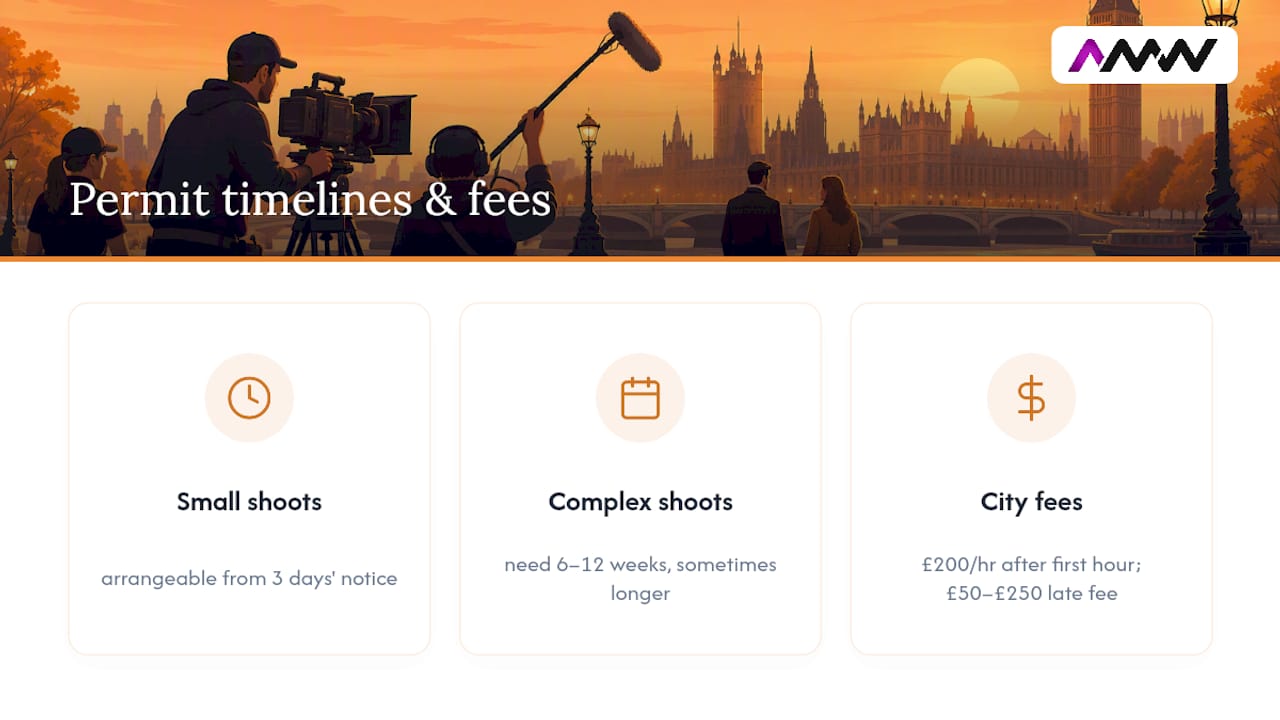
Budget for more than the headline permit fee. City of London figures give a useful benchmark for how costs scale with crew size.
Pro Tip: Ask about administration charges before you commit to a shoot date. The City of London’s fee schedule adds £200 per hour once you go past the first hour, and late-notice applications can attract a further £50 to £250 on top.
Timelines matter as much as cost. A small, low-impact shoot can sometimes be arranged with three days’ notice. Anything involving road closures, large crews or multiple locations wants six to twelve weeks, sometimes more once a site meeting gets added to the process.
Do you need CAA clearance for drone filming in London?
Yes, if your drone falls outside the lightest weight categories, you’ll need authorisation from the Civil Aviation Authority before you fly anywhere in London.
- Open category covers lower-risk flying with fewer restrictions, largely for lighter drones flown well away from people.
- Specific category covers riskier operations, and PDRA01 authorisation is the route that lets you fly closer to people or infrastructure than the Open category allows.
- Drones under 250g, or those rated C0 to C1, carry fewer restrictions, though London’s dense airspace still limits where you can realistically launch.
- CAA guidance points to a working distance of roughly 150 metres from uninvolved people as a sensible baseline for many operations.
None of this replaces ground permission. Flying over TfL infrastructure or the river still needs separate sign off from TfL or the Port of London Authority, whatever your CAA authorisation covers.
What insurance and safety documents do productions need?
Permits are only half the job. Authorities want to see you’ve thought about safety and liability before they’ll say yes.
- Public liability insurance, commonly requested at a £5 million baseline, higher for shoots involving pyrotechnics, vehicles or large crowds.
- Police support for anything needing traffic control, with road closures often needing a minimum of 12 weeks’ notice in some boroughs.
- Hoarding licences for non-portable kit, and vehicle access restrictions around historic sites.
- Risk assessments, method statements (RAMS), and child performance licences where relevant.
Pro Tip: Include a clear camera-position map and named contact details in every submission. Authorities move faster on applications they don’t have to chase you for clarification on.
Step-by-step: applying for a London filming permit
- Call first. Ring the relevant BFS or Film London to check the location’s viable for your dates and get a feel for likely conditions.
- Confirm calendar clashes. Ask whether roadworks, events or other bookings might clash with your shoot day.
- Arrange a recce or site meeting if the authority asks for one, and start drafting RAMS, method statements and insurance certificates in parallel.
- Submit your application through the right channel, whether that’s Filmapp, a GLA form, TfL or the PLA, respecting whatever minimum notice period they state.
- Get it in writing. Once approved, confirm any fees, circulate conditions to cast and crew, and run a short pre-shoot briefing so nobody’s caught out on the day.
Practical tips from running location shoots
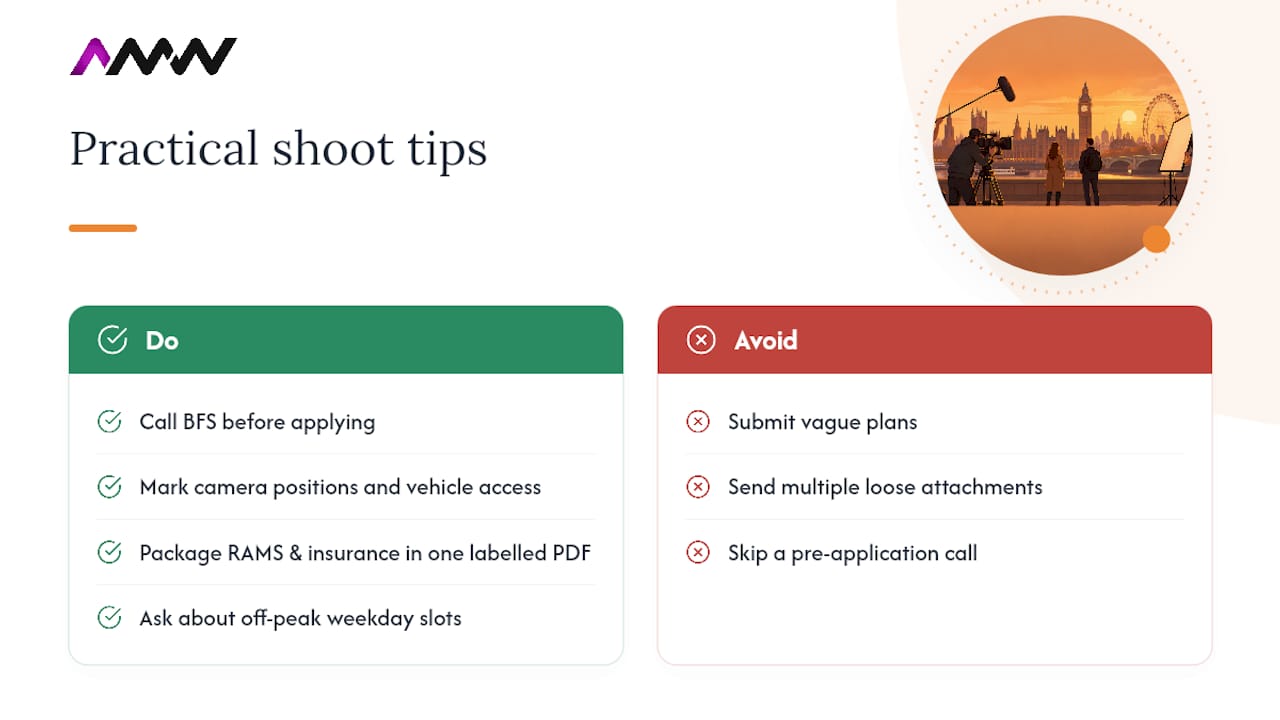
A short phone call before applying saves more time than most productions expect. BFS teams will often flag viability issues for free that would otherwise show up as a rejected application weeks later.
Mark camera positions, vehicle access and stewarding clearly on your plans. Vague submissions invite extra conditions or a second round of questions. Package RAMS and insurance into one clearly labelled PDF rather than several loose attachments, and it genuinely speeds up how quickly an assessor can say yes. It’s also worth asking about off-peak weekday slots, since some locations quietly discount quieter days.
Why permissions are production insurance, not paperwork
Permits get treated as a box-ticking exercise until the day a location manager turns up mid shoot and shuts you down. Coordinating early with boroughs and location teams isn’t bureaucracy for its own sake, it’s what stops a half-day shoot turning into a wasted crew day and a very awkward call to the client.
One pattern shows up again and again on London shoots: the productions that call ahead, even for a five-minute chat, almost never get stopped on the day. The ones that assume a quiet street doesn’t need checking are the ones who do.
— Amir
How AMW Media handles location permissions and production logistics
Chasing five different authorities while also trying to run a shoot is where most productions lose days, and that’s exactly the gap Amwmedia fills for clients who’d rather have someone else own the permissions headache. Amwmedia is the alternative to juggling this yourself: our team handles location liaison, RAMS and insurance packaging, and drone coordination alongside the actual production work, so you get one point of contact instead of five separate email threads.
If you’re planning a shoot in or around London, get in touch with your dates, the location, expected crew size and a short brief. That’s enough for us to give you a realistic timeline and flag any permission issues before they become a problem on the day. Have a look through our services or past projects to see the kind of location work we’ve handled, then send us the details and we’ll take it from there.
Sources
- Filming fees – City of London
- Get Permission | Film London
- PDRA01 overview – Civil Aviation Authority
- Application for Commercial filming and photography in Parliament Square Gardens
FAQ
Do you need a permit to film in London?
For most commercial or crew based shoots, yes, and the correct authority depends on the location, whether that’s your Borough Film Service, the City of London Film Office, or TfL. A single person filming handheld with no equipment may not need a formal permit but should still notify the local authority to avoid being moved on.
What are the legal requirements for filming people in the UK?
Filming in public places is generally lawful, but using someone’s likeness commercially or filming in a way that infringes privacy can create legal exposure. Productions typically use release forms for identifiable individuals and take extra care around anyone who hasn’t consented to appear.
Do you need a permit to film on the street?
Small, non-obstructive handheld filming can sometimes be covered by a Notice of No Objection, but anything that blocks pavements, uses equipment, or involves a crew needs a formal application through your Borough Film Service. It’s always worth a quick call to check, since some streets are booked out by other productions or roadworks without any obvious signage.
What film is currently being filmed in London?
Productions filming on London’s streets change constantly and aren’t centrally published for public viewing, largely for security and disruption reasons. If you’re planning your own shoot nearby, Film London or your BFS can tell you about any bookings that might clash with your dates.
Recommended
- Shooting locations London: where to find and book them
- UK music licensing: 6 step checklist to get TheMusicLicence
Our free marketing audit looks at your site, your ads and your content, and comes back with a 30 day plan. No pitch deck.
Founded AMW Media in 2024 and runs strategy, paid media and the CRM builds. The reason everything here is in house and measured in revenue. Meet the team.