
 Black Steel Doors
 Woodstock Campers
 Phillips Joinery

TL;DR:
- User experience design focuses on creating positive and efficient interactions for users throughout their engagement with products. It emphasises human-centred principles like usability, accessibility, and consistency, which directly influence customer satisfaction and business success. Continuous research, iterative prototyping, and evaluating with real users are essential practices for effective UX development in 2026.
User experience design is the practice of crafting a product’s overall experience for end users, covering usability, usefulness, desirability, and every interaction a person has with a company’s services and products. The term was coined by Don Norman at Apple in the 1990s, and the discipline has since grown into one of the most consequential fields in digital product development. The Nielsen Norman Group describes the move toward “experience design” as a signal of a shared, human-centred philosophy that spans UX, customer experience, and service design. Tools like Figma have made the craft more accessible, but the fundamentals remain unchanged: understand your users deeply, design for their needs, and test relentlessly. This guide covers the principles, processes, and practical realities of UX design in 2026.
What is user experience design and why does it matter?
UX design is defined as the practice of designing a product’s overall experience for end users, encompassing usability, usefulness, desirability, and all perceived qualities across a person’s interactions with a company. This framing is deliberately broad. It includes what happens before someone opens an app, during their session, and after they close it. That scope is what separates UX from the narrower discipline of user interface design.

The goal, as the UX Design Institute puts it, is to design products that provide positive and relevant interactions, making them logical, functional, intuitive, and user-friendly. That is not a vague aspiration. It is a measurable outcome, tested with real users against real tasks. When UX design works, people accomplish their goals without frustration. When it fails, they leave and rarely return.
For design professionals, understanding UX design at this level matters because it reframes the work. You are not producing screens. You are shaping how people feel about a product and, by extension, about the brand behind it. That shift in perspective changes every decision you make.
What are the core principles of UX design in 2026?
The core UX principles for 2026 are user-centricity, consistency, hierarchy, context, user control, accessibility, and usability. These are not abstract ideals. Each one maps directly to design decisions that affect whether a product succeeds or fails with real users.
User-centricity is the foundation everything else rests on. Every design decision should trace back to a user need, validated through research rather than assumption. Without this anchor, teams default to designing for themselves or for stakeholders, which rarely produces good outcomes.
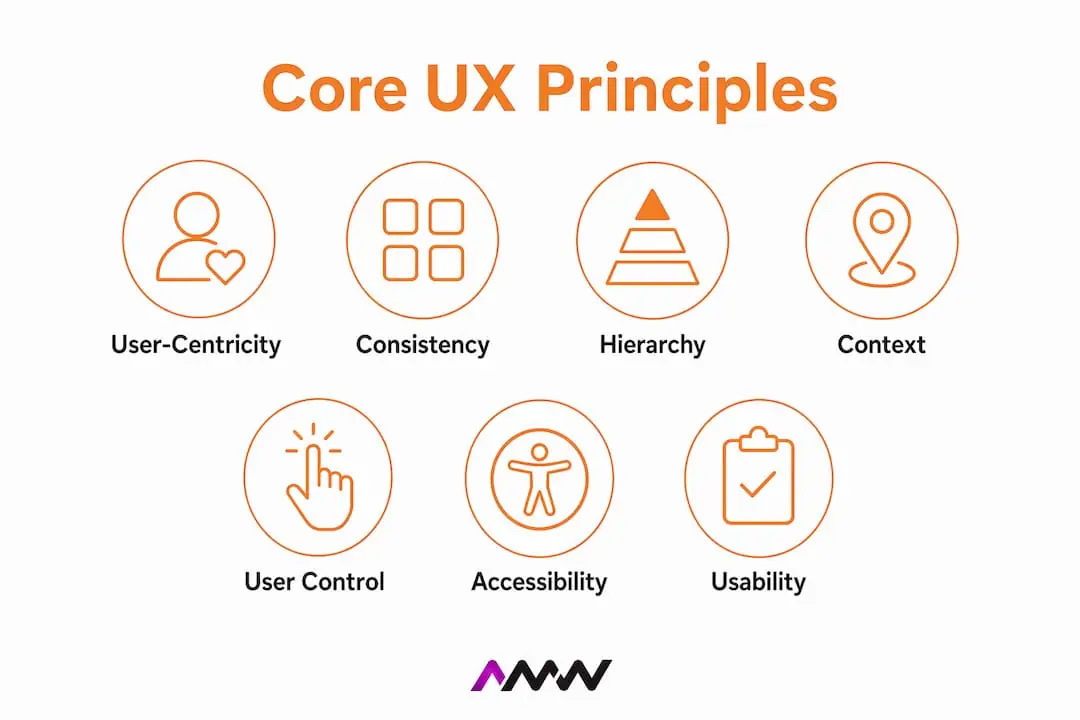
Usability and accessibility function as a pair. Usability means a product is easy to learn and efficient to use. Accessibility means it works for people with a range of abilities, including those using screen readers, keyboard navigation, or low-vision settings. Web accessibility also carries SEO benefits, making it a business priority as much as an ethical one.
The remaining principles work together to create coherent, trustworthy products:
- Consistency reduces cognitive load by making patterns predictable across screens and interactions.
- Hierarchy guides attention to what matters most, using size, colour, and placement deliberately.
- Context accounts for where and how users interact with a product, including device type, environment, and emotional state.
- User control gives people the ability to undo actions, adjust settings, and feel in command of their experience.
The ISO 9241-110 standard formalises several of these as dialogue principles, including expectation conformity, controllability, and error tolerance. Referencing ISO standards is not pedantry. It gives design teams a shared, defensible framework when stakeholders push back on design decisions.
Pro Tip: When a stakeholder asks you to remove a confirmation step to “speed things up,” point to ISO 9241-110’s error tolerance principle. It reframes the conversation from opinion to standard.
How does the UX design process work?
The UX design process aligned with ISO 9241-210 follows four iterative stages: understand the context of use, derive user requirements, develop design solutions, and evaluate those solutions with real users. The process repeats until the design meets its goals. That last part is the one most teams skip, and it is the part that matters most.
Here is how each stage plays out in practice:
Understand context of use. This means going beyond demographics. You need to understand user goals, the tasks they are trying to complete, the environment they are working in, and any constraints they face. A context of use analysis that ignores stress, device limitations, or interruptions will produce designs that fail in the real world even when they look perfect in a controlled test.
Derive user requirements. Interviews, surveys, and observational research translate context into specific, testable requirements. A requirement is not “users want a simple checkout.” It is “users must complete a purchase in under three steps without creating an account.” Specificity is what makes requirements useful.
Develop design solutions. This is where Figma, wireframing, and prototyping come in. The output at this stage is not a finished product. It is a testable artefact, built quickly enough to throw away if the research demands it. Low-fidelity prototypes are often more valuable than polished mockups because they invite honest feedback.
Evaluate with real users. Usability testing, task analysis, and heuristic evaluation all belong here. Skipping this stage is the most common pitfall in product development. Teams convince themselves that internal review is sufficient. It is not. Real users will always surface problems that internal teams cannot see.
The research-driven, iterative nature of UX design is what separates it from graphic design or visual styling. Aesthetics matter, but they are never the primary measure of success.
Pro Tip: Run at least five usability tests per iteration. Research from Nielsen Norman Group consistently shows that five participants surface around 85% of usability problems. More tests add diminishing returns.
What is the difference between UX design and UI design?
UX design and UI design are related but distinct disciplines, and conflating them causes real problems for product teams. UI design focuses on the visual and interactive elements of an interface: typography, colour palettes, button states, icons, and layout. UX design covers the wider journey, including research, information architecture, content strategy, and overall satisfaction.
The table below captures the key distinctions:
| Dimension | UX design | UI design |
|---|---|---|
| Focus | Overall user journey and satisfaction | Visual and interactive interface elements |
| Methods | User research, usability testing, prototyping | Visual design, component libraries, style guides |
| Output | User flows, wireframes, research reports | High-fidelity mockups, design systems |
| Measure of success | Task completion, satisfaction scores | Visual consistency, brand alignment |
| Scope | Before, during, and after product use | On-screen interactions |
A useful analogy: UX design is the architecture of a building. UI design is the interior decoration. Both matter enormously, and they must work together. But confusing the two leads to teams that produce beautiful products nobody can use, or functional products that feel cheap and untrustworthy.
In practice, UX designers and UI designers collaborate closely. On smaller teams, one person often covers both roles. On larger product teams, the disciplines are separated precisely because each requires distinct skills and a different relationship with the user. UX designers spend more time talking to users. UI designers spend more time in Figma.
Why is user experience design important for digital products?
Good UX design directly affects customer satisfaction, loyalty, and the commercial performance of a digital product. This is not a soft claim. Products that are easy to use and enjoyable to interact with retain users. Products that frustrate people lose them, often permanently, to competitors.
The benefits of strong UX design extend across several dimensions:
- Customer satisfaction and retention. When users accomplish their goals without friction, they associate that positive feeling with the brand. Repeat visits and word-of-mouth follow naturally.
- Reduced development costs. Validating designs with users early in the process is far cheaper than fixing problems after launch. A usability test with five participants costs a fraction of a post-launch redesign.
- Accessibility and inclusivity. Designing for users with disabilities expands your audience and, as noted earlier, improves user engagement across the board. Accessible design is almost always better design for everyone.
- Brand reputation. A product that works well communicates competence and care. A product that frustrates users communicates the opposite, regardless of how strong the marketing is.
- Digital marketing outcomes. UX design and digital marketing are more connected than most teams realise. A well-designed landing page converts better. A clear user flow reduces bounce rates. Strong UX supports brand engagement in ways that no amount of paid advertising can compensate for if the product itself is broken.
The organisations that treat UX as a cost centre rather than a strategic investment consistently underperform those that do not. The evidence for this is visible in every product category, from e-commerce to SaaS to mobile apps.
What practical steps help teams design better user experiences?
Designing better user experiences does not require a large team or an enterprise budget. It requires discipline, the right methods, and a genuine commitment to learning from users rather than assuming you already know what they need.
The most effective steps are:
- Start with user research, not assumptions. Before opening Figma, conduct at least three to five user interviews. Ask about goals, frustrations, and current workarounds. The answers will reshape your design brief in ways no internal brainstorm can replicate.
- Prototype early and cheaply. Paper sketches and low-fidelity wireframes are faster to produce and easier for users to critique than polished mockups. Save the visual polish for after the structure is validated.
- Test with real users at every stage. Usability testing is not a final-stage activity. Run tests on prototypes, on beta versions, and on live products. Each round will surface something the previous round missed.
- Collaborate across disciplines. UX designers who work in isolation produce worse outcomes than those who involve developers, UI designers, content strategists, and stakeholders early. Developers in particular can flag technical constraints that would otherwise derail a design at the build stage.
- Follow ISO 9241-210 as a process framework. The iterative four-stage process gives teams a defensible, structured approach that scales from small projects to complex products.
- Use Figma for prototyping and collaboration. Figma’s shared design environment reduces the gap between design and development, making handoff faster and reducing the chance of implementation errors.
- Never skip the evaluation loop. The most common mistake in UX practice is treating the first design solution as the final one. Iteration is not a sign of failure. It is the mechanism by which good design happens.
Pro Tip: Build a simple research repository in Notion or Airtable to store user interview notes, usability test recordings, and key findings. Teams that can reference past research make better decisions faster and avoid repeating the same mistakes across projects.
The digital marketing strategies that perform best are almost always built on a foundation of strong UX. Traffic means nothing if the experience on the other end drives people away.
Key takeaways
User experience design succeeds when it combines rigorous user research, iterative prototyping, and continuous evaluation, guided by principles like usability, accessibility, and user-centricity.
| Point | Details |
|---|---|
| UX design is broader than UI | UX covers the full user journey and satisfaction; UI focuses on visual interface elements only. |
| Iteration is non-negotiable | The ISO 9241-210 process repeats until design goals are met. Skipping evaluation loops produces poor outcomes. |
| Context of use shapes everything | User goals, environment, and constraints must inform design. Demographics alone are insufficient. |
| Accessibility benefits everyone | Designing for users with disabilities improves usability for all users and supports SEO performance. |
| UX drives business results | Products with strong UX retain users, reduce development costs, and support brand reputation directly. |
UX design has changed more than most people admit
I have worked with enough product teams to notice a pattern: the ones that struggle with UX are rarely short on talent or tools. They are short on honesty about what UX actually is. They treat it as a deliverable phase, something that happens between the brief and the build, rather than as a continuous practice woven through the entire product lifecycle.
Jakob Nielsen’s observation that UX is shifting from artefact production to intent shaping resonates with me deeply. The best UX designers I have encountered are not the ones who produce the most polished wireframes. They are the ones who ask the most uncomfortable questions: “Have we actually tested this with users?” “Does this feature solve a real problem or one we invented?” “Are we designing for our users or for our stakeholders?”
Most UX problems are not design problems. They are organisational problems. Teams skip user research because it takes time. They skip usability testing because it feels like it might delay the launch. They conflate UX with UI because it is easier to point at a screen than to explain a user journey. Fixing these habits requires cultural change, not just better tools.
UX designers are, at their best, customer advocates who validate ideas with real users rather than assumptions. That role is more valuable than any individual deliverable. If you are building a career in UX, invest in your research skills and your ability to communicate findings to people who did not ask for them. That combination is rarer than you think, and more powerful than any Figma shortcut. If you would rather have this done for you, our Reading marketing page starts with what £12.50 a lead actually bought Woodstock Campers over thirteen months.
Amir
How AMW Media can help with your UX and web design
If this article has made you think about the gap between where your digital product is and where it could be, that is exactly the right reaction.
At AMW Media, we build websites and digital products with UX principles at the centre, not as an afterthought. Our web design service combines user research, iterative design, and conversion-focused development to produce digital experiences that work for real users and deliver measurable results for ambitious brands. Starting from scratch or rethinking an existing product: we bring the strategic thinking and creative execution to make it count. Get in touch to talk through your project.
FAQ
What is UX design in simple terms?
UX design is the practice of creating products that are easy, enjoyable, and useful for the people who use them. It covers every aspect of a user’s interaction with a product, from first impression to task completion.
How is UX design different from UI design?
UX design covers the overall user journey, including research, structure, and satisfaction. UI design focuses specifically on the visual and interactive elements of an interface, such as buttons, typography, and colour.
What does a UX designer actually do?
A UX designer conducts user research, creates wireframes and prototypes, runs usability tests, and iterates on designs based on real user feedback. They act as advocates for the user throughout the product development process.
Which tools do UX designers use most?
Figma is the most widely used tool for UX prototyping and collaboration in 2026. Teams also use Notion or Airtable for research repositories, and various usability testing platforms to gather user feedback on prototypes.
Why is user experience design important for businesses?
Strong UX design improves customer satisfaction, reduces development costs by catching problems early, and directly supports brand reputation and digital marketing performance. Products that are easy to use retain users; products that frustrate them do not.
Recommended
- how to design a website a practical guide for 2026 | AMW Media
- Digital presence strategy guide for brand growth in 2026 | AMW Media
- What is storytelling in marketing: a 2026 guide | AMW Media
- Creative branding ideas list: top strategies for 2026 | AMW Media
Our free marketing audit looks at your site, your ads and your content, and comes back with a 30 day plan. No pitch deck.

Owns how everything looks and feels, from a brand identity to the grade on a reel, and makes the animated films such as Blue Light Services' Journey to Net Zero. Meet the team.