
 Black Steel Doors
 Woodstock Campers
 Phillips Joinery
TL;DR:
- Web development involves creating, maintaining, and improving websites that boost a business’s online credibility. A well-built website influences visitors’ trust, supports digital marketing, and requires careful planning through distinct development phases.
Web development is the process of building, maintaining, and improving websites and web applications that give businesses a functional, credible presence online. If you have ever wondered why some websites feel trustworthy and others make you click away in seconds, the answer almost always comes down to how well they were built. 75% of users judge a business’s credibility based on its website design alone. That single statistic explains why understanding web development basics matters for every small business owner, not just developers. This guide walks you through the full picture, from the first planning conversation to the ongoing work that keeps a site performing well.
What is web development, and why does it matter?
Web development is the industry term for everything involved in creating a website or web application, from writing code to configuring servers to making sure the site loads quickly on a mobile phone. The term covers two broad disciplines: front-end development, which is everything a visitor sees and interacts with, and back-end development, which is the server-side logic, databases, and infrastructure that make the site work behind the scenes. Full-stack development combines both.
A website is not just a digital brochure. For a small business, it is often the first point of contact with a potential customer. Design quality directly influences how trustworthy visitors perceive a brand to be. A slow, poorly structured site signals to visitors that the business behind it is equally disorganised.
Web development also underpins every other digital marketing activity. SEO, paid advertising, email campaigns, and social media all drive traffic to a website. If that site is not built well, the rest of the marketing budget is wasted. Well-crafted websites support lead generation and conversions far more effectively than a patched-together DIY page.
What are the main stages of the web development process?
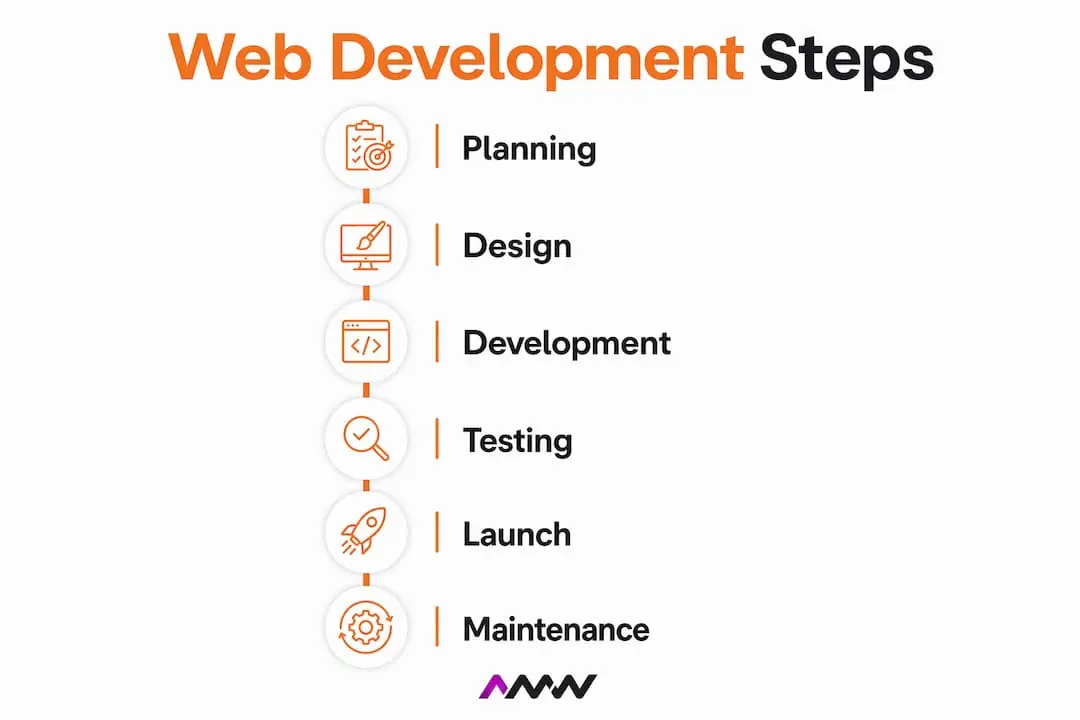
The web development life cycle involves seven distinct phases. Each one builds on the last, and skipping any of them creates problems that are expensive to fix later.
Discovery and requirements gathering. This is where you define what the site needs to do, who it is for, and what success looks like. It sounds obvious, but skipping this phase is the primary cause of project failure and budget overruns in small and medium-sized businesses. Rushed discovery leads to scope changes mid-build, which costs time and money.
Planning. The team maps out the site structure, user journeys, and technical requirements. A clear sitemap and content plan produced here saves weeks of rework later.
Design. Wireframes and visual mockups are created before a single line of code is written. This stage establishes the look, feel, and layout of every key page. Good design is not decoration. It directly shapes how users experience and trust the site.
Front-end development. Developers translate the approved designs into HTML, CSS, and JavaScript. This is the code that controls everything a visitor sees, from typography and colour to buttons and animations.
Back-end development. This covers the server, database, and application logic. If your site has a contact form, a shop, or a login area, the back-end is what makes those features work.
Testing and quality assurance. The site is tested across browsers, devices, and screen sizes. Broken links, slow load times, and form errors are caught and fixed before launch.
Deployment and maintenance. The site goes live, but the work does not stop there. Post-launch maintenance, including security updates, performance monitoring, and content updates, is as important for long-term results as the initial build.
Pro Tip: Before briefing any developer or agency, write down three things your website must achieve within six months. Concrete goals make the discovery phase far more productive and keep the whole project on track.
What technologies and skills are fundamental in web development?
Web development relies on a layered set of technologies. Understanding the categories helps you ask better questions when working with a developer or agency.
Front-end technologies
- HTML (HyperText Markup Language) is the structural foundation of every web page. It defines headings, paragraphs, images, and links.
- CSS (Cascading Style Sheets) controls the visual presentation. Colours, fonts, spacing, and responsive layouts are all handled here.
- JavaScript adds interactivity. Dropdown menus, image sliders, form validation, and dynamic content all depend on JavaScript.
These three languages are the non-negotiable front-end essentials. Front-end essentials like HTML, CSS, and JavaScript form the visible layer of every website on the internet.
Back-end technologies

Back-end development uses server-side languages to process data and communicate with databases. Common categories include scripting languages such as PHP and Python, frameworks that speed up development, and database systems that store and retrieve information. The right choice depends on the project’s complexity and the developer’s expertise. Our web design High Wycombe page explains why most websites fail in month eighteen rather than at launch, and how owning the site and being trained on it prevents that.
How they work together
| Layer | What it does | Example technologies |
|---|---|---|
| Front-end | Controls what visitors see and interact with | HTML, CSS, JavaScript |
| Back-end | Handles data, logic, and server communication | PHP, Python, Node.js |
| Database | Stores and retrieves structured information | MySQL, PostgreSQL |
| CMS | Allows non-technical users to manage content | WordPress, Shopify |
A well-built site integrates all four layers cleanly. When they are poorly connected, the result is a site that looks fine on the surface but breaks under real-world conditions, such as a spike in traffic or a software update.
Pro Tip: If you are commissioning a website rather than building one yourself, ask the developer which CMS they plan to use and whether you will be able to update content without their help. The answer tells you a lot about how the project will work long-term.
Why is professional web development crucial for small businesses?
A professionally built website does several things at once. It builds trust, supports sales, and gives your business a foundation for growth. Each of these outcomes depends on decisions made during the development process.
Credibility and first impressions
Almost 75% of visitors judge credibility based on design quality. That judgement happens within seconds of landing on a page. A site with inconsistent fonts, broken images, or a layout that falls apart on mobile tells visitors the business is not worth their time.
Mobile responsiveness and SEO
Google uses mobile-first indexing, which means it ranks the mobile version of your site, not the desktop version. A site that is not built with responsive design will rank lower in search results, regardless of how good the content is. Integrating SEO considerations from the start of a web project costs far less than retrofitting them later.
Lead generation and conversion
Your website is your hardest-working salesperson. It is available around the clock, and it either converts visitors into enquiries or it does not. Professional web development ensures that contact forms work, calls to action are clear, and page load times do not drive potential customers away before they even read your offer.
“Businesses often mistake launch as project completion, but sustainable success demands continuous maintenance and optimisation. A website that is not actively maintained loses search rankings, accumulates security vulnerabilities, and gradually stops reflecting the business it represents.”
The long-term maintenance argument
A structured web development workflow with clear task division and ongoing project control leads to predictable, high-quality outcomes over time. Businesses that treat their website as a living asset, updating content, fixing performance issues, and adapting to new devices, consistently outperform those that treat launch as the finish line.
- Regular security patches prevent data breaches and downtime.
- Performance monitoring catches slow pages before they affect rankings.
- Content updates keep the site relevant and give Google new material to index.
- Analytics reviews reveal which pages convert well and which need attention.
How can you learn and apply web development fundamentals?
Learning web development is achievable for individuals and small business owners, even without a technical background. The key is knowing what you actually need to learn versus what you can safely leave to a professional.
Start with HTML and CSS. Free resources such as freeCodeCamp and the Mozilla Developer Network (MDN) offer structured, beginner-friendly courses. Spending a few hours here gives you enough vocabulary to communicate clearly with any developer you hire.
Understand the web development process before touching any tools. Reading a clear introduction to web design principles before you start building prevents the most common beginner mistakes, particularly around layout and user experience.
Learn a CMS before learning to code. WordPress and Shopify allow you to build and manage a functional website without writing code. For most small businesses, this is the most practical starting point. You can always add custom development later as your needs grow.
Do not skip the discovery phase, even for a solo project. Write down your goals, your audience, and the three to five pages your site absolutely needs. This ten-minute exercise prevents weeks of rework.
Know when to hire a professional. If your website needs e-commerce functionality, custom integrations, or a strong SEO foundation from day one, a professional agency will deliver a better result faster than a DIY approach. The cost of a poorly built site, in lost credibility and missed leads, almost always exceeds the cost of getting it right the first time.
The honest truth about learning web development is that the technical skills are learnable, but the strategic thinking is what separates a site that performs from one that just exists. Understanding the process gives you the confidence to make good decisions, whether you build the site yourself or brief someone else to do it.
Key takeaways
Web development is the end-to-end process of building and maintaining a website, and every stage from discovery to ongoing maintenance directly affects how well that site performs for your business.
| Point | Details |
|---|---|
| Credibility depends on design | 75% of users judge business credibility from website design, making professional development a priority. |
| Discovery prevents costly mistakes | Skipping requirements gathering is the leading cause of project failure and budget overruns in small businesses. |
| Three technology layers matter | Front-end, back-end, and database technologies must work together for a site to function reliably. |
| Launch is the beginning, not the end | Post-launch maintenance, including security updates and performance monitoring, drives long-term results. |
| Strategy beats technical skill | Understanding the web development process helps small business owners make better decisions, whether building or hiring. |
Why most small business websites underperform (and what I have learned from it)
After working on web projects with businesses of all sizes, the pattern I see most often is not a lack of budget or technical skill. It is a lack of planning at the start. Owners rush to get something live, skip the discovery phase, and end up with a site that looks reasonable but does not actually do anything useful for the business. Six months later, they are back at square one.
The second mistake I see constantly is treating the launch as the end of the project. A website is not a brochure you print once and file away. It is a system that needs feeding. Content needs updating, performance needs monitoring, and the site needs to evolve as the business does. The businesses I have seen grow their online presence consistently are the ones that treat their website like a member of staff, not a one-off purchase.
The third thing I would push back on is the idea that a cheap DIY site is a sensible starting point. For a very early-stage business with no customers yet, perhaps. But the moment you are spending money on any form of marketing, your website needs to be good enough to convert the traffic you are paying for. A weak site is a leaky bucket. You can pour as much advertising spend in as you like, and it will still drain away.
My honest advice is this: invest in the discovery and planning phases, even if it means delaying the build. Get the strategy right before you touch the design. And once the site is live, treat maintenance as a non-negotiable running cost, not an optional extra.
Amir
How AMW Media helps small businesses build websites that actually work
Building a website that performs well takes more than picking a template and writing some copy. AMW Media works with small businesses and ambitious brands to plan, design, and build websites that are built around real business goals, not just aesthetics.
From the initial discovery session through to design, development, and post-launch support, the AMW Media team handles the full process. The result is a site that loads quickly, ranks in search, and converts visitors into enquiries. If you are ready to build something that works as hard as you do, take a look at AMW Media’s web design and development services to see how the team approaches each project. For businesses that also want to grow their visibility after launch, AMW Media’s SEO services integrate directly with the web development process from day one.
FAQ
What is web development in simple terms?
Web development is the process of building and maintaining websites and web applications. It covers everything from writing code and designing layouts to configuring servers and keeping a site secure after launch.
How long does the web development process take?
Timescales vary depending on complexity. A simple small business website typically takes four to eight weeks from discovery to launch, assuming content and feedback are provided promptly.
Do I need to learn to code to manage my website?
Not necessarily. Content management systems such as WordPress and Shopify allow you to update text, images, and products without writing any code. Basic HTML knowledge is useful but not required for day-to-day management.
Why does website design affect business credibility?
Stanford’s web credibility research found that 75% of users judge a business’s credibility by its website design. Poor design signals a lack of professionalism, regardless of the quality of the product or service behind it.
When should a small business hire a professional web developer?
Hire a professional when your site needs e-commerce, custom integrations, or a strong SEO foundation from the outset. The cost of a poorly built site in lost leads and credibility almost always exceeds the cost of professional development.
Recommended
- What is custom web design? A guide for businesses | AMW Media
- Web Development and Design That Elevates Your Brand | AMW Media
- Web design process guide: steps, tools, and tips | AMW Media
- how to design a website a practical guide for 2026 | AMW Media
Our free marketing audit looks at your site, your ads and your content, and comes back with a 30 day plan. No pitch deck.

Builds and maintains client sites with Mateusz: templates, speed, accessibility and the small fixes that keep a site converting. Meet the team.