
 Black Steel Doors
 Woodstock Campers
 Phillips Joinery
If you want to use a photo on your website, in an ad or on social media, you need either to own the copyright or to hold a licence that covers what you’re doing. That’s the whole idea. The fiddly bit is knowing which of the two you actually have, because “we paid for it” and “we own it” are two very different sentences in UK law.
This guide walks through who owns an image, what a licence really is, how stock, commissioned and free images differ, and what to do if a letter turns up claiming you’ve used something you shouldn’t have. It’s written for business owners and marketing managers, not lawyers, so expect plain words and the occasional joke. It isn’t legal advice: if you’re facing a claim or signing a big contract, talk to an IP solicitor.
TL;DR
- In the UK, copyright in a photograph arises automatically when it’s created. The photographer is usually the first owner, not the person who paid for the shoot.
- A licence is permission to use an image in specific ways. Always check the medium, the length of time, the territory and whether it’s exclusive.
- Commissioned photos need a written agreement. Without one, you may only have a limited implied licence.
- People and private property in the frame can mean you need model or property releases, even when the copyright is sorted.
- Never ignore a copyright claim letter. Check it, pull the image and respond in writing.
Table of Contents
- Who owns the copyright in a photo?
- What a licence actually is
- The main types of image licence
- How much does an image licence cost?
- Commissioning photography: get it in writing
- Model and property releases: the paperwork people forget
- What about photographing people and places in public?
- Stock and free images: convenient, with strings
- Our view: licensing is a brand decision, not just a legal one
- What happens if you use an image without permission?
- A practical image-licensing checklist for your business
- Need photography you actually own the rights to?
- FAQ
- Sources
Who owns the copyright in a photo?
Start here, because everything else follows from it. Copyright protection is automatic. According to GOV.UK’s copyright overview, you don’t apply for it or pay a fee. Take the picture, and the right exists.
The first owner is normally the person who created the work. GOV.UK’s guidance on ownership says the author or creator of an artistic work, which includes a photograph, is usually the first owner. There’s one big exception: if an employee creates the image in the course of their job, the employer generally owns it. So the photo your in-house designer took for the brochure is likely yours. The photo the freelancer took for the same brochure is likely theirs.
How long does it last? For photographs, the copyright term is the lifetime of the photographer plus 70 years, and for anonymous photographs it’s 70 years from creation or from when the image was first made public. In practical terms: a picture that looks old isn’t automatically free to use. Check before you assume.
Common myths that cost businesses money
Three beliefs cause most of the trouble:
- “It was on Google Images, so it’s free.” A search engine finding a picture says nothing about its licence. The image still belongs to whoever made it.
- “We paid the photographer, so we own it.” Payment buys what the agreement says it buys. Without a written assignment of copyright, the commissioner may at best hold an implied licence.
- “We’ve got the original file.” Holding the file and holding the rights are different things. Owning a laptop doesn’t make you the author of what’s on it.
What a licence actually is
A licence is a contract. As GOV.UK puts it, it’s a contractual agreement between the copyright owner and the person who wants to use the work. The owner decides whether and how to license it. That framing matters: experts at Naomi Korn Associates make the point that licensing is fundamentally contractual, so the wording of the agreement beats any assumption about what’s “fair”.
When you read a licence, look for five things:
- Medium: web only, print, broadcast, social, out-of-home advertising? A licence for a blog post doesn’t automatically stretch to a billboard.
- Duration: a year, five years, forever?
- Territory: the UK, Europe, worldwide? If you sell internationally, this matters.
- Exclusivity: can the photographer or agency license the same image to your competitor next week?
- Editing and sublicensing: can you crop it, add text, hand it to an agency or a printer, or pass it on to a franchisee?
If any of those is missing from the paperwork, ask. Awkward now is cheaper than awkward later.
The main types of image licence
Names vary between suppliers, so always read the actual terms. But most images you’ll meet fall into a handful of buckets.
| Type | How it works | Good for | Watch out for |
|---|---|---|---|
| Royalty-free (stock) | You pay once (or subscribe) and use the image within the supplier’s terms, without per-use fees | Websites, blogs, social posts, general marketing | “Royalty-free” doesn’t mean free, and it usually isn’t exclusive |
| Rights-managed | Licence is priced and limited by use, time, territory and sometimes exclusivity | Big campaigns where you want control over who else uses it | Cost rises with scope, so re-licensing is needed if the use grows |
| Commissioned, licensed | A photographer shoots for you and grants a licence in writing | Brand photography, team shots, product images | Scope can be narrower than you expect |
| Commissioned, assigned | The photographer transfers copyright to you in writing | Core brand assets you want to control fully | Usually costs more, and it needs a signed assignment |
| Open or Creative Commons style | The owner publishes it under stated public terms | Editorial, internal, non-commercial work | Terms can bar commercial use or demand attribution |
| Public sector open licences | Government material under a published licence such as the Open Government Licence | Reusing official content with attribution | Third-party images inside a government document may not be covered |
That last row is a quiet trap. Some public bodies publish content under the Open Government Licence, as the London Assembly FOI response about art acquisitions shows for its own material. Always check whether a specific image is covered, not just the page it sits on.
How much does an image licence cost?
This is one of the questions people ask most, and the honest answer is: it depends on the scope. There’s no standard UK tariff for a licence. A small web-only licence for one image can be modest, while a national campaign across print, digital and out-of-home for several years can be a different order of money. The price follows the five points above: medium, duration, territory, exclusivity and editing rights.
Two practical tips:
- Price the use you actually plan, then add a little headroom. If you might push a winning image into paid social next year, say so now. Extending a licence later is possible but you’ll be negotiating from a weaker position.
- Compare total cost, not headline price. A cheap subscription image that thousands of other brands also use may cost you more in sameness than a custom shoot costs in cash.
We don’t publish fixed prices for photography at AMW Media because every shoot is scoped to the brief. Our guide to professional photography services for business explains what goes into that scoping.
Commissioning photography: get it in writing
Hiring a photographer is where most licensing muddles start, usually because everyone is friendly, nobody wants to mention contracts, and the shoot is going brilliantly. The trouble arrives two years later when someone wants to use the photo on a trade-show banner.
The AOP (Association of Photographers) information pages stress that formal contracts should be used for commissioned work to settle ownership. Where there’s no contract, courts tend to grant only limited, non-exclusive implied licences. That’s a thin foundation for a brand asset.
A sensible commissioning agreement covers:
- Who owns the copyright. Either it stays with the photographer and you get a licence, or it’s assigned to you in writing. Both are legitimate, and you should know which one you’re buying.
- The scope of the licence. Use the five points from earlier: medium, duration, territory, exclusivity, editing.
- Deliverables. How many final images, what resolution, what file types, and whether you get raw files.
- Releases. Who obtains model and property releases, and who holds them.
- Credits. Does the photographer need a credit line wherever the image appears?
- Usage by others. Can your PR agency, printers or franchise partners use the images?
- Fees and extras. Rights fees, expenses, location costs and what happens if you want to extend the licence.
If you’re planning a shoot, our piece on photography for brands shows how the pictures fit into the wider marketing picture, and if you’re looking at venues, there’s a guide to shooting locations in London. Locations are worth reading about before the shoot, not after, because they bring us neatly to releases.
Model and property releases: the paperwork people forget
Here’s a scenario. You’ve got a gorgeous photo of your shop with customers inside. You own the copyright. Can you put it on a bus shelter? Not necessarily. Naomi Korn Associates flag that even where you own an image, you may still need a model or property release to use it commercially, partly to avoid privacy and data protection complications.
In plain terms:
- Model release: written consent from an identifiable person in the image, allowing you to use their likeness for specified purposes.
- Property release: permission from the owner of a private property, or distinctive property, shown in the image.
Stock platforms take this seriously. Getty Images publishes a property release form in which the owner gives permission to license and use the content in any media. The same guidance notes that agencies and savvy clients often ask for these documents, and that a missing one can make an otherwise excellent image commercially useless. Alamy also explains what releases are and how they’re used for stock images.
Our advice, which is boringly effective: keep an organised archive. One folder per shoot, signed releases next to the images, and a short note on what each person agreed to. Future you will be grateful.
What about photographing people and places in public?
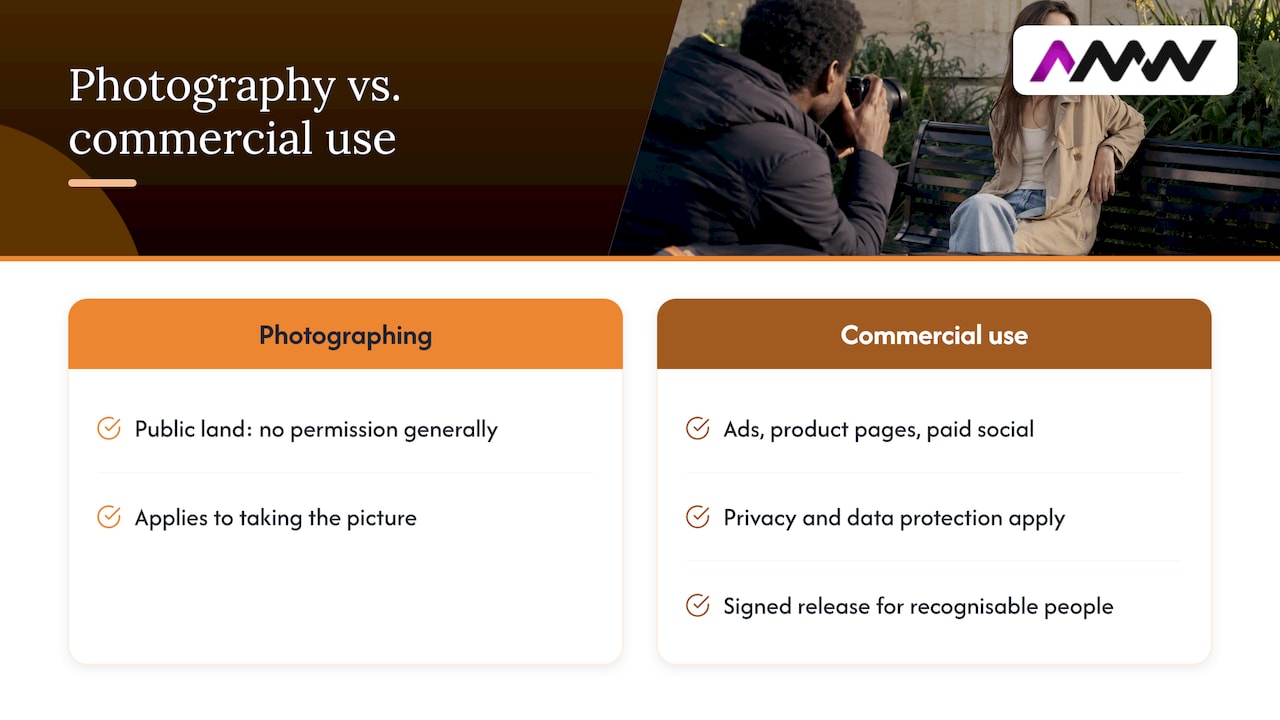
The rules on taking photos are different from the rules on using them commercially. In general, you don’t need permission to photograph someone in the UK while you’re standing on public land. But that’s about taking the picture. Once it’s heading into an advert, a product page or a paid social campaign, releases, privacy and data protection come into play, and the safest route is a signed release from anyone recognisable.
If you’re not sure, ask the question before the shoot. A two-minute chat and a signature beat a takedown demand.
Stock and free images: convenient, with strings
Stock libraries are a legitimate, sensible choice for many businesses. They’re quick, and the terms are usually standardised. The risks are mostly about reading the small print:
- Check the licence tier. A standard licence may cap print runs or exclude resale products such as mugs, prints or templates.
- Keep your receipts. Save the licence agreement, the image ID and the date you downloaded it. If someone challenges you later, this paperwork is your defence.
- Don’t assume “free” means “free for commercial use”. Some free sites carry restrictions, and not all uploaders actually own what they upload.
- Think about identifiable people. Even in stock, some uses (sensitive subjects, for instance) can be restricted.
- Be careful with website templates. Buying a template does not mean you’ve bought the copyright in the pictures shown in its demo. Copyright doesn’t pass with the file or template unless a written agreement says so.
The UK Intellectual Property Office also publishes a copyright notice on digital images, photographs and the internet, aimed at small businesses and individuals who want to use digital images. It’s a short, readable starting point.
And while we’re on licensing, if your video content needs a soundtrack, the same logic applies to music. Our UK music licensing checklist covers that side of things.
Our view: licensing is a brand decision, not just a legal one
We work with brands on photography, video and social every week, and the licensing chats we have with clients tend to be quite similar. So here’s our perspective, as we’d say it over a coffee.
First, the cheapest image is rarely the cheapest outcome. A generic stock photo gets you live quickly, but it also puts you in the same visual space as every competitor who downloaded the same smiling person in a headset. Original photography costs more upfront and earns it back by being recognisably yours. We think of images as brand assets, and assets deserve proper paperwork.
Second, agree the licence before the shoot, not after the edit. Once a great set of images exists, everyone’s keen to use them everywhere, and that’s the worst moment to discover the licence says web only. Five minutes on scope at the start saves a lot of awkward emails.
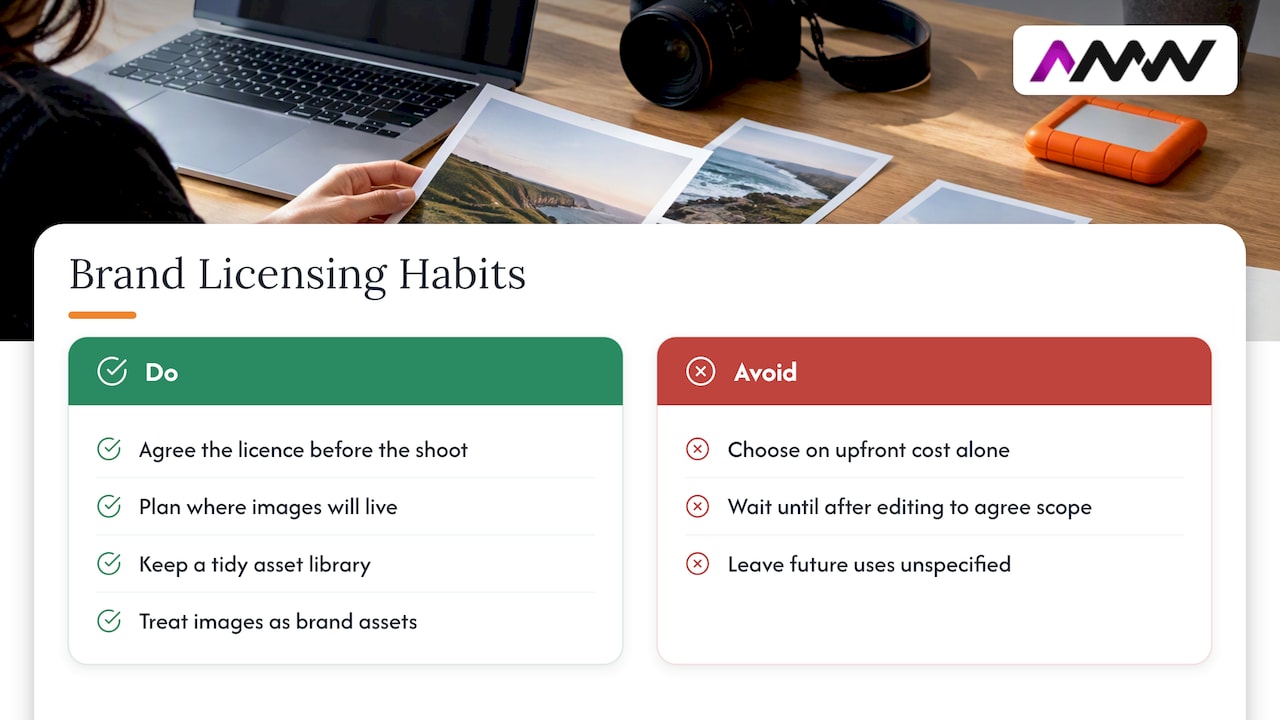
Third, the question we ask on every brief is “where will this live in two years?” Website, social, a trade-show stand, a partner’s site, a pitch deck? If you tell us, the licence can be shaped around it. We’d rather scope it generously than have you quietly paying for a re-licence later.
Finally, keep a tidy asset library. Image, licence, release, expiry date, in one place. It sounds dull because it is dull. It’s also the thing that stops a licensing question turning into a crisis. Our approach is project-based with transparent reporting and no long-term contracts, and we apply the same transparency to rights: you should always be able to see what you can use and for how long.
Amir Wanas, founder of AMW Media
What happens if you use an image without permission?
Unauthorised use can lead to legal action, including claims for damages and injunctions. GOV.UK’s page on taking legal action explains the routes. For claims under £10,000 there’s the Intellectual Property Enterprise Court small claims track, which doesn’t require legal representation, though the court expects you to try mediation first.
Want a sense of scale? In one reported case, Absolute Lofts South West London Ltd v Artisan Home Improvements Ltd, a business was ordered to pay £6,300 in damages for using 21 photographs without permission. That’s a few hundred pounds per image, for what could have been a small licence fee.
Accidents count too. Courts can award damages even for small, accidental infringements where the breach is seen as flagrant or as having benefited the defendant. “We didn’t know” is not a shield on its own.
If a claim letter lands on your desk
These letters often come from rights holders or agencies acting for them. Commentary from UK copyright specialists at Sprintlaw says do not ignore a PicRights claim: it may be valid, overstated or missing evidence, but silence can make escalation more likely. A calm, documented reply is safer than none.
A sensible sequence:
- Don’t panic, and don’t bin it. Read it properly and note any deadlines.
- Remove or quarantine the image while you check the facts. Take screenshots first so you know where and how it was used.
- Find out where it came from. Who uploaded it? An agency, a freelancer, a former employee, a template? Dig out any licence or invoice.
- Check the claim. Does the claimant actually hold the rights? How long was the image live? Is the amount reasonable for that use?
- Reply in writing, politely and factually. Aim for an early, negotiated settlement rather than a long standoff.
- Get advice from an IP solicitor if the sum is large, the facts are murky or you’ve received formal court papers.
If you’ve been the one whose work was copied, GOV.UK’s guide to enforcing your copyright notes that copyright is a private right, so the decision on how to enforce it is yours.
A practical image-licensing checklist for your business
Pin this somewhere your team will see it.
- Decide who owns what. For every image, record whether you own the copyright, hold a licence, or are using it under an open licence.
- Write down the scope. Medium, duration, territory, exclusivity, editing rights.
- Get commissioned work in writing, including the ownership model and who holds releases.
- Collect releases for every recognisable person and any private or distinctive property.
- Store the proof. Licence, invoice, image ID, date, and expiry in a shared library.
- Set a reminder a month before any licence ends.
- Brief your team and agencies. The person scheduling social posts at 4.55pm on a Friday should know that “found it online” isn’t a licence.
- Audit once a year. Check your website, your socials and your older campaigns against the library. Remove anything you can’t evidence.
Need photography you actually own the rights to?
If you’d rather have images made for your brand, with the usage rights spelled out up front, that’s what our content team does. We shoot photography and video for UK brands and we’re happy to talk through licence scope as part of the brief. Have a look at our video and content production services, or get in touch via our services page and tell us where the images need to live.
FAQ
Do I own the copyright of a photograph if I take it?
Usually, yes. In the UK, the creator is normally the first owner, and protection starts automatically with no registration or fee. The main exception is employment: if you took the photo as part of your job, your employer is generally the first owner. Anything you agreed in writing with a client can also change the position.
How much does a copyright licence cost?
There’s no fixed price. The fee depends on how the image will be used: the medium, how long, where, and whether it’s exclusive. A small web-only licence is a very different proposition from a multi-year national campaign. Ask the owner or agency for a quote based on your exact plans, and get the scope in writing.
Can I sue someone for using my photo without permission in the UK?
Yes, you can bring a claim for infringement, which can include damages and an injunction. For claims under £10,000, the Intellectual Property Enterprise Court small claims track doesn’t require a lawyer, but the court expects mediation to be tried first. For anything larger or more complicated, speak to an IP solicitor.
Is the 20-60-20 rule in photography a legal thing?
No, it has nothing to do with licensing. It’s a creative rule of thumb that means different things to different photographers: a lighting ratio, a split of shoot time, or a compositional guide. Photographer Paul Nicklen, for example, uses a version of it to plan his time shooting.
Can I use a photo if I credit the photographer?
Not automatically. A credit is not the same as permission, so you still need a licence or the owner’s consent unless the work is under an open licence that allows your use. If the licence does require attribution, follow its wording exactly.
Sources
- How copyright protects your work: Overview, GOV.UK
- License, sell or market your copyright material, GOV.UK
- Ownership of copyright works, GOV.UK
- Defend your intellectual property: Take legal action, GOV.UK
- Enforcing your copyright, GOV.UK
- Copyright notice: digital images, photographs and the internet, GOV.UK
- London Assembly question 2021/3896
- Can I Ignore PicRights In The UK?, Sprintlaw UK
- Information for photographers, AOP
- Looking at photographs through a copyright and UK GDPR lens, Naomi Korn Associates
- Property Release, Getty Images
- Model and property releases for stock images, Alamy
- How Paul Nicklen uses his 20-60-20 rule, Digital Camera World
Recommended
Our free marketing audit looks at your site, your ads and your content, and comes back with a 30 day plan. No pitch deck.
Founded AMW Media in 2024 and runs strategy, paid media and the CRM builds. The reason everything here is in house and measured in revenue. Meet the team.