
 Black Steel Doors
 Woodstock Campers
 Phillips Joinery
TL;DR:
- A strong, consistent brand identity enhances customer trust, loyalty, and market differentiation, driving revenue growth.
- Enforcing brand guidelines across all touchpoints and tailoring identity cues to cultural contexts maximises advocacy and long-term value.
Brand identity is the cohesive expression of a business’s visual, verbal, and emotional characteristics that make it instantly recognisable and trusted by customers. It is not simply a logo or a colour palette. It is the sum of every touchpoint a customer encounters, from your website typography to the tone of your customer service emails. Understanding why brand identity matters is the difference between a business that competes on price alone and one that commands loyalty, premium positioning, and genuine advocacy. Consistent brand presentation across channels can increase revenue by an average of 23%, which means identity is not a creative indulgence. It is a commercial lever.
Why brand identity matters for trust and customer loyalty
Consistency is the mechanism through which brand identity converts recognition into trust. When customers encounter the same visual cues, the same tone of voice, and the same quality of experience repeatedly, their brain registers reliability. That reliability lowers the psychological cost of buying from you again. It is the same reason people return to the same coffee shop even when a cheaper option is across the street.
The numbers behind this are striking. Consistent brand voice increases social media engagement by 23% and follower growth by 60%, while inconsistent brands spend 1.75 times more on media to achieve equivalent results. That last figure deserves attention: inconsistency does not just slow growth, it actively inflates your marketing costs. Every pound you spend correcting mixed messages is a pound that could have compounded your reach.
Brand guidelines are the operational tool that makes consistency possible at scale. Yet only 25 to 30% of companies actively enforce their brand guidelines, despite 95% having them in place. The gap between having a rulebook and following it is where most businesses quietly haemorrhage brand equity. Enforcement matters as much as creation.
Loyalty programmes are one of the most direct ways to embed brand identity into customer behaviour. According to Deloitte’s 2025 research, loyalty programmes closely follow price, value, and quality as drivers of brand loyalty across demographics. When a loyalty programme reflects your brand’s personality, from the language used in reward notifications to the visual design of the membership card, it reinforces identity at every redemption moment.
The practical steps for building this kind of consistency include:
- Publish and enforce brand guidelines covering logo usage, colour palette, typography, tone of voice, and photography style.
- Audit all customer touchpoints quarterly, including email footers, social bios, and chatbot scripts, to catch drift before it compounds.
- Train every customer-facing team member on brand voice, not just the marketing department.
- Use AI writing tools configured with your brand voice parameters to maintain omnichannel coherence across high-volume content production.
Pro Tip: Configure any AI content tools your team uses with a locked brand voice profile. This removes the single biggest source of tonal inconsistency in modern content operations and means your brand sounds the same whether a post is written by your head of marketing or an intern at 11pm.
How does brand identity create customer advocacy?
Brand advocacy, the point at which customers actively recommend you without prompting, does not emerge from a single great product experience. It is built through two distinct psychological pathways, and understanding both is what separates sophisticated brand managers from those who treat identity as decoration.
A 2026 PLOS ONE study confirms that brand image and customer trust act as dual mediators between frontline employee behaviours and brand evangelism. Brand image is the symbolic pathway: customers advocate because the brand reflects an identity they want to be associated with. Trust is the relational pathway: customers advocate because the brand has consistently delivered on its promises. Both matter, but they do not always matter equally.
The same research reveals a cross-cultural nuance that most brand managers overlook entirely. In markets like Vietnam, the symbolic image pathway tends to dominate advocacy outcomes. In markets like Thailand, relational trust carries more weight. This has direct implications for any business operating across multiple regions or demographic segments. Tuning your identity cues to the cultural context of your audience is not optional if you want to maximise advocacy.
Here are four implications for brand managers working on advocacy:
- Audit which pathway your current identity activates. Ask whether your brand communications lean more on aspiration and symbolism or on reliability and proof. Neither is wrong, but knowing which you lead with helps you close gaps.
- Train frontline staff as brand ambassadors. The PLOS ONE research specifically links employee behaviour to advocacy outcomes. A poorly briefed customer service agent can undermine months of brand investment in a single interaction.
- Integrate loyalty programme participation into your advocacy strategy. The study confirms that loyalty programme participation strengthens both pathways, making members significantly more likely to advocate.
- Approach rebranding with caution. Brand identity changes risk shifting either symbolic image cues or relational trust cues, potentially affecting customer advocacy in ways that are difficult to predict or reverse quickly.
“Brand evangelism is not one-dimensional: symbolic image and relational trust pathways must be cultivated thoughtfully depending on cultural and market context.”, PLOS ONE, 2026
The practical takeaway is that building brand identity for market advantage requires you to know your audience’s dominant advocacy pathway before you decide which identity elements to prioritise. Getting this wrong does not just mean slower growth. It means investing in the wrong signals entirely.
Why is brand identity essential for brand equity and market differentiation?
Brand equity is the commercial value that accrues when customers choose your brand over a functionally equivalent alternative. Brand identity is the mechanism that builds it. Without a coherent, consistent identity, brand equity cannot accumulate because there is nothing stable for customers to attach value to.

NielsenIQ’s 2026 framework introduces the concept of brand irresistibility, the point at which a brand becomes the immediate, automatic choice for consumers. Irresistibility amplifies marketing effectiveness across every channel because it reduces the persuasion work each individual campaign must do. A brand with strong mental availability and emotional attachment converts media spend into sales at a fundamentally higher rate than a brand that is merely visible.
The contrast between short-term tactics and long-term identity building is worth examining directly:
| Approach | Short-term tactics | Long-term identity building |
|---|---|---|
| Primary goal | Immediate sales conversion | Mental availability and preference |
| Customer relationship | Transactional | Emotional and habitual |
| Pricing power | Competes on price | Commands premium |
| Marketing efficiency | Diminishing returns over time | Compounding returns over time |
| Differentiation | Easily copied by competitors | Difficult to replicate |
Distinctiveness is the most underrated benefit of a strong brand identity. Commoditisation is the default fate of any product category where brands fail to differentiate. When customers cannot tell the difference between your offering and a competitor’s, price becomes the only decision variable. A strong identity removes you from that race entirely. Apple, for instance, does not compete on price in any category it operates in. Its identity, built on simplicity, premium materials, and a specific aesthetic language, makes price comparison feel almost irrelevant to its core customers.
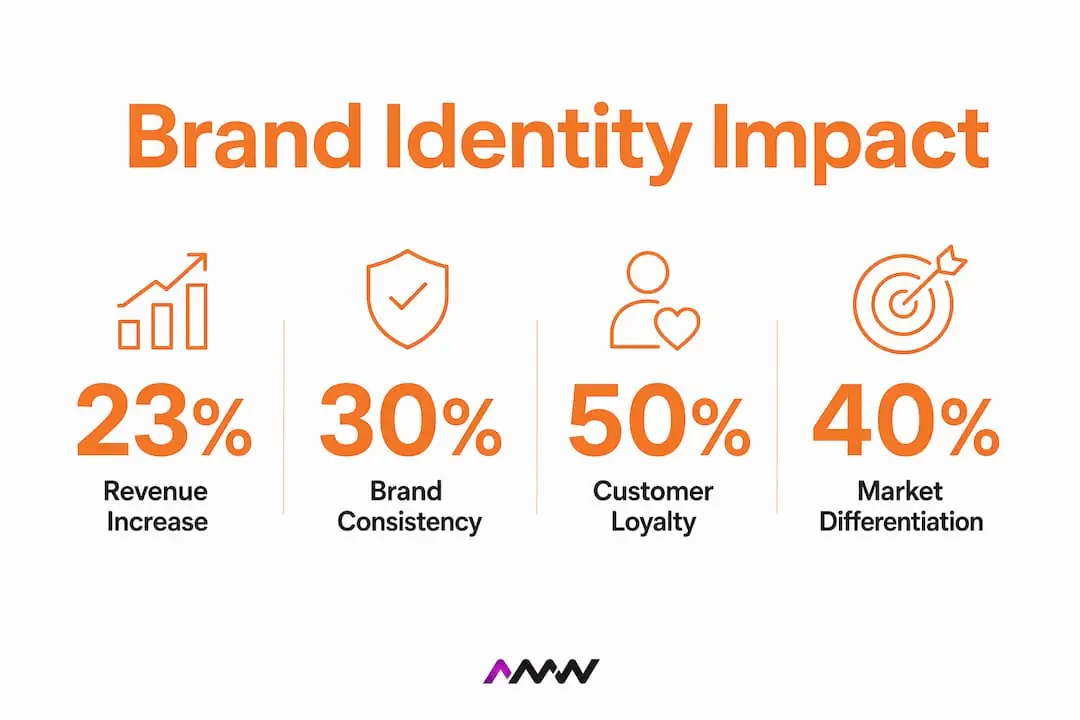
Mental availability, brand image, and brand attachment are the three equity pillars that consistent identity maximises. Mental availability means your brand comes to mind first in a purchase situation. Brand image means the associations customers hold are positive and aligned with your positioning. Brand attachment means customers feel a genuine emotional connection that makes switching feel like a loss. All three require sustained identity consistency to develop. None of them can be bought with a single campaign.
Measuring brand equity impact requires linking identity consistency metrics directly to downstream commercial KPIs like sales activation and customer retention. Top-of-funnel metrics, such as impressions and reach, can be misleading without this connection. A brand manager who can demonstrate that identity investment correlates with reduced customer acquisition costs and higher lifetime value will always have an easier conversation with the finance director.
How to use brand identity in loyalty programmes and customer engagement
Loyalty programmes have shifted from optional perks to strategic levers for deepening customer engagement. The Deloitte 2025 survey makes clear that tech-enabled personalisation and effortless reward redemption are now the baseline expectation for next-generation loyalty engagement. Programmes that feel generic or disconnected from the brand’s personality fail to deliver the emotional reinforcement that drives spending increases.
The most effective loyalty programmes treat every interaction as a brand identity moment. This means:
- Tone of voice in reward communications should match your brand personality precisely. A playful, irreverent brand that sends stiff, corporate reward emails creates cognitive dissonance that erodes trust.
- Visual design of loyalty assets, including app interfaces, physical cards, and email templates, should be indistinguishable in style from your core brand materials.
- Reward structures should reflect brand values. A sustainability-focused brand offering carbon-offset rewards reinforces identity far more powerfully than generic cashback.
- Personalisation at scale is now achievable through CRM platforms and marketing automation. Addressing customers by name and referencing their specific purchase history within loyalty communications increases perceived value without increasing cost proportionally.
Personalised loyalty experiences that make reward redemption effortless increase both engagement and perceived value. The friction of redemption is one of the most common ways brands accidentally undermine their own loyalty investment. If earning points is easy but spending them requires navigating a confusing portal, the emotional experience ends on a negative note. That is the note customers remember.
Physical brand touchpoints deserve mention here too. Branded merchandise and apparel, such as those available through A3M’s merch range, extend identity into the physical world and give loyal customers something tangible to associate with the brand. A well-designed piece of branded merchandise worn in public is both a loyalty reward and a brand impression delivered to everyone who sees it.
Pro Tip: Audit your loyalty programme’s redemption journey from the customer’s perspective at least twice a year. The gap between what your team thinks the experience is and what customers actually encounter is almost always larger than expected, and it is where brand identity most frequently breaks down in practice.
Key takeaways
A strong brand identity is the single most reliable driver of customer loyalty, pricing power, and marketing efficiency available to any business.
| Point | Details |
|---|---|
| Consistency drives revenue | Consistent brand presentation can increase revenue by 23% on average, making enforcement a commercial priority. |
| Dual advocacy pathways | Brand image and trust are separate routes to customer evangelism; effective identity work cultivates both deliberately. |
| Identity builds brand equity | Mental availability, emotional attachment, and brand image compound over time to create pricing power and differentiation. |
| Loyalty programmes amplify identity | Embedding brand personality into loyalty communications and reward design deepens emotional engagement and increases spending. |
| Enforcement gap is costly | Only 25 to 30% of companies enforce their brand guidelines, leaving the majority of potential brand ROI unrealised. |
Where brand identity enforcement breaks down
I have worked with enough businesses to know that the gap between having a brand identity and actually living it is where most of the value gets lost. Companies invest in beautiful brand guidelines documents, commission professional logo suites, and then watch their social media manager use a slightly different shade of blue because the correct hex code is buried on page 47 of a PDF nobody opens.
The enforcement problem is not a creative problem. It is an operational one. Brand guidelines need to be embedded into the tools people actually use, not stored in a document that requires a specific person to locate. When I see a business spending more on new brand campaigns than on making sure the existing identity is applied correctly across every channel, I know exactly where the ROI is leaking.
The rebranding risk is equally underappreciated. I have seen businesses refresh their visual identity to feel more contemporary and inadvertently dismantle the trust signals that made their existing customers loyal. A subtle shift in colour palette or a change in tone from warm to authoritative can alter customer perception in ways that take years to rebuild. The research backs this up: rebranding must be managed with care because even small visual or tonal shifts can affect advocacy and loyalty in unpredictable ways.
My advice is to link your identity metrics directly to commercial indicators before you make any significant brand changes. If you cannot demonstrate a clear relationship between your current identity and your customer retention rate or your average order value, you do not yet have enough data to justify the risk of changing it. Build that measurement framework first. Then you can make decisions with confidence rather than instinct.
The brands that compound their growth year on year are almost always the ones that treat identity consistency as a non-negotiable operational standard, not a creative aspiration. That discipline is unglamorous. It involves spreadsheets, audits, and uncomfortable conversations with teams who think brand guidelines are optional. But the commercial return, measured in lower acquisition costs, higher loyalty engagement, and genuine pricing power, is entirely worth it. Our Oxford page starts with a number, 157 leads at £4.59 each for Cotswold Gloss, because that is the only part of an agency page you can check.
Amir
How AMW Media helps you build and activate your brand identity
At AMW Media, we work with ambitious businesses that understand brand identity is not a one-off project. It is an ongoing operational commitment. Our social media management service maintains consistent brand voice and visual identity across every channel, so your audience encounters the same brand whether they find you on Instagram or LinkedIn. Our web design and graphic design teams build the visual foundations that make your identity unmistakable. If you are ready to turn brand identity from a creative exercise into a measurable growth driver, we would love to talk through what that looks like for your business specifically.
FAQ
What is brand identity and why does it matter?
Brand identity is the cohesive set of visual, verbal, and emotional elements that make a business recognisable and trusted. It matters because consistent presentation can increase revenue by an average of 23% and builds the mental availability that converts marketing spend into sales.
How does brand identity impact customer loyalty?
Brand identity reinforces loyalty by creating consistent, familiar experiences that reduce buyer hesitation and deepen emotional attachment. Loyalty programmes that reflect brand personality amplify this effect by making every reward interaction a brand moment.
Why is brand identity crucial for market differentiation?
A strong brand identity removes a business from price-based competition by building distinctiveness that competitors cannot easily replicate. NielsenIQ’s 2026 research identifies brand irresistibility, built through consistent identity, as the key driver of automatic consumer preference.
What are the biggest mistakes businesses make with brand identity?
The most common mistake is creating brand guidelines but failing to enforce them. Research shows only 25 to 30% of companies actively enforce their guidelines, which means the majority never capture the full revenue and recognition uplift that consistency delivers.
How do you measure the return on brand identity investment?
Link identity consistency metrics directly to commercial KPIs such as customer retention rate, average order value, and sales activation. Top-of-funnel metrics like impressions alone are insufficient to demonstrate the commercial value of brand identity work.
Recommended
- How to build brand identity for market advantage | AMW Media
- Why branding matters: grow and differentiate your business
- Harness social media in branding for growth in 2026
- Creative branding ideas list: top strategies for 2026 | AMW Media
Our free marketing audit looks at your site, your ads and your content, and comes back with a 30 day plan. No pitch deck.

Owns how everything looks and feels, from a brand identity to the grade on a reel, and makes the animated films such as Blue Light Services' Journey to Net Zero. Meet the team.