
 Black Steel Doors
 Woodstock Campers
 Phillips Joinery
There is no single magic number for video length for ads. Start testing at 9 to 21 seconds on TikTok and Reels, 15 to 30 seconds on Meta feed, and 20 to 45 seconds for YouTube skippable in-stream. Whatever the platform, front-load your hook into the first 3 to 5 seconds, then test your sweet spot against one longer cut to see which one actually lowers your cost per acquisition.
TL;DR:
- Shorter videos between 9 and 15 seconds on TikTok and Reels tend to perform best because they align with platform engagement habits.
- Meta recommends keeping ads shorter across placements, especially for Stories and Reels, but allows longer videos that often underperform compared to shorter cuts.
- YouTube skippable ads do best within 15 to 45 seconds, with the first five seconds critical for capturing viewer attention before skipping is possible.
- Longer ad durations can work for considered purchases on platforms like YouTube and LinkedIn, provided they match the audience’s buying stage and content expectations.
- Regular testing of multiple lengths, with CPA or cost-per-qualified-action as the main success metric, is essential to find the optimal ad length for each objective.
Video length for ads: the platform cheat sheet
Every platform has its own idea of a “long” video, and treating them the same can lead to inefficient spending. The difference between technical limits and optimal performance is significant, causing wasted spend.
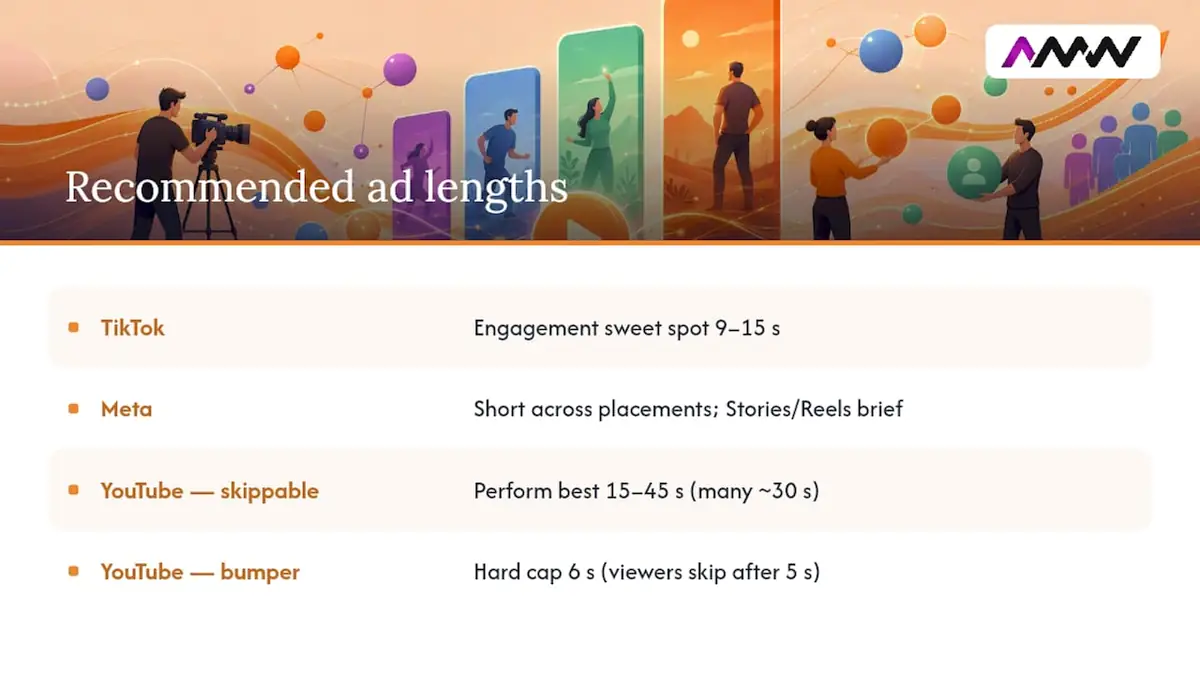
TikTok in-feed ads will let you run up to 60 seconds, but Shopify’s breakdown of TikTok ad guidance puts the real engagement sweet spot at 9 to 15 seconds. The platform’s native loop behaviour rewards a tight ending that clicks back into the start, so if your ad drags in the middle, the algorithm will notice before your finance team does.
Meta is similar but not identical. Its own placement specifications recommend shorter videos across the board because people scroll fast on mobile, and feed placements tend to land best around a short duration, while Stories and Reels want you under a brief length. Worth remembering: Meta’s technical maximums go well beyond its performance sweet spots, so “allowed” and “effective” are two different questions.
YouTube plays by different rules again. Skippable in-stream ads tend to perform best between 15 and 45 seconds, with a lot of advertisers converging near 30. Bumper ads are capped hard at 6 seconds, and because viewers can skip after 5, your first few frames are doing more work than the rest of the advert combined.
These ranges come from a mix of official platform guidance and aggregated 2026 platform data, and they’re a starting point, not gospel. Your product, audience, and creative will always push the number around a bit.
How do you choose video ad length by objective?
Length should follow your objective, not the other way round. A brand awareness ad and a retargeting ad are doing completely different jobs, and forcing them into the same runtime is a bit like using a sledgehammer to hang a picture frame.
Here’s a rough framework worth building into your creative brief:
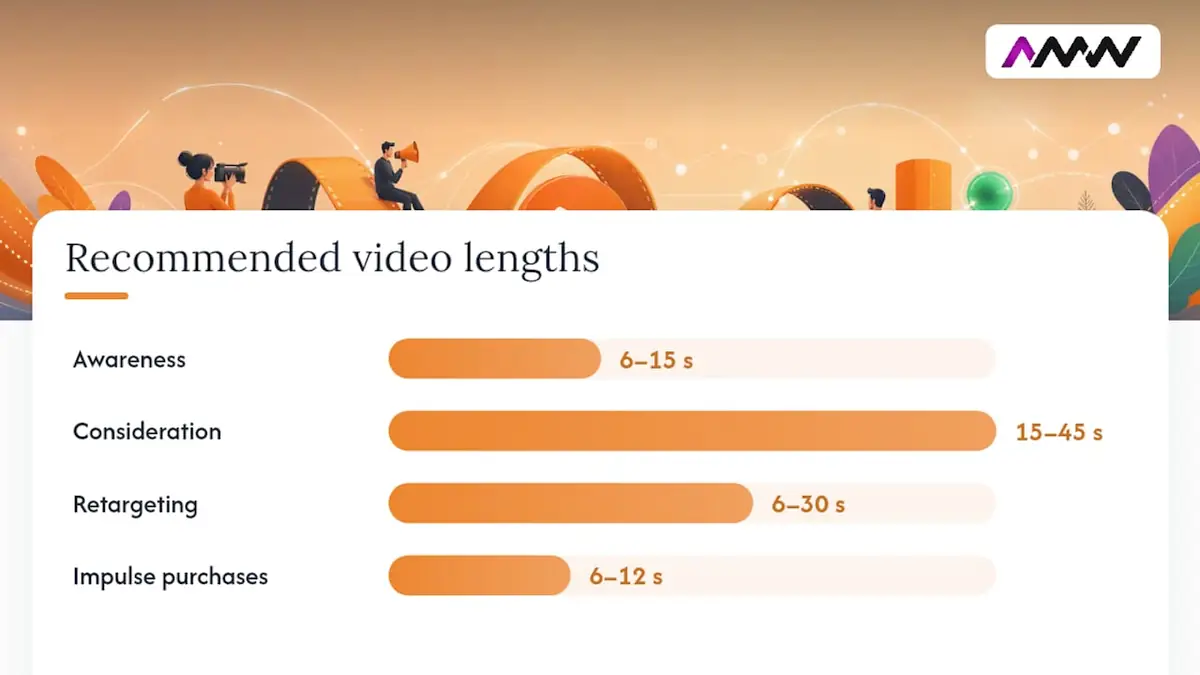
- Awareness (6 to 15 seconds): you’re buying attention, not explanation. Keep it visual, keep it punchy, and don’t try to squeeze in a value proposition nobody asked for yet.
- Consideration (15 to 45 seconds): now you can afford to explain what the product does and why it matters, but you still need to earn every second past the hook.
- Retargeting (6 to 30 seconds): these viewers already know you. Skip the introduction and go straight to the reason they should come back.
- Impulse purchases: shorter almost always wins here. If the product sells itself on price or novelty, a 6 to 12 second cut usually does the job.
- Considered purchases (finance, B2B software, high ticket items): longer cuts can filter for a more qualified viewer, and a slightly worse completion rate can still deliver a better cost-per-qualified-action.
During peak sale periods, shorter offer ads in the 6 to 12 second range tend to rotate more cheaply and fatigue slower than longer creative, which matters when your daily budget is getting eaten alive by rising CPMs. If you’re weighing up how video supports the wider funnel, our piece on video content and brand engagement digs into that a bit further.
How do you test and measure the right ad length?
Completion rate feels like the obvious metric, but it’s frequently the wrong one. A 9 second ad will always look great on completion. What matters is whether it’s actually making you money.
- Prioritise CPA or cost-per-qualified-action over completion. A shorter ad with high completion but weak conversion has been a bad ad.
- Use completion rate as a diagnostic, not a scoreboard. It’s genuinely useful for spotting where attention drops off, just not for deciding a winner outright.
- Run the same creative concept at two lengths with an equal budget split. Practitioner testing data backs “ship two lengths and let CPA decide” as a solid default approach, and it removes a lot of guesswork from the brief.
- Give the test enough time and spend to reach statistical confidence before calling a winner. Cutting a test short because one version is “ahead” after a day is how bad decisions get made.
- Read the retention curve properly. A sharp cliff at, say, 18 seconds tells you there’s a specific content problem at that exact moment, not that the whole ad is broken.
Pro Tip: If your retention curve for a 60 second ad shows most conversions happening before the 40 second mark, re-cut it to 40 seconds. Long-form is only worth keeping if the audience that sticks around actually converts better than the shorter version.
Our guide to Facebook A/B testing walks through the practical setup for running this kind of experiment properly.
How do you produce multiple ad lengths efficiently?
Producing four separate ads from scratch for every concept is a fast way to burn a production budget. The smarter approach is a script skeleton that scales, so you shoot once and edit down.
- Write your script in modular chunks: a hook, a core message, proof or demo, and a call to action, so any section can be trimmed without breaking the flow.
- Keep the presenter, visual identity, and CTA consistent across every cut. Viewers who see two versions shouldn’t feel like they’re watching different brands.
- Build a standard asset pack per concept: a 6 second bumper, a 15 second feed cut, a 30 second consideration version, and a 60 second long-form piece for platforms that reward depth.
- Check aspect ratios before you finalise anything. Feed, Stories/Reels, and in-stream placements all crop differently, and Sprout Social’s spec guide is worth bookmarking for exact safe zones.
- Add captions by default. A huge share of mobile viewing happens with sound off, and a missed caption is a missed message.
A tight 12 second loop that repeats cleanly can rack up more total watch time than a longer cut that loses people halfway through, which is worth remembering before you assume “longer equals more value.” For the strategic groundwork behind all this, optimising your digital strategy covers how creative planning should tie back to broader marketing goals.
What has running these tests actually taught us?
Working across the Google, Meta, and Shopify certifications AMW Media’s team holds, the pattern that keeps showing up is simple: the platform’s technical maximum is almost never the length that performs best. Clients who insist on a 45 second brand story for a cold-audience Meta feed placement are usually paying more per result than they need to.
The recurring lesson from client creative reviews is that a shorter, sharper cut nearly always beats a longer one on CPA for cold audiences, but retargeting and considered purchases often flip that rule entirely. Length isn’t a fixed rulebook, it’s a variable you test per objective.
If you’re planning a campaign and want a second pair of eyes on your length strategy before you brief production, ask an agency for a short audit or test plan rather than guessing from a blog post (even a good one).
Optimal video lengths by industry or product type
Fashion and beauty ads tend to skew short, often in the 9 to 15 second range, because the visual product does most of the persuading and impulse purchase behaviour rewards speed. Food and drink follows a similar pattern, particularly on TikTok and Reels, where a satisfying visual beats a long explanation every time.
Financial services, software, and B2B products behave differently. These are considered purchases, and viewers researching a pension platform or a project management tool are willing to sit through 30 to 60 seconds if the content actually answers their question. LinkedIn ads for this audience regularly stretch towards the 30 to 60 second range for thought leadership content without losing engagement.
Automotive and property sit somewhere in the middle. Awareness cuts run short and punchy, but consideration-stage content (a walkthrough, a feature demo) often runs 45 seconds or more because the purchase decision takes weeks, not seconds.
Healthcare and professional services tend to need a bit more runtime too, largely because trust has to be built rather than triggered. A 6 second bumper won’t convince anyone to book a consultation, but it works perfectly well as a reminder ad to someone who’s already seen your longer piece once.
How has preferred ad length changed over time?
Five years ago, 30 seconds was treated as the safe default across almost every platform. That assumption has aged badly. Attention has fragmented further, feed algorithms reward watch-through more aggressively, and the rise of TikTok pulled the entire industry towards shorter, punchier cuts.
Meta’s own guidance shifting toward “shorter performs better on mobile” reflects that same movement, and platforms that once tolerated a slow build now actively punish it in the auction. YouTube is the interesting exception. Skippable in-stream ads have held fairly steady around the 15 to 45 second range because the format itself filters for a viewer willing to watch past the skip button.
What’s changed most is how quickly a brand needs to earn attention within that runtime. The hook window has compressed from roughly the first 10 seconds to the first 3 to 5, largely because scroll speed on mobile keeps increasing. Expect this trend to keep tightening rather than reversing, particularly as short-form platforms keep gaining ad inventory share.
What effect does length have on engagement and ad recall?
Shorter ads generally produce higher completion rates, which makes sense; there’s simply less time for someone to lose interest or get distracted by a notification. But completion isn’t the same as recall, and recall isn’t the same as intent to purchase.
Longer ads that survive to the end tend to filter for a more engaged viewer, and that self-selection can produce a stronger memory of the brand and message, even with fewer total views. This is part of why longer cuts can sometimes deliver better CPA for considered purchases despite worse completion numbers on paper.
The psychology at play is fairly intuitive once you see it laid out. A short ad relies on a single strong impression, a striking visual, a punchy line, a recognisable face, delivered before the viewer’s thumb moves. A longer ad relies on narrative or demonstration to build understanding, which works better when the product needs explaining rather than just showing.
The risk with longer formats is drop off before the message lands, which is exactly what a retention curve will show you. A steep drop at 12 seconds into a 40 second ad means most of your audience never even reached your value proposition, let alone your CTA.
What do successful ad campaigns by length actually look like?
Short-form success stories tend to share one trait: the entire message is compressed into a single visual beat rather than spread across several ideas. Fashion and food brands running 9 to 15 second TikTok and Reels ads consistently outperform longer cuts on cost efficiency, largely because the format punishes anything that isn’t immediately visual.
Mid-length campaigns, roughly 20 to 30 seconds, tend to work best when there’s a clear before-and-after or problem-solution structure that needs just enough time to land. This length shows up repeatedly in Meta feed and YouTube skippable placements where the audience has already shown some intent.
Long-form success is rarer but not rare enough to ignore. B2B and financial services campaigns running 45 to 60 second explainer-style ads on YouTube and LinkedIn regularly justify the extra runtime because the audience watching to the end is genuinely closer to a buying decision. The lesson across all three lengths is consistent: success comes from matching the format’s natural behaviour, not fighting it.
What’s the honest trade-off between short and long ad cuts?
Short cuts are cheap to refresh but burn out fast, so if you’re leaning on 9 to 15 second content, plan for creative fatigue within a couple of weeks, not months. Two things I’d tell any team briefing this work: put your strongest visual in the first frame, not the fifth, and when you’ve got a longer piece performing well, re-cut it down using the same footage rather than reshooting from scratch. If you want help building that testing plan properly, get in touch with AMW Media.
Amir
Need help putting this into practice?
Reading a cheat sheet is one thing. Actually shooting, editing, and running four length variants across three platforms while your day job keeps happening around you is another. AMW Media’s social media management team handles exactly this kind of production and testing workload for brands who’d rather spend their time on strategy than in a video editor at 11pm.
Our in-house content production covers scripting, filming, and cutting each concept into the asset pack we’ve described here, six second bumpers through to sixty second long-form, without losing the visual consistency that makes a brand recognisable across every cut. Pair that with our PPC campaign management and we can also run the actual length tests for you, reading the retention curves and CPA data so you’re not stuck guessing which cut deserves the bigger slice of budget.
Most engagements start with a short discovery call where we look at your current creative, your objectives, and roughly what you’re spending, then come back with a practical test plan rather than a generic pitch deck. If that sounds useful, reach out to AMW Media and we’ll take it from there.
Sources
- Video length specifications across placements in Meta Ads Manager
- How long should a TikTok ad be? (Shopify)
- The Ideal YouTube Video Ads Lengths and File Sizes
- Optimal video length for every platform in 2026
- Social media video specs guide (Sprout Social)
FAQ
What is the best length for a video ad?
There isn’t one universal answer. Start with 9 to 15 seconds for TikTok and Reels, 15 to 30 seconds for Meta feed, and 15 to 45 seconds for YouTube skippable, then let CPA testing refine it from there.
Is a 3 minute video too long for Facebook?
Meta technically allows videos far longer than 3 minutes, but its own guidance shows shorter content performs better on mobile feeds, so a 3 minute cut would need a genuinely engaged, warm audience to justify the runtime.
Can I post a 20 minute video on Facebook?
Yes, Facebook’s technical limits go well beyond 20 minutes, but that length suits organic content or retargeting warm viewers far more than cold-audience ad placements, where shorter cuts consistently perform better.
Is a 4 minute video too long for TikTok?
For a paid TikTok in-feed ad, yes. The platform allows up to 60 seconds for ads, and engagement data points firmly toward 9 to 15 seconds, so a 4 minute video sits well outside the format’s paid advertising norms.
How long should a YouTube skippable ad be?
Aim for 15 to 45 seconds, with plenty of advertisers converging near 30. Since viewers can skip after 5 seconds, treat that opening window as the part of the ad doing the real work.
Recommended
- What is video marketing: effective strategies for 2026
- The role of video content in digital brand engagement
- Guide to video production for creators and small businesses
- Facebook A/B testing for marketers: run reliable experiments
Our free marketing audit looks at your site, your ads and your content, and comes back with a 30 day plan. No pitch deck.

On site with the cameras most days of the week. Installs, interviews, products and events, from London to Liverpool. Meet the team.