
 Black Steel Doors
 Woodstock Campers
 Phillips Joinery

There is no single “UK filming permit”. There is no national office that stamps a form and lets you roll camera from Land’s End to John o’Groats. Permission depends on where you stand, who owns that bit of ground, and what you plan to do there. On public land you ask the local council (and sometimes the police). On private property you ask the owner. Get that sorted early and most shoots are far less painful than people fear.
This guide walks through who to ask, how much notice to give, what the paperwork and fees can look like, and where the rules differ between London, the rest of England and Scotland. It is written for business owners and marketing managers commissioning a promo, a social campaign or a brand film, as well as anyone producing their own.
TL;DR
- No national permit exists. Public land means the local authority; private property means the owner; roads and special effects mean the police too.
- Notice varies hugely. Small London shoots can need as little as three days, while major filming in Westminster can need 12 to 16 weeks.
- Costs and paperwork grow with your footprint: insurance, traffic plans, parking suspensions and admin fees all add up.
- “Public” is not always public. Squares, parks and shopping centres are often privately managed, so you need the manager’s permission.
- Even when permission is not strictly required, telling the local film office is the cheapest insurance you can buy.
Table of Contents
- Why there is no single filming permit
- Who issues the permission
- How to apply, and how much notice to give
- What the paperwork and fees can look like
- Filming on private property
- Practical rules on parking, traffic and tidying up
- Do the rules differ across the UK?
- Our view: plan the permission around the story
- When it is easier to hand it over
- A quick pre-shoot checklist
- FAQ
- Sources
Why there is no single filming permit
UK filming permission is local. Councils control public land, public buildings, roads and parking, which is why the British Film Commission’s guidance on regulations tells filmmakers to check with the appropriate local authority first. Privately owned land is a separate conversation with the owner or manager. Police get involved when roads, weapons or special effects enter the picture.
So the honest answer to “do I need a permit?” is: it depends on four things.
- Location: street, park, beach, building interior, private home, shopping centre.
- Crew size and kit: a two-person team with a handheld camera is very different from a lorry full of lighting.
- Impact: blocking pavements, closing a road, needing parking bays, filming at night.
- Content: uniformed police, marked police cars, firearms (including replicas), explosives or special effects.
The British Film Commission notes that police cooperation is required for filming on a public highway or when using special effects, explosives or firearms, and that you need permission to portray uniformed officers or marked police vehicles on film.
Who issues the permission
Local councils
For most street and park filming, the council is your first call. In London, that usually means the Borough Film Service. Film London’s guidance on working with boroughs says you apply to the relevant local authority through its film service, and that even where permission is not legally required, contacting the borough is the best way to prevent problems on the day.
That last point is worth repeating, because it is the bit people skip. A quick email to the film office can save you from a chat with an irritated parking warden, a resident who has rung the police, or a location that turns out to have another shoot booked on the same day.
Privately managed “public” spaces
Some places feel public but are not. The British Film Commission points out that certain squares, parks and shopping centres are privately managed, so they always need filming permission even though anyone can wander in. If a security guard in a hi-vis jacket is patrolling it, assume it is private until you have checked.
Police and highways
Before filming on a public road, the British Film Commission advises contacting both the local police and the council’s Highways Department so they can confirm your plans are safe and pose no threat to road users. If you need anything more than people walking along a pavement with a camera, expect this to be part of the process.
City of London
The Square Mile has its own film team. The City of London’s filming permissions page covers traffic management, police support and parking dispensations, so a shoot there does not go through a normal borough route.
How to apply, and how much notice to give
The process is broadly the same everywhere, even if the forms differ.
- Work out your footprint. Crew numbers, equipment, vehicles, dates, times and exact addresses.
- Identify the authority. Which council covers the spot? Is any part of it private, or on a road managed by someone else?
- Contact the film office. Most areas have one, and many councils point you to an online system.
- Submit insurance and any plans. Public liability cover is the standard ask.
- Pay the fee, if there is one. Timescales often start only once payment lands.
- Tell the neighbours. If your location notice goes to residents or businesses, do it properly and early.
Typical notice periods
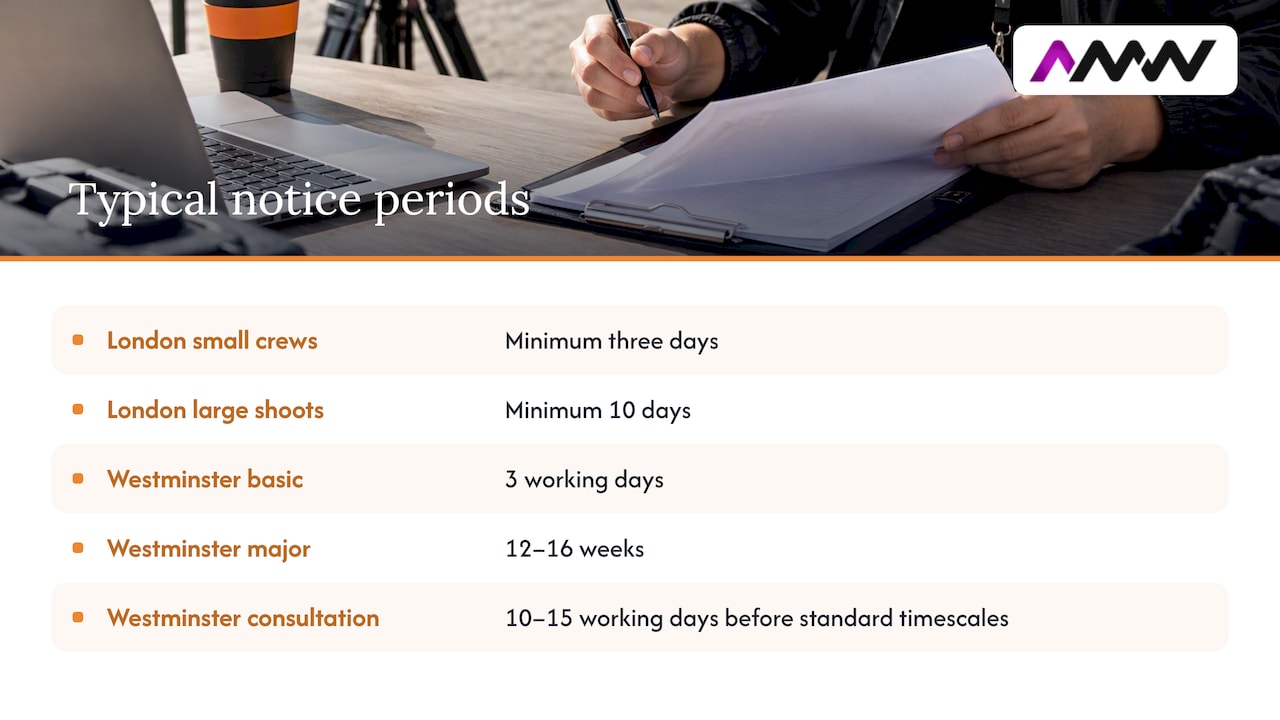
Film London gives minimum notice of three days for small crews and 10 days for large crews and complex shoots. Treat those as the floor, not the target.
Westminster is a good example of how steeply the numbers climb. Its timescales page lists 3 working days for basic filming and 12 to 16 weeks for major filming, with timescales counted from when the application fee is received. It also highlights pre-application consultations, held 10 to 15 working days before the standard timescales begin, as a way to spot opportunities and costs early.
If you want the London-specific version of this in more detail, we cover it in our guide to filming permits in London and who to call.
Online systems you may be sent to
A lot of the admin now happens online. Two names come up often:
- FilmApp is an online film application process used by some permitting authorities. According to the FilmApp applicant’s guide, you can save drafts, enter insurance details and upload policy documents. You use it only when your permitting authority directs you to it.
- Film Here is a standard enquiry system for productions filming in England outside London. The Film Here page says it is BFI-funded and offers dedicated production liaison to feature-film and high-end TV productions. A small brand shoot will mostly use it as a simple enquiry route.
What the paperwork and fees can look like
For a handheld shoot with a tiny crew on a quiet street, the paperwork may be almost nothing. As soon as you want to hold traffic, park a van or build a set on the pavement, the list grows.
The City of London gives a useful sample of what authorities ask for. On its page, applications involving traffic control need a Traffic Management Plan plus indemnity and public liability insurance. Intermittent traffic control has to be carried out by qualified personnel. A hoarding licence is listed at £720. The page also notes that the Royal Borough of Kensington and Chelsea charges £80 per hour for officer administration and may add an £80 late application fee.
Fees differ council by council and change over time, so always read the current page for the borough you are using. Here is a rough guide to what tends to move the cost:
| What you plan | Likely extras |
|---|---|
| Handheld, tiny crew, public pavement | Often just a courtesy notification to the film office |
| Lighting, tripods, larger crew | Insurance, location notice, possible fee |
| Parked unit vehicles | Parking suspension or dispensation, plus fees |
| Closing or controlling traffic | Traffic Management Plan, qualified traffic personnel, police and Highways involvement |
| Weapons, replicas, special effects | Police cooperation, extra safety planning |
Insurance
Public liability cover is the one item almost everyone asks for. If you are hiring a production company, check that their policy covers your shoot type and location before you send any applications. If you are doing it yourself, a business policy that covers filming is not a bonus, it is the ticket to getting a yes.
Filming on private property
This is where the other question readers ask lives: do you need a permit to film on private property? Usually the answer is not a permit, but permission.
Ask the owner, in writing
Film London’s permission guidance is clear that for private locations such as residential properties, you apply directly to the owner. Get that agreement in writing. A short location agreement should say:
- the dates and times you will be on site
- which rooms or areas you can use
- crew numbers and parking
- what you will do about damage and cleaning up
- any fee, and what is included
- whether the owner is happy for the footage to be used commercially
That last line matters for brands. A friendly “sure, film in my café” is fine for a Saturday afternoon. It is a lot less fine when the film turns into a paid advert and the owner has second thoughts.
When the council still needs to know
Private does not always mean council-free. The same guidance says the Royal Borough of Kensington and Chelsea asks productions filming on private property to notify its film office, and if you need parking or use of the public highway, you apply as usual. Cables across a pavement, a van on a residents’ bay or a camera on the road all pull the council back in.
Filming the outside of a building
Film London also says that in London, filming a building’s exterior does not infringe its copyright, but permission may still be needed from the relevant authority or the property owner depending on where you put the camera. Standing on a public pavement is a different thing from setting up in a private forecourt.
For more on picking spots, see our look at shooting locations in London and how to book them.
Interiors of shops, offices and venues
If you are filming in someone else’s premises, think about people as well as property. Customers, staff and passers-by may appear in shot. Put up clear signage, tell staff and ask anyone who does not want to feature to step out of frame. That is good manners, and it keeps your edit clean.
Practical rules on parking, traffic and tidying up
Most complaints about film crews come down to five things: noise, parking, blocked pavements, litter and being surprised. Fix those and you are 90% of the way to a good reputation.
- Parking: do not assume you can leave a van wherever. Ask the council about suspensions or dispensations and get them confirmed.
- Pavements: keep a clear route for wheelchairs, pushchairs and people with sight loss. Cable ramps beat tape and hope.
- Noise and hours: residential areas dislike early starts and night shoots. Councils often have extra rules for night filming.
- Neighbours: a polite note through the door, with a phone number, solves a surprising number of problems.
- Leaving no trace: take everything you brought, and a bit more. Leave the place as you found it.
Some areas publish a Code of Practice for filmmakers that spells out all of this. Read it before you apply, because the council will assume you have.
Do the rules differ across the UK?
Yes, quite a lot, and the differences can work in your favour or against you.
London: boroughs and the City of London handle filming separately, with the timescales and fees above. Film London is the main coordination point.
England outside London: each council has its own approach. Many direct enquiries through Film Here, or through an online system such as FilmApp.
Scotland: in Edinburgh, the Lothians and the Scottish Borders, Film Edinburgh says you do not need a permit to film on the street as long as the filming causes no obstruction, nuisance or offence, although a Notice of No Objection can be arranged on request. Permission is required for parks, beaches and cemeteries, and for private property you need the owner’s say-so. Controlling the street or using heavy equipment needs the relevant Order or Permit after a joint agency meeting.
Wales and Northern Ireland: we have not listed their rules here. Each has its own screen agency and local authorities, so start with the council for your location and ask for its film contact.
The lesson is the same everywhere: do not carry your London assumptions to Glasgow, or your Edinburgh ones to Manchester. Check the local page.
Our view: plan the permission around the story
We make video and photography for brands, and permissions are one of the least glamorous but most important parts of the job. Here is how we think about them.
First, decide what you actually need to film. A brand film shot mostly inside a studio or a friendly venue can sidestep half the council paperwork. Save the street scenes for the shots that genuinely need them.
Second, start earlier than feels necessary. Notice periods are minimums. A permit that arrives two days before the shoot is a worry. One that arrives two weeks before is a plan.
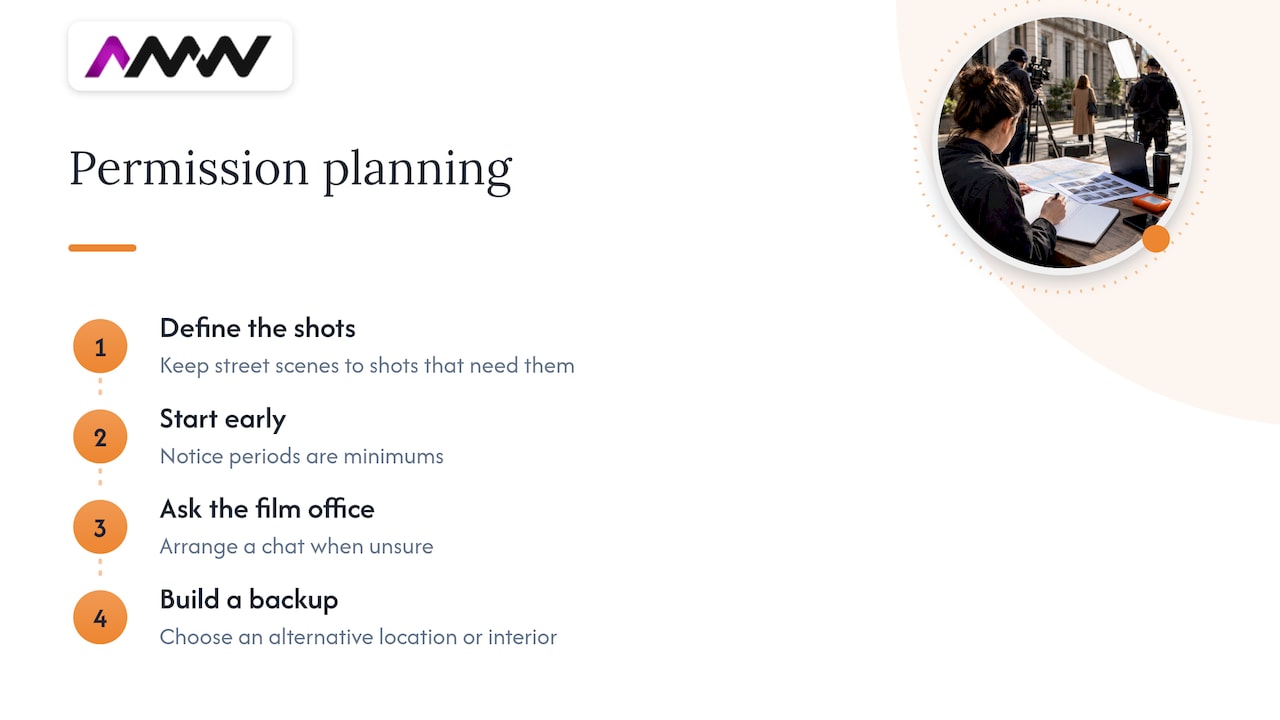
Third, ask the film office for a chat if you are unsure. They would rather answer a daft question on Tuesday than field a complaint on Saturday.
Finally, build a backup. Weather, a no from a venue or a road closure can all wobble a shoot day. Having an alternative location, or an interior option, keeps a client from watching the budget burn while everyone stands on a pavement.
Amir Wanas, founder of AMW Media
When it is easier to hand it over
If you are a business owner with a launch to run, chasing four councils and a landlord is probably not how you want to spend a week. We handle video and content production for brands, from planning and locations through to the edit, and we can take the permission questions off your desk. Have a look at our video production services or get in touch via our services page to talk through what you are planning.
A quick pre-shoot checklist
- List every location and decide if each is public, private or privately managed public.
- Find the right council or film office for each one.
- Note the notice period and when the clock starts (often when you pay the fee).
- Arrange public liability insurance that matches the shoot.
- Get written agreement from every private owner.
- Sort parking, Highways and police contact if roads or vehicles are involved.
- Check content issues: uniforms, marked police cars, replica weapons and effects.
- Tell neighbours, brief your crew and print copies of every permission to carry on the day.
- Have a plan B location.
FAQ
Do I need a permit to film in public in the UK?
Not always. Small, low-impact filming on a public street often needs no formal permit, but it depends on the area and you should check with the local film office. Parks, beaches, cemeteries and public buildings generally need permission, and so do privately managed spaces that look public. If you will use lights, vehicles or block a pavement, assume you do.
How far ahead should I apply?
As early as you can. Film London’s minimum is three days for small crews and 10 days for large or complex shoots, while Westminster lists 12 to 16 weeks for major filming. Check the current timescales for your borough, because they can change.
Can I film on private property without permission?
No. You need the owner’s permission, ideally in a written location agreement that covers commercial use of the footage. If you also need parking, cables on the pavement or the public highway, the local council needs to know too.
Is there a fee?
Sometimes. Some councils charge application or administration fees, and extras such as hoarding licences or parking suspensions cost more. For example, the City of London lists a hoarding licence at £720. Read the current fee page for the authority you are applying to.
Can I film a building’s exterior from the street?
In London, filming the outside of a building does not infringe its copyright, according to Film London. Permission can still depend on where your camera is, so a public pavement is safer than private ground.
Sources
- Regulations, British Film Commission
- Working with Boroughs, Film London
- Get Permission, Film London
- Timescales, permits and licences, Westminster City Council
- Film and photography permissions, City of London
- FilmApp: An Applicant’s Guide
- Film Here, Filming in England
- Permits, Film Edinburgh
Recommended
- 3 Days to 12 Weeks: Filming Permits in London and Who to Call
- Shooting locations London: where to find and book them
Our free marketing audit looks at your site, your ads and your content, and comes back with a 30 day plan. No pitch deck.

Founded AMW Media in 2024 and runs strategy, paid media and the CRM builds. The reason everything here is in house and measured in revenue. Meet the team.