
 Black Steel Doors
 Woodstock Campers
 Phillips Joinery

The quickest way to repurpose content is to pick one piece that already works, split it into its main ideas, and give each idea a new format for a different channel. A blog post becomes a short video, a carousel, an email and a handful of social posts. A webinar becomes a blog, a clip reel and a checklist. You do far less new thinking and your best ideas get seen by far more people.
This guide is the practical version. You’ll find 15 ideas sorted by what you’re starting with, a worked example, a simple process, and the two UK rules that catch people out (copyright and ad labelling). It’s written for business owners and marketing managers who are already making content and suspect it’s working harder somewhere else than it is on the page it was published on.
TL;DR
- Repurpose what has already proven itself. Start with your best-performing posts, videos and talks, not whatever is newest.
- Build around one pillar piece, then break it into channel-ready formats instead of copying and pasting it everywhere.
- Keep one master document of facts, figures and claims, so every spin-off says the same thing.
- Only repurpose material you own. In the UK, lifting other people’s work without permission is infringement, and repurposed content that sells something needs to be labelled as an ad where the rules say so.
- Give it time. A few months of data tells you which pieces deserve a second life.
Table of Contents
- What repurposing actually means (and what it doesn’t)
- Choose the right source piece first
- Keep one source of truth
- Content repurposing ideas by starting point
- A worked example: one post, twelve pieces
- A simple process that doesn’t take over your week
- Our view: repurposing is a strategy, not a shortcut
- The UK rules worth knowing before you hit publish
- Mistakes that waste a good piece of content
- Where we can help
- FAQ
- Sources
What repurposing actually means (and what it doesn’t)
Repurposing is taking an idea you’ve already spent time and money developing and giving it a new shape. The idea stays; the packaging changes.
It isn’t reposting the same link five times, and it isn’t chopping a long article into mush and pasting it into LinkedIn. Someone who reads your blog on Monday and sees a carousel on Thursday should feel they’ve learned something new from the second one, even if the core point is the same. Each format has its own habits: a video needs a hook in the first couple of seconds, an email needs one clear thing to do, and a carousel needs one idea per slide.
There’s also a quieter benefit. Most of your audience never saw the original. Your blog might get a few hundred visits, while your followers scroll past on a different day and in a different mood. Different people like different formats, so one idea in several shapes simply reaches more of them.
Choose the right source piece first
The biggest repurposing mistake isn’t the format. It’s picking something weak and multiplying it. You end up with ten mediocre assets instead of one.
A good source piece usually has at least some of these traits:
- It has already performed: steady traffic, shares, enquiries, or comments from real customers.
- It deals with something that won’t date quickly, such as how to choose a web designer, rather than a news item from last spring.
- It contains several separate points, not one thin idea stretched over 1,200 words.
- It’s something you or your team know inside out, so you can add fresh detail when you repurpose it.
It helps to wait. Marketers often suggest leaving a piece for a few months after publishing, so you can see which ones actually got traction before investing more effort. If you’ve got a year of blog posts, check which five drew the most traffic or led to the most enquiries. Those are your shortlist.
A good repurposing system, as Scheduler’s guide to repurposing puts it, starts with selecting strong source assets and mapping ideas to channels. That’s the right order: choose first, then decide where each idea goes.
Keep one source of truth
Here’s the unglamorous bit that saves you embarrassment. When one article becomes ten assets, the figures and claims inside it get copied ten times. Someone updates a price or a statistic in one place and forgets the rest. A few months later your website says one thing and an old carousel says another.
The fix is a single document, sometimes called a source of truth, that holds the key claims, statistics, quotes and sources for the pillar piece. Every spin-off draws from it. When something changes, you change it once and then check the pieces that use it.

It doesn’t need to be fancy. A shared document with headings like “Main claims”, “Numbers and where they came from”, “Quotes we have permission to use” and “Links” will do. Your future self, or a colleague covering for you, will be grateful.
Content repurposing ideas by starting point
Here are 15 ideas, grouped by what you’ve already got. Pick two or three that suit your audience and ignore the rest. Nobody needs to be on every channel.
If you’ve got a blog post
1. Turn it into a short video. Take the three or four main points and record yourself, or a colleague, explaining each in under a minute. You don’t need a studio. A decent phone, good light and a quiet room beat a fancy set-up with a stiff presenter. If you want something more polished, that’s where professional video production earns its keep.
2. Make a carousel. Each subheading becomes a slide. Lead with a bold promise on slide one, give one point per slide, and end with a clear next step. Carousels suit LinkedIn and Instagram, and they force you to cut every sentence down to what matters.
3. Send it as an email series. Split a long guide into three or four short emails, each tackling one section. Subscribers get a drip of useful advice and you get several sends from one piece of writing. If you’d like to automate the sequence, our guide to automated marketing strategies is a good place to start.
4. Pull out quotable lines. Every decent article has two or three sentences that stand alone. Turn them into text graphics or short posts. Keep them genuinely useful rather than motivational wallpaper.
If you’ve got a video, webinar or podcast
5. Clip the best moments. A 40-minute talk usually contains five or six strong 30 to 60 second moments: a surprising answer, a neat example, a joke that landed. Cut each into its own short video with captions, because lots of people watch with the sound off.
6. Write the transcript up as an article. Don’t paste the raw transcript; nobody speaks in paragraphs. Edit it into a proper post with headings, tidy the waffle and add detail you skipped when speaking. It also gives search engines something to read.
7. Create a checklist or one-page summary. If your talk was a how-to, a downloadable checklist is a handy lead magnet. Put it behind a simple form and you’ve turned a video into a way of collecting enquiries.
8. Pull still images. If you filmed it properly, you have photos too. Behind-the-scenes shots, speaker portraits and key slides can feed your social feeds for weeks. Our piece on types of creative content shows how many formats a single shoot can cover.
If you’ve got a case study or customer feedback
9. Turn results into a social proof series. One case study can become a headline-figure graphic, a short quote from the client, a before-and-after image, and a “how we did it” thread. Always get the client’s say-so before using their name, logo or words.
10. Feed sales conversations. Take the questions prospects ask on calls and the objections that keep coming up, then answer each in a short post or video. This is among the most reliable ideas on the list because the topics are already proven to matter to buyers. See our content marketing examples for how brands do this well.
If you’ve got data, research or an in-depth guide
11. Build an infographic or chart set. Original numbers, even from a small survey of your own customers, are worth splitting up. One chart per post, with a clear takeaway under it, goes further than one dense infographic that nobody can read on a phone.
12. Create a “myth versus reality” series. Take the surprising findings and set them against common assumptions. It’s an easy format to write and people enjoy being told they were wrong, as long as you’re kind about it.
If you’ve got a pile of small bits
13. Combine several short posts into one guide. Repurposing works in reverse too. Ten social posts on the same theme can be reworked into a single, more thorough article, with new examples and a sensible structure.
14. Update and republish. Refresh an old post with new examples and current figures, change the headline if needed, and share it as if it were new, because in a useful sense it is. Do this only if the advice still stands up.
15. Turn FAQs into a proper page. Collect the questions customers email, DM and ask on calls, then write clear answers. That page becomes a resource for your website and a bank of short posts for social channels.
A worked example: one post, twelve pieces
Say you run a small accountancy firm in Leeds and you’ve published a 1,500-word post called “Five tax deadlines small businesses forget”. It’s done well, with steady traffic since spring. Here’s how it could stretch over a month.
| Week | Piece | Channel | Effort |
|---|---|---|---|
| 1 | The original post, updated with current dates | Website | Low |
| 1 | Carousel: one deadline per slide | LinkedIn, Instagram | Medium |
| 1 | Email 1: the first two deadlines | Newsletter | Low |
| 2 | 45-second video on the deadline people miss most | Instagram Reels, TikTok, LinkedIn | Medium |
| 2 | Email 2: the next two deadlines | Newsletter | Low |
| 2 | Quote graphic from the post | Facebook, LinkedIn | Low |
| 3 | Short post: “the mistake we see most” | Low | |
| 3 | Email 3: the last deadline plus a call to action | Newsletter | Low |
| 3 | Client question turned into a Q&A video | YouTube Shorts | Medium |
| 4 | Downloadable deadline checklist | Website, email | Medium |
| 4 | Round-up post: what readers asked | Website | Medium |
| 4 | Reminder post linking back to the checklist | All social | Low |
That’s the same research, the same facts and the same voice, shown to different people at different times. The example is illustrative, not a real client result, but the maths is realistic: one decent piece of work, roughly a dozen outputs, and most of them are low or medium effort.
A simple process that doesn’t take over your week
One framework worth borrowing is a four-step loop: create a pillar piece, atomise it into channel-ready formats, distribute it where your audience already spends time, then refresh it with new data. Here’s how that looks day to day.
- Pick the pillar. Choose one strong piece each month or quarter, depending on how much you publish.
- Write the source-of-truth notes. List the main points, the facts, and the sources. Ten minutes.
- Decide the channels. Look at where your customers actually are. A B2B service firm may get more from LinkedIn and email than from TikTok. A local shop might be the reverse. Don’t spread yourself thin just because a format is trending.
- Batch the work. Record all your short videos in one session, write all your emails in one sitting, design all your graphics in one go. Switching between tasks is where the time goes.
- Schedule it. Use a scheduling tool or your platform’s built-in scheduler so the spin-offs trickle out over weeks. Our guide to creating engaging social media content covers how to keep that feed from feeling repetitive.
- Check the numbers. After a month, see which formats got clicks, replies and enquiries. Do more of those.
Our view: repurposing is a strategy, not a shortcut
We see two kinds of businesses come to us about this. The first has a lot of content and little to show for it. The second has barely any content and hopes repurposing will cover for that. The first group gets quick wins. The second needs to start by making one good thing.
Our view is simple: repurposing multiplies whatever you put in. Take a sharp, useful piece and it becomes a month of decent marketing. Take a vague one and you’ve made a month of vague marketing. So we’d always rather you spent your effort on the pillar piece, making it specific and properly useful, than on dozens of quick spin-offs.
A few things we’ve learned from the kind of work we do across video, social, web and email:
- Format matters more than people expect. The same advice told on camera, in an email and in a carousel will attract three different groups. Don’t assume the people reading your blog are the ones watching your videos.
- Design it as a set from day one. If you know you’ll cut clips from a video, film it so you can: good audio, clear framing, natural pauses. It costs almost nothing extra at the shoot and saves hours afterwards.
- Be honest about what’s not working. If a format gets nothing after a few tries, drop it. We’d rather you do three channels well than seven badly.
- Keep it recognisably yours. Same tone, same look, same standards. Repurposed content that looks like it came from five different businesses does more harm than good.
We also don’t tie clients into long contracts, so if something isn’t performing, we’ll say so and change course with you rather than keep it going for the sake of it.
— Amir
The UK rules worth knowing before you hit publish
This section isn’t glamorous, but it’s the part that causes real trouble. If your content is mostly your own and you’re only reusing it across your own channels, you’re mostly fine. The risks appear when other people’s work or paid promotion get involved.
Only repurpose what you own or have permission to use
It’s tempting to take a great statistic from an industry report, or a striking image from another site, and drop it into a carousel. Be careful. According to GOV.UK’s copyright guidance, you don’t have to copy a whole work to infringe; copying a substantial part of it can be enough, and adapting an existing image without permission can also infringe.
In practice, that means:
- Use your own photos, footage, writing and graphics, or properly licensed ones.
- If you quote someone, keep it short, credit the source clearly, and link to it.
- Get written permission before using customer quotes, names, faces or logos.
- If a freelancer or agency made the original, check your contract confirms you own the rights to reuse and adapt it. This catches people out more than you’d think.
If you’re unsure about a specific piece of work, speak to a solicitor who deals with intellectual property. That’s better than guessing.
Label repurposed content that has become an ad
A post that began as ordinary organic content can become advertising once you give it a commercial purpose. The Advertising Standards Authority’s report on influencer ad disclosure makes the point that ads must be obviously identifiable as ads. If you take a clip and put money behind it, add a discount code, link to a product, or work with a creator who is paid or otherwise rewarded, treat it as an ad and label it clearly, with something like #ad or the platform’s paid partnership tool, at the start where people will see it.
The ASA has also ruled against brands whose posts didn’t carry the right label when seen. In one case involving Daniel Wellington and Louise Thompson, the brand had asked for hashtags such as #sponsored or #ad, but they weren’t in the post as it appeared. The lesson: having a rule in your brief isn’t the same as having the label on the post. Check the live version.
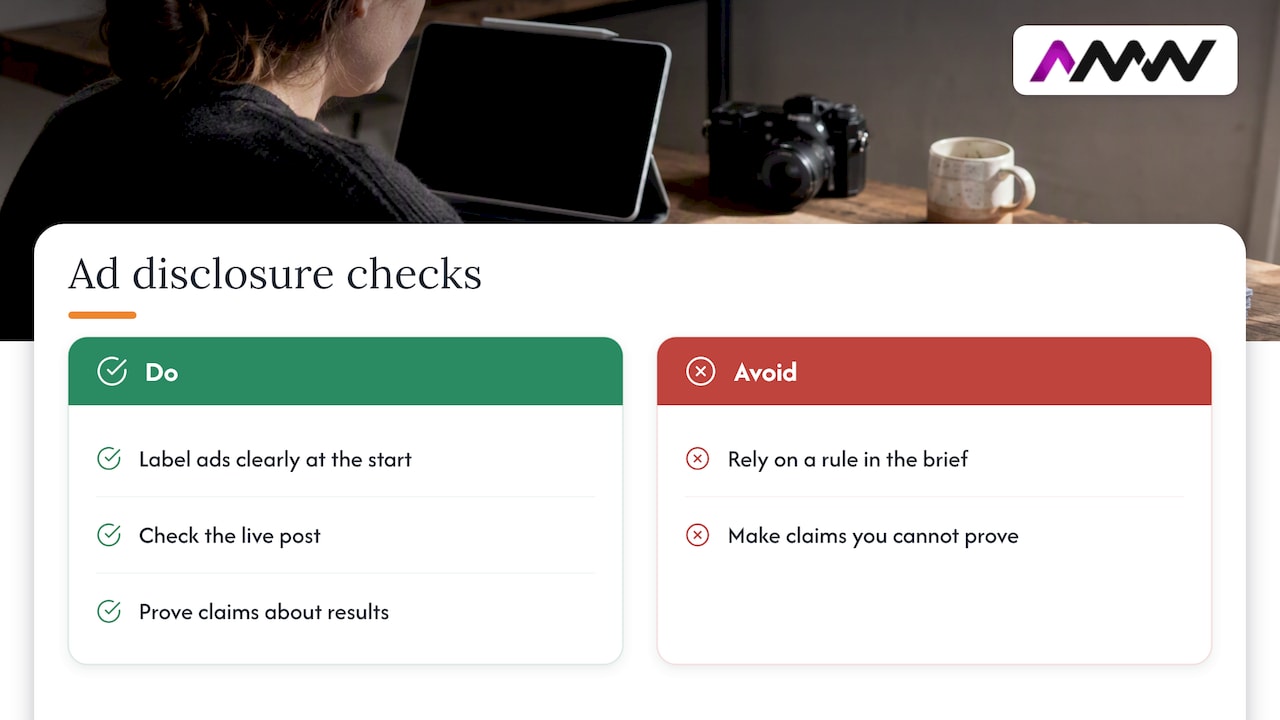
If you’re running repurposed clips as paid social ads, the same principle applies to your claims. Anything you say about results should be something you can prove, and your source-of-truth document is where that proof lives.
Mistakes that waste a good piece of content
- Copy and paste. The same text on four platforms, unchanged, reads as lazy and often performs badly. Rewrite for the format.
- Repurposing everything. Weak content stays weak. Be selective.
- Forgetting the call to action. Every piece needs to point somewhere: the original article, a checklist, a contact page, a booking link.
- Never refreshing. Old figures and outdated advice damage trust. Review your top pieces at least once or twice a year.
- Posting all at once. Spread things out. Seeing the same idea on five channels in one afternoon feels spammy.
- No tracking. If you can’t tell which repurposed piece led to an enquiry, you can’t decide what to do more of. Use UTM links and a simple spreadsheet if nothing else.
Where we can help
If you’ve got the ideas but not the time, this is the kind of work we do day to day. We produce video and photography built to be cut into several formats, manage social media so the spin-offs go out consistently, and handle email and automation so the sequences run themselves. You can see what we’ve made on our projects page, or look through the full list of services and get in touch if you’d like to talk it through. We’ll give you a straight answer on whether repurposing is the right next step for your business.
FAQ
How do I repurpose content without it feeling repetitive?
Change the angle, not just the format. Lead with a different point, use a new example, or speak to a different stage of the buying journey. Spread the pieces over several weeks, and link them back to the original so people who want more can find it.
How often should I repurpose old content?
There’s no fixed schedule, but a sensible rhythm is to review your best-performing pieces every few months. Update anything that has dated, then give the strongest a new format. If a piece is still driving traffic or enquiries, it’s usually worth another outing.
Do I need special tools to repurpose content?
No. A phone, a free design tool, a basic video editor and a scheduling tool will cover most of it. Tools help with speed, but the real work is choosing good source material and writing for each channel. Start simple and add software only when a task is eating your time.
Can I repurpose content from other websites or competitors?
Not without permission. Under UK copyright rules, copying a substantial part of someone else’s work or adapting their image can infringe, and quotation exceptions are limited and need proper acknowledgement. Use your own material, or link to the original and add your own commentary.
Do repurposed posts need to be labelled as ads?
They do if they’ve become advertising, for example when you boost them with paid spend, add a discount code, or work with a paid creator. The ASA expects ads to be obviously identifiable as ads. When in doubt, label it clearly at the start of the post.
Sources
- GOV.UK: Copyright notice, digital images, photographs and the internet
- ASA: Influencer ad disclosure on social media report
- ASA ruling: Daniel Wellington AB
- Cognism: Content repurposing strategy and examples
- Scheduler: How to repurpose content the right way
Recommended
- Types of creative content: 10 formats that drive results
- Effective content production strategies for brand growth
- Examples of branded content: 10 campaigns that actually work
- Innovative social media content ideas to boost engagement
Our free marketing audit looks at your site, your ads and your content, and comes back with a 30 day plan. No pitch deck.

Founded AMW Media in 2024 and runs strategy, paid media and the CRM builds. The reason everything here is in house and measured in revenue. Meet the team.