
 Black Steel Doors
 Woodstock Campers
 Phillips Joinery
Conversion optimisation (CRO) is the systematic process of increasing the percentage of website visitors who complete a desired action, whether that is making a purchase, booking a call, or signing up for a newsletter. It turns existing traffic into measurable revenue without spending more on ads.
Here is why it matters immediately:
- More revenue per visitor. You are already paying to attract traffic. CRO makes each visit worth more.
- Lower cost per acquisition. When more visitors convert, your ad spend and SEO investment go further.
- Better ROI across every channel. A higher conversion rate amplifies the return from PPC, social, and organic alike.
Quick wins, such as fixing a confusing checkout or adding a trust badge, can show measurable results in 2 to 4 weeks. Structured programmes typically deliver significant impact within 60 to 90 days.
Why does conversion optimisation matter for UK businesses?
Most UK SMEs focus their marketing budget on getting more traffic. That makes sense up to a point, but it ignores a simpler lever: make the traffic you already have work harder. If your site converts at 1.5% and you lift that to 2.5%, you have effectively gained 67% more customers from the same spend.
The business case is simple:
- Revenue per visitor rises without touching your ad budget.
- Cost per acquisition falls because the same spend produces more paying customers.
- Paid channels become more profitable. A better-converting landing page directly improves your return on ad spend for Google Ads or Meta campaigns.
Consider a UK e-commerce SME selling outdoor gear. Their mobile checkout had five steps and no guest option. Simplifying it to three steps with a guest checkout is the kind of change that, according to LUNIDEV data, averages a significant lift in checkout conversions. That is not a redesign. It is a targeted fix based on where visitors were dropping off.
Small lifts compound quickly. A 1% improvement this month, another next month, and a third the month after do not add up to 3%. They multiply. That compounding effect is why CRO is one of the highest-return activities a growth-focused business can run alongside its digital marketing strategy.

How do you calculate conversion rate, and what should you measure?
The formula is simple:
Conversion Rate = (Conversions ÷ Total Visitors) × 100
So if 4,000 people visit your site in a month and 80 make a purchase, your conversion rate is 2%. That is your macro conversion, the primary goal of the page or site.
Macro vs micro conversions
Not every valuable action is a sale. Micro conversions are the smaller steps that lead to the main goal:
- Email sign-ups
- Add-to-basket events
- Video plays or brochure downloads
- Live chat initiations
- Account registrations
Tracking micro conversions tells you where visitors are engaging and where they are stalling. A visitor who adds to basket but never checks out is a different problem from one who bounces from the product page entirely. If you are weighing up paid advertising, our Milton Keynes PPC page explains why the cost per lead you have been shown is probably wrong.
Secondary metrics worth tracking
Beyond conversion rate, keep an eye on:
- Average order value (AOV), a higher conversion rate at lower AOV can mean less revenue overall
- Revenue per visitor, the single number that combines rate and value
- Funnel abandonment rate, which step loses the most people
- Bounce rate by traffic source, tells you whether your traffic quality matches your page
Pro Tip: Before you run a single test, audit your tracking. Check for missing mobile events, duplicate form-submission counts, and cross-device attribution gaps in Google Analytics 4 (GA4). Flawed analytics event health produces garbage results, and you will not know it until you have wasted weeks on a test built on bad data.
A quick sanity checklist before testing:
- Conversion events fire on the correct page (not on every page load)
- Mobile events match desktop event counts proportionally
- No duplicate transactions from double-firing tags
- Goals are set at the session level, not the hit level, where appropriate
What does a repeatable CRO process look like?
The biggest mistake teams make is jumping straight to “let’s test a new button colour.” Real CRO is forensics, not aesthetics. A research-driven testing approach produces a 30 to 40% test win rate compared with 10 to 15% for ad-hoc testing. That gap is the value of a documented process.
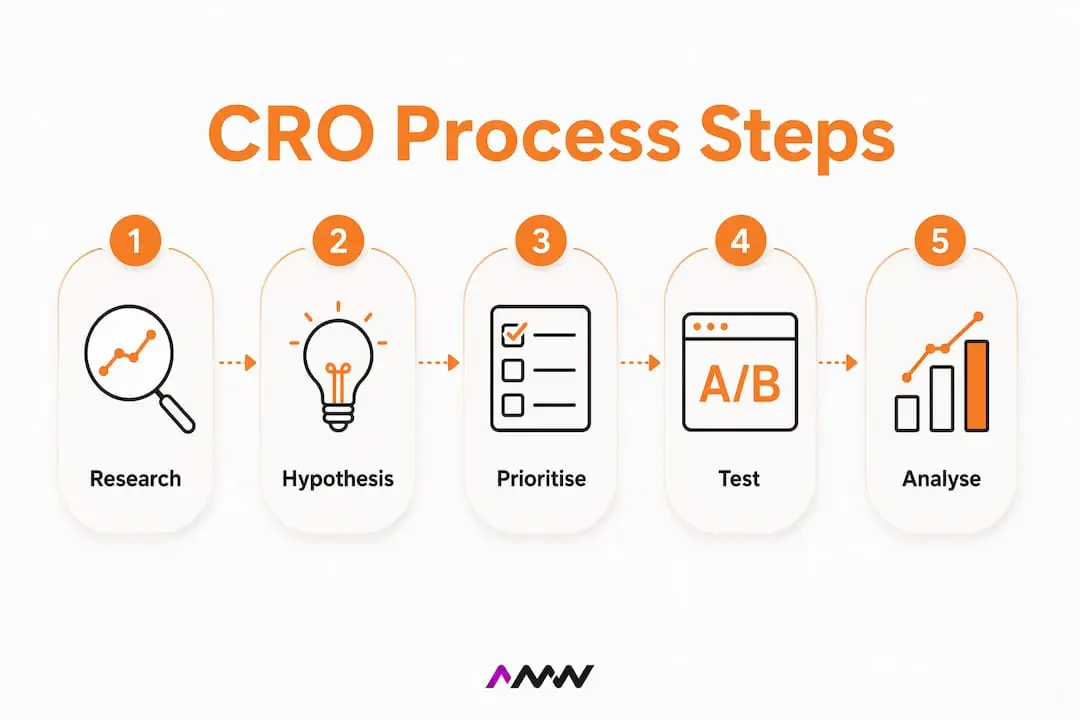
Here is a framework you can follow:
- Research. Pull quantitative data (GA4 funnels, heatmaps, session recordings) and qualitative data (surveys, user interviews, support tickets). You are looking for patterns, not hunches.
- Analysis. Identify where visitors drop off and why. Use a conversion barrier framework covering clarity, relevance, value, friction, anxiety, and distraction to categorise what you find.
- Hypothesis. Write a structured hypothesis: “Because [evidence], we believe [change] will [outcome], measured by [metric].” A hypothesis template that links observed evidence to measurable outcomes keeps your testing disciplined.
- Prioritisation. Score your ideas using ICE (Impact, Confidence, Ease) or PIE (Potential, Importance, Ease). For example: a checkout simplification scores high on Impact and Importance but medium on Ease; a headline tweak scores high on Ease but low on Impact. Run the high-scorers first.
- Test. Set your primary metric, determine minimum detectable effect (MDE), calculate required sample size, and set a fixed duration before you start. Do not peek.
- Learn and iterate. Whether the test wins or loses, document the finding. The learning log is the real asset of a CRO programme, as it prevents teams from repeating the same experiments and builds institutional knowledge over time.
Pro Tip: Treat your prioritisation backlog as a living document. Add new ideas from every research sprint, re-score them quarterly, and archive tests with their outcomes. This is what separates a disciplined marketing process from a series of random experiments.
Which testing method should you use?
Not every site needs A/B testing, and not every question can be answered with one. Choosing the right method saves time and avoids wasted experiments.
- A/B testing pits one version against another on a single variable. Best for high-traffic pages with a clear hypothesis. Requires sufficient traffic to reach statistical significance.
- Multivariate testing tests multiple elements simultaneously to find the best combination. Needs significantly more traffic than A/B and is suited to pages where several elements interact (hero image, headline, CTA button).
- Split URL testing sends visitors to entirely different page versions at separate URLs. Useful for radical redesigns where you want a clean comparison rather than an element swap.
- Qualitative methods (session recordings, heatmaps, user interviews, on-site surveys) answer the why behind the numbers. Tools like Hotjar and Microsoft Clarity are widely used in the UK for this.
Traffic thresholds matter
For sites with fewer than 2,000 monthly visitors, A/B testing is rarely viable. The sample sizes needed to reach statistical significance simply are not there, and underpowered tests produce misleading results. The better approach is qualitative research: watch session recordings, run a five-question survey, and implement clear UX fixes based on what you observe. That is not a compromise. For low-traffic sites, it is the right method.
Pro Tip: Pre-determine your sample size and test duration before you launch. Stopping tests early based on interim results is one of the most common causes of false positives in CRO. Set a calendar reminder for the end date and do not check results until you reach it.
What are the best practices, and what mistakes should you avoid?
Good CRO is mostly about discipline. The technical side is learnable. The hard part is resisting the urge to act on gut feel.
Do:
- Start with research. Your site data should drive the test roadmap, not generic best practice lists.
- Test one variable at a time in A/B tests. Multiple changes make it impossible to know what caused the result.
- Verify tracking before every test. A broken event tag invalidates the whole experiment.
- Document every test outcome, win or loss. Losses teach you as much as wins.
- Prioritise high-impact pages: checkout, pricing, key landing pages, and mobile entry points.
Don’t:
- Stop a test early because it looks like it is winning. That is how false positives happen.
- Test trivial changes (font size, minor colour tweaks) when bigger friction points remain unaddressed.
- Run underpowered tests on low-traffic pages and trust the results.
- Rely on “best practice” alone. What works on another site may not work on yours.
- Declare victory on vanity metrics. A lift in clicks means nothing if revenue per visitor stays flat.
Red flags that signal poor CRO practice:
- Sample ratio mismatch (SRM) in test results, which suggests the traffic split is broken
- Inconsistent conversion counts between your testing tool and GA4
- Tests that run for less than one full business cycle (typically one to two weeks minimum)
- A “winning” variant that improves micro conversions but not macro conversions
Three examples of small changes that lift conversions
1. Clearer CTA copy
A generic “Submit” button on a lead form was replaced with “Get my free quote.” The change reduces ambiguity and sets an expectation. Behaviourally, specificity reduces anxiety at the point of commitment. Visitors know exactly what happens next. Changes of this type consistently show meaningful lifts in form completion rates across industries.
2. Checkout simplification
A five-step checkout was reduced to three steps with a guest option added. Fewer steps mean fewer opportunities to abandon. The guest option removes the account-creation barrier, which is one of the most common friction points in UK e-commerce. Checkout simplification of this kind averages a +47% conversion lift, making it one of the highest-return quick wins available, according to LUNIDEV data.
3. Trust signals on payment pages
Adding visible security badges, a short returns policy summary, and a recognisable payment logo (Visa, Mastercard, PayPal) directly above the “Pay now” button addresses purchase anxiety at its peak moment. Social proof and trust signals are among the simplest high-return moves for small business websites, particularly on mobile where screen space forces prioritisation.
Are you ready to start CRO, and how long will it take?
Before running experiments, check these readiness signals:
- You have sufficient monthly sessions on the page you want to test (generally more sessions are required for A/B testing)
- Conversion tracking is set up and verified in GA4
- You have a clear primary business goal tied to a measurable metric
- You have baseline analytics data covering at least four weeks
- Someone owns the programme (internal or agency)
Realistic timelines
| Phase | Timeframe | What to expect |
|---|---|---|
| Quick wins | 2 to 4 weeks | UX fixes, trust signals, copy clarity improvements |
| First measurable impact | 60 to 90 days | Structured tests with documented results |
| Compounding gains | 6 to 12 months | Iterative programme with growing learning log |
These timelines reflect structured programmes, not one-off tests. A single experiment tells you one thing. A programme tells you how your customers think.
Agency vs in-house
In-house CRO works well when you have an analyst, a developer, and someone who can write hypotheses and interpret results. Most UK SMEs do not have all three. An agency engagement typically delivers an analytics audit, a prioritised test backlog, and two to four live experiments in the first 12 weeks. The output is not just test results. It is a documented measurement map and a repeatable process you can continue independently or scale with the agency.
Pro Tip: Before signing with any CRO agency, ask to see their hypothesis template and their learning log format. If they cannot show you both, they are running experiments, not a programme. The website optimisation checklist is a good starting point for your own audit before that first conversation.
How to start CRO today: a six-step checklist
- Audit your analytics. Confirm GA4 is tracking the right events. Check for gaps in mobile tracking, duplicate events, and missing funnel steps. Use the marketing results analysis guide to structure your review.
- Fix tracking issues. Do not proceed until your data is clean. This is non-negotiable.
- Run a research sprint. Spend one week reviewing heatmaps, session recordings, and any existing survey data. Identify the top three friction points.
- Build a hypothesis backlog. Write at least five structured hypotheses using the evidence-change-outcome format. Score each with ICE or PIE.
- Run your first test. Pick the highest-scoring hypothesis, set your primary metric, calculate sample size, and set a fixed end date. For low-traffic pages, implement the fix directly and measure the before/after.
- Document and iterate. Record the outcome, the learning, and the next hypothesis it generates. This log is your programme.
One-page plan template:
| Element | Your answer |
|---|---|
| Primary KPI | e.g. checkout completion rate |
| Target lift | e.g. +15% relative improvement |
| Test duration | e.g. 3 weeks (pre-calculated) |
| Owner | e.g. Marketing Manager |
| Required resources | e.g. Developer (2 hrs), Copywriter (1 hr) |
When your learning log has 10+ documented tests, you have enough data to identify patterns, scale winning hypotheses to similar pages, and make a credible ROI case for expanding the programme. You can also validate early-stage ideas using a tool like Spark Concept’s idea checker before committing development time to a full experiment.
Key takeaways
Conversion optimisation is a compounding programme: research-driven testing consistently outperforms ad-hoc changes, and the learning log is the asset that makes results durable.
| Point | Details |
|---|---|
| CRO definition | Systematically increasing the share of visitors who complete a desired action on your site. |
| Core process | Research, hypothesise, prioritise (ICE/PIE), test, document. Repeat every cycle. |
| Traffic threshold | A/B testing needs 2,000+ monthly visitors; use qualitative methods below that. |
| Timeline expectations | Quick wins in 2 to 4 weeks; measurable programme impact in 60 to 90 days. |
| AMW Media | Delivers analytics audits, prioritised test backlogs, and structured CRO programmes for UK SMEs. |
The case for doing CRO properly, not just doing CRO
There is a version of conversion optimisation that most businesses end up with: a few button colour tests, a headline swap, and a dashboard showing inconclusive results. It feels productive. It rarely is.
The gap between that and a real CRO programme is not tools or budget. It is the discipline to do the research before forming a hypothesis, and the patience to let tests run to their pre-determined end. Most teams skip the research because it feels slow. They peek at results because the temptation is real. They declare a winner at 60% of the required sample size because the number looks good.
What actually works is treating CRO the way a scientist treats an experiment: define the question, control the variables, collect enough data, and record the outcome regardless of whether it confirms your hypothesis. A losing test that teaches you something about your customers is more valuable than a winning test you cannot explain.
The other thing worth saying: CRO does not replace good marketing. It amplifies it. A well-run PPC campaign sending traffic to a poorly converting page is money left on the table. Fix the page, and the same budget produces materially better returns. That is the real business case, and it is why CRO belongs in every growth-focused marketing plan, not as a one-off project but as a continuous programme with a backlog, a learning log, and an owner.
What AMW Media can do for your conversion rate
If your site is getting traffic but not enough of it is converting, the problem is rarely the traffic itself. AMW Media works with UK SMEs to identify exactly where visitors are dropping off and why, then builds and runs structured experiments to fix it.
The engagement starts with a full analytics audit, checking your GA4 setup, event tracking, and funnel data for the gaps that make test results unreliable. From there, the team builds a prioritised hypothesis backlog based on your actual site data, not generic best-practice lists. Tests are planned with pre-determined sample sizes and durations, documented in full, and reported against your primary business KPI.
Whether you need a one-off web design fix to unblock a specific conversion barrier or a retained CRO programme that compounds over 6 to 12 months, AMW Media can scope the right engagement for your stage. Get in touch to book a free CRO health check and find out where your biggest conversion gains are hiding.
Useful sources and tools
Further reading:
- Conversion Rate Optimisation overview (Wikipedia), a solid starting point for definitions and background.
- OMCP: Conversion Optimisation overview, covers the professional competency framework for CRO practitioners.
- Behaviour Digital: 7-step CRO process, detailed process guide with hypothesis templates and barrier frameworks.
- Acceleroi: CRO process framework, explains win rates and the value of structured research-driven testing.
- Phloz: Running a CRO programme for agency clients, practical guidance on measurement maps and continuous programmes.
Recommended tools (UK-applicable):
- Google Analytics 4 (GA4), free, essential for funnel analysis and event tracking.
- Hotjar, heatmaps, session recordings, and on-site surveys. Free tier available.
- Microsoft Clarity, free session recording and heatmap tool with no traffic limits.
- VWO (Visual Website Optimiser), A/B and multivariate testing platform used widely by UK agencies.
- Optimisely, enterprise-grade testing platform for higher-traffic sites.
- Unfollio, for privacy-proof analytics that align with UK GDPR requirements.
Legal and privacy note:
CRO in the UK operates under UK GDPR and the Privacy and Electronic Communications Regulations (PECR). Any tool that sets cookies or collects behavioural data requires a lawful basis and proper consent management. Ensure your consent banner covers analytics and testing tools, and review the ICO’s guidance on cookies before deploying new tracking. This article is general information, not legal advice. Confirm your specific setup with a qualified data protection professional or the ICO directly.
FAQ
What is conversion optimisation in simple terms?
Conversion optimisation (CRO) is the process of increasing the percentage of website visitors who take a desired action, such as buying, signing up, or booking. It uses data and structured testing to find and fix the barriers stopping visitors from converting.
How do you calculate conversion rate?
Divide the number of conversions by total visitors, then multiply by 100. For example, 80 purchases from 4,000 visitors gives a 2% conversion rate.
How long does CRO take to show results?
Quick wins such as checkout fixes or trust signal additions can show results in 2 to 4 weeks. A structured programme typically delivers measurable revenue impact within 60 to 90 days, with compounding gains over 6 to 12 months.
What is the difference between A/B testing and multivariate testing?
A/B testing compares two versions of a single variable. Multivariate testing tests multiple elements simultaneously to find the best combination, but requires significantly more traffic to reach valid results.
Do I need a lot of traffic to start CRO?
Not necessarily. Sites with fewer than 2,000 monthly visitors should focus on qualitative methods such as heatmaps, session recordings, and user surveys rather than A/B testing, which needs sufficient traffic to produce statistically reliable results.
Recommended
- Website optimisation checklist: your 2026 UK guide | AMW Media
- How to optimise digital strategy for marketing success
- SEO trends in 2026: what UK marketers need to know | AMW Media
- Best sentio-pm.co.uk alternatives for UK businesses 2026 | AMW Media
Our free marketing audit looks at your site, your ads and your content, and comes back with a 30 day plan. No pitch deck.

Runs the business alongside Amir: contracts, onboarding and making sure every client knows what is happening and when. Meet the team.