
 Black Steel Doors
 Woodstock Campers
 Phillips Joinery
TL;DR:
- An automation strategy guide helps organisations plan, prioritise, and implement automation to improve efficiency and achieve measurable ROI. It emphasises the importance of organising change management, governance, and phased implementation, especially for small businesses building foundational automation capabilities. Proper planning and leadership involvement are essential for successful, scalable automation projects.
An automation strategy guide is a structured plan that helps business leaders identify, prioritise, and implement automation across their operations to deliver measurable efficiency gains and return on investment. Without one, most organisations automate reactively, picking tools before they understand the problem. The result is wasted budget and frustrated teams. This guide gives UK business leaders and decision-makers a practical framework for building a business automation plan that actually works, drawing on 2026 industry benchmarks, governance principles, and hard-won lessons from real implementation experience.
What is an automation strategy guide and why does it matter?
A business automation plan is only as good as the thinking behind it. The most common mistake leaders make is treating automation as a technology purchase rather than an organisational change. Buying a platform without a clear process map, baseline metrics, or governance structure produces the same results as buying a gym membership and never going.
The standard industry term for this discipline is business process automation (BPA), which covers everything from simple rule-based task automation to AI-augmented workflows. An automation strategy guide sits above the tools. It defines which processes to automate, in what order, with what success criteria, and who owns the outcomes.
For UK SMEs in particular, the stakes are high. Most UK businesses operate between automation maturity Levels 1 and 2, meaning they are still building a prioritised roadmap rather than scaling advanced AI workflows. That is not a criticism. It is an opportunity, because getting the foundations right at this stage determines whether automation delivers lasting value or becomes another expensive experiment.
How do you identify and prioritise the right processes for automation?
The starting point for any automation implementation guide is process selection. Not every task is worth automating, and choosing the wrong one first is a fast route to disappointment.

The three criteria that matter most
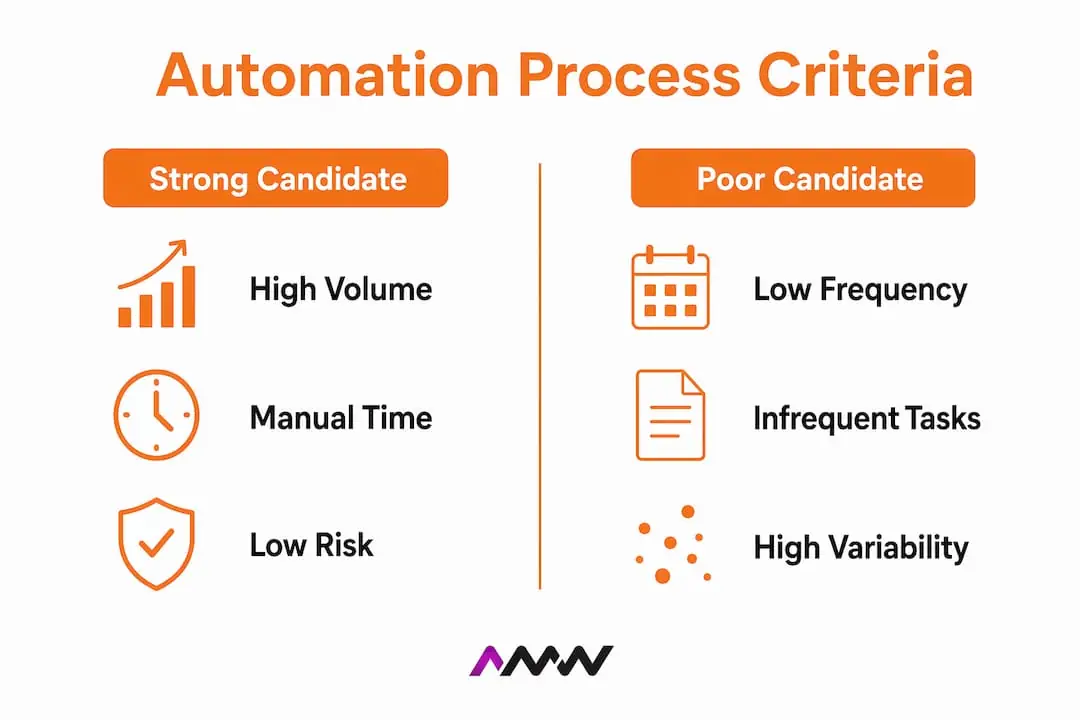
2026 industry guidance recommends evaluating automation candidates against three criteria: volume, manual time, and error risk. Processes that occur frequently, consume 15 to 30 minutes per instance, and carry a high cost when errors occur are the strongest candidates. That combination means the return on automation effort is both large and fast.
Ideal first candidates include invoice processing, customer enquiry routing, employee onboarding checklists, and purchase order approvals. These processes share a common trait: they are rule-based, stable, and well-defined. A rule-based process follows the same logical steps every time, which means it can be mapped, tested, and handed to an automated system without ambiguity.
Low-frequency or unstable processes are poor candidates. If a workflow changes every few weeks, or depends on judgement calls that vary by context, automating it will create more problems than it solves. Automating broken workflows accelerates inefficiency rather than fixing it. Process re-engineering must come before automation, not after.
Pro Tip: Involve frontline workers in the identification stage. They know which tasks are repetitive and error-prone far better than any senior manager reviewing a process map from a distance.
Process prioritisation criteria
| Criterion | Strong candidate | Poor candidate |
|---|---|---|
| Volume | High frequency, daily or more | Occasional, ad hoc |
| Manual time per instance | 15 to 30 minutes or more | Under 5 minutes |
| Error risk and cost | High cost per error | Low impact if wrong |
| Process stability | Consistent, rule-based steps | Frequently changing |
| Data availability | Structured, digital inputs | Unstructured, paper-based |
What does a phased automation roadmap look like?
A phased approach is the most reliable way to implement automation without disrupting operations or burning through budget. UK SMEs that prove ROI within a 90-day window before scaling report significantly higher confidence and stakeholder buy-in than those who attempt organisation-wide rollouts from the start.
A practical roadmap runs across four phases:
Quick wins (weeks 1 to 4). Automate one high-volume, rule-based process. The goal is a working proof of concept with measurable results. Invoice processing or a standard customer enquiry response are typical starting points. Success here builds the internal credibility needed to fund the next phase.
Core workflows (weeks 5 to 8). Expand automation to two or three additional stable processes. At this stage, teams begin developing internal familiarity with the tools and the discipline of process mapping. Errors and edge cases surface here, which is exactly when you want them to.
Integration and optimisation (weeks 9 to 11). Connect automated processes to each other and to existing systems such as CRM platforms, accounting software, or project management tools. This phase also introduces monitoring dashboards and exception-handling protocols. You can read more about SaaS tools that support this stage in AMW Media’s dedicated guide.
AI augmentation (beyond week 11). Introduce machine learning or AI-assisted decision-making into mature, stable workflows. This is where automation moves from rule-following to pattern recognition. Examples include predictive lead scoring, dynamic pricing adjustments, or intelligent document processing.
Pro Tip: Define your business metrics before you start, not after. Decide what “success” looks like in numbers: cycle time, error rate, cost per transaction. Without that baseline, you cannot prove the value of what you have built.
Phase comparison
| Phase | Focus | Expected outcome | Key risk |
|---|---|---|---|
| Quick wins | Single process proof of concept | Measurable ROI within 90 days | Choosing the wrong first process |
| Core workflows | Expand to 2 to 3 stable processes | Internal capability building | Underestimating change management |
| Integration | Connect systems, add monitoring | Reduced manual handoffs | Integration complexity |
| AI augmentation | Pattern recognition and prediction | Higher-value decision support | Over-reliance on AI outputs |
How to structure governance and change management for automation success
Governance is the part of an automation strategy that most leaders skip, and it is the part that most often causes projects to fail at scale. Automation sprawl without defined governance leads to operational fragility, where automated processes break silently and nobody notices until a customer complains or a payment fails.
What good governance looks like
Effective governance for automating business workflows requires three things: ownership, oversight, and a clear escalation path.
- Board-level ownership or a Centre of Excellence (CoE). Someone at a senior level must own the automation programme. A CoE is a small internal team responsible for setting standards, approving new automation projects, and maintaining the overall roadmap.
- Human-in-the-loop checkpoints. The UK Government’s AI Playbook is explicit on this point: meaningful human control during automated processes is essential for accountability and operational safety. Every automated workflow should have defined points where a human reviews, approves, or can override the output.
- Monitoring and drift detection. Automated processes degrade over time as the underlying data or business rules change. Governance must include regular testing protocols and alerts for when outputs fall outside expected parameters.
“The primary barrier in automation projects is change management, not technology itself. People adoption of automated tools is where most automation projects fail.”
That finding shapes everything about how you should communicate automation to your teams. Frame it as removing drudgery, not replacing people. Share early wins loudly. Publish the time saved and the errors avoided. Regular ROI updates to stakeholders keep momentum alive and reduce the resistance that kills otherwise well-designed programmes.
Pro Tip: Communicate ROI metrics to your team every month, not just to the board. When the people doing the work can see that the automation saved 40 hours last month, they become its advocates rather than its critics.
What tools and capabilities does an effective automation strategy need?
The tools matter less than the skills and processes surrounding them. Most UK firms lack the internal capability to implement complex automation from the start, which is why engaging external consultants initially while building internal expertise over time is the most common path to sustainable success.
Core skills your team needs
- Workflow design. The ability to map a process end-to-end, identify decision points, and define exception paths before touching any software.
- Data literacy. Understanding what data the process produces, where it lives, and how to measure its quality. Automation depends on clean, structured inputs.
- Platform administration. Someone internally must own the configuration, testing, and maintenance of whatever automation platform you use.
- Change management. The human side of implementation: communication, training, and handling resistance.
The technology categories most relevant to a business automation plan include robotic process automation (RPA) for repetitive desktop tasks, workflow orchestration platforms for multi-step approvals and routing, API integration tools for connecting software systems, and AI-assisted platforms for document processing or predictive tasks. The right category depends entirely on the process being automated, not on what is fashionable.
Baseline measurement of current process time, cost, and error rates is non-negotiable before selecting any tool. Without that data, you cannot prove ROI, and without proof of ROI, the programme will not survive its first budget review.
Pro Tip: Never automate a broken process. If a workflow is inconsistent or poorly defined, fix it first. Automation will only make the inconsistency faster and harder to spot.
Skills and technology requirements
| Capability | Purpose | Build or buy? |
|---|---|---|
| Workflow design | Map and standardise processes before automation | Build internally over time |
| Data literacy | Ensure clean inputs and meaningful outputs | Build with training |
| Platform administration | Configure, test, and maintain automation tools | Build internally |
| External consultancy | Accelerate early implementation | Buy initially |
| Monitoring and alerting | Detect failures and drift in live automations | Buy via platform |
How can leaders avoid common automation implementation mistakes?
Most automation failures are predictable. They follow the same patterns, and knowing them in advance is the cheapest form of risk management available.
Automating the wrong process first. Choosing a low-volume or unstable process as the starting point produces weak results and kills stakeholder confidence. Use the volume, time, and error-risk criteria from the prioritisation stage without exception.
Skipping baseline measurement. Without baseline data, automation ROI cannot be proven. This is not a nice-to-have. It is the evidence that justifies every subsequent investment in the programme.
Failing to define exception handling. Every automated process will encounter inputs it was not designed for. Exception handling paths must be defined before go-live, not discovered in production. Decide in advance: what happens when the automation cannot process an input? Who gets notified? What is the fallback?
Ignoring change management. Technology is rarely the reason automation projects fail. Change management is the primary barrier, and skipping it is the single most expensive shortcut a leader can take.
Scaling before proving. Expanding automation across the organisation before the first process is stable and measured is a common and costly mistake. Prove the model small, then scale with confidence.
“Many SMEs overestimate digital readiness. Adopting a test-and-learn approach to digital adoption consistently improves outcomes.”
That principle applies directly to automation. Assume your organisation is less ready than it thinks it is, build in learning loops, and treat the first 90 days as a controlled experiment rather than a full deployment.
Pro Tip: Start with one process, measure everything, and share the results widely. A single well-documented success story is worth more than a dozen half-finished automations.
Key takeaways
A successful automation strategy requires prioritising stable, high-volume processes, implementing in phases, and maintaining human oversight throughout every stage.
| Point | Details |
|---|---|
| Prioritise by volume and risk | Choose processes that are frequent, time-consuming, and costly when errors occur. |
| Measure before you automate | Capture baseline time, cost, and error rates before any tool is selected or deployed. |
| Use a phased roadmap | Start with quick wins, prove ROI within 90 days, then expand to core workflows and integration. |
| Governance prevents sprawl | Assign board-level ownership and define human-in-the-loop checkpoints for every workflow. |
| Fix processes before automating | Re-engineer unstable or broken workflows first, or automation will accelerate the problem. |
What I have learned from watching automation projects succeed and fail
Working with UK businesses across different sectors, the pattern I see most often is this: leaders invest in the technology and underinvest in everything around it. The platform gets bought, the licence gets paid, and then six months later the automation is barely used because nobody trained the team, nobody defined what success looked like, and nobody owned the outcome.
The organisations that get automation right treat it as a change programme with a technology component, not a technology purchase with a change component. That distinction sounds subtle, but it changes every decision that follows. It changes who leads the project, how success is measured, and how the rollout is communicated.
The phased roadmap approach works. I have seen businesses go from sceptical to evangelical about automation in 90 days, simply because they chose the right first process and measured it properly. That first win creates a momentum that no amount of internal advocacy can manufacture.
The governance piece is where I see the most avoidable damage. Automation sprawl is real. Businesses end up with dozens of automations nobody fully understands, running on platforms nobody fully administers, producing outputs nobody fully monitors. A Centre of Excellence does not need to be large. Even one person with clear authority and a documented approval process makes an enormous difference.
The trend towards AI augmentation is real and accelerating. But the businesses that will benefit most from it are the ones building clean, well-governed, well-measured automation foundations right now. AI augmentation on top of a chaotic automation estate is just expensive chaos. You can explore how marketing automation strategies fit into this broader picture as a practical starting point.
Amir
How AMW Media helps businesses build their automation foundations
Automation works best when it connects to a well-built digital infrastructure. AMW Media works with ambitious UK businesses to design and implement custom SaaS and automation solutions that integrate with existing marketing, sales, and operations workflows. From automation-ready web design to PPC campaign management that feeds clean data into your reporting systems, the team brings both the technical and strategic expertise to make automation deliver real results.
If you are ready to move from planning to implementation, AMW Media’s team can help you map your first automation candidates, define your success metrics, and build the digital foundations that make scaling simple. Get in touch to discuss what a practical automation plan looks like for your business. Closer to home, our marketing agency High Wycombe page makes the case that almost nobody looking for a nearby agency actually cares about the distance.
FAQ
What is an automation strategy guide?
An automation strategy guide is a structured plan that defines which business processes to automate, in what order, and how to measure success. It covers prioritisation, phased implementation, governance, and change management.
How do I choose which processes to automate first?
Prioritise processes that are high-volume, take 15 to 30 minutes per instance, and carry a significant cost when errors occur. Invoice processing and customer enquiry handling are common and effective starting points for UK SMEs.
How long does a phased automation roadmap take?
A typical phased roadmap covers quick wins and core workflow automation within approximately 11 weeks. AI augmentation and deeper integration work follows once the foundational processes are stable and measured.
Why do most automation projects fail?
The primary cause of failure is change management, not technology. Teams that are not trained, communicated with, or shown the benefits of automation resist adoption, which undermines even well-designed implementations.
Do I need external consultants to implement automation?
Most UK firms benefit from external expertise in the early stages, particularly for process mapping and platform configuration. The goal is to build internal capability over time so the organisation is not permanently dependent on outside support.
Recommended
- Top automated marketing strategies to accelerate growth | AMW Media
- SaaS & Business Automation Solutions London | AMW Media | AMW Media
- Examples of SaaS tools every business should know in 2026 | AMW Media
- What is automation in marketing? A complete guide | AMW Media
Our free marketing audit looks at your site, your ads and your content, and comes back with a 30 day plan. No pitch deck.

Leads the WordPress, Shopify and custom builds, and the integrations that connect them to your CRM. Fast, accessible and yours to keep. Meet the team.