
 Black Steel Doors
 Woodstock Campers
 Phillips Joinery
TL;DR:
- Most agency growth now depends on strategic partnerships that build reciprocal relationships and expand service offerings. These alliances reduce client acquisition costs, increase resilience, and enable faster market entry without significant headcount increases. Effective partnership management requires clear goals, formal agreements, ongoing measurement, and diversification to sustain long-term competitive advantage.
Most agency owners assume scaling means hiring more staff, running more ads, or investing in expensive tools. That assumption is expensive and slow. High-maturity partnership programmes generate 28% of total revenue, comfortably outstripping paid search at 18%. That single data point should shift the way you think about growth entirely. This guide breaks down how strategic partnerships work in practice, which structures deliver the strongest results, and how to build a partnership framework that creates compounding growth for your agency without inflating your headcount or burn rate.
Key Takeaways
| Point | Details |
|---|---|
| Partnerships drive growth | Strategic partnerships give agencies faster scaling, higher revenues, and new client access. |
| Structure for success | Formal agreements, clear goals, and regular reviews reduce failure risk in partnerships. |
| Measure beyond revenue | Track referral retention, CAC, and mutually agreed metrics for sustainable success. |
| Adapt to technology shifts | Ecosystem platforms and AI tools are reshaping partnership models and agency capabilities. |
| Diversification mitigates risk | Build multiple partner relationships to avoid over-reliance and ensure long-term stability. |
Why partnerships are the new growth engine for agencies
The agency landscape has changed dramatically over the past few years. Clients are more demanding, margins are tighter, and competition has intensified across every specialism. Yet the agencies consistently outpacing the market are not necessarily the ones with the biggest teams. They are the ones building smart, reciprocal relationships with complementary businesses.
“The shift from competition to collaboration is not just a trend. It is a structural advantage that compounds over time.”
This mindset shift matters because it changes how agencies approach capacity, positioning, and client value. Rather than trying to do everything in-house, forward-thinking agencies are asking a better question: who already has what our clients need, and how can we serve those clients together?
Agency growth trends for 2026 show a clear pattern: agencies that integrate partnership strategies into their core business model grow faster and more profitably than those relying solely on direct sales and paid acquisition.
The practical advantages of a partnership-first approach are significant:
- Reduced client acquisition costs by tapping into partners’ existing networks and trust
- Broader service offerings without the overhead of building every capability in-house, because strategic partnerships enable agencies to expand service offerings without in-house development
- Faster market entry into new industries or geographies through a partner’s established relationships
- Resilience built through revenue diversification across multiple channels
- Brand credibility transferred when you align with respected partners in adjacent spaces
Consider a mid-sized digital agency specialising in paid media. Rather than hiring a full web development team to serve clients needing integrated digital solutions, they partner with a development-focused agency. Both parties refer business to each other, the client gets a more complete solution, and neither agency has to carry the cost of a capability they use only occasionally.

The role of creative agencies has evolved beyond execution. Today’s most effective agencies function as strategic connectors, orchestrating ecosystems of partners to deliver greater client outcomes than any single agency could achieve alone.
Pro Tip: Before approaching potential partners, document exactly what gaps exist in your current service delivery. Partnerships built around genuine client need outperform those built around convenience.
Types of partnerships and their advantages
Not all partnerships are equal. The structure you choose should match your agency’s core capabilities, growth goals, and the level of resource you can commit. Here is a breakdown of the four most impactful partnership formats for agencies:
| Partnership type | Key benefit | Primary risk | Commitment level |
|---|---|---|---|
| White-label | Expand service range under your brand | Quality control issues | Medium to high |
| Referral | Low-cost client acquisition | Reciprocity imbalance | Low to medium |
| Technology/Ecosystem | Scalable delivery and automation | Platform dependency | Medium |
| Co-marketing | Shared audience growth and awareness | Diluted brand messaging | Low to medium |
White-label partnerships allow you to deliver services to clients under your own brand while a specialist partner does the actual work. This is ideal for agencies wanting to offer SEO, PPC, or content production without building those departments internally. The risk is maintaining consistent quality when you are not directly managing delivery.
Referral partnerships are the most accessible starting point. You send leads to partners who serve your clients’ needs outside your scope, and they return the favour. Partnerships open access to complementary providers and revenue-sharing opportunities that a standalone agency simply cannot replicate at the same speed. The challenge is ensuring the relationship remains balanced over time.
Technology and ecosystem partnerships are increasingly powerful, particularly for agencies adopting SaaS-like delivery models. Integrating with platforms like Shopify, HubSpot, or Google Ads creates co-sell opportunities and positions your agency within the partner’s ecosystem, opening up inbound referrals. Partner-influenced deals are 26% higher performing than self-sourced deals, which makes the case for building platform-level relationships early.
Co-marketing partnerships involve joint content creation, events, webinars, or campaigns with a complementary brand. This is particularly effective for building authority in a niche without doubling your content budget.
Here is a practical process for choosing the right partnership type:
- Audit your current service gaps and identify what clients frequently request that you cannot currently deliver
- Map complementary businesses operating in adjacent spaces without directly competing for the same clients
- Assess your internal capacity for managing different partnership structures, since white-label demands more oversight than referral
- Define your revenue goal from the partnership and select the structure most likely to produce it within 12 months
- Research how similar London agency models structure partnerships and learn from established examples before committing to terms
Pro Tip: Start with referral agreements. They require minimal contract complexity, build trust quickly, and reveal whether a deeper partnership is worth pursuing. Many successful white-label and co-marketing arrangements began as simple referral relationships.
How to structure and manage agency partnerships effectively
Good intentions and a strong relationship are not enough to make a partnership succeed long-term. Structure matters enormously. 70% of strategic partnerships fail within two years due to poor alignment or inadequate execution, and in most cases the failure is entirely preventable with better planning at the outset.
Here is a step-by-step methodology for structuring a partnership that actually holds up:
- Define shared goals from day one. Both parties need to articulate what success looks like at 3, 6, and 12 months. Vague aspirations lead to vague results.
- Map each party’s contributions. Who brings what? Who owns client relationships? Who handles billing? Clarity here prevents resentment later.
- Draft a formal agreement. Even for referral partnerships, a written document covering commission rates, exclusivity terms, and review periods protects both sides.
- Set benchmarks and review cadences. Monthly or quarterly reviews with specific metrics keep the partnership accountable.
- Create an exit strategy. No one likes to plan for failure, but a clean exit clause protects both parties if the relationship no longer serves its purpose.
Key methodologies for successful partnerships include defining clear goals, crafting value-focused proposals, and establishing formal agreements with measurable benchmarks. The agencies that skip these steps are the ones who end up in frustrating situations six months later wondering why the relationship is not delivering.
When vetting potential partners, pay close attention to how they handle their own client relationships. A partner who is disorganised internally will be disorganised with your clients. Do not skip background checks in agency partnerships, particularly for white-label arrangements where your brand reputation is on the line.
Here is a reference table for what a solid partnership agreement should cover:
| Agreement element | What it covers | Red flag if missing |
|---|---|---|
| Scope of work | Services each party provides | Scope creep and disputes |
| Revenue terms | Commission rates, payment timelines | Payment conflicts |
| Exclusivity clauses | Geographic or sector restrictions | Undisclosed conflicts of interest |
| Communication protocols | Contact points, response times | Relationship breakdown |
| Exit terms | Notice periods, client ownership | Difficult separations |
| Performance benchmarks | Specific targets and review dates | Accountability gaps |
Most partnership failures happen not because the opportunity was wrong, but because the structural foundations were weak. Treat your partnership agreements with the same rigour you would apply to a client contract.
Pro Tip: Assign a dedicated partnership manager or point of contact on your side, even if it is a part-time responsibility. Partnerships managed by committee or left to everyone tend to be managed by no one.
How to measure, optimise, and scale partnership success
Knowing how to track and improve partnership performance separates agencies that grow through partnerships from those who try and abandon the model. The metrics you focus on matter just as much as the effort you put in.
Start with these core partnership ROI indicators:
- Partner-sourced revenue: The total revenue directly attributed to partner referrals or co-sell activity
- Partner-sourced growth rate: Month-over-month or quarter-over-quarter change in partner-generated income
- Customer acquisition cost (CAC) from partnerships: Compare this against paid channels to understand true efficiency
- Pipeline velocity: How quickly leads from partners move through your sales process
- Retention from partner-referred clients: Retention from referrals is 37% higher than from other channels, which means the long-term value of a partner-acquired client is substantially greater
Track partner-sourced revenue and set mutual targets, such as a 25% increase in referred revenue within a defined period. Without shared targets, partners have no common compass to align activity.
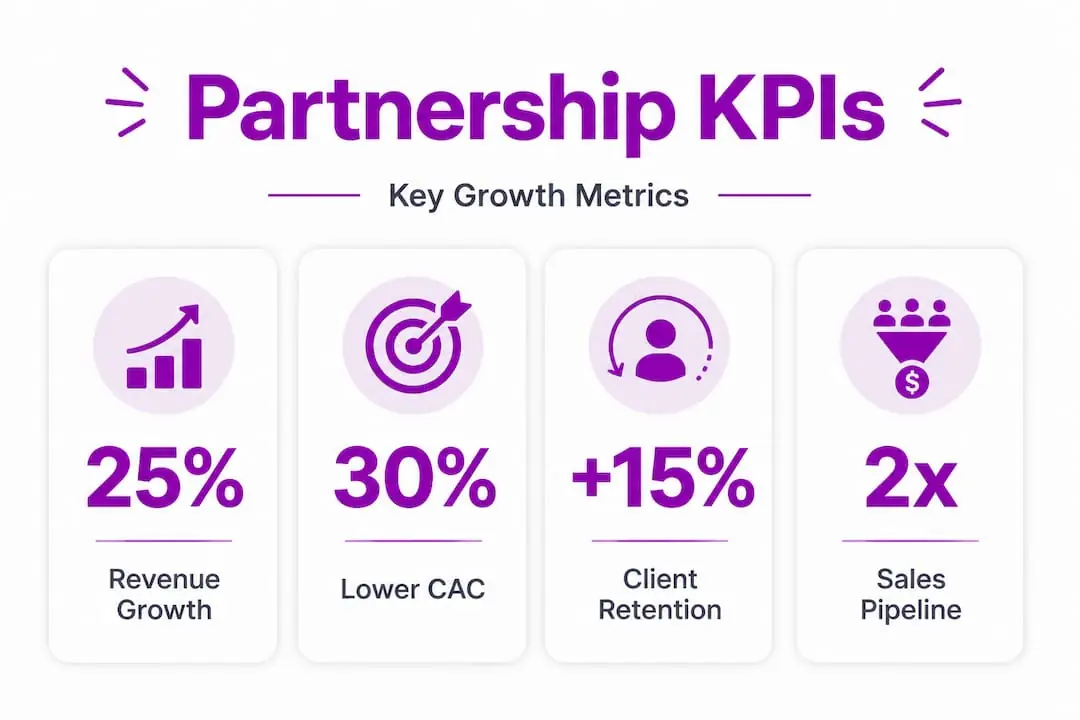
One of the most common mistakes agencies make when measuring partnerships is focusing only on immediate revenue. That misses a large portion of the value. The reduction in CAC, the improved client lifetime value, the brand exposure from co-marketing, and the speed at which new capabilities enter your service catalogue all represent real returns that do not show up in a simple revenue report.
If a partnership is underperforming, here is how to respond:
- Identify whether the issue is activity or conversion. Low referral volume is a different problem from referrals that do not convert.
- Review the incentive structure. Misaligned commissions or complicated payment processes reduce partner motivation significantly.
- Increase communication frequency. Stalled partnerships often just need more regular, structured touchpoints to reactivate momentum.
- Reassess goal alignment. Both parties’ businesses evolve; revisit original objectives and update them if needed.
- Consider whether the partnership has run its course. Some partnerships deliver maximum value in a defined period. Recognising that and closing it cleanly is better than letting it drift.
You can also draw useful benchmarks from SEO and partnership ROI research to better contextualise your performance against wider market norms.
Pro Tip: Measure beyond revenue. Include CAC reduction, retention rates, and pipeline velocity in your partnership scorecards. Agencies that only measure revenue miss 40 to 60% of the actual value a good partnership generates.
Ecosystem, technology, and the future of agency partnerships
The next wave of agency growth is being shaped by digital ecosystems and AI-powered platforms. This is not abstract future thinking; it is happening now, and agencies that build ecosystem-oriented partnership strategies today are building structural advantages that compound over years.
69% of agencies are increasing investment in partnerships, specifically citing AI and ecosystem plays as the primary drivers of amplified partnership impact. The agencies leaning into this shift are finding that their partnership networks become more valuable as the tools connecting them improve.
Here are the technology tools agencies should be integrating to support partnership programmes:
- Partner relationship management (PRM) software such as PartnerStack, Impact, or Alliances to track referrals, commissions, and partner activity at scale
- CRM integrations that tag partner-sourced leads automatically and feed them into reporting dashboards
- Shared content platforms for co-marketing partnerships, enabling both parties to collaborate on assets without cumbersome email chains
- AI-powered matching tools that identify compatible partners based on audience overlap, service complement, and growth trajectory
- Automated onboarding sequences for new partners, reducing friction and getting relationships to a productive state faster
Agencies adopting SaaS-like service models find that partnership-led retention becomes even more critical than acquisition. When clients are on retainer-style contracts, partners who reinforce and extend the value of your services become a key factor in renewal rates and lifetime value.
The evolving role of creative agencies in the modern ecosystem places them at the centre of brand strategy, content production, and distribution orchestration. Agencies positioned at these intersections are uniquely placed to build high-value partnerships across technology, media, and professional services sectors.
Content creation for brand advantage is increasingly a shared endeavour, where agencies and partners co-produce assets that serve both parties’ audiences simultaneously.
Pro Tip: Diversify your partner ecosystem deliberately. Agencies that rely heavily on a single platform partnership face significant risk if that platform changes its commission structure or referral policies. Aim for at least three to five active partnerships across different categories.
Beyond the playbook: What most agencies get wrong about growth partnerships
Most agency partnership strategies fail, and not because the market conditions were wrong or the partner was bad, but because the agency approached the partnership as a transaction rather than a relationship.
The majority of guidance on partnerships focuses on mechanics: how to structure the agreement, what metrics to track, which platforms to use. What it rarely addresses is the strategic intent behind the partnership. Agencies that enter partnerships primarily to extract short-term revenue consistently underperform against those who treat partnerships as long-term brand equity investments.
We see this pattern repeatedly. An agency signs a white-label agreement, extracts value for six months, then lets the relationship drift when internal work picks up. They count the immediate revenue and consider it successful. What they miss is the compounding value that would have built if they had continued to invest in the relationship: referrals that come years later, introductions to a partner’s network, co-branded positioning that elevates both parties in the market.
The real risk is not failure. It is a lack of strategic intent from the outset. Agencies that treat partnerships as a supplementary channel rather than a core growth mechanism will always find themselves returning to expensive paid acquisition the moment pipeline looks thin.
Using agency services smartly requires understanding that the most durable competitive advantages are relational. Technology changes. Algorithms shift. A network of trusted partners who actively refer and support your business is something no competitor can easily replicate.
Mutual accountability is the other piece most agencies neglect. A partnership where one party is more invested than the other always deteriorates. Before entering any agreement, ask: what can we offer this partner? If the answer is vague, the partnership will be fragile. The strongest partnerships are those where both parties would describe the relationship as one of their most valuable business assets.
Flexibility matters too. Agencies that build rigid, tightly controlled partnership structures struggle to adapt when market conditions shift. Those that prioritise mutual value creation and allow the relationship to evolve tend to survive disruptions far more reliably.
Grow your agency with the right partners
Building a high-performing partnership programme takes strategic clarity, structured execution, and the right services to back it up. At AMW Media, we work with agencies and ambitious brands to develop scalable digital strategies that make the most of partnership-led growth. If you would rather have this done for you, our Reading marketing page starts with what £12.50 a lead actually bought Woodstock Campers over thirteen months.
Whether you need expert social media management to deliver for white-label clients or solid SEO packages that make your agency more attractive to technology and ecosystem partners, our team brings the creative and strategic depth to elevate your partnerships from opportunistic to transformational. If you are ready to explore how a collaborative service model can accelerate your agency’s growth, we would love to talk through your goals and how we might support them.
Frequently asked questions
What are the main types of agency partnerships?
Common formats include white-label, referral, technology alliance, and co-marketing partnerships, each with specific advantages for scaling. Partnerships open access to complementary providers and revenue-sharing opportunities suited to different growth stages.
How do agencies measure the ROI of a partnership?
Track partner-generated revenue, retention improvements, and CAC reductions alongside shared targets. Tracking partner-sourced revenue with a 25% growth target in referred business gives both parties a measurable, aligned objective.
What is the risk of over-relying on one partner?
Agencies should diversify partnerships across multiple categories, as over-dependency on one alliance increases vulnerability if that relationship ends or platform terms change.
Why do many partnerships fail?
Up to 70% fail within two years due to poor goal alignment, inadequate performance reviews, or weak structural agreements established at the outset.
How can technology solutions enhance agency partnerships?
AI and ecosystem platforms streamline partner management and automate referral tracking, with 69% of businesses increasing investment in these tools to scale their partnership programmes more efficiently.
Recommended
- Why use agency services to grow your brand in 2026
- Digital Marketing Agency London | AMW Media
- Why invest in content creation for competitive brand growth
- Creative campaign process: Step-by-step guide for growth | AMW Media
- Trusted Partnerships, Inspire Wellness
Our free marketing audit looks at your site, your ads and your content, and comes back with a 30 day plan. No pitch deck.

Founded AMW Media in 2024 and runs strategy, paid media and the CRM builds. The reason everything here is in house and measured in revenue. Meet the team.